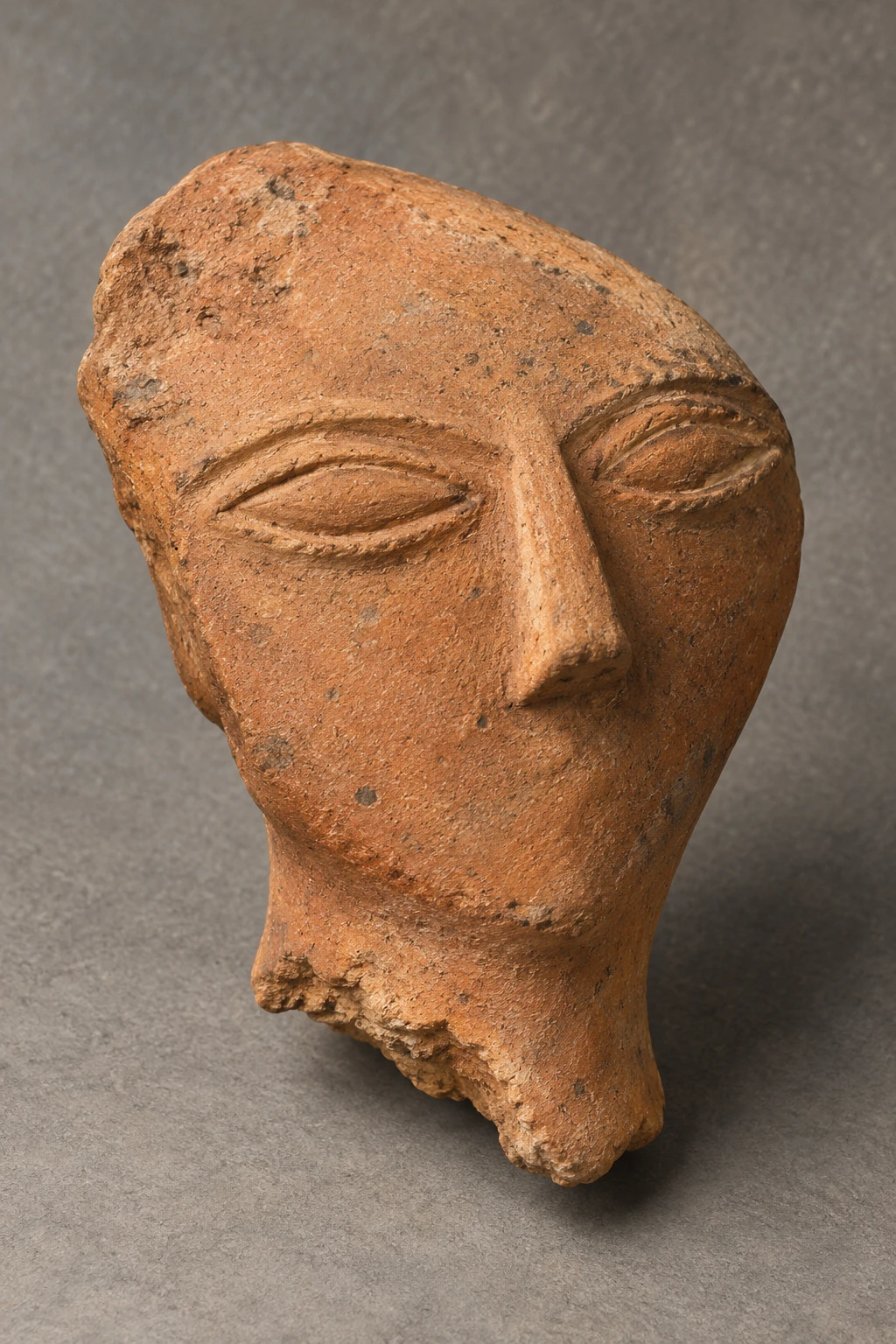
The face is small, angular, and deliberate. A few incisions can make eyes, a raised ridge can suggest a nose, and clay can turn a human form into something that feels both familiar and strange. A Neolithic figurine asks us to recognize a body while admitting that recognition is not the same as understanding its purpose.
Vinča figurines from southeastern Europe attract confident labels: deity, mother, priestess, toy, portrait. Some may be plausible for particular finds, but a name can race far ahead of the evidence. The objects become more interesting when we ask what would let us distinguish among those possibilities.
A culture name is not an ancient person’s name
The National Museum of Serbia’s late Neolithic collection includes material from Vinča-Belo Brdo, Pločnik, Belovode, and other sites. It places its collection broadly between the middle of the sixth and middle of the fifth millennium BCE and describes pottery, figurines, stone objects, and early copper artifacts.
That wider setting matters. A figurine did not emerge from a world containing nothing but mysterious sculptures. It belonged among settlements, agriculture, animal husbandry, material production, and the ordinary work of living. A museum’s archaeological culture label groups evidence through scholarly comparison; it does not recover every ancient person’s self-description.
The museum’s wording about figurine use remains open: decoration or ritual are possibilities. This is a good model for public writing. Uncertainty can identify a real research question without becoming an excuse to supply a fantasy.
Describe the clay before naming the being
A British Museum figurine from Vinča is cataloged as a stylized terracotta figure, with a question mark attached to the possible category of religious or ritual equipment. The question mark is not a failure of expertise. It distinguishes the surviving form from an interpretation of its use.
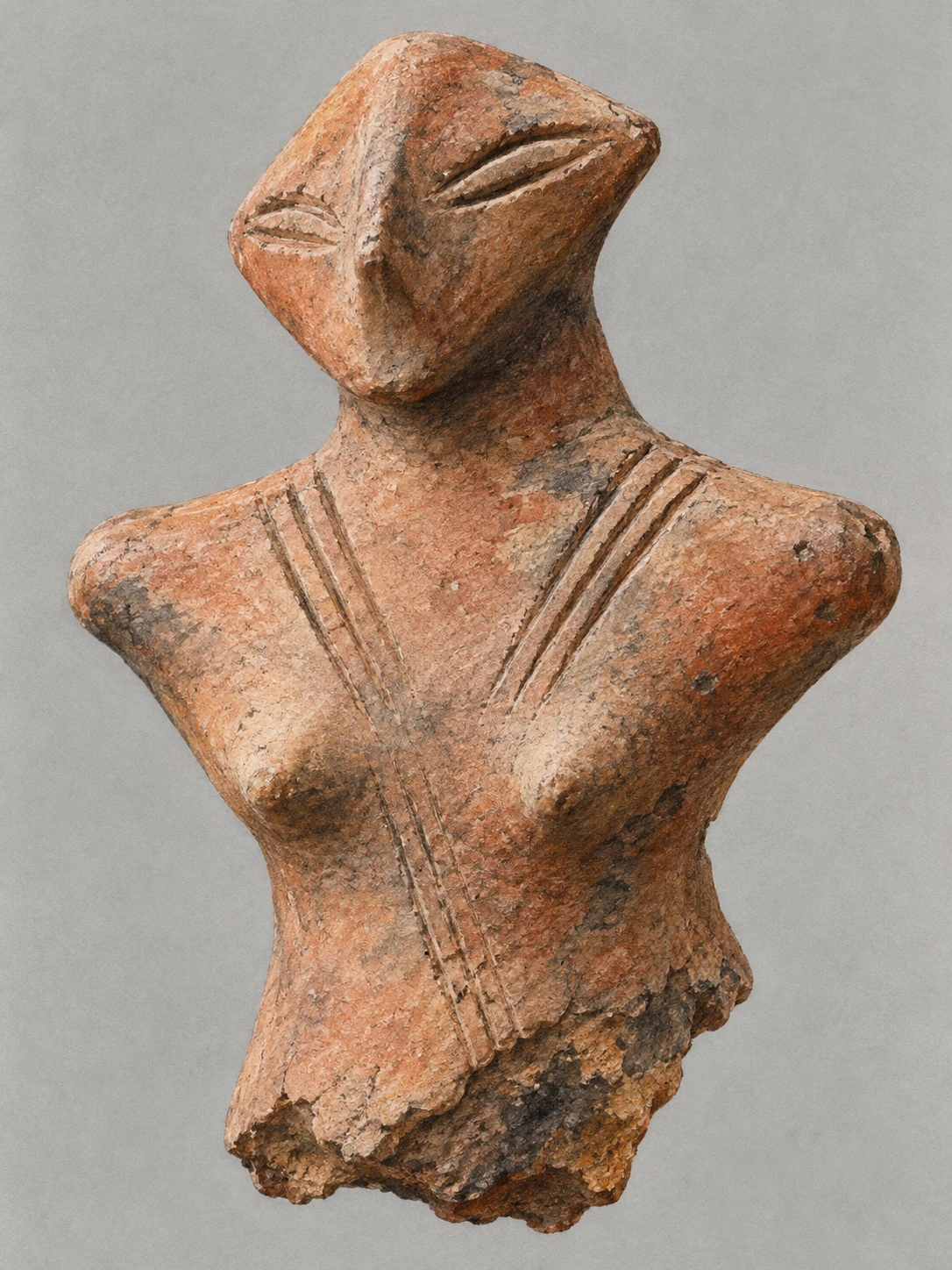
Try a description that uses only visible attributes: material color, surface finish, preserved parts, incised lines, proportions, holes, breaks. “Large eyes” describes form. “All-seeing goddess” introduces an identity and a theology. The second statement needs more evidence than the first.
Surface marks present a similar challenge. A line might be a construction trace, a body feature, an ornament, a garment detail, a repeated sign, or something else. Its placement and comparison with other objects matter. The mere presence of an incision does not make a text, and recognizing a repeated shape does not by itself decipher one.
Context is more than a dot on a map
An object’s findspot can include the building or deposit in which it lay, the other materials nearby, its position, and the history of how the layer formed. A broken head in disturbed soil and an intact figure in a carefully recorded deposit offer different opportunities for interpretation.
When details of excavation are missing, the object does not become worthless. Its form and material remain available for study. The missing context does limit which questions can be answered confidently. A visually striking piece in an old collection should not be given an invented ritual scene simply because the scene would make a good illustration.
A study of symbols on southeastern European figurines analyzes decoration in relation to other attributes and argues for patterned rules of making. Such an approach is richer than selecting one spectacular figure and asking it to explain an entire belief system.
A body is not a simple gender label
The archaeological discussion in Becoming Gendered in European Prehistory addresses the varied and sometimes ambiguous treatment of bodies in Neolithic imagery. It warns against importing an easy modern binary or assuming that one anatomical emphasis explains every figure’s social meaning.
The broader methodological question is explored in Can We Interpret Figurines?: figurines can carry several dimensions of meaning, and simple labels such as mother goddess or sex object can conceal the questions that need investigation.
That does not require pretending bodies have no visible features. It requires separating the observed feature, the assigned category, and the proposed social meaning. Each step adds an argument.
Use a second photograph of the same figurine if one is available. Compare how the eyes and nose read under another angle or light. A shallow incision may look like a heavy dark line in one view and almost vanish in another. Sketch only the marks that both photographs support, leaving uncertain features dotted. You are not restoring the ancient face; you are recording the limits of the images you have. The little drawing can expose how much a modern impression of expression depends on shadows, cropping, or the direction from which the object was photographed.
A break is evidence, but intention takes an argument
Recent work outside the Vinča group shows what a stronger argument about breakage can involve. A study of 378 figurine fragments from Těšetice-Kyjovice–Sutny combined microscopic and three-dimensional fracture analysis, internal structure, experimental breakage, and spatial information. Its authors argue for deliberate fragmentation in that Lengyel-culture assemblage. This is a finding about a different site and archaeological culture, not a result that can be pasted onto every broken Vinča head.
A separate Vinča pottery investigation at Belovode and Pločnik studied ceramic technology through well-dated sherds. It concerns pottery production rather than the identity of a figurine. Read together, these studies show why the object’s physical history and an explanation of its cultural meaning need several kinds of evidence, carefully attached to the material actually studied.
Consider a fictional fragment with a break at the neck. Four possibilities are available before investigation: breakage during manufacture, damage during use, deliberate separation, and change after burial. Listing them does not make them equally likely, and it does not decide among them. It creates a fairer question than beginning with the most dramatic story and searching only for details that fit.
Now ask what would distinguish the possibilities. Does the break follow a weak construction join? Are similar breaks repeated across a well-recorded assemblage? Do matching pieces occur together or in different contexts? What do experiments reproduce, and what conditions do they leave out? These are research prompts, not a home authentication method.
For a reader activity, take a museum description and highlight every word that concerns the object’s present condition. Use a second color for words about the event that produced that condition. “Broken” belongs to the first group. “Intentionally broken in a ceremony” belongs to the second. Mark which evidence supports the move from one group to the other.
Do not break an object to perform the exercise. A paper outline with a missing section is enough to test the language of inference. Its purpose is to slow the sentence down at the point where a visible condition becomes an account of somebody’s action.
The fragile face remains compelling through that slower reading. A fracture can disclose construction, use, and later history without immediately disclosing motive. Knowing what an additional study would need to test is itself a substantial step toward understanding the object.
Give three hypotheses a fair test
Choose one official museum photograph and write three possible functions on a sheet: display, play, and ritual. These are thinking prompts, not a claim that they exhaust ancient possibilities. For each, ask what additional evidence would make it stronger.
- Would wear or handling traces be relevant?
- Would repeated placement in similar contexts help?
- Would a set of related objects change the interpretation?
- Would scale, fragility, or means of attachment matter?
Now cross out any “evidence” that comes only from how strange the face looks to you. Strangeness is a relationship between object and viewer, not an archaeological context.
For a final exercise, write a museum label in two sentences. The first describes what survives. The second presents a carefully qualified interpretation and says what remains unknown. This compact form is harder than a dramatic declaration, but it offers a reader something they can evaluate.
The Vinča face does not need a solved identity to hold our attention. Someone made choices about what a body should look like in clay, and those choices entered a material world we can investigate. The wonder lies in the encounter and in the work of asking better questions, without pretending the missing answers are already ours.
Sources and a closer look
National Museum of Serbia: late Neolithic collection; British Museum: Vinča terracotta figurine; Journal of European Archaeology: figurine decoration and context; American Antiquity: gender in European prehistory; Cambridge Archaeological Journal: Can We Interpret Figurines?.
Find more art, ideas, and unexpected connections at Incoprea.




