A laptop makes a faint high note while doing a particular task. There may be no spinning part responsible for that note. A tiny electrical component can change shape under voltage, transfer vibration to a circuit board, and turn a structure designed to carry signals into an unintended sound radiator.
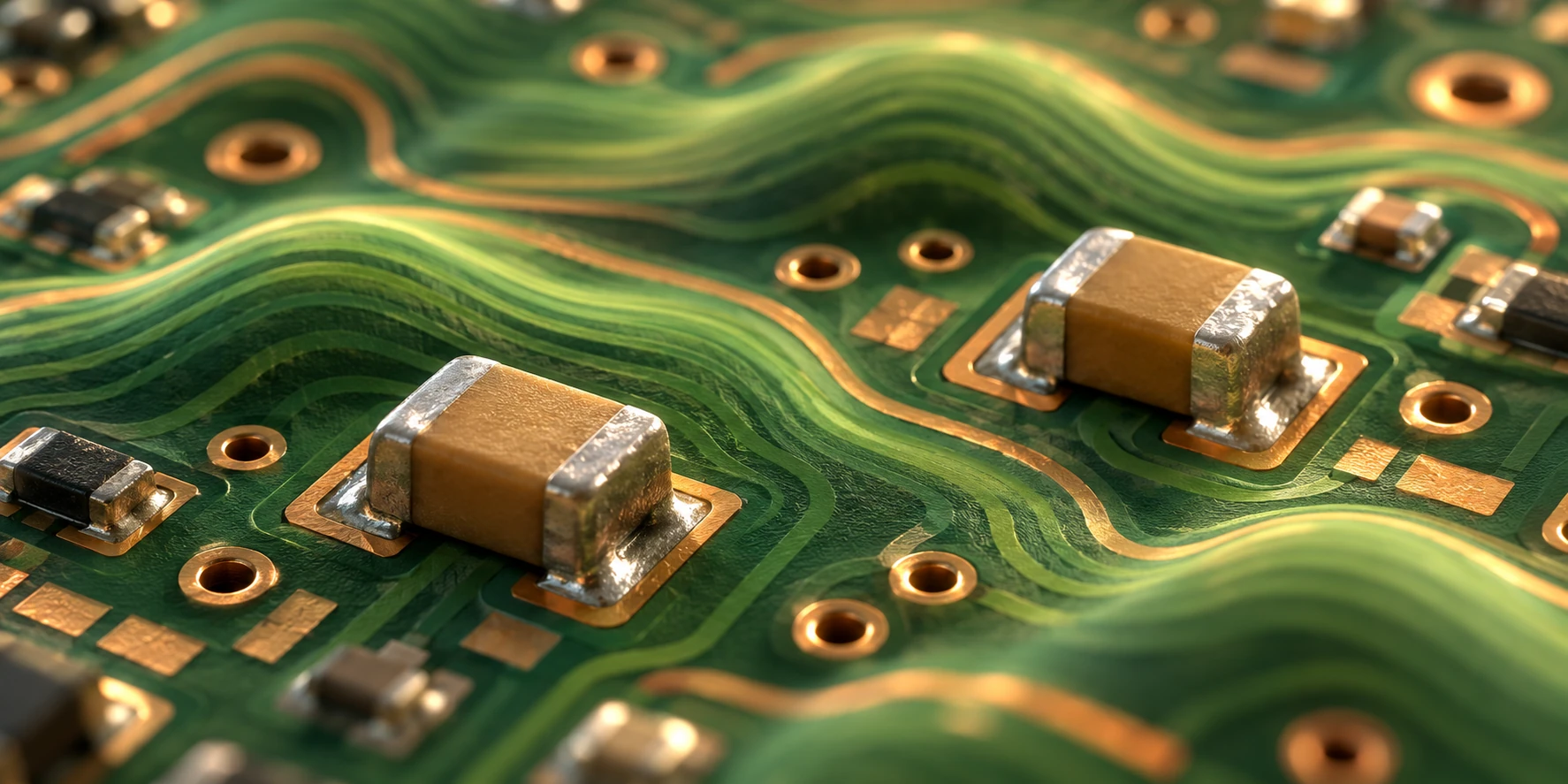
One possible source is a ferroelectric multilayer ceramic capacitor. It is a useful example because it crosses several boundaries at once: electrical input, material deformation, mechanical coupling and audible pressure variation. A complete explanation follows all four, rather than simply saying “electricity makes noise.”
The capacitor is not perfectly motionless
Murata's engineering FAQ describes voltage-related expansion and contraction in ferroelectric ceramic capacitors using barium titanate. When an applied voltage varies, the resulting tiny deformation can become a repeated mechanical drive. If the board vibrates at audible frequencies, a listener can hear a tone or buzz.
The material response is often discussed using piezoelectric and electrostrictive terminology. Those terms should not be read as a statement that every capacitor behaves the same way. Ceramic class, construction, bias and drive conditions matter. A capacitor is a component category, not a promise of one identical mechanical response.
The surprising step is amplification through structure. The component does not have to move like a visible loudspeaker cone. It can transfer small repeated forces through its attachments into a board with much more surface area. Whether the result is audible depends on how that larger structure responds.
Follow the chain rather than naming the nearest part
| Stage | Question |
|---|---|
| Electrical drive | What time-varying voltage reaches the component? |
| Material response | How does the dielectric or another structure deform? |
| Mechanical coupling | How does force reach the board and enclosure? |
| Acoustic radiation | Which vibrating surfaces efficiently move air? |
This chain explains why changing a circuit's operating state can change a sound. It also explains why the loudest audible location need not be the precise electrical source. A structure can carry vibration away from the component that excites it.
For a familiar analogy, place a small mechanical sound source against a larger resonant object and the result can become more audible. A music box uses a sounding surface intentionally. A circuit board can participate unintentionally. The analogy concerns coupling; it does not imply that electronics contain musical combs or that every sound is a resonance at one fixed frequency.
The same symptom has other sources
TDK's discussion of singing inductors makes an important diagnostic point: inductive components can also produce audible vibration. Fans, enclosures and other parts add still more possibilities. Calling every high-pitched electronic sound “a ceramic capacitor” is therefore an identification error, even when the capacitor mechanism is real.
A sensible report describes the device's state before guessing the part. Does the note appear only under a particular workload? Does it change when the display state or normal power mode changes? Is it reproducible at a similar distance? Those observations can help a technician or manufacturer investigate without pretending that a microphone has already identified the component.
A consumer should not open a powered device or probe a circuit to reproduce this article. The mechanism is worth understanding without turning a quiet sound into an improvised electrical repair. Manufacturer diagnostics and service procedures are the appropriate route when a device needs assessment.
Silencing it is a system decision
Murata's FAQ links to construction approaches intended to reduce acoustic noise. A separate manufacturer comparison video discusses a different capacitor technology as another route. These are examples of design choices, not interchangeable parts recommendations. Electrical requirements still have to be met when a mechanical symptom is addressed.
Imagine a hypothetical board whose strongest mechanical response lies near a certain drive frequency. A designer could investigate the electrical waveform, component structure, mounting and board dynamics. Changing one of these may reduce the sound, but it may also alter other performance. That is why “replace the capacitor with a bigger one” is not an adequate general engineering rule.
The useful design question specifies a goal and constraints: reduce sound under defined operating conditions while preserving electrical behavior, dimensions, reliability and manufacturability. A local material effect becomes a system tradeoff.
A quiet component is still a physical object
The capacitor's familiar electrical model is useful, but it is an abstraction. The real part also has mass, elasticity, a microstructure and mechanical attachments. Those properties are usually irrelevant to a simple circuit diagram until a particular condition makes them matter.
The faint note is therefore more than an irritating mystery. It is a reminder that a circuit board belongs to the material world as well as the schematic one. A changing voltage can become a changing shape, that shape can drive a structure, and the structure can announce an electrical task through the air.
Sources and a closer look: Murata: ceramic-capacitor vibration mechanism; TDK: audible vibration in inductors; Murata: acoustic-noise technology comparison.
Explore art, experiments and other unexpected connections at Incoprea.