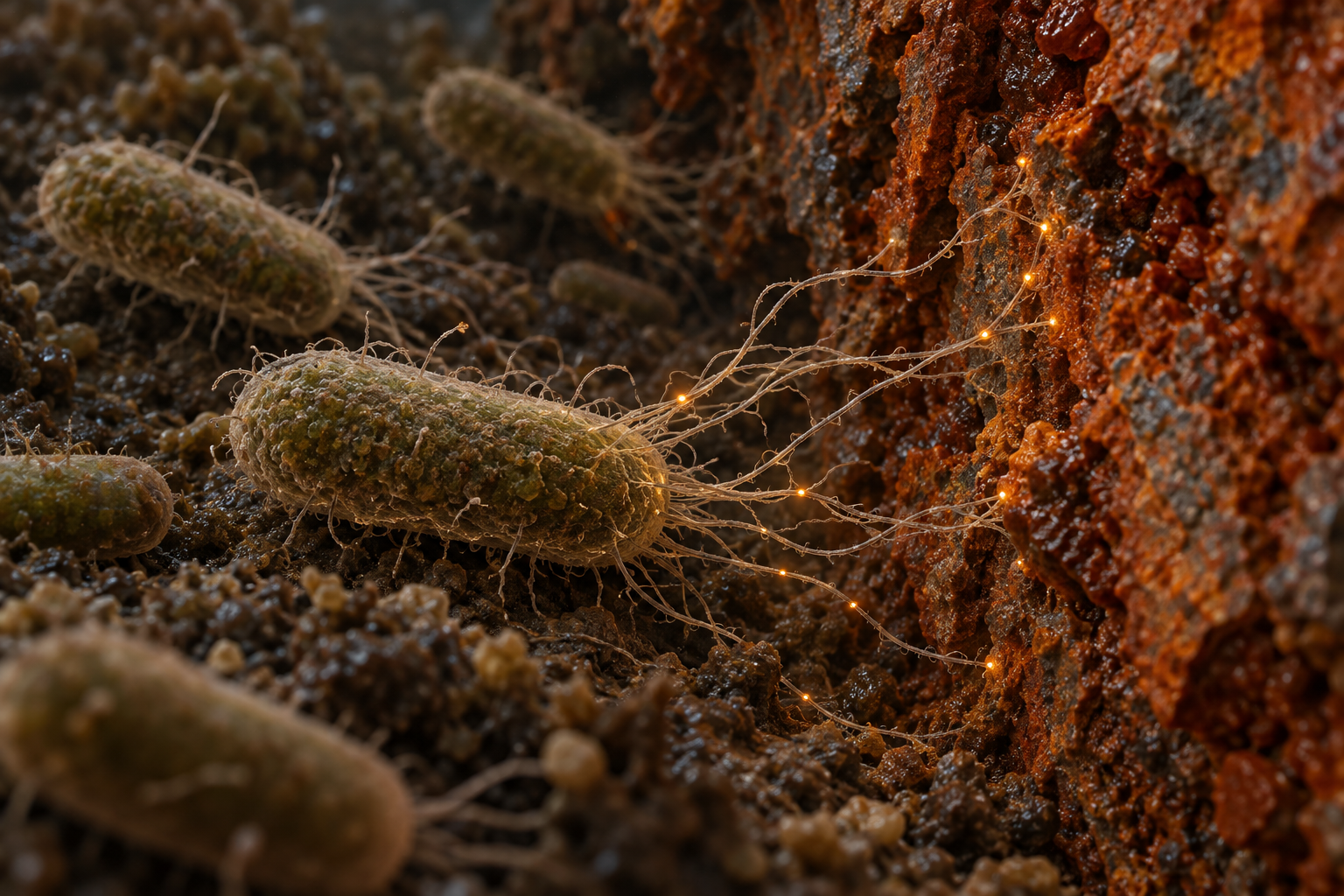
In oxygen-poor sediment, some bacteria make a living through chemistry that seems almost electrical engineering. Members of the genus Geobacter can transfer electrons to materials outside their cells. Iron minerals and laboratory electrodes can become participants in a microbial energy system.
The surprising part is not that living cells use electrons. All respiration depends on electron transfers. The unusual feature is where the electrons go: a Geobacter cell can connect its metabolism to a solid surface it cannot simply pull inside.
Respiration beyond oxygen
When organisms break down an energy source, they need somewhere for the resulting electrons to end up. Oxygen plays that final role in much familiar respiration. In suitable environments, Geobacter can instead use oxidized iron or other electron acceptors.
Transferring electrons to an iron oxide changes the iron's chemical state. These reactions influence mineral formation and the chemistry of sediments. The microbe is therefore part of a larger environmental circuit, linking the breakdown of organic material with transformations in the surrounding ground.
This is a form of energy metabolism, not electricity created from nothing. A laboratory system that collects current still needs an electron donor and suitable chemical conditions. The visible wire leading from an electrode is only one part of that energy accounting.
Protein connections
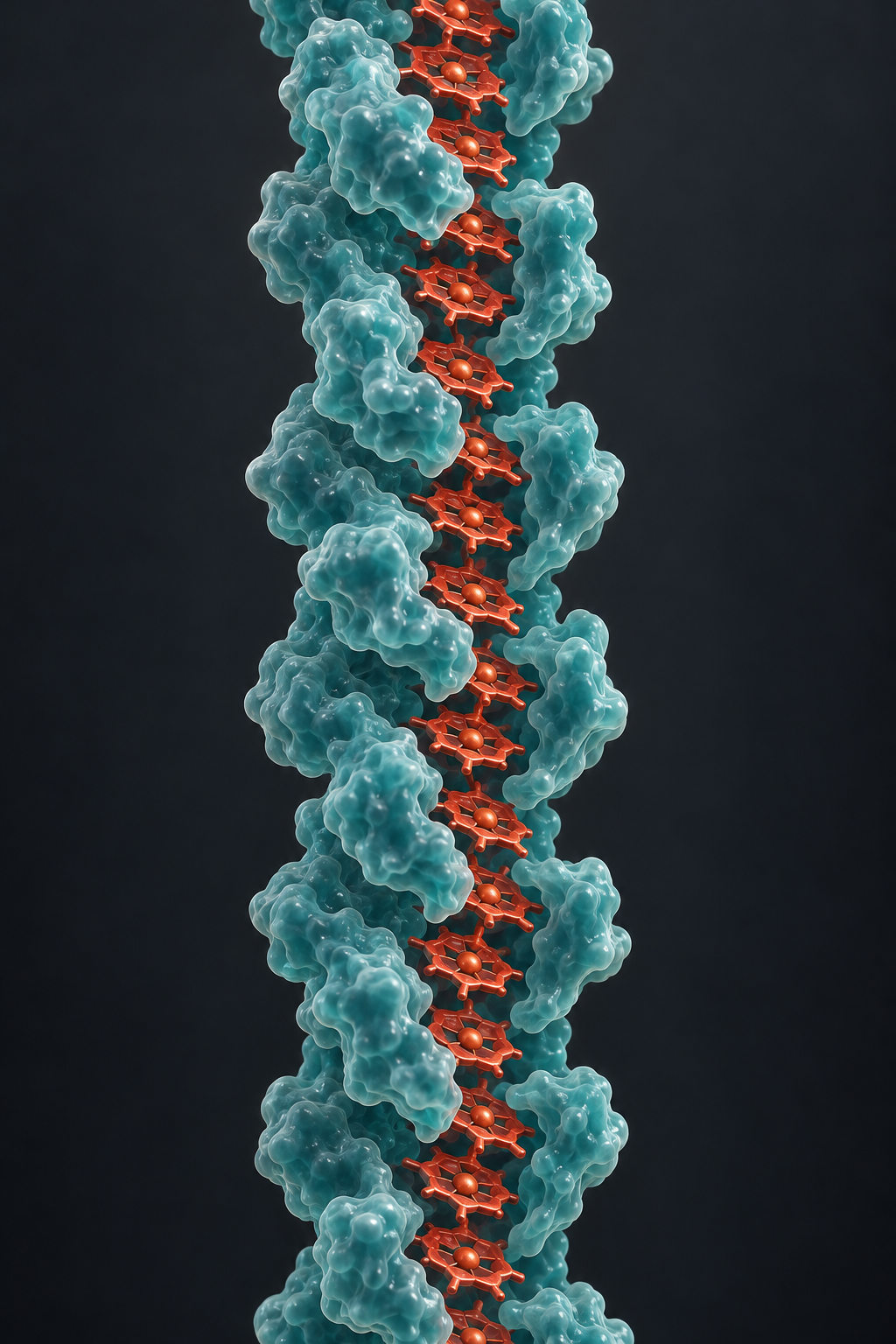
Scientists have investigated how electrons travel from the cell to a distant surface. Cytochromes, proteins containing electron-carrying heme groups, are important components. Certain filaments produced by Geobacter sulfurreducens act as conductive microbial nanowires.
In 2019, structural studies showed that a studied wire type consisted of repeating units of the cytochrome OmcS, with closely arranged hemes. These findings revised earlier interpretations of those particular filaments as pili made from a different protein. Other conductive cytochrome filaments have also been identified.
The distinction is useful because “nanowire” describes a small conducting structure, not one universal molecule. Different organisms, filament types and experimental conditions cannot automatically be treated as interchangeable. The illustrated glowing points are a visual metaphor for electron transfer; a real sediment sample does not display little sparks moving down the proteins.
From muddy habitats to electrodes
In microbial fuel-cell research, electrodes can collect electrons from microbial metabolism. Geobacter can form electrode-associated biofilms, making it valuable for investigating biological current production and possible applications. Researchers also study conductive biological materials for sensing and electronics.
The possibilities are attractive, but a small laboratory current and a practical power system are different achievements. Output, durability, substrate supply and manufacturing all matter. The ecological biology remains interesting even when a proposed device is still under development.
A bacterium in sediment has no intention of building a circuit. Yet its need to exchange electrons with its surroundings creates connections that scientists can measure, model and sometimes redirect. What looks like inert mud can contain a remarkably active network of chemical relationships.
Sources and further reading: Structure of microbial nanowires and stacked hemes; Cryo-EM structure of cytochrome-based nanowires; Yale Malvankar Laboratory research program.
Explore more creative discoveries at Incoprea.




