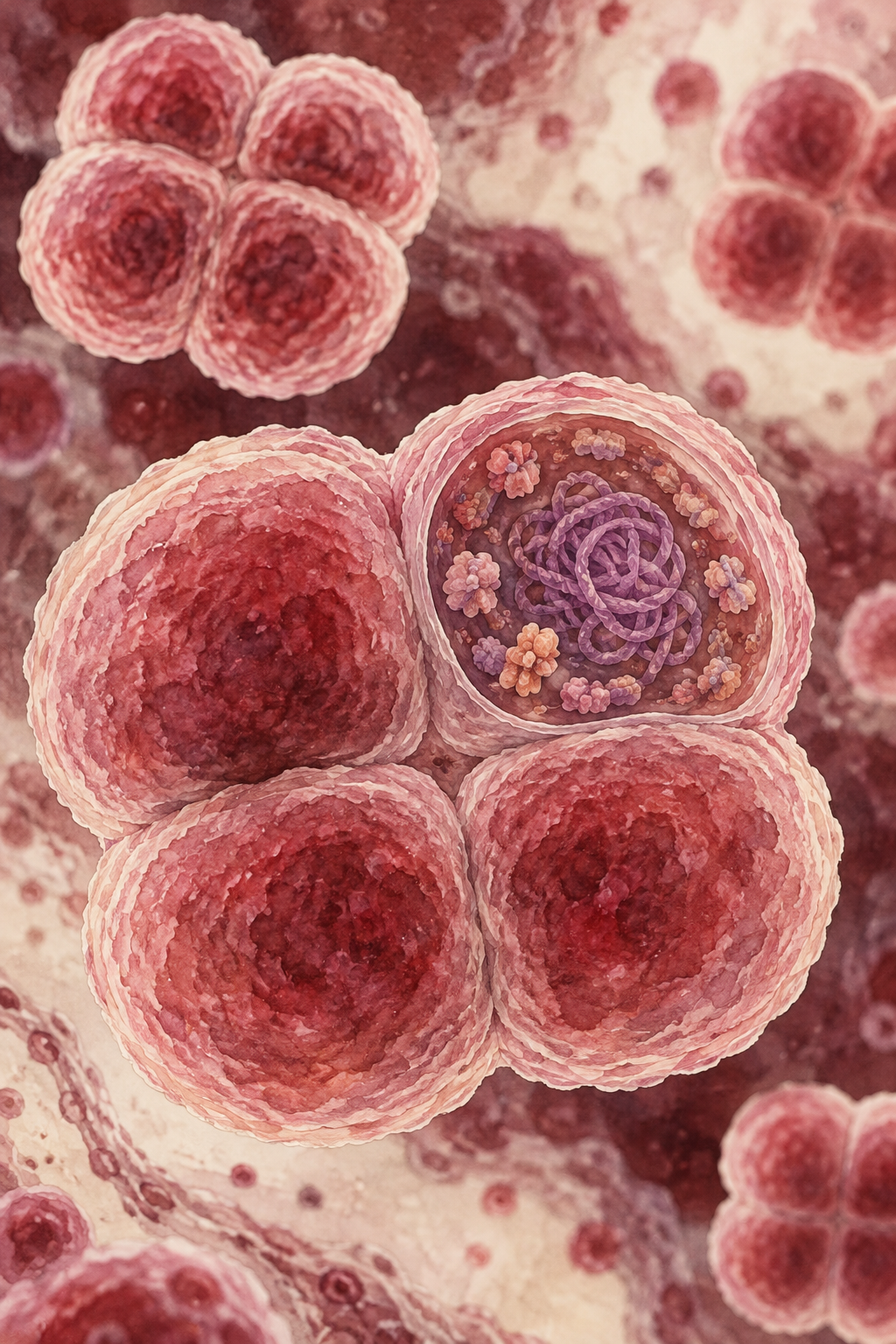
Some bacteria can survive radiation exposures that would destroy most familiar organisms. Among the best studied is Deinococcus radiodurans, often seen as pinkish spherical cells grouped in fours. Its name has become shorthand for resilience, but the most interesting part is how that resilience works.
Radiation can fragment its DNA. The bacterium does not avoid every injury or possess an unbreakable genome. Instead, it combines protection of important cellular machinery with an exceptional ability to repair damage when conditions permit recovery.
Protect the repair workers
Ionizing radiation can damage molecules directly and generate reactive products that attack them. DNA is an obvious target, but proteins also matter. If the enzymes needed to repair DNA are ruined, possessing repair instructions is not enough.
Studies of D. radiodurans found that manganese-containing small-molecule complexes help protect proteins against oxidative damage. Experiments with cell extracts and reconstituted mixtures showed powerful protection of enzyme activity under irradiation. These laboratory mixtures are evidence about a mechanism, not proof that a dose tolerated by an isolated enzyme is also tolerated by a whole living animal.
The insight changes the familiar story about radiation resistance. Keeping repair machinery functional can be as important as the DNA repair process itself. Protection and reconstruction are complementary tasks, and the bacterium employs several defenses rather than one magic ingredient.
A genome repaired from fragments
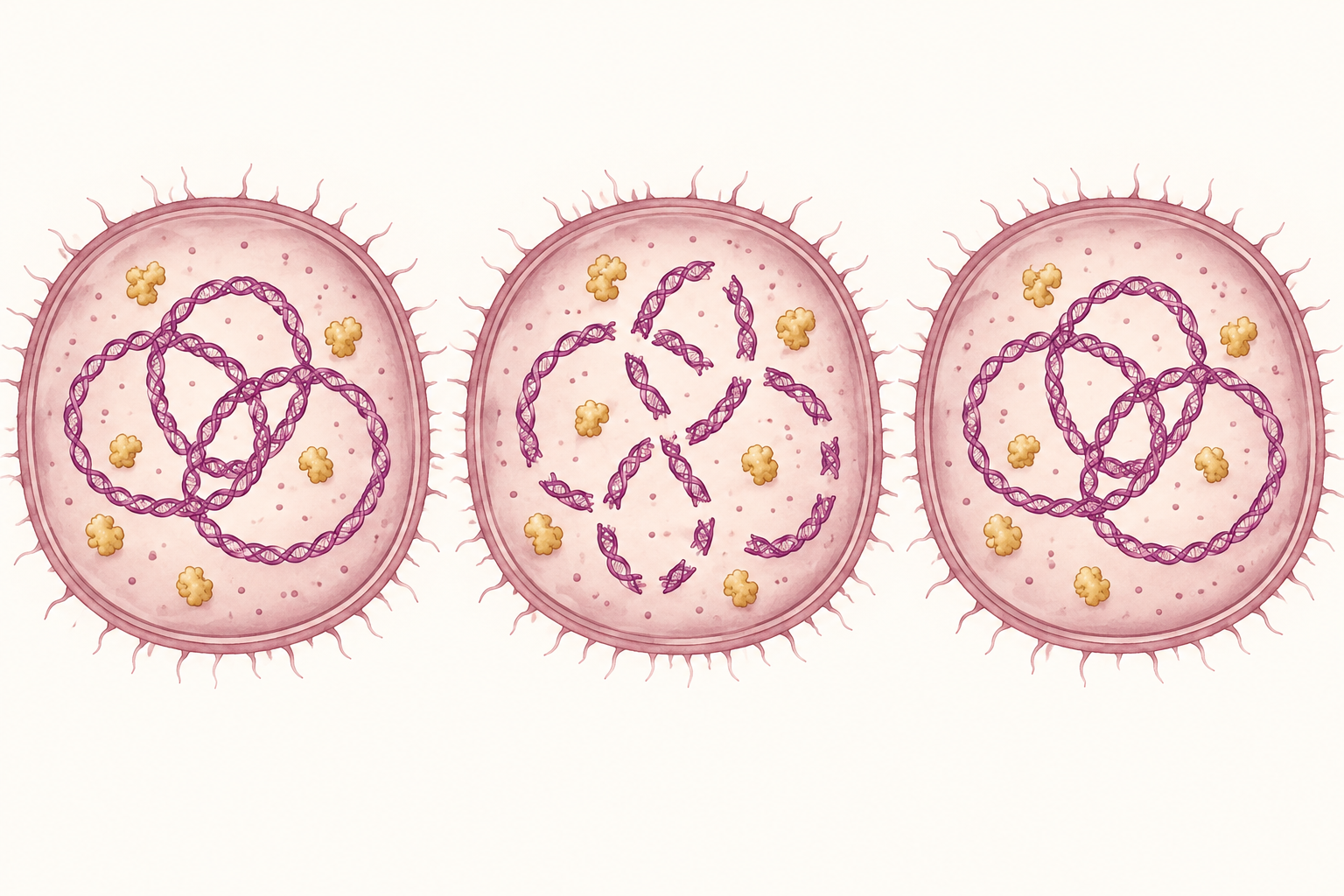
The bacterium carries multiple copies of its genetic material. That redundancy supplies overlapping information when chromosomes are broken. A landmark 2006 study described a two-stage recovery process: DNA synthesis and joining first reconstruct longer pieces, and recombination completes functional chromosomes.
It is useful to imagine damaged copies of a document with overlapping surviving passages. Comparing those overlaps helps recover the original order. The molecular process is much more precise than that analogy, and it relies on enzymes, compatible sequences and the cell's physiological condition.
Researchers can measure survival by whether cells recover and form new colonies after treatment. That is different from saying they were unharmed, or that they remained fully active throughout the exposure. Radiation type, dose, growth conditions and recovery procedures all affect what an experiment establishes.
Resilience with an ecological context
Extreme radiation is not the only stress these defenses address. Drying can also damage cellular components and DNA. The relationship between desiccation tolerance and radiation resistance helps explain why such capabilities are relevant beyond a laboratory radiation source.
Studying Deinococcus gives scientists a model for understanding how cells manage severe molecular damage. It has also motivated biotechnology research. Any practical application still has to account for the organism's limits and for the conditions needed to function.
The most compelling achievement is not invulnerability. It is recovery: a living system preserves enough useful machinery and information to rebuild after damage that initially looks catastrophic. That distinction makes the science more impressive, because it identifies something researchers can investigate rather than a superpower they can only admire.
Sources and further reading: Reassembly of shattered chromosomes; Protein oxidation and bacterial radioresistance; Small-molecule antioxidant proteome shields.
Explore more creative discoveries at Incoprea.




