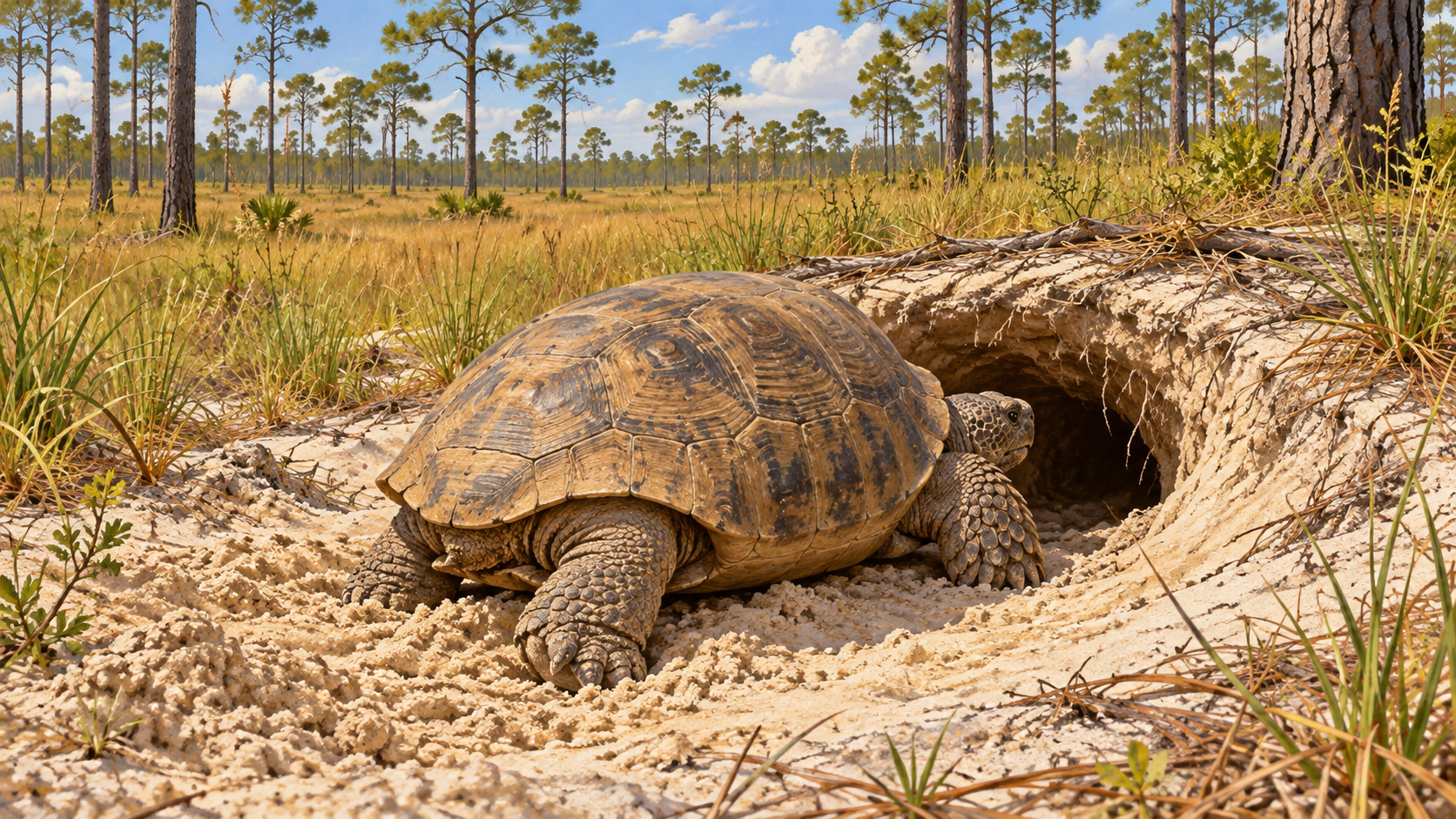
A mound of pale sand beneath open pine woodland can mark an entrance to a much larger world. Its builder is the gopher tortoise, a sturdy reptile that uses broad digging forelimbs to excavate a sloping underground refuge. The hole is useful to far more than its owner.
Across the tortoise's range in the southeastern United States, hundreds of other animal species have been recorded using these burrows. That figure describes the diversity of users across places and observations. It does not mean hundreds of animals are packed into every tunnel.
An underground climate buffer
The burrow usually follows a single descending tunnel, with an enlarged space near its deepest part. Its dimensions vary with the animal, soil and water table. Sandy ground can allow a substantial excavation; the depth and shape are not a fixed architectural blueprint.
Below the surface, temperature and humidity fluctuate less sharply than they do in the exposed habitat. The US Forest Service's research review describes burrows as refuges from temperature extremes, predators and fire. The tortoise can retreat from conditions that would be much harder to endure above ground.
The sandy apron outside the entrance is part of the structure too. It is excavated soil brought to the surface, making the entrance conspicuous and changing the immediate patch of ground. A burrow is both an empty space below and a disturbance of the surface above.
The builder has many visitors
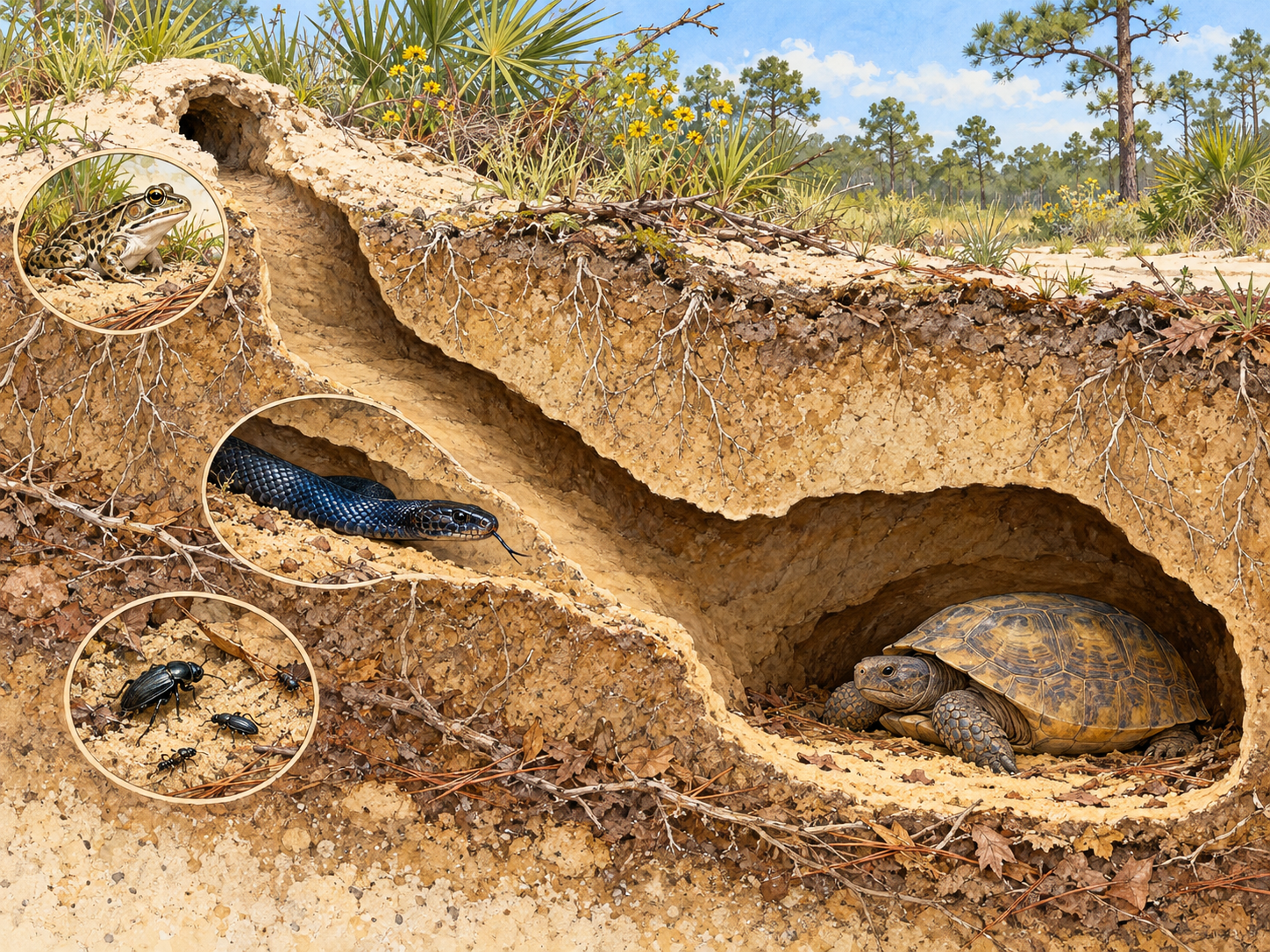
Other users include gopher frogs, eastern indigo snakes and a variety of insects. Their relationships with the burrow differ. Some use it temporarily, some shelter there under particular conditions, and some have closer associations with the underground environment.
That is why the term ecosystem engineer fits. The tortoise changes the physical surroundings in a way that creates opportunities for other organisms. It need not invite them, cooperate with them or understand the community that benefits. Moving soil is enough to alter what the habitat can offer.
Nor is a burrow automatically a peaceful communal household. Animals may arrive at different times, avoid one another or use different parts. The supporting cutaway is a composite illustration of possible users, rather than a photograph of an actual gathering.
The habitat supports the architect
Open longleaf-pine landscapes provide an important setting for these tortoises. Sunlight reaching the ground supports the low vegetation they feed on, while suitable soils allow digging. Fire helps maintain the open structure of many such landscapes; fire suppression and habitat change can transform those conditions.
The conservation implication follows from the engineering. Losing a tortoise population can also mean losing the ongoing creation and maintenance of shelter used by other animals. Protecting the builder requires attention to the larger habitat that makes its work possible.
A tortoise moves slowly enough to seem like a minor presence in a landscape. Its burrow tells another story. Below an ordinary sandy entrance lies a piece of living infrastructure, constructed by an animal whose everyday survival quietly expands the possibilities for its neighbors.
Sources and further reading: Florida FWC guide to burrow users; US Forest Service species and burrow review; USDA account of longleaf-pine habitat.
Explore more creative work at Incoprea.




