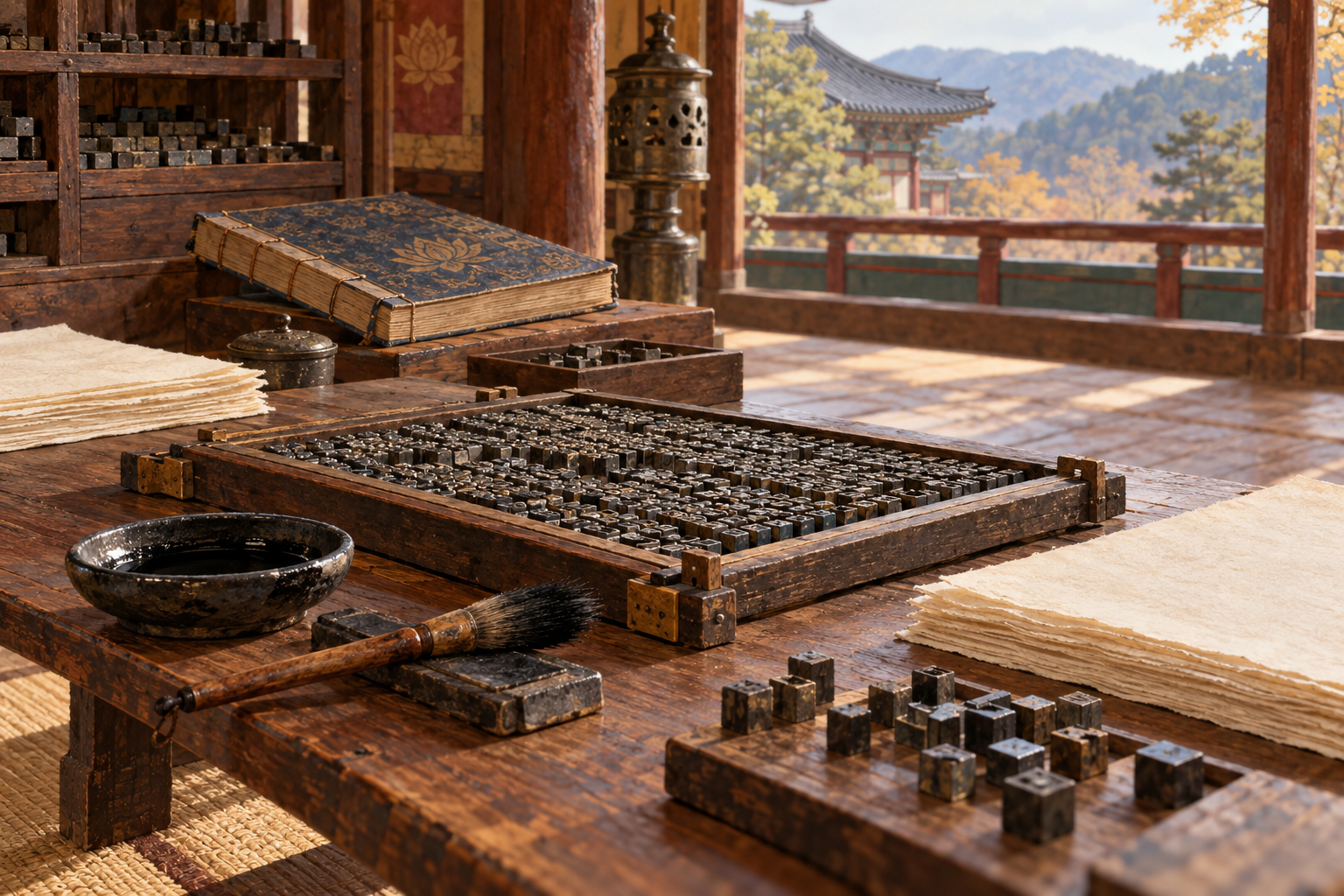
Picture a history of printing that begins with a European press and a famous Bible. Then place beside it a Buddhist book made in Korea in 1377. The sequence suddenly becomes more interesting. Known as Jikji, this book is the oldest surviving known example of a book printed with movable metal type.
That careful wording matters. It identifies surviving evidence, not the first moment anyone attempted the technique. Earlier Korean metal-type printing is recorded in historical texts. Jikji gives us something particularly powerful: a physical printed witness that can still be examined.
A book with a purpose
Jikji was printed at Heungdeok-sa temple in Cheongju, in what is now the Republic of Korea. Its compiler, the monk Baegun, brought together Buddhist teachings intended to support understanding and meditation. Its makers were producing a working religious text, rather than a demonstration for a future technology museum.
The surviving metal-type edition is the second volume, held by the Bibliothèque nationale de France. Its first leaf is missing. Even an incomplete book can carry remarkably precise historical information: the surviving publication details identify its place, method and year of production.
Reusable characters, different choices
Movable type turns writing into an arrangement of reusable pieces. Individual characters can be set together, inked and printed, then rearranged for another text. A woodblock instead carries a whole carved page. Both methods require considerable skill, and both remained useful.
A reusable system is not automatically the cheapest answer for every book. Casting, storing and selecting a large inventory of characters brings its own demands. Woodblocks can be retained for later reprinting. The University of Utah's printing-history project describes how Korean metal type and woodblocks could serve complementary roles in distributing texts.
| Method | What is prepared | What can be reused |
|---|---|---|
| Woodblock printing | A carved page | The same page for later copies |
| Movable metal type | Separate cast characters | Characters rearranged into new pages |
A wider history of invention
Jikji precedes the Gutenberg Bible of around 1455 by roughly eight decades. This expands the familiar story without making the different printing traditions interchangeable. Their materials, languages, institutions and systems of production deserve study in their own contexts.
It also does not, by itself, prove a direct route of transmission from a Korean workshop to Gutenberg. Similar technological ideas and their historical relationships require evidence beyond an earlier date. Researchers can compare type impressions, materials and surviving documents while keeping that distinction clear.
The most rewarding way to look at Jikji is therefore as a book that people made to circulate ideas. Its achievement becomes richer when we ask who needed the text, who paid for its production and how craftspeople turned learning into repeatable marks on paper.
Sources: Bibliothèque nationale de France: Jikji · UNESCO: Jikji nomination · University of Utah: From Jikji to Gutenberg
Explore more creative curiosities at Incoprea.




