Write 105, then remove the zero. The remaining 15 is not simply a shorter spelling of the same number. The empty position is doing work. A tiny mark can organise a number, and the Bakhshali manuscript preserves dot-shaped zeros within a much larger tradition of mathematical calculation.
The manuscript also supplies an unusually good lesson in dating evidence. Bark, ink and mathematical ideas each have a history. When a measurement changes the age assigned to one layer, it does not automatically date the other two. The more carefully those layers are separated, the more interesting the surviving book becomes.
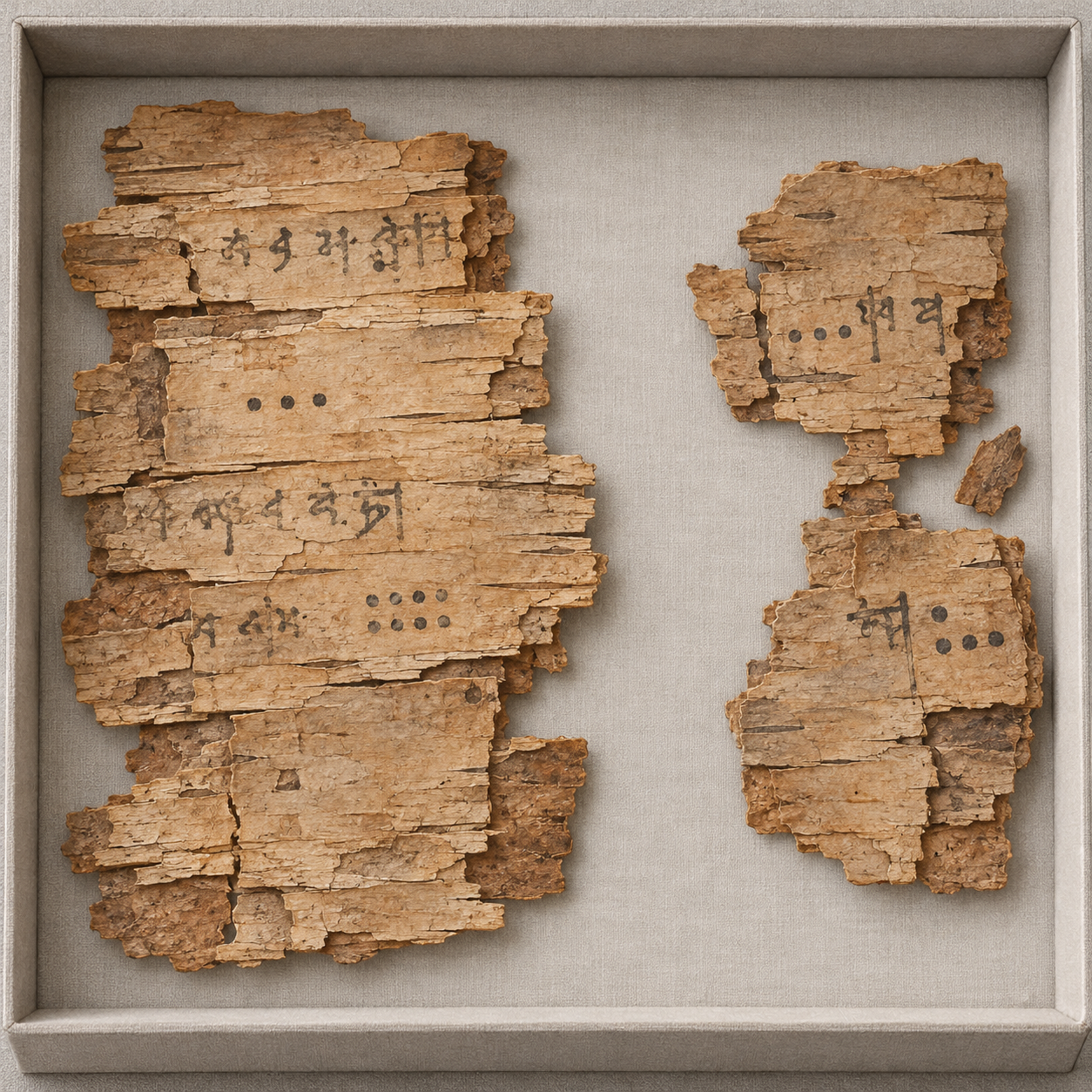
Begin with the mathematics
The manuscript was found in 1881 near Bakhshali in present-day Pakistan and is held at Oxford's Bodleian Libraries. Its surviving birch-bark folios preserve a Sanskrit mathematical work with regional linguistic features. The material is fragmentary, but rules and worked examples give researchers more than isolated numerical symbols.
A worked problem preserves a sequence: state a task, apply a method, obtain a result and sometimes check it. That sequence helps historians investigate what a notation actually does. A dot's appearance is a beginning, while its role inside a calculation supplies further evidence.
Think of a modern exercise in which a blank box stands for an unknown number. Its shape is not enough to tell us its function. The surrounding instruction might ask us to fill the box, add a quantity or compare results. Historical mathematical notation also needs to be read in context.
Three jobs for a small mark
A placeholder distinguishes positions in a numeral. Zero as a number can participate in arithmetic. A symbol can also stand for an unknown quantity. These ideas are related, but they are not identical, and a single visual form can be used within more than one procedure.
In their response to the 2017 dating announcement, historians Kim Plofker and colleagues challenged the description of the manuscript's zeros as merely placeholders. They considered large-number operations and a rule involving substitution for an unknown, arguing that the mathematical procedures complicate such a sharp division.
Their point is valuable even if you do not follow every Sanskrit term. To understand a mathematical symbol, examine the actions performed with it. A claim about the writer's concepts should be supported by the calculations, rather than deduced solely from whether the mark looks like a dot or a circle.
Try a modern comparison. In 105, the zero distinguishes the tens position. In 5 minus 5 equals 0, it is an arithmetic result. In “a number plus 5 equals 12,” an empty space might indicate the unknown 7. These are teaching examples, not transcriptions of Bakhshali problems.
Why the 2017 headline needed revision
Oxford's 2017 announcement drew attention to widely separated radiocarbon results from three pieces of bark, including an early date in the third or fourth century CE. The announcement connected that finding with the history of the zero symbol. Specialists questioned how the samples should be related to the writing and the manuscript as a whole.
A 2024 Oxford report provides later determinations for five folios and a new model. It places the start of the dated bark-formation phase within 799–892 CE and its end within 900–1102 CE, at the stated 95.4 percent probability level. These are modelled boundaries, not two precisely observed days of copying.
The report makes the central distinction explicit: radiocarbon concerns the formation of the bark. Ink must be applied after its writing surface exists, but it can be applied later. The composition of a mathematical rule can be older still, transmitted through copies that have not survived.
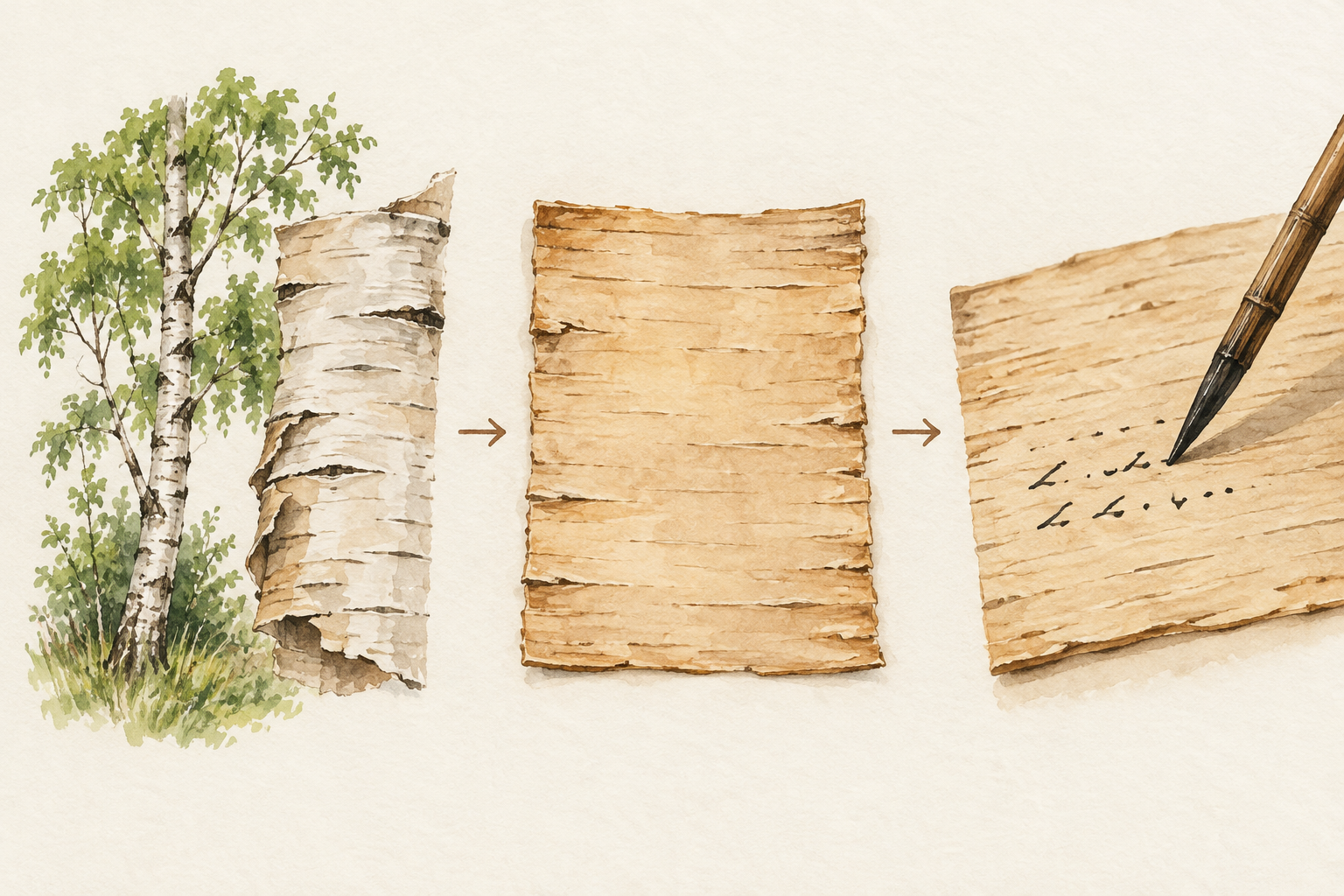
The layered illustration is a conceptual aid. It does not reproduce a measured folio or assign a time interval between bark formation and writing. That interval has to be investigated with evidence rather than supplied by the attractiveness of a sequence.
A dating exercise with three clocks
Imagine an old notebook copied from an even older textbook. A laboratory tests the paper. A handwriting specialist studies the script. A historian compares the problems with other books. Each investigator can be right while addressing a different date.
| Evidence | Primary question |
|---|---|
| Radiocarbon of bark | When did this sampled organic material form? |
| Handwriting and physical structure | When and how was the surviving copy written? |
| Comparison of mathematical works | How were rules and ideas developed and transmitted? |
Now test a headline: “The oldest piece of bark gives the invention date of zero.” Which links would have to be demonstrated? You would need a defensible relationship between the sample and the writing, and then between that particular copy and the first development of the idea. The short headline skips both.
That does not make material dating unhelpful. It makes its proper question more precise. Several independent kinds of evidence can strengthen a chronology, especially when a proposed interpretation explains how apparently conflicting results fit together.
Read the report as an argument
Open the 2024 Oxford report record and follow its document link. Look first for the folio identifiers, then for the discussion of modelling. Compare its language with the earlier announcement, keeping the publication dates in view.
The manuscript's value survives that comparison. It remains evidence of people teaching, calculating and checking through a sophisticated mathematical tradition. A later surviving copy can preserve earlier knowledge; an earlier surface cannot by itself establish when every idea was invented. The dot is small, but reading it well requires a generous view of the book around it.




