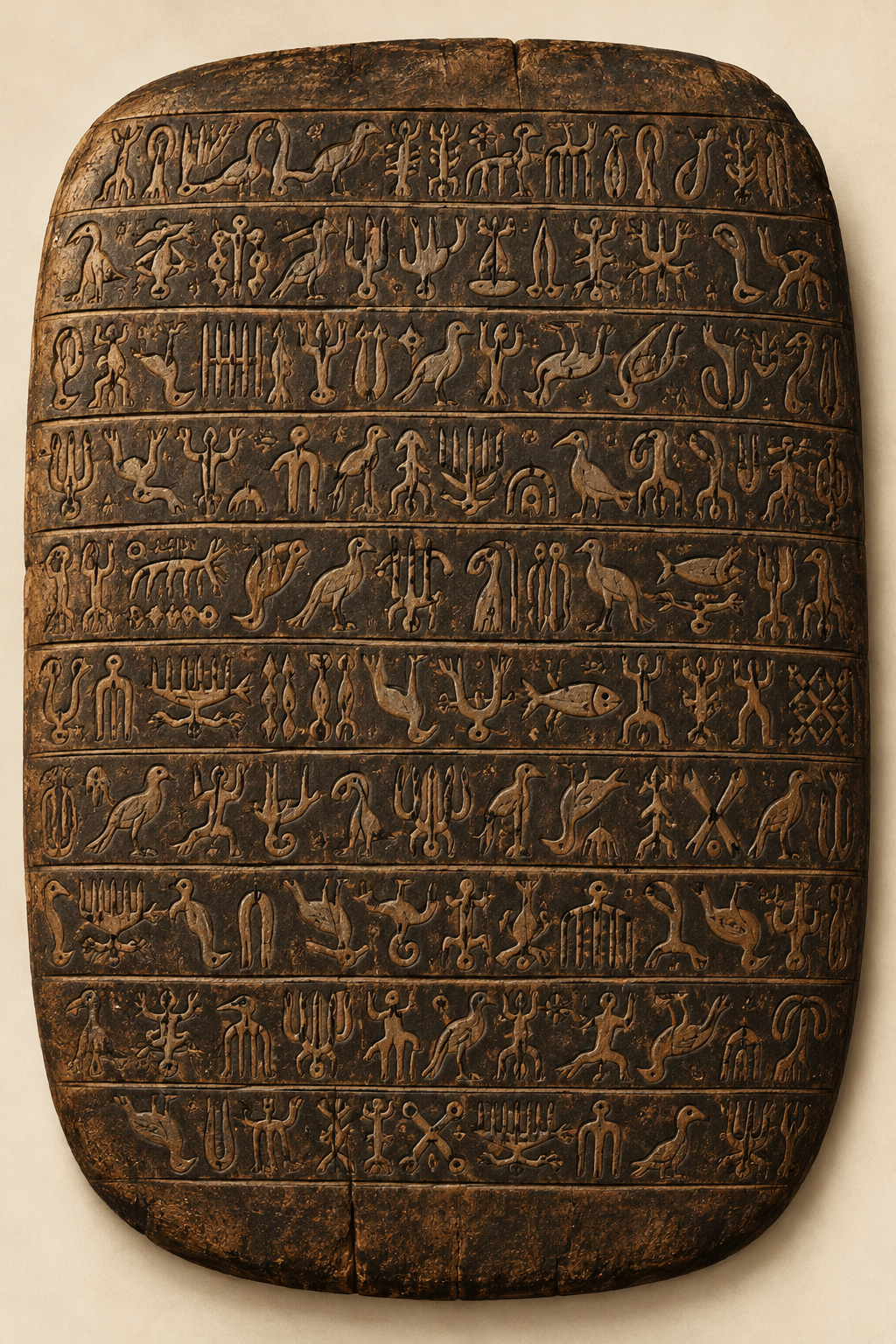
On a small group of wooden objects from Rapa Nui, also known as Easter Island, rows of incised signs resemble birds, people and other forms. They invite recognition. Recognition, however, is not reading. Rongorongo remains undeciphered: there is no generally accepted system that allows scholars to translate its surviving texts.
The temptation is to treat each image as an obvious word. A bird must mean bird, perhaps. Writing systems rarely make life so easy. A recognizable form could represent a sound, an idea, part of a compound sign or something conventional that cannot be guessed from its appearance.
The problem of a small archive
The surviving corpus is limited, and the objects are dispersed among collections. Damage, differences between published drawings and the difficulty of inspecting carved surfaces add obstacles. Researchers need a dependable account of what is actually cut into the wood before arguing about what those marks encode.
The University of Bologna's INSCRIBE project has used three-dimensional documentation to improve that foundation. A digital model can preserve surface geometry, help examine a groove under different virtual lighting and make comparisons easier. It offers evidence about signs; it does not supply missing meanings.
One striking feature is the arrangement in which successive lines can be oriented in opposite directions. Such layout gives researchers a structural clue about how the object might have been handled or followed. It still leaves the relationship between signs and language unresolved.
Dating wood is not dating a sentence
A 2024 study radiocarbon-dated four tablets held in Rome. Three yielded comparatively recent wood dates, while one was made from much older wood. The authors discuss the importance of this result for debates over whether rongorongo arose before European contact.
The distinction remains crucial: radiocarbon measures organic material, not carving. Wood can be stored, reused or obtained as driftwood before someone inscribes it. An old wooden surface therefore does not automatically give us the age of the signs. The study itself considers the old-wood problem.
| Observation | What it does not settle |
|---|---|
| Repeated signs | Their sound or meaning |
| A three-dimensional groove | A translation |
| A wood date | The exact date of carving |
A mystery with a human context
Uncertainty should not turn rongorongo into an invitation for invented civilizations or spectacular secret messages. These objects belong to the history and cultural heritage of Rapa Nui. Their survival, collection and study are part of that story too.
A convincing decipherment would need to explain many inscriptions consistently and withstand independent testing. A few attractive readings are insufficient. Until then, patient work on the corpus can still produce meaningful results: clearer documentation, better chronology and more precise questions. A text does not become unimportant merely because we cannot yet read it.
Sources: Ferrara and colleagues: new rongorongo radiocarbon dates · University of Bologna: INSCRIBE research · British Museum: rongorongo tablet cast
Explore more creative curiosities at Incoprea.




