Most tree stories begin with a seed in soil. A strangler fig can begin with a seed high in another tree, where an animal has left it. The young plant starts with an elevated platform, then sends roots toward the ground. Over time, that borrowed support can be surrounded by a new tree.
Strangler fig is a growth description applied to several fig species, rather than the name of one universal organism. Their forms and outcomes vary. The common pattern is an unusual route from canopy establishment to a substantial rooted structure.
Starting with a head start
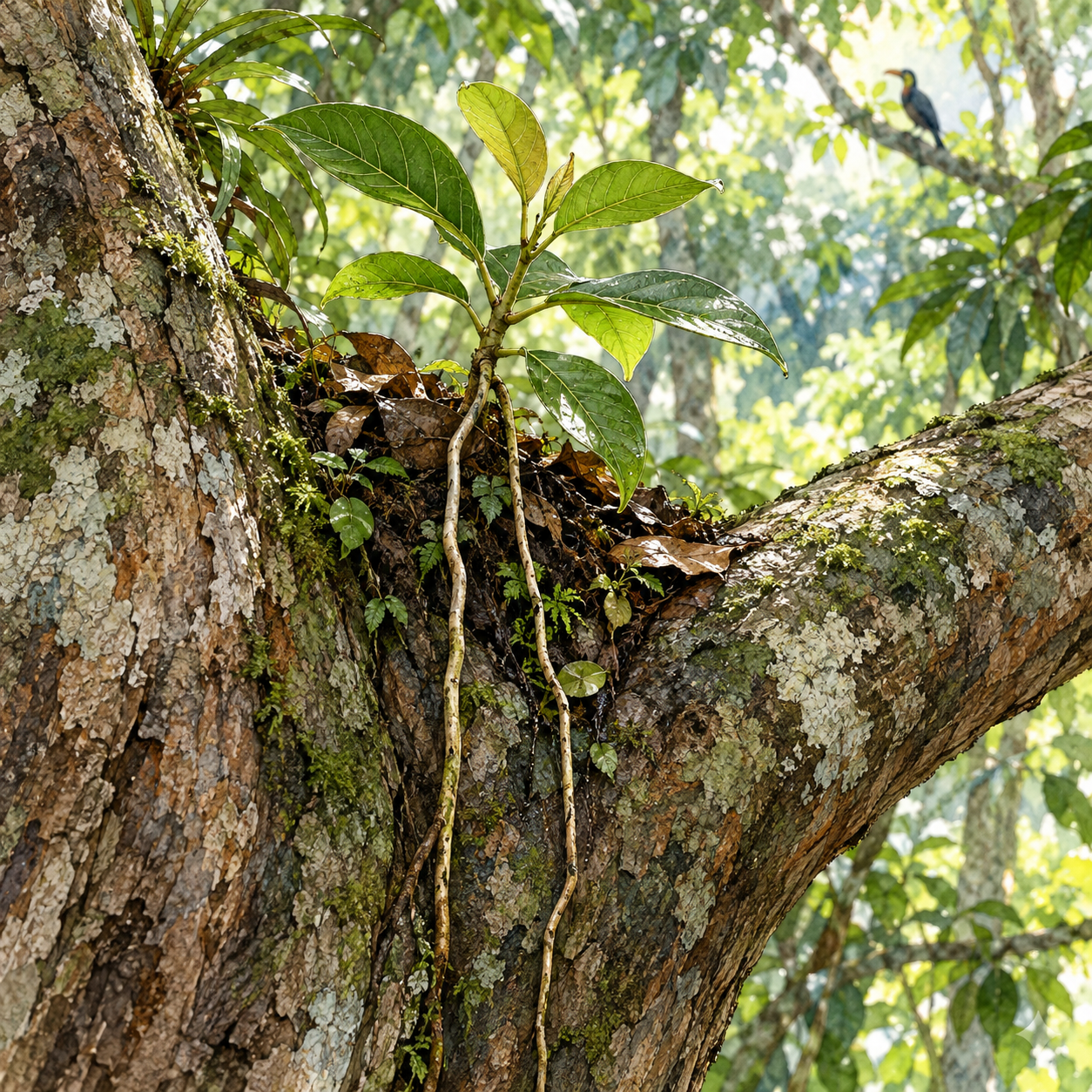
In a crowded tropical forest, access to light is a major challenge. Establishing above ground changes the starting position. The Florida Museum describes fig seedlings beginning in a host's crevice, while Singapore's National Parks records birds and small mammals dispersing the fruits of a strangler fig species.
The early fig is an epiphyte: it grows on another plant. Its location should not be confused automatically with a parasitic feeding mechanism. The host provides a place to start and physical support, while the fig grows its own leaves and roots.
That distinction helps make sense of the name. The relationship can become harmful through competition and surrounding growth, without the fig needing to extract food directly from the host's tissues.
Roots become a framework
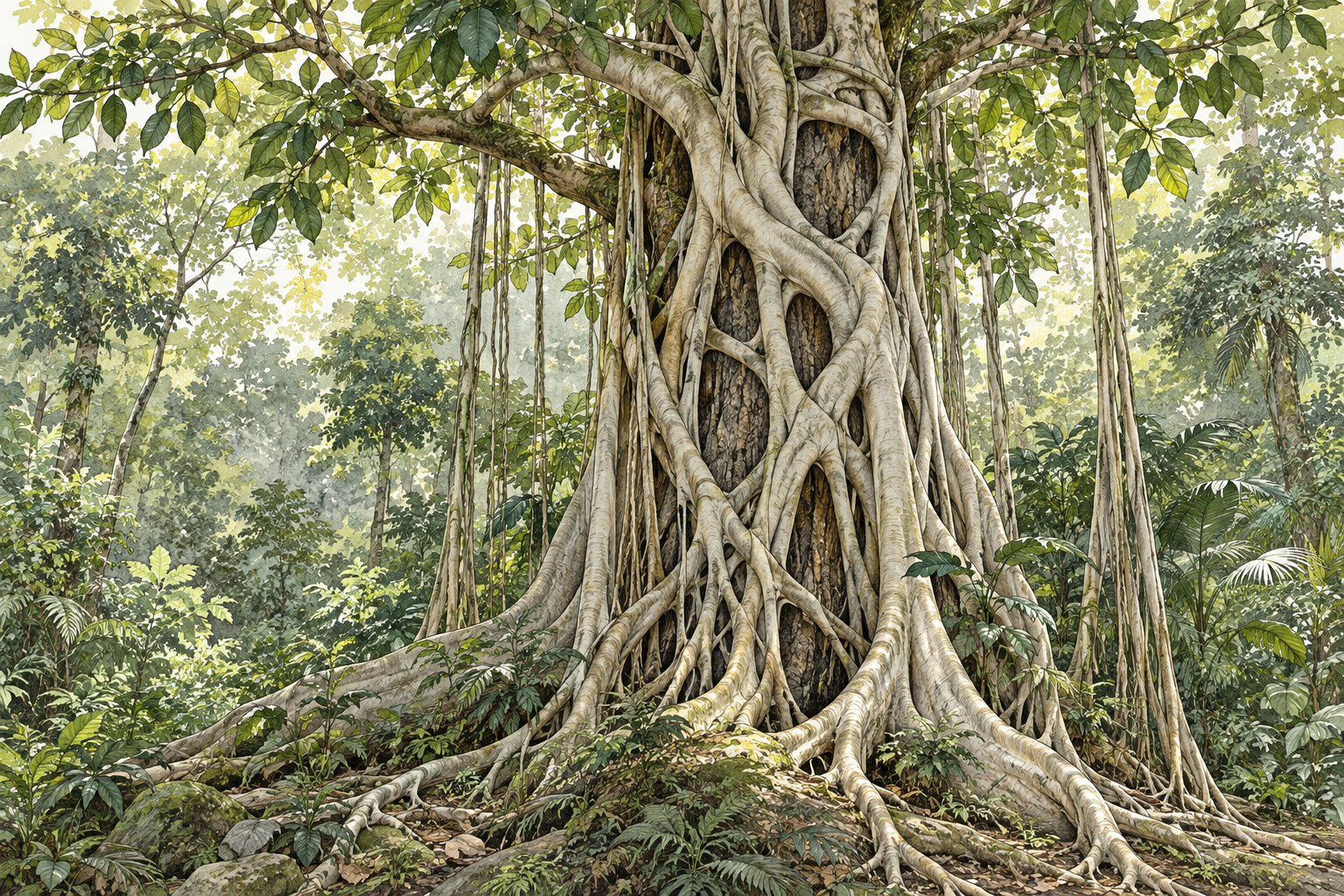
As roots reach the soil, they can thicken and contribute to an enclosing structure. The University of Florida's account of Ficus aurea describes a canopy-starting plant developing into a self-supporting tree, with heavy aerial roots surrounding its original host.
It is a slow architectural process. Thin hanging roots, a lattice around a trunk and a large mature fig represent different stages, rather than three unrelated kinds of tree. Looking for the original trunk can reveal which structures belong to which participant.
The host may eventually die, and the fig can persist. Yet the dramatic common name should not imply that every fig has the same growth habit or that every relationship follows an identical timetable.
A competitor that feeds a community
Smithsonian Gardens emphasizes another side of figs: their importance as food for tropical animals. Fig fruits can sustain a wide range of species, including birds, bats, reptiles and mammals. The genus also includes shrubs, vines and ordinary trees.
The species that competes with one host can therefore contribute resources to many other organisms. Ecology often contains such overlapping roles. A plant need not fit neatly into the category of villain or helper.
The strangler fig is most rewarding when observed as both a living history and a changing structure. Its roots record a route from an elevated foothold to the ground. Its fruits connect that structure with animals moving through the forest, some of which may carry a seed to the next unlikely starting place.
Sources: Smithsonian Gardens: the fruitful fig · University of Florida: Ficus aurea · Singapore National Parks: Ficus drupacea · Florida Museum: the strangler fig
Explore more creative curiosities at Incoprea.




