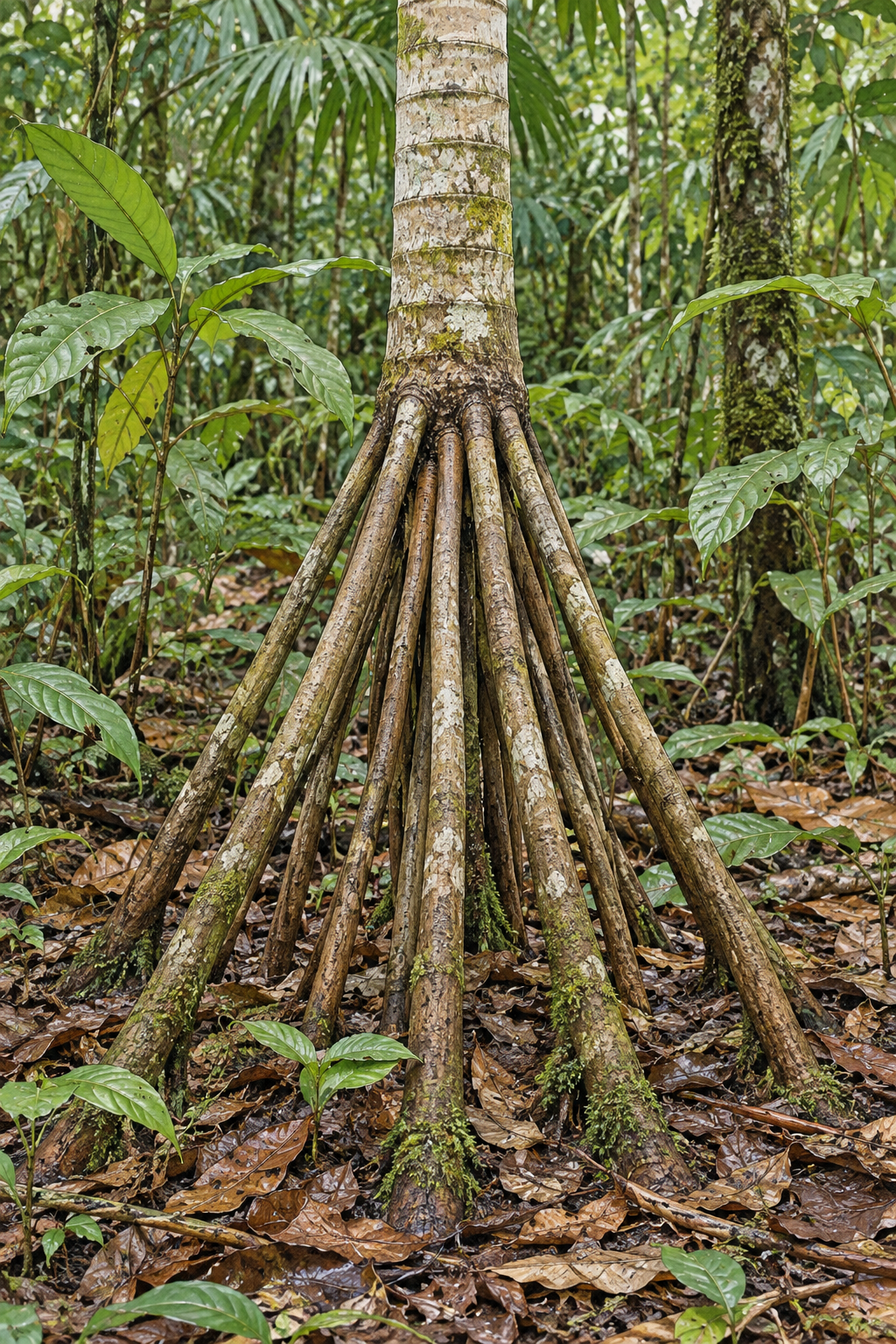
A palm raised above a cone of long, angled roots looks as though it might get up and leave. Socratea exorrhiza is widely called the walking palm, and the name has encouraged a popular story that mature trees slowly move across the forest by growing roots in a chosen direction.
The roots are real. That stronger walking claim remains unsubstantiated. Keeping the distinction does not make the palm less interesting; it lets its unusual architecture become a research question rather than a ready-made tale.
What the roots actually show
Stilt roots extend from the lower trunk to the ground, making a supporting cone. A Smithsonian archival record preserves a photograph of this distinctive structure from Barro Colorado Island in Panama. The shape has attracted attention for many decades.
Scientists Gerardo Avalos and colleagues measured root-cone structure in Socratea and another stilt-rooted palm at Costa Rican sites. They compared palm size and slope, rather than assuming that the roots had one obvious purpose.
Their 2005 study found root-cone dimensions related more to palm size than to slope conditions. Larger palms had larger cones. The results provided evidence about support and growth, while showing why a plausible explanation must be tested against measurements.
Falling and rerooting are different
A 2024 Smithsonian research chapter by Cecilia Williamson and Helene Muller-Landau revisits the walking story. It explains that an often-cited 1980 report described seedlings and saplings knocked down by falling material. They could reroot and produce an upright stem at a different location.
That is a form of recovery after damage. It does not establish that a standing mature palm travels horizontally through selective root growth. The chapter explicitly says the mature walking claim remains unsupported.
| Observation | Interpretation to keep separate |
|---|---|
| A stilt-root cone | Support structure does not demonstrate locomotion |
| A fallen young plant reroots | Recovery is different from a mature trunk moving |
| Unequal root growth | Shape alone does not measure displacement |
A better question than the myth
To show a tree moving, researchers would need repeated measurements relative to fixed references, and an explanation of how apparent change differs from bending, damage or new growth. A photograph with leg-like roots cannot provide that evidence by itself.
The useful question is how the root structure contributes to the palm's life. Growth, mechanical demands and recovery can be studied separately. Hypotheses may overlap, and their importance can vary with a plant's size and setting.
Common names often contain vivid comparisons. They help us notice an organism, but should not take over the explanation. With the walking palm, the comparison opens the door. Careful observation leads to the more durable interest: how a tall living structure builds and maintains its unusual foundation.
Sources: Williamson and Muller-Landau: Socratea exorrhiza · Avalos and colleagues: stilt-root structure · Smithsonian: historical stilt-root photograph record
Explore more creative curiosities at Incoprea.




