The operator presses a key, but no letter strikes a sheet of paper. Instead, a small brass matrix joins a growing row. More keys add more matrices. Eventually the row becomes a mould for a line of metal type. The machine is composing a future printing surface, one choice at a time.
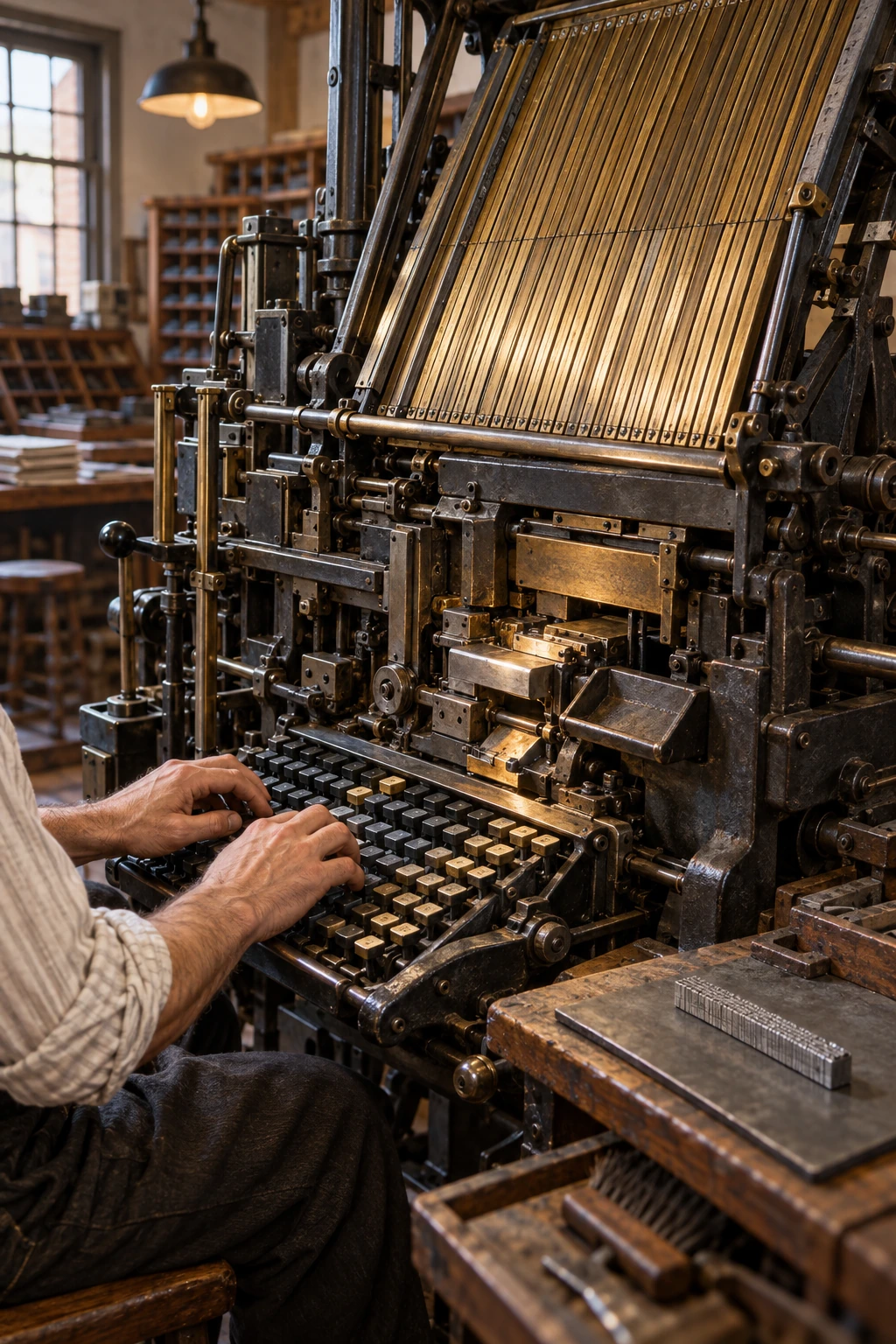
A Linotype is easy to mistake for a large typewriter or a printing press. Its distinctive job lies between writing and printing. It assembles and casts type that another machine can use to make impressions on paper.
A matrix is not the finished letter
Smithsonian curator Joan Boudreau describes learning to use an Intertype linecasting machine. Her account follows the keyboard, the line of matrices, casting and the later arrangement of type for printing. The distinction becomes clear in the photographed objects: matrices and finished lines are different things.
A matrix carries the form needed to cast a character. It must reach the right place, align with its neighbors and later return to storage. The resulting line of metal type is the item that leaves the composing cycle for use at the press.
This circulation is a remarkable part of the machine's design. Reusable matrices can participate in another line while previously cast lines remain available for page composition. The system separates the expensive precision of the mould from the temporary arrangement needed for a particular text.
The line must fit before it can become solid
Writing a sentence and fitting it to a column are different problems. A row of characters needs to occupy a chosen measure. Spaces between words provide room for adjustment, but they cannot absorb every possible excess or shortage without limits.
The Linotype maintenance material on matrices makes alignment and fit concrete. The casting arrangement has to keep molten metal where it belongs. The elegance of the printed line depends on mechanical relationships that are mostly invisible to the eventual reader.
The toy composer below isolates the spacing question. It assigns every letter one arbitrary unit and lets word spaces expand to fill a measure. Real type has unequal widths and real machines have mechanical constraints. This is a reasoning tool, not a working linecaster.
Make one line fit a measure
An explicit unit-width toy model separates letter count and adjustable word spacing.
Begin with “TYPE MAKES A LINE” at a width of 24 units. Then shorten the measure until the words and minimum spaces cannot fit. Notice that adding more space is not always the solution. At some point the line needs a different break, a different measure or different content.
The keyboard still needs an attentive reader
In the Smithsonian account, Boudreau describes difficulties reading the representative letters on one set of matrices and finding another set more legible. That small observation matters. A keyboard can automate the movement of components while leaving the operator responsible for checking what has been assembled.
Imagine proofreading the line before casting, then discovering an error after it has become a solid object. The consequences differ from deleting a character on a screen. The material form changes the cost and sequence of correction, even when the linguistic mistake is the same.
Try a harmless version with paper. Write a short line, check it, then copy it neatly into a fixed rectangle. Ask someone to point out one correction only after the copy is complete. The exercise does not imitate casting, but it makes the difference between checking before and after commitment tangible.
A fast press creates pressure elsewhere
The Smithsonian's overview of printing machines explains that faster presses required improvements in other parts of production. A press cannot print useful pages faster than type, ink, paper handling and page preparation make them available.
That larger system helps explain why a machine for assembling lines mattered. Speed at one stage can expose a bottleneck at another. Mechanizing the impression alone does not supply a page's worth of correctly composed text.
A viewing task for a linecasting demonstration
Follow one matrix through the process and ask when it becomes available again. Then follow one finished line and ask where it goes next. Keeping those two routes separate is the quickest way to understand why the apparatus is more than a keyboard attached to a furnace.
No working demonstration is needed to appreciate the logic. The keyboard selects. The matrices assemble. The spacing and alignment establish a usable mould. Casting produces a line. A separate printing operation turns that line into marks on paper.
The most satisfying object may be the modest metal slug at the end. It looks still and simple because the complicated work has already happened. A machine has converted a sequence of keystrokes into a physical line that can join other lines and become a page.
Sources and further exploration: Smithsonian: printing history and the Intertype; Linotype maintenance: matrices; Smithsonian: printing machines.
Explore all 50 new articles · Browse the complete illustrated collection
Explore more art, ideas, and independent projects at Incoprea.




