A book can survive because something went wrong. The Derveni papyrus is a particularly unsettling example: the roll was charred in a funerary setting, and the damaged remains preserved writing that would otherwise probably have disappeared in the Greek climate.
Its contents produce another surprise. This is a text about interpreting a text. An ancient commentator works through a poem attributed to Orpheus, arguing that its language carries an account of the world beneath its stories about gods. Modern readers encounter that interpretation through another layer of work: the reconstruction of a fragile, incomplete manuscript.
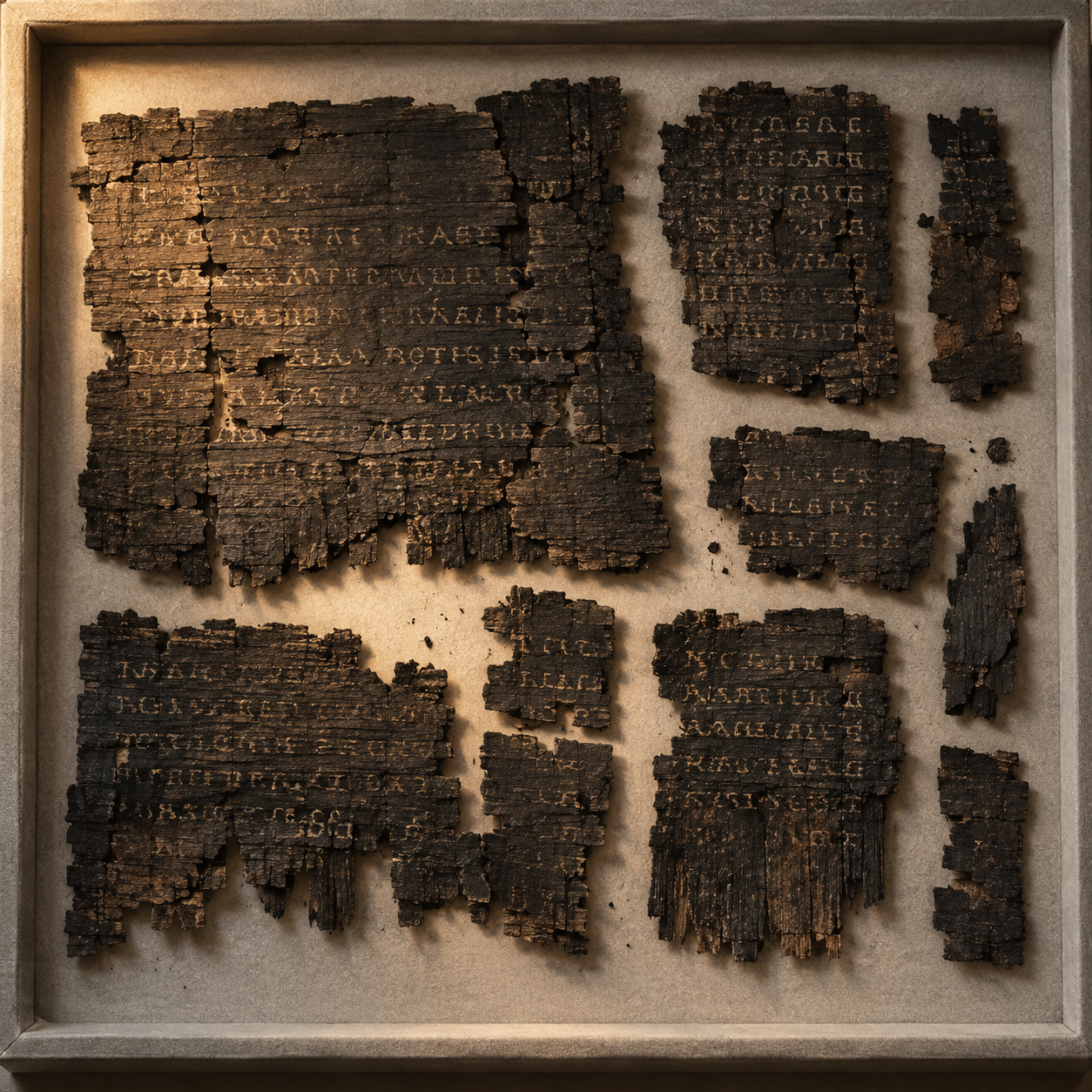
What survived the pyre
The papyrus was found in 1962 at Derveni, near Thessaloniki, among remains associated with a funeral pyre. The Archaeological Museum of Thessaloniki dates the writing to roughly 340–320 BCE. The work being copied is considered older, so the surviving physical roll and the composition it transmits belong to different moments.
Only part of the roll remained. Specialists separated charred layers and joined fragments, recovering portions arranged into twenty-six columns. The lower areas had been lost. A display of ordered columns can make the result look surprisingly complete, but that orderly presentation is itself a major scholarly achievement.
Picture the work at two scales. A fragment may preserve a few strokes or letters. A reconstructed column needs those fragments to occupy defensible positions. The entire roll then requires a larger sequence. Moving from carbonised pieces to readable argument involves several kinds of comparison, not just improving the visibility of ink.
An ancient reader explaining another voice
The Center for Hellenic Studies describes religious instructions alongside allegorical commentary on a theogonic poem, a poem concerning the origins and relationships of gods. The commentator treats its language as something to be explained rather than merely repeated.
That distinction is the heart of the book's appeal. A summary would tell us what happens in a poem. Commentary asks why particular words are used, how they should be understood and what account lies behind them. The reader doing the explaining becomes a forceful presence of his own.
Classicist Jeffrey Rusten's study draws attention to the relationship between quotation and explanation, including how the physical width of a column could accommodate a verse. Format and argument meet: a book can visually organise the movement from an earlier line to a later reader's discussion of it.
A modern analogy might be a heavily annotated edition in which short extracts sit inside an extended interpretation. The analogy helps with structure, but should not determine the author's purpose. The Derveni text belongs to its own religious and intellectual environment, where categories such as philosophy, ritual and poetry overlapped differently.
Three speakers, three different questions
It helps to give each layer its own question. What does the poem say? What does the commentator claim it means? What can an editor recover from the surviving papyrus? Those questions are connected, but an answer at one layer cannot simply be substituted for an answer at another.
A commentator's explanation is evidence for an ancient act of interpretation. It is not automatic proof of an original poet's intention. Similarly, an editorial restoration can make excellent sense without being a surviving letter on the papyrus. Both distinctions allow us to appreciate the work more precisely.
The attribution to Orpheus also belongs to the text's cultural world. It should not be treated as a verified signature by a historically documented author. The identity of the commentator remains debated. Assigning a familiar name too confidently would close a question the material does not settle.
A reader's tour of a reconstructed column
The Center for Hellenic Studies' online text lets you see the visible machinery of an edition. You need not read Greek to notice column numbers, line numbers, brackets, dots and spaces. These marks turn uncertainty into something that can be discussed.
- Choose a short stretch where the printed text is relatively continuous. Notice how the line divisions are displayed.
- Find a nearby area with brackets or an extended gap. Compare the amount of surviving-looking text with the amount supplied or left open.
- Read the edition's conventions before deciding what an individual symbol means. Editors can distinguish several kinds of uncertainty.
- Return to an institutional photograph of the fragments. What work has the printed arrangement made easier to follow?
The exercise is about recognising the kind of object an edition is. A clean translation offers access to an argument; an edited text exposes some of the decisions that make that access possible. Read together, they provide a fuller experience than either can offer alone.
The CHS project page also lists its 2006 edition and a later treatment of the opening columns. Some older linked tools may depend on legacy hosting, but the project's introductions and text pages still show the collaborative character of the work. Disagreement about a passage can be a productive comparison of evidence.
Why the damage remains part of the story
UNESCO placed the Derveni papyrus on its Memory of the World register in 2015, recognising its significance for Greek religion and philosophy. The distinction celebrates a rare survivor, not a claim that every line has become certain.
Its unusual preservation also changes the way we imagine ancient books. The surviving collection of texts from any period depends on conditions of storage, destruction, copying and recovery. What happens to survive is not a neutral sample of everything people wrote.
The papyrus finally offers a meeting between readers. Someone in antiquity believed a difficult poem required close explanation. Modern specialists believe damaged remains deserve equally close attention. We can join that meeting by taking both the argument and the gaps seriously, allowing the book to be incomplete without making it silent.




