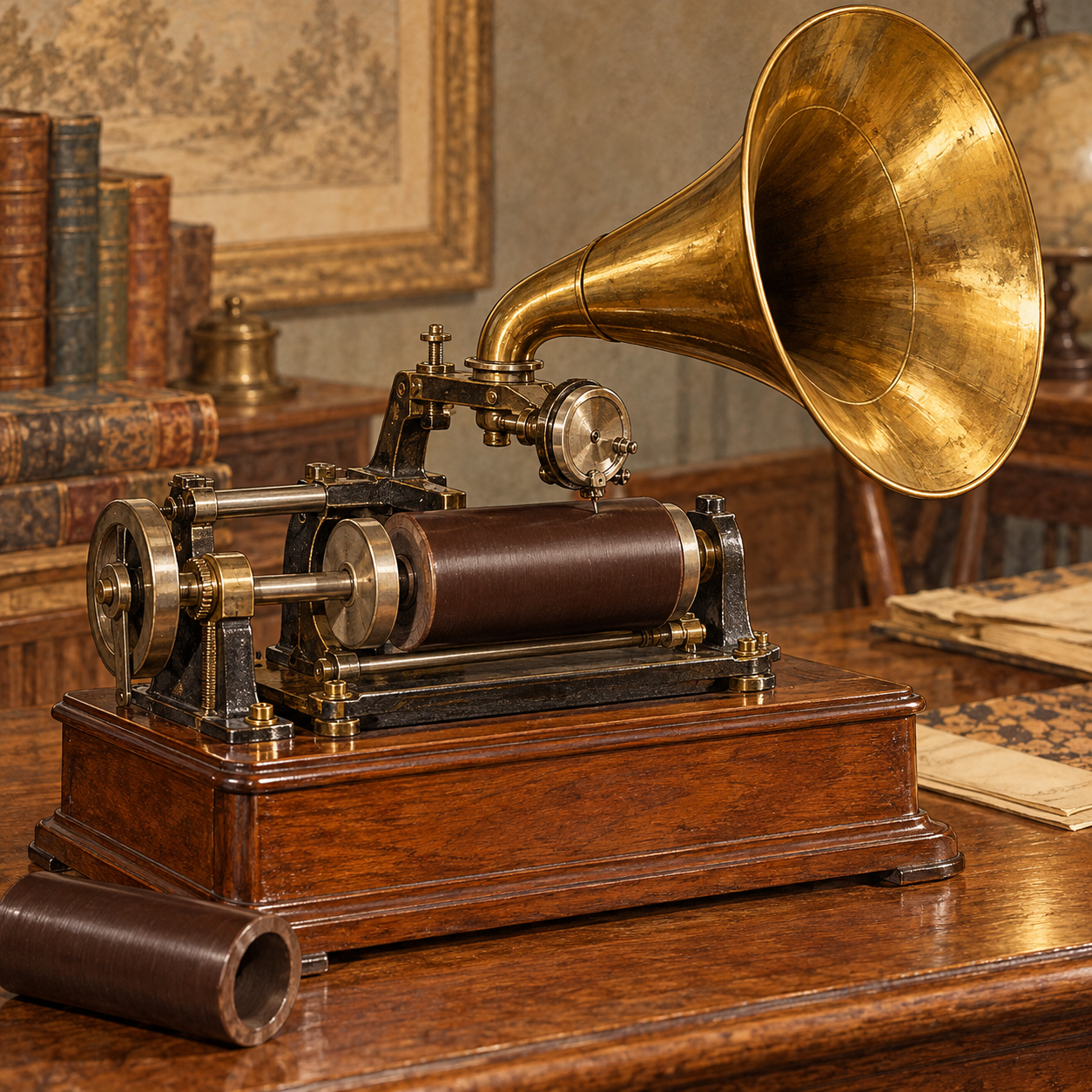
A voice can leave a physical path around a cylinder. In early phonographs, a rotating record and a moving stylus converted sound into a groove, then used that groove to make sound again. The recording was a shaped surface that a machine could revisit.
Listening to a surviving cylinder makes the mechanism feel unexpectedly intimate. A brief voice from the nineteenth century is carried through a chain of materials, machines and preservation decisions.
A horn gathered the energy
Acoustical recording used a flared horn to gather sound waves and direct them toward a diaphragm. The diaphragm's movement drove a stylus that marked a rotating recording surface. Playback reversed the process: movement along the groove made a diaphragm vibrate and produce sound.
The Library of Congress describes recording before microphones and electrical amplification, when performers had to work with the horn's limitations. Position mattered. A stronger passage might require moving away, while a quiet sound might call for coming closer.
The process captured a restricted range of frequencies, so different voices and instruments did not emerge equally well. Recording technique influenced what listeners received, long before an engineer could adjust an electronic mixing console.
The cylinder changed as recording developed
Edison's 1877 phonograph used tinfoil on a cylinder. Later work by Chichester Bell and Charles Sumner Tainter, as well as Edison's renewed experiments, helped develop wax-cylinder recording. The familiar cylinder era therefore involved changes in both the machine and its recording medium.
Office dictation was one proposed use, but prerecorded entertainment became an important market. Cylinders carried music, speech and comic performances, making replayable sound part of ordinary listening.
The National Park Service offers an especially direct example: Around the World on the Phonograph, attributed to Thomas Edison and dated approximately late October 1888. The park describes it as the earliest believed surviving recording of his voice, a claim narrower than calling it the first sound recording.
Listen to the preserved 1888 voice recording
Preservation includes knowing how to listen
Keeping the cylinder is only part of preserving its contents. A transfer requires suitable playback equipment, an appropriate stylus and knowledge of the particular format and condition.
A Library of Congress preservation specialist described using the Archeophone, a modern player designed for historical cylinders. In some damaged examples, playing in reverse could allow the stylus to follow a track that it could not follow normally; software could then restore the direction of the transferred audio.
That example shows why an old recording is not simply waiting for any needle. Physical condition, equipment and expertise influence what can be recovered from the surface.
The resulting sound joins two kinds of survival: a groove remains on an object, and people retain the knowledge needed to interpret it. A short, imperfect voice can become a remarkably powerful connection when that whole chain is preserved.
Sources and further reading: Library of Congress: Making records in the acoustical era; Library of Congress: History of Edison sound recordings; National Park Service: Very early recorded sound; Library of Congress: Preserving audio cylinders.
Explore more creative work at Incoprea.




