A row of drinking glasses makes a charming instrument until a melody asks for a leap, a chord, and another leap in quick succession. Benjamin Franklin's glass armonica changes the arrangement. Graduated bowls nest on a turning spindle, bringing their rims into a compact sweep beneath the player's hands.
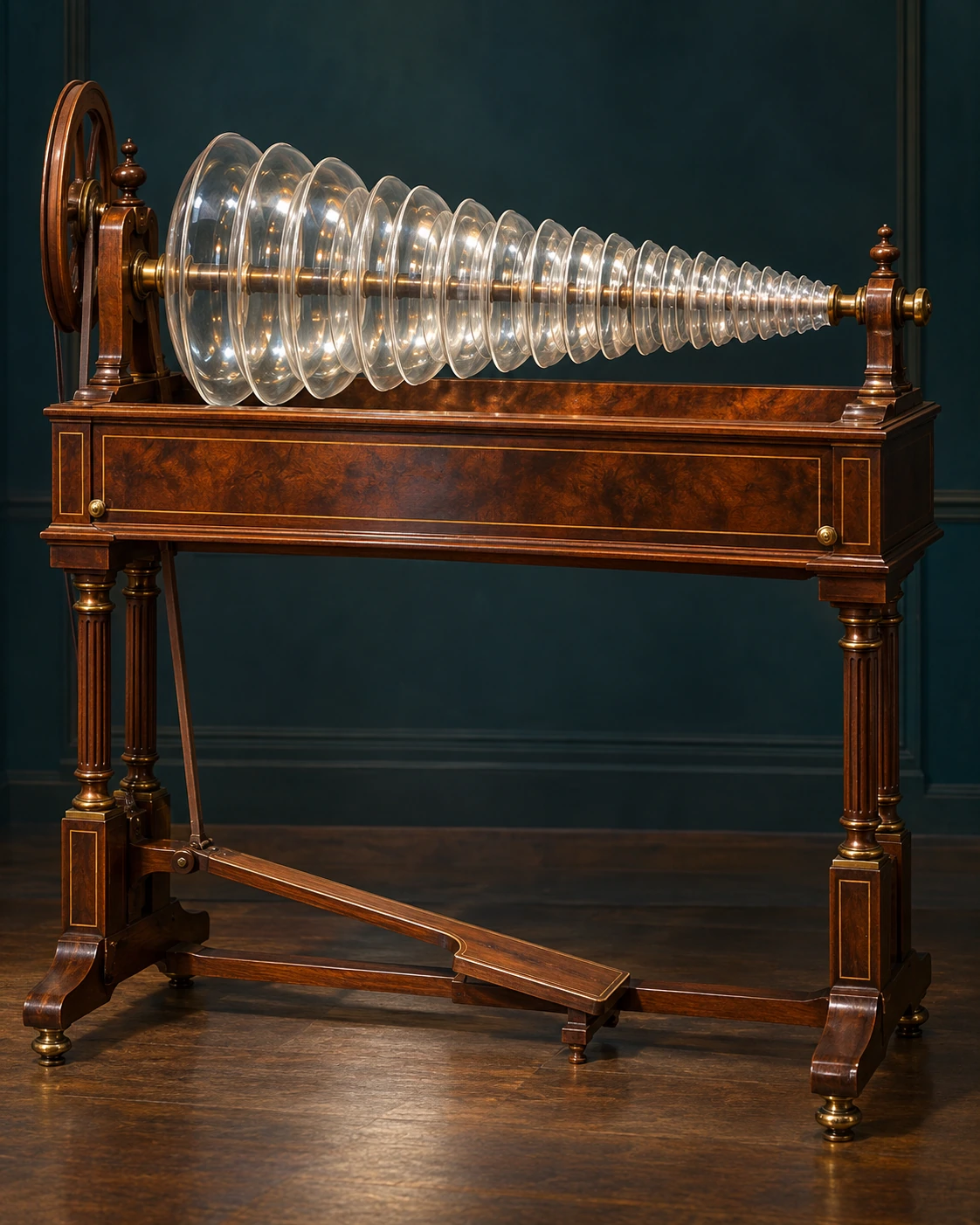
The idea is more revealing than a story about an eccentric invention. The sounding material is still glass, but the player's work has been redistributed. Feet can supply the continuous rotation. Fingers can concentrate on choosing rims and shaping contact. A design can transform an activity by moving the object rather than asking the user to move farther.
Where the note lives
The Franklin Institute's instrument account describes bowls made to different sizes and thicknesses so that each sounds its intended note without being filled with tuning water. A pedal rotates their shared rod. Moistened fingers touch the rims to produce sound.
Separate two roles that are easy to mix together. Water in a familiar musical glass can help determine its vibrating behavior. Moisture on a player's finger helps the frictional interaction at a rim. “It uses water” is therefore too vague to explain how a particular instrument is tuned or played.
For a paper exercise, sketch six separate circles across a table, then imagine reaching three nonadjacent rims at once. Redraw the circles as six nested arcs with exposed edges. You have changed the reach problem even though the number of notes is unchanged. The sketch is a design comparison; it is not a fabrication plan, and the real instrument depends on carefully made glass.
The surviving object may have more than one date
The Corning Museum of Glass's armonica has bowls dated 1818–1830 and a wooden case possibly made in the 1930s. Its record names non-lead glass among the materials. A single museum object can therefore carry the history of making, repair, and later support rather than one simple birthday.
Look at a historic instrument as an assembly. Which parts make sound? Which parts hold those sounding parts? Which parts let a player reach them? If two components have different dates, the object may tell two different stories. The museum record helps prevent a beautifully coherent display from hiding that complexity.
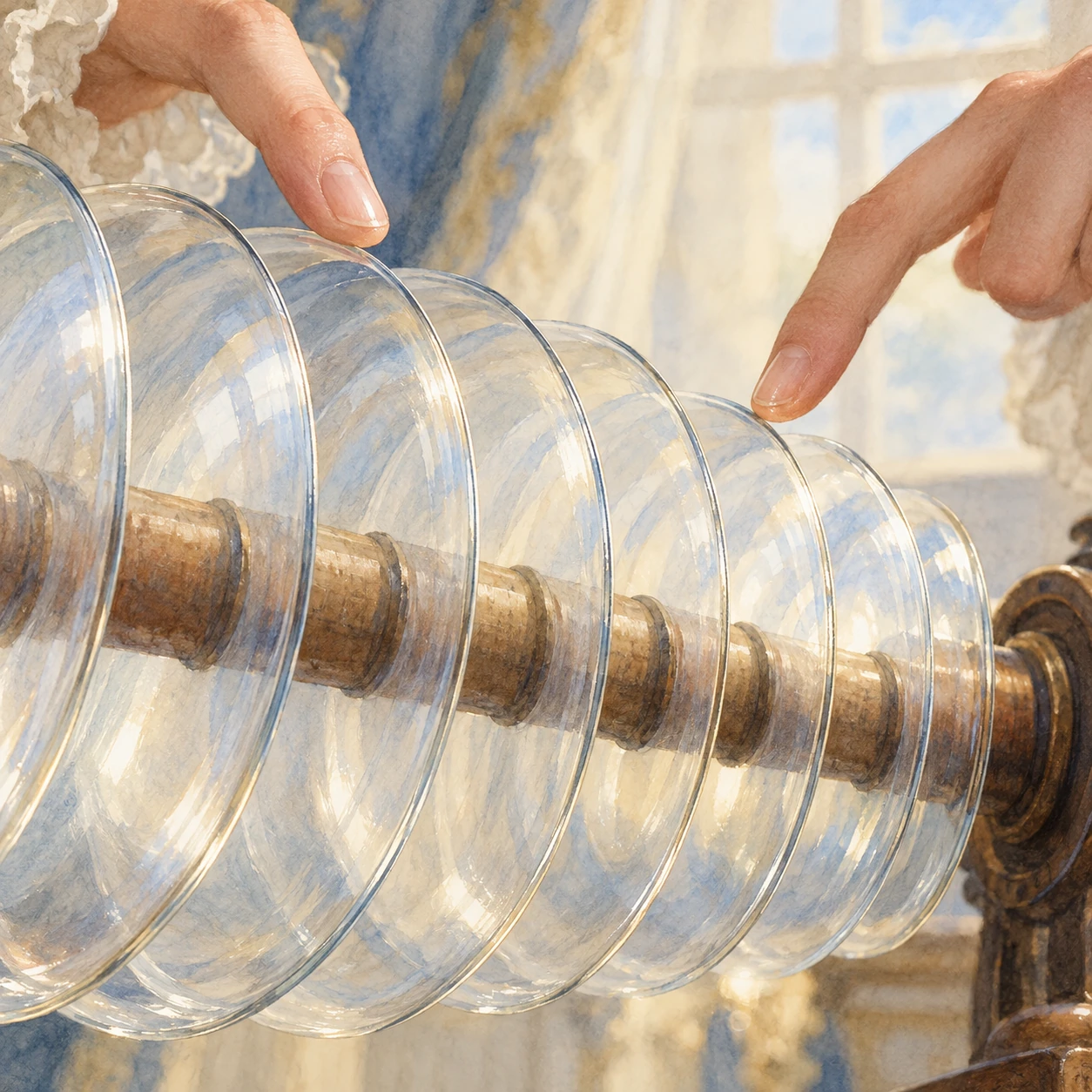
In the detail illustration, the visible rims and gaps are the important features. Their appearance suggests how fingers might choose neighboring notes. The image cannot tell you a bowl's pitch, glass composition, or date; those require a physical object or a documented collection record.
A foot pedal is one answer, not the definition
The National Music Museum's glass armonica uses a crank rather than a treadle to rotate the spindle. That difference makes a good comparison question: how does the source of rotation affect a player's available hands, a helper's role, or the continuity of a phrase?
Do not infer the complete performance practice from the crank alone. Instead, treat it as evidence that the instrument family supports variations. A label that says “glass armonica” does not erase the maker's choices about how movement reaches the bowls.
Visit the three collection records as a design detective
Make three columns headed sounding glass, rotation, and support. Add only features explicitly visible or stated in each record. Use a question mark where the angle hides something. Then choose one difference worth investigating. This gives you a stronger comparison than assuming that the oldest-looking example must represent every later version.
Listen for a beginning
If a museum or performer provides a demonstration, follow one sustained note from its first audible moment to its release. Listen for whether the sound begins abruptly or grows into place. Next listen to a change between notes. Is the continuity mainly in the tone, in overlapping notes, or in your attention?
Those are useful listening categories even when the instrument's texture makes the answers uncertain. You need not identify a famous composition or know how to read music. Your task is to hear the contact becoming a phrase.
Notice which rim a fingertip can reach without crossing another hand. A compact arrangement offers opportunities, but it can also create decisions about fingering. Imagine holding one note while reaching its neighbor. The design question has moved from finding room on a tabletop to navigating a closely spaced set of edges.
The armonica is often surrounded by dramatic historical rumors. The objects themselves offer a better starting point: glass carefully shaped, a spindle kept in motion, and a hand negotiating a luminous set of edges. The remarkable part is the small practical rearrangement that makes a much larger musical possibility available.
Sources and further exploration: Franklin Institute: the glass armonica; Corning Museum: a composite surviving instrument; National Music Museum: a crank-driven example.
Explore all 50 new articles · Browse the complete illustrated collection
Explore more art, ideas, and independent projects at Incoprea.