The pianist's hands have left the keyboard, but the keys continue moving. A paper roll passes over a tracker bar inside the instrument. The result feels like a musician has become a readable pattern of holes. That impression is powerful—and incomplete.
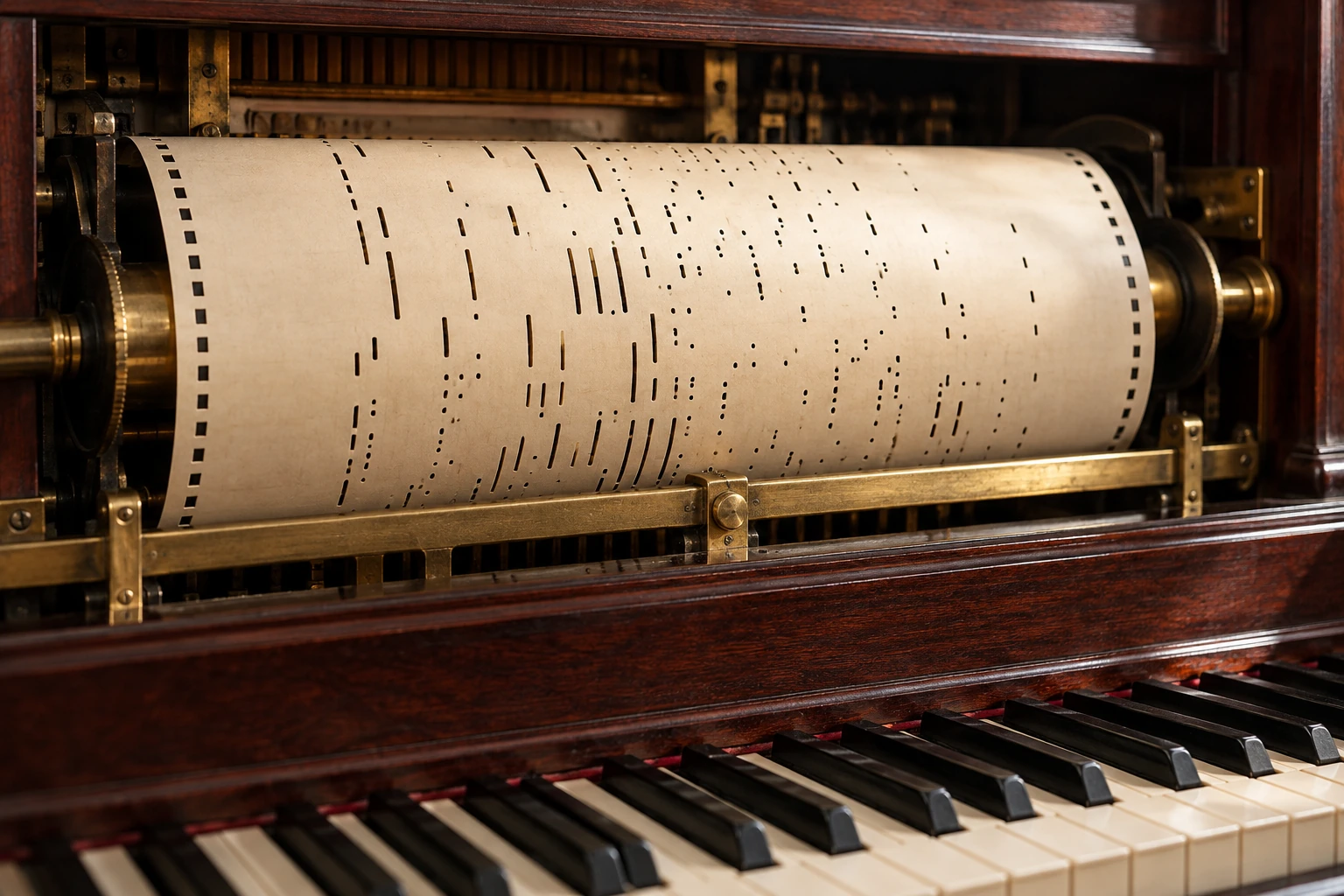
A reproducing piano offers a fascinating kind of recorded experience because the final sound is made again by a physical piano in the room. A roll does not contain the air pressure waveform of an earlier concert. It contains information that a compatible mechanism turns into actions. To understand what survived, we need to ask what the instructions actually describe.
Start by reading across and along
The Automatic Musical Instrument Collectors' Association distinguishes regular, expression, and reproducing player pianos. Extra control channels can separate a more elaborate system from a regular player. A neat rectangle of perforated paper is therefore not enough to identify how much musical behavior it carries.
Imagine a roll moving steadily downward. One direction across the paper selects channels; distance along the paper relates to when an event reaches the reader. A longer opening can maintain an instruction for longer than a short one. This is a conceptual way to read a roll, not a decoding chart for any particular brand.
Draw four vertical lanes on scrap paper. Mark a short event in lane one, a longer event in lane three, and two simultaneous marks across lanes two and four. Someone can now recover a small sequence without seeing you perform it. They still do not know whether you wanted it whispered, hammered, rushed, or hesitant. A useful recording system has to decide which of those distinctions to encode.
Expression is an additional problem
The Player Piano Group's account emphasizes that reproducing mechanisms and rolls aim to recreate the effect of a performance. It also describes the production roll as a collaboration between recording artist and editor. The finished artifact should not be mistaken for an untouched fingerprint of a pianist's fingers.
That is not an automatic argument against its value. Editing is part of many recording practices. It does mean that the question “Did the pianist really play this?” may be too broad. Which aspects were captured during playing? Which were adjusted? What could the playback mechanism deliver? Those questions make the artifact more legible.
Consider your four-lane drawing again. Add a separate strip that says “gentle,” then “strong,” then “gentle.” That strip changes the interpretation of several notes at once. It does not necessarily store independent force for every simultaneous note. The analogy exposes a distinction between global or grouped control and note-by-note measurement; it is not a historical specification for Ampico, Duo-Art, or Welte.
The piano is part of the playback chain
In technician John Tuttle's discussion of reproducing rolls, extra expression holes operate mechanisms that ordinary player pianos lack. He also warns that the same roll can sound different on different instruments. Their regulation, timing, and individual musical character matter to the result.
Picture the same instructions given to two different performers, or the same recipe made in two different ovens. The directions constrain the outcome without becoming the whole outcome. A reproducing piano adds a similar interpretive layer through its mechanical and acoustic condition. A video labelled with a famous pianist's name is also a recording of a particular playback event.
Three questions to bring to a roll demonstration
First, can the presenter identify the roll system and compatible piano? Second, is the sound from an actual roll-driven piano, a MIDI conversion, or a sampled instrument? Third, what restoration or expression emulation was involved? A missing answer does not make the demonstration worthless. It tells you which claims you can safely make about it.
Preservation can separate holes from interpretation
AMICA's roll-scanning archive preserves information about scanning technology and conversion to MIDI. A scan, a decoded file, and an expressive playback are related stages. Keeping the stages distinct helps future researchers revisit an interpretation without losing the underlying pattern.
For a small listening project, choose one short historical piece represented in both a roll playback and a conventional recording, if an archive supplies them. Compare only a few bars. Note tempo, relative emphasis, and pauses rather than ranking authenticity by instinct. Record the instrument and source beside each observation. You may discover that an apparent difference in interpretation belongs partly to the playback chain.
The paper roll's wonder is that it can make old instructions act on a living acoustic instrument. Its limitation is equally instructive: a readable code always reflects choices about what deserves a channel. Once you start looking for those channels, the empty spaces beside the note holes become part of the music's history.
Sources and further exploration: AMICA: player-piano categories; Player Piano Group: the reproducing piano; John Tuttle: reproducing rolls and playback limits; AMICA: roll-scanning archive.
Explore all 50 new articles · Browse the complete illustrated collection
Explore more art, ideas, and independent projects at Incoprea.




