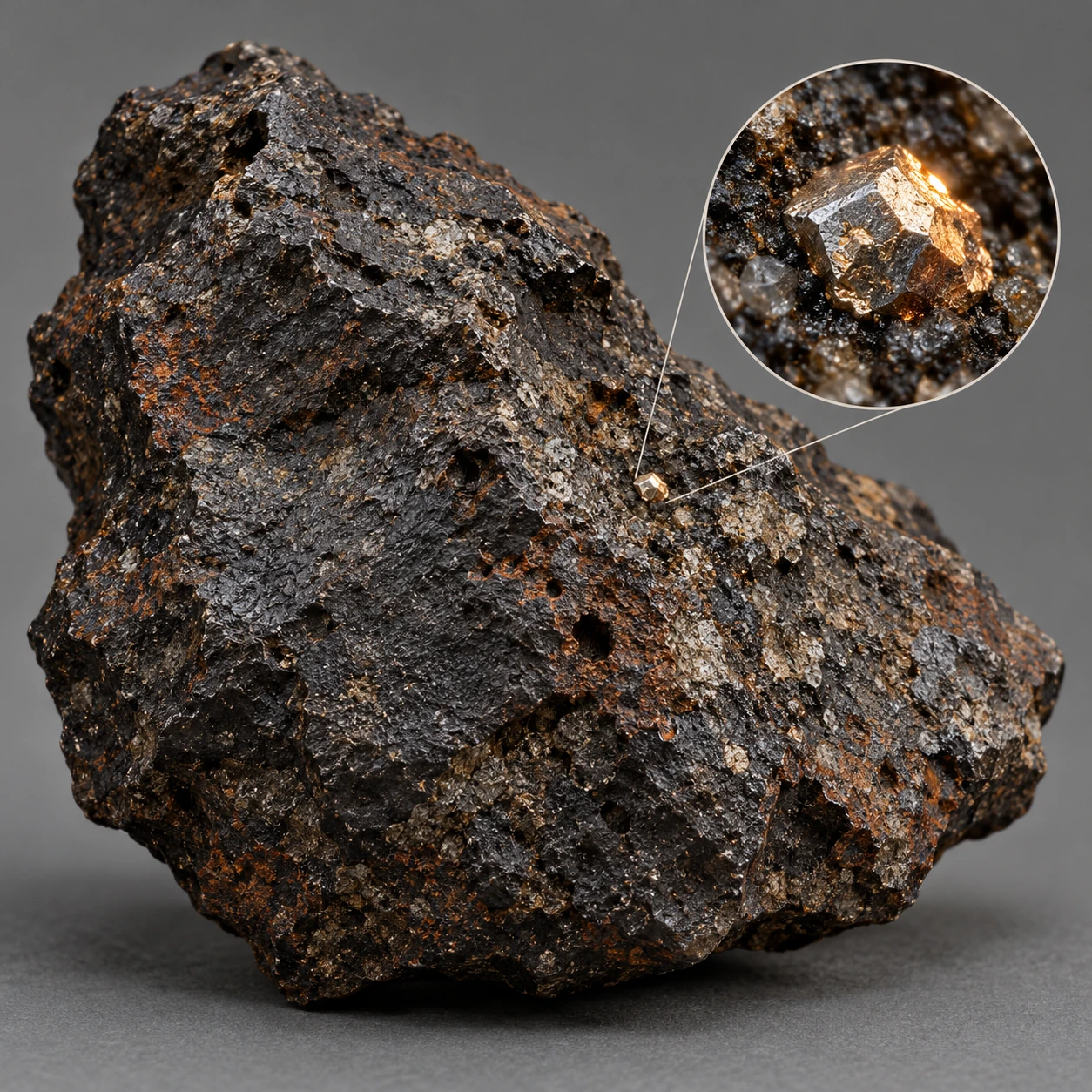
The important object was not a spectacular crystal large enough to hold up to the light. It was a tiny metallic phase inside a much more complicated rock. Its atomic order required instruments to recognize, and its natural origin required a separate investigation.
Those two questions are easy to merge: “Is this a quasicrystal?” and “Where did it form?” They demand different evidence. Diffraction identifies a kind of order. Mineral associations, isotopes and textures help establish the history of the material containing it.
Order does not require a repeating box
Many familiar crystals can be described by a small atomic arrangement repeated through space. Translating the arrangement by an appropriate lattice vector reproduces the same structure. A quasicrystal has long-range order without that ordinary three-dimensional translational periodicity.
It is not halfway between an ordered solid and a random mess. The International Union of Crystallography’s dictionary explicitly includes ordered aperiodic structures in its discussion of crystals. Diffraction, rather than an attractive outer shape, provides a central test.
Sharp diffraction peaks indicate organized spatial correlations. Their arrangement can display symmetries incompatible with a conventional periodic lattice. A fivefold axis, for example, is not allowed as the rotational symmetry of such a three-dimensional lattice. That restriction does not forbid every solid from showing fivefold order.
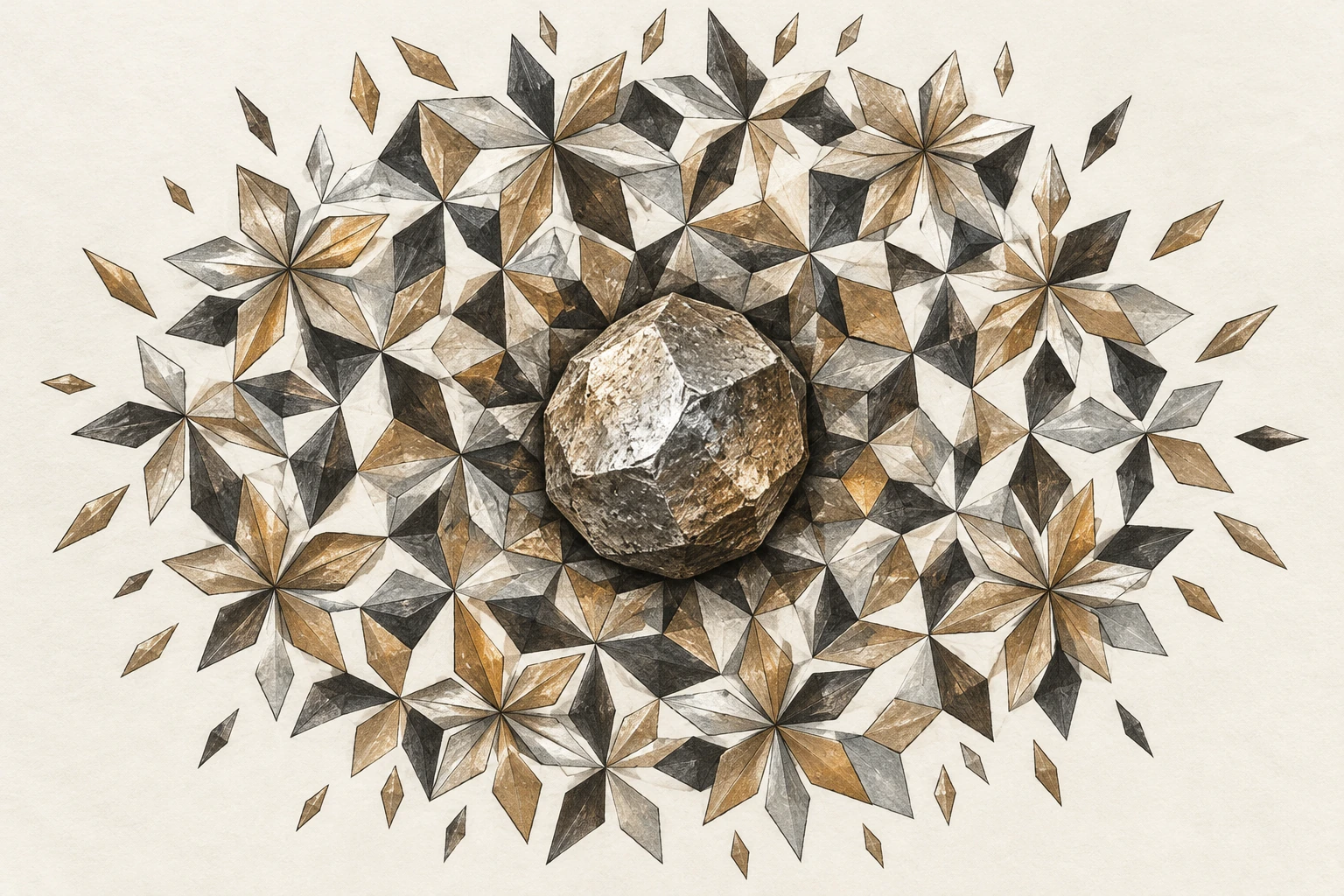
A small geometry exercise helps with the vocabulary. Five equal turns divide a circle into 72-degree steps; ten equal turns divide it into 36-degree steps. These calculations explain the words fivefold and tenfold. They do not prove that a drawn star pattern represents the atomic structure of a material.
Repeated local motifs also do not automatically make an entire arrangement periodic. To claim translational periodicity, a translation must reproduce the whole ideal pattern, not merely place one attractive cluster over a similar-looking neighbor. This is why recognizing a shape and determining a structure are different tasks.
The rock needed its own identification
The first recognized natural quasicrystal, icosahedrite, contained aluminum, copper and iron. The original material was found in a museum collection associated with a locality in far eastern Russia. A museum label supplied a starting point, not a complete proof of origin.
Bindi and colleagues’ extraterrestrial-origin study examined the surrounding minerals and oxygen isotopic compositions. The oxygen measurements aligned with carbonaceous-chondrite material rather than ordinary terrestrial compositions. A high-pressure silica phase, stishovite, provided another significant clue.
Each line answers a different objection. Unusual alloy chemistry by itself might invite suspicion of industrial material. A convincing diffraction pattern would identify the metallic phase without proving its geological setting. Mineral contacts and isotopic measurements connect the phase to a physical sample with an extraterrestrial history.
For readers, the method is transferable. When an extraordinary specimen is announced, separate its identity from its provenance. Ask which measurement establishes composition, which establishes structure and which links it to an origin. A single impressive image rarely performs all three jobs.
Pressure did not act uniformly through the meteorite
A 2014 investigation of Khatyrka meteorite material assembled evidence for an impact shock. High-pressure phases and textures indicated a heterogeneous distribution of pressure and temperature. Some portions reached at least five gigapascals and about 1,200 degrees Celsius under the study’s interpretation.
“Some portions” matters. A meteorite is not necessarily a uniformly heated laboratory block. Local melting, sharp contacts and rapid cooling can leave neighboring regions with different histories. The relevant question is which conditions affected the particular phases being interpreted.
The number five gigapascals is five billion pascals. Its scale is large, but converting it into a familiar comparison would not establish the exact conditions at every microscopic contact. The mineral evidence constrains an event; reconstructing that event still requires a model of how shock, heat and deformation were distributed.
A second symmetry added another test
A 2015 study reported a natural decagonal quasicrystal in Khatyrka material, with aluminum, nickel and iron as its principal constituents. Diffraction showed tenfold order in one orientation and periodic behavior along the stacking direction.
That combination is more specific than calling the grain “nonrepeating.” Different directions can have different structural properties. The study combined chemical analyses, diffraction and microscopy rather than asking a single external shape to prove the result.
Open Figure 2 in the paper, then compare it with the microscopic image associated with the sampled fragment. The first useful distinction is between an image of material and a pattern of scattered radiation. They are different views of evidence, with different axes and scales.
Next locate the direction with tenfold symmetry and compare the perpendicular views. Finally read which composition was assigned to that particular fragment. This short sequence ties the striking symmetry to a measured piece of matter instead of treating it as an isolated geometric ornament.
Could an impact actually make the phase?
Asimow and colleagues’ 2016 shock-recovery experiment tested whether a high-speed impact could synthesize a quasicrystalline phase from selected starting materials. The recovered sample contained microscopic quasicrystals at boundaries involving an aluminum–copper material, olivine and the steel chamber.
The experiment established a plausible synthesis route under controlled shock conditions. Its alloy composition included elements contributed by the experimental setup and did not simply duplicate every feature of the natural specimen.
Reproducing a mechanism is different from replaying a unique historical event. The authors explicitly left questions about the roles of high-pressure stability and favorable reaction kinetics. The experiment narrowed the physical possibilities without turning the meteorite’s entire history into a solved film.
There is no need to describe quasicrystals as impossible. The more interesting story is how an expanded understanding of order met a difficult natural sample. Structure measurements established what was present; provenance evidence located it in a meteorite; impact studies explored how it could form. Keeping those achievements distinct shows how much a tiny grain can reveal.
Sources and further exploration
- IUCr Online Dictionary: Crystal
- Bindi and colleagues: Evidence for an extraterrestrial natural quasicrystal
- Hollister and colleagues: Impact shock and natural quasicrystal formation
- Bindi and colleagues: Natural quasicrystal with decagonal symmetry
- Asimow and colleagues: Shock synthesis of quasicrystals
Explore all 80 new articles · Browse the complete illustrated collection
Keep exploring at Incoprea.




