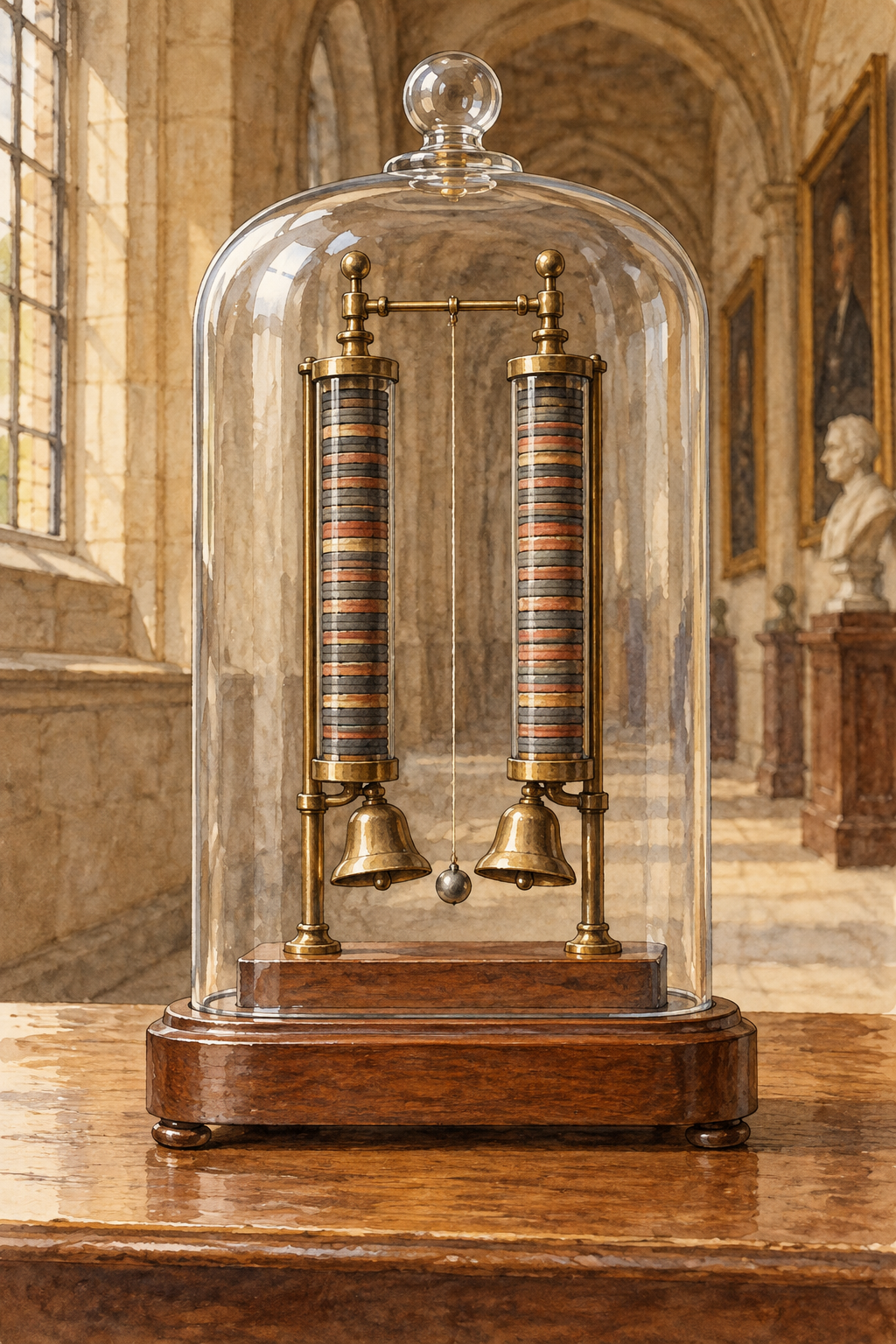
Two little bells, a suspended metal sphere and a pair of old batteries form one of the most memorable long-running experiments in physics. The Oxford Electric Bell, also called the Clarendon Dry Pile, is famous for an almost continuous history beginning with its recorded installation in 1840.
Its appeal is easy to understand. We are accustomed to batteries becoming exhausted. Here, a modest apparatus demonstrates what an extraordinarily small demand on stored energy can make possible.
A clapper carried by electric forces
The device uses two dry piles connected to the bells. A small metal sphere hangs between them. When it touches one bell, it receives charge; electric forces then help move it toward the other bell, where its charge changes and the motion reverses.
The clapper's motion is therefore an electrostatic process. It does not require a motor continuously turning a heavy mechanism. Only a tiny amount of charge is transferred on each movement, and the work associated with the gentle motion is correspondingly small.
Oxford's archive describes a sphere about four millimeters across and a motion frequency of roughly two oscillations per second. Those dimensions belong to a deliberately light task, which is central to explaining the device's longevity.

The batteries remain part of the mystery
The archive records Robert Walker's purchase and his handwritten installation label. A later note suggested the apparatus might have been built earlier. The distinction between manufacture and installation is small but useful when telling its history.
The precise internal construction of the dry piles remains uncertain. Oxford compares them with contemporary devices that used alternating metal foil and coated paper. Their insulating sulfur covering and the desire to preserve the experiment limit how casually investigators can examine the interior.
That uncertainty should not become a story about secret limitless energy. The general operation is understood. What is less certain is the exact construction and condition of these particular historical batteries.
Long-lived is different from perpetual
The bell is sometimes presented as a perpetual-motion curiosity. It is better understood as a stored-energy system doing very little work each time. The batteries have finite resources, and mechanical wear can also matter.
Almost continuous operation is not the same claim as never pausing. Historical accounts use qualified wording, and a description of its long record should not pretend to be a live measurement of the apparatus at this moment.
The protective glass also changes what a visitor experiences. Oxford's account notes that the clapper can be seen while the sound is muffled. A famous bell may be more compelling as a visible motion than as a ringing noise.
Its broader lesson is about matching a power source to a task. Instead of demanding more energy, the apparatus asks for very little. That makes an old pair of batteries a quietly effective example of how scale, efficiency and patience can turn ordinary physics into an extraordinary record.
Sources and further reading: Oxford Physics: Clarendon archive highlights; A. J. Croft: The Oxford electric bell.
Explore more creative curiosity at Incoprea.