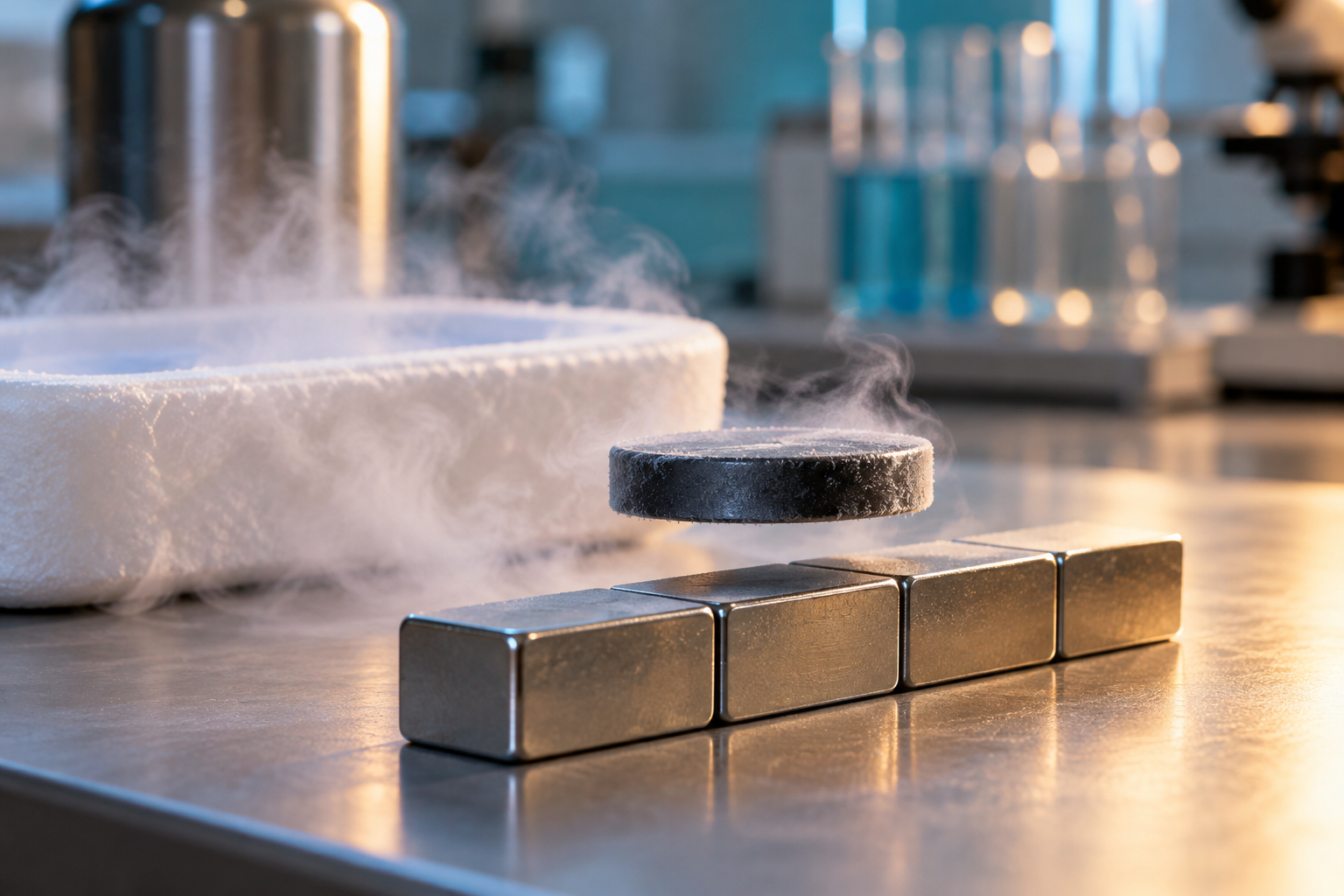
A small disk floats above a magnetic track, visibly separated from its support. It can look like a trick, particularly when the disk remains stable instead of sliding sideways. A superconducting levitation demonstration makes an invisible electromagnetic interaction unusually easy to see.
The cold vapor around the apparatus is a clue. Such demonstrations typically use materials cooled below their superconducting transition temperature. The hovering object does not show that superconductivity works at ordinary room temperature.
Cold changes the material's behavior
Superconductors have remarkable electrical and magnetic properties under suitable conditions. Below a critical temperature, they can carry current without ordinary electrical resistance. Their response to an applied magnetic field is also central to levitation.
The phrase “high-temperature superconductor” is relative. Some materials can operate at temperatures accessible with liquid nitrogen, around minus 196 degrees Celsius, rather than requiring colder liquid-helium conditions. That is high compared with many earlier superconductors, but extremely cold by everyday standards.
Temperature is not the only limit. Applied magnetic field and current also matter. A working material must remain within the conditions that support its superconducting state.
Stability involves more than repulsion
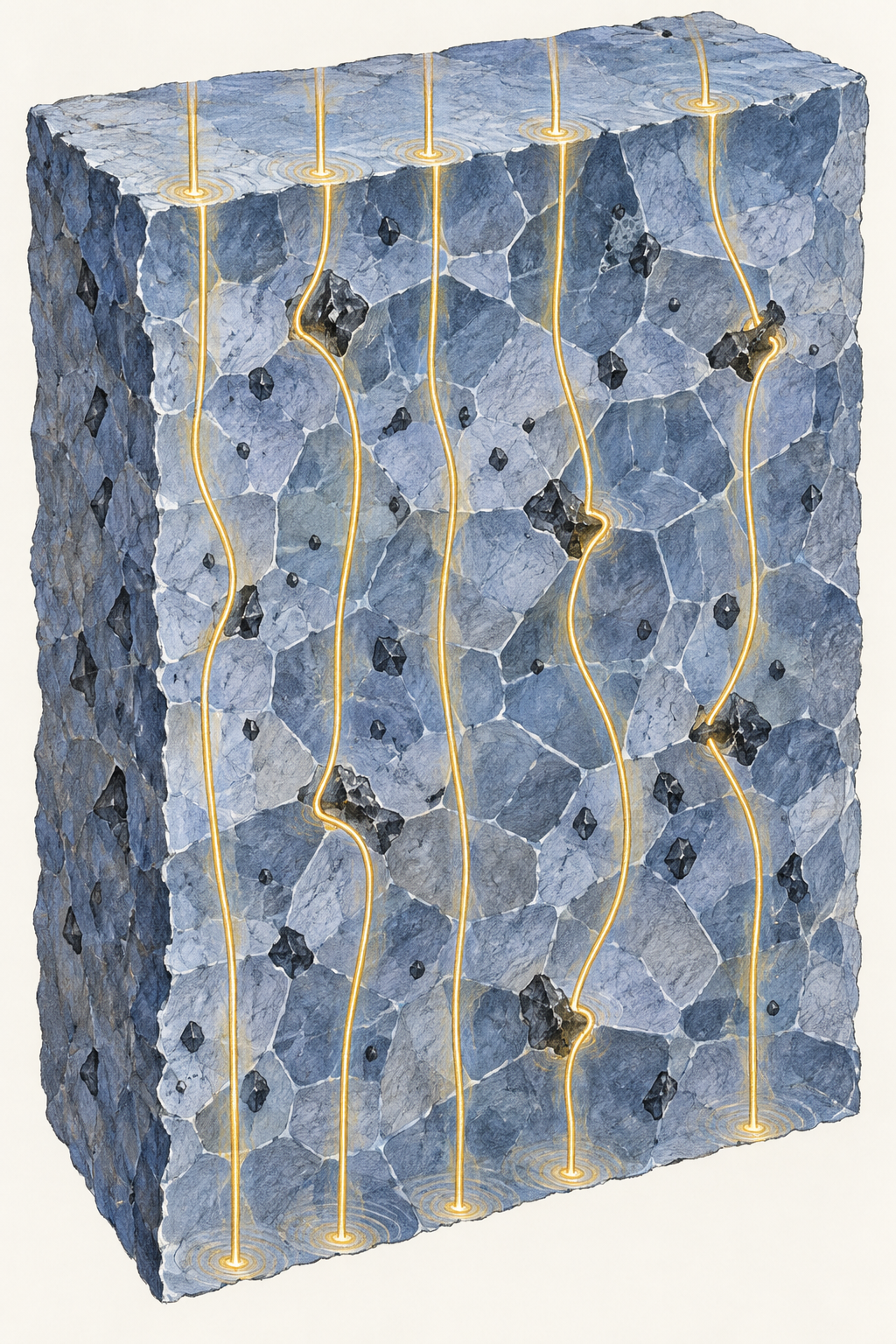
A simple explanation says that the superconductor pushes magnetic field away. Magnetic flux exclusion, associated with the Meissner effect, is important to superconductivity. But the stable demonstrations commonly using type-II materials involve an additional process called flux pinning.
In these materials, magnetic flux can enter in quantized vortices under suitable conditions. Defects and other features can impede their movement. That interaction can resist changes in position relative to a nearby magnet, allowing both levitation and suspension configurations.
Cambridge's Bulk Superconductivity Group explicitly distinguishes this pinning-based behavior from describing the whole demonstration as merely the Meissner effect. The terminology matters because the stability is part of what needs explaining.
A useful effect with practical costs
Researchers investigate superconducting bearings and other systems that use magnetic support to reduce mechanical contact. A well-designed arrangement can let an object rotate or move along a track while constraining unwanted sideways movement.
Low contact friction does not mean a system has no energy losses. Air resistance, imperfect magnetic fields and the requirements of cooling remain relevant. A compelling demonstration is the beginning of an engineering discussion, not proof of an effortless perpetual machine.
Keeping the material cold is particularly important. As conditions move outside the superconducting range, the magnetic behavior changes. The cooling arrangement therefore belongs to the explanation rather than being an incidental prop beside it.
The appeal of the hovering puck is that it makes a complicated material state visible through a simple gap. What looks like an object refusing gravity is an object supported by another force. The more interesting achievement is arranging that force so that the floating position remains stable.
See the effect in motion: Cambridge’s superconducting platform videos show a larger engineering demonstration of stable magnetic support.
Sources and further reading: Cambridge Bulk Superconductivity Group: Levitation and flux pinning; Cambridge: Trapped magnetic fields and cooling temperatures; Cambridge: Levitating trains and engineering principles.
Explore more creative curiosity at Incoprea.