From a distance, the panel can look like a few great blocks of blue and yellow. At the edge, the image breaks into thousands of small feathers. Each one belonged to a bird; each had to be obtained, selected, arranged, and secured. A broad field of color becomes a record of extraordinary material coordination.
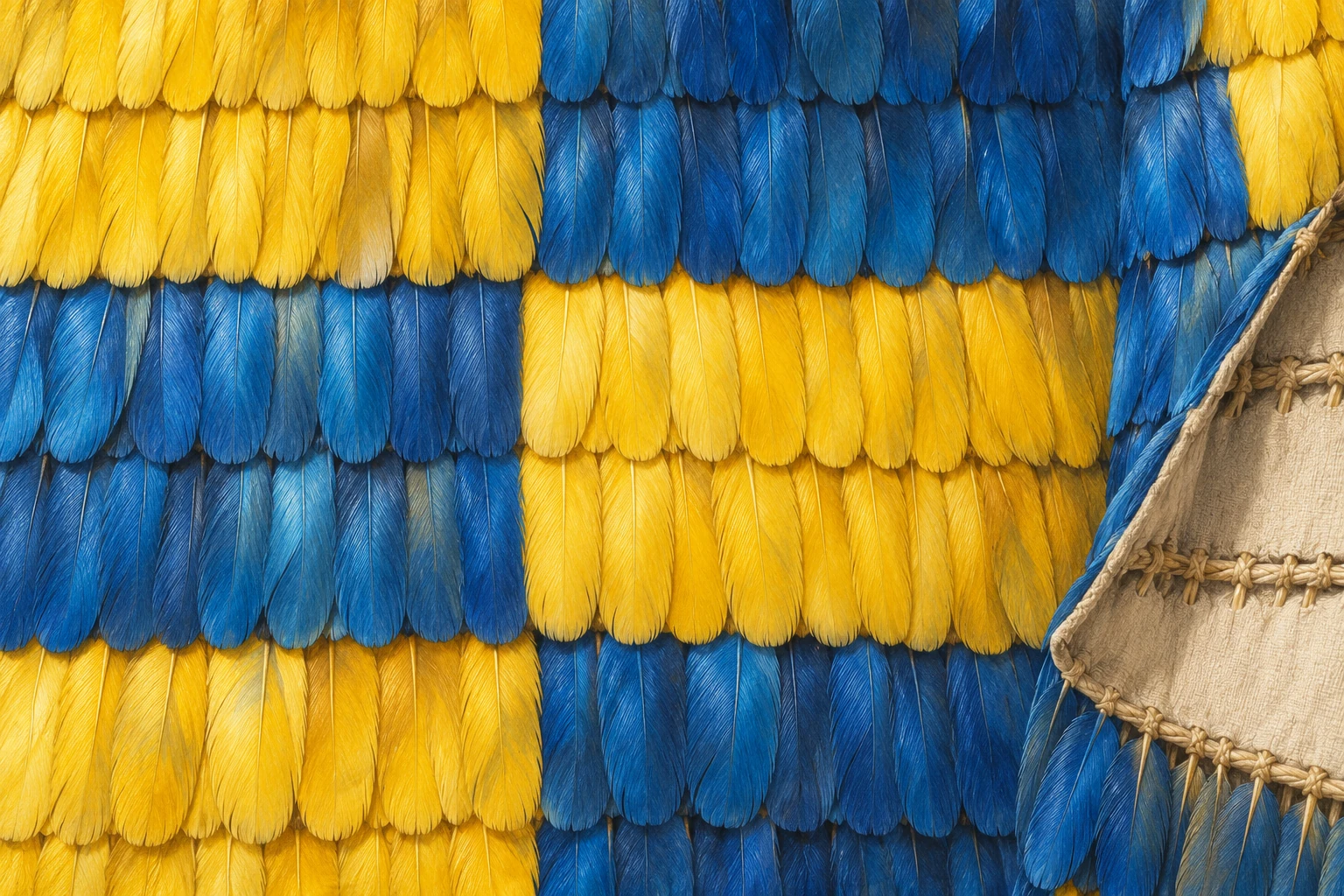
Wari feather panels from Peru are often described as spectacular, but scale alone does not explain their fascination. The work joins textile structure, the surfaces of feathers, long-distance connections, and a preservation history that still leaves important questions unanswered.
A dry find containing rainforest materials
The Metropolitan Museum’s Feathered Panel, 1979.206.472, is dated 600–900 CE and cataloged as feathers on cotton with camelid hair. Its account describes a cache of roughly 96 panels discovered in the Churunga Valley region in 1943. Rolled panels inside large ceramic jars survived in arid soil.
The museum identifies many feathers as those of blue-and-yellow macaws, birds of the Amazonian rainforest east of the Andes. The materials therefore connect the dry find region with a very different environment. They do not, on their own, reveal whether every exchange involved live birds, feathers, or several stages of movement.
That distinction matters because the labor begins before the visible sewing. Obtaining an enormous supply is a practical achievement in its own right. A finished rectangle makes that dispersed work look concentrated and effortless.
The pattern is built through strings and rows
The Met’s Feathered Walls exhibition explanation describes horizontal strings of feathers attached to the textile. On multicolored panels, strings were cut where colors changed along the vertical axis. The arrangement supports the conclusion that feather workers followed a predetermined design using strings of selected colors.
This is a different process from painting a blue rectangle onto a yellow ground. The colored surface has depth, direction, and overlapping components. A seam or a color boundary can reveal the sequence of assembly more clearly than the center of a broad uninterrupted field.
Look at the panel as a set of nested scales: individual feather, row, colored block, whole textile. Each scale has its own order. The large design succeeds because many small alignments cooperate.
Uniformity is evidence, but function remains a question
The Met’s Weaving Abstraction publication places the panels within the wider diversity of Andean textile construction and discusses their striking regularity. Standardized forms invite questions about organized production, shared designs, and the coordination of materials and labor.
The panels’ cords suggest attachment to some structure, but the Met’s object record explicitly leaves their actual function unresolved. “Probably hangings” is a reasoned possibility, not permission to invent the room, ceremony, owner, and arrangement in which they were used.
Heidi King’s re-examination of the Corral Redondo context also reminds us that the discovery itself required historical research. An object’s find story can become fragmented as material is dispersed and later accounts accumulate. Reconstructing that story is part of understanding the artifact.
The Wari world was larger than this one medium
The Cleveland Museum of Art’s Wari exhibition places the society broadly between 600 and 1000 and presents ceramics, ornaments, sculpture, and garments together. The feather panels belong within that wider material world. They should not become a single exotic image standing in for every aspect of Wari life.
Likewise, Wari and Inca are not interchangeable names for ancient Peru. Keeping the cultural attribution and date attached to a panel lets the reader appreciate a history that precedes the better-known Inca Empire.
A counting exercise that changes the view
Draw a modest paper rectangle and divide it into 12 rows. Put 20 short marks in each row. You have made 240 units. Now imagine that each unit requires one small decision about placement and orientation. Repeat the rectangle ten times: 2,400 decisions about individual positions, before considering how material is collected or how the backing is made.
These numbers are an illustrative exercise, not a count of feathers in a particular Wari panel. Their purpose is to make repeated labor perceptible. A great block of color can conceal an immense number of small actions.
Now change color at the same vertical line in every row. Notice the attention needed to preserve a clean boundary while building horizontally. The exercise helps explain why the museum’s observation about strings being cut at color changes is such a valuable construction clue.
Try hiding all but a small area of the institutional photograph with two sheets of paper. Study the direction of individual feathers, then uncover the whole panel. The shift reveals how local orientation contributes to a broad field of color. A catalog’s flat color description can be accurate while still missing this patterned play between many small surfaces.
Look at the edge, then move back
In a museum image, begin with the edge where feathers meet the textile or a cord. Describe what the image allows you to see: overlap, density, row direction, the relation between the soft surface and the supporting fabric. Avoid filling invisible details with a guessed stitch pattern.
Then move back to the whole composition. The abstraction may feel almost modern, but that reaction belongs to our act of looking. It is more useful to ask how the ancient work organizes its materials than to praise it mainly for resembling a later art movement.
If viewing the panel with someone else, compare what each of you notices first. One person may see geometry; another may see the memory of a bird’s body. Both observations can lead toward the making, provided they remain separate from claims about an undocumented original meaning.
The panel’s surface is an achievement of repeated care. Its broad colors hold together because countless small elements were brought into relation. At the edge, where the apparent simplicity opens into construction, the object becomes even more astonishing.
Sources and a closer look
The Met: Feathered Panel 1979.206.472; The Met: Feathered Walls; The Met: Weaving Abstraction; Heidi King: Corral Redondo context re-examined; Cleveland Museum of Art: Wari, Lords of the Ancient Andes.
Find more art, ideas, and unexpected connections at Incoprea.