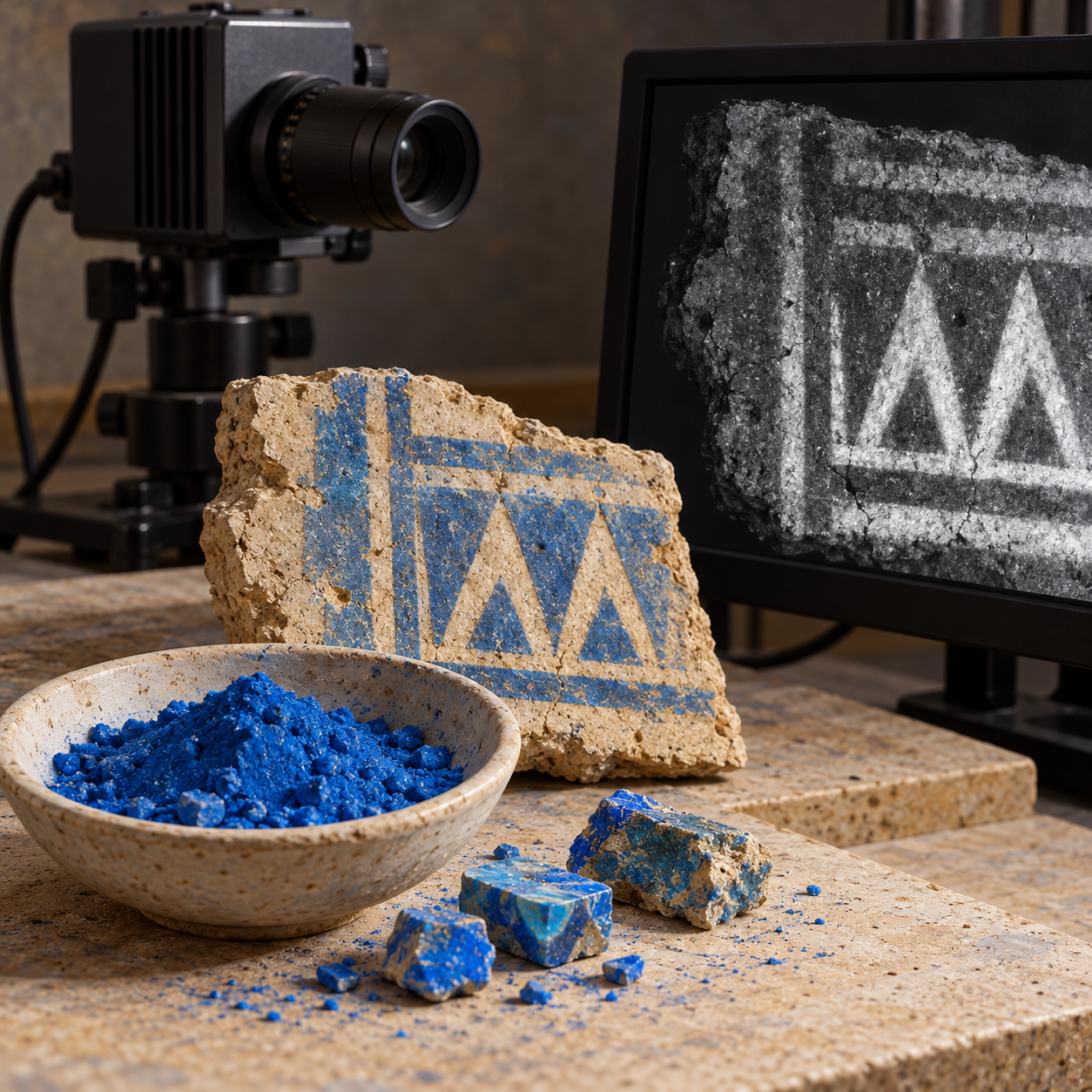
A patch of Egyptian blue can look like an ordinary fragment of old paint. Under the right examination, it sends a second signal that our eyes cannot see. Illuminate this ancient pigment with visible light and it can emit near-infrared light, allowing a specially equipped camera to detect traces that seem almost absent.
Blue made by people
Egyptian blue is a synthetic calcium copper silicate pigment, also known by the mineral name cuprorivaite. Ancient craftspeople produced it through high-temperature processing rather than simply grinding a naturally blue stone. It is commonly described as the oldest known synthetic pigment.
The name does not mean that every occurrence is Egyptian. The material circulated widely, and it has been found in painting and objects from different parts of the ancient Mediterranean. Its visible shade can vary with factors including the size of the pigment grains.
That distinction between a material and a color is useful. Two blue surfaces may contain different pigments, while a surface containing Egyptian blue may not look blue at all if the material was mixed sparingly with other colors.
A camera notices what an eye misses
The method called visible-induced infrared luminescence, or VIL, takes advantage of the pigment's characteristic response to illumination. The emitted near-infrared light can be recorded with suitable imaging equipment. In an analytical image, it may be displayed as bright areas against a dark background.
This is not an ancient paint that glows blue in the dark. The emission is outside ordinary human vision, and the image is a way of presenting a measurement. The difference matters: the exciting effect occurs in the examination, not as a visible magical shine on the artifact.
British Museum researchers have used the technique to detect remnants of Egyptian blue on the Parthenon sculptures. Those small surviving traces help investigate surfaces whose original painted appearance has largely been lost.
The blue hiding in a face
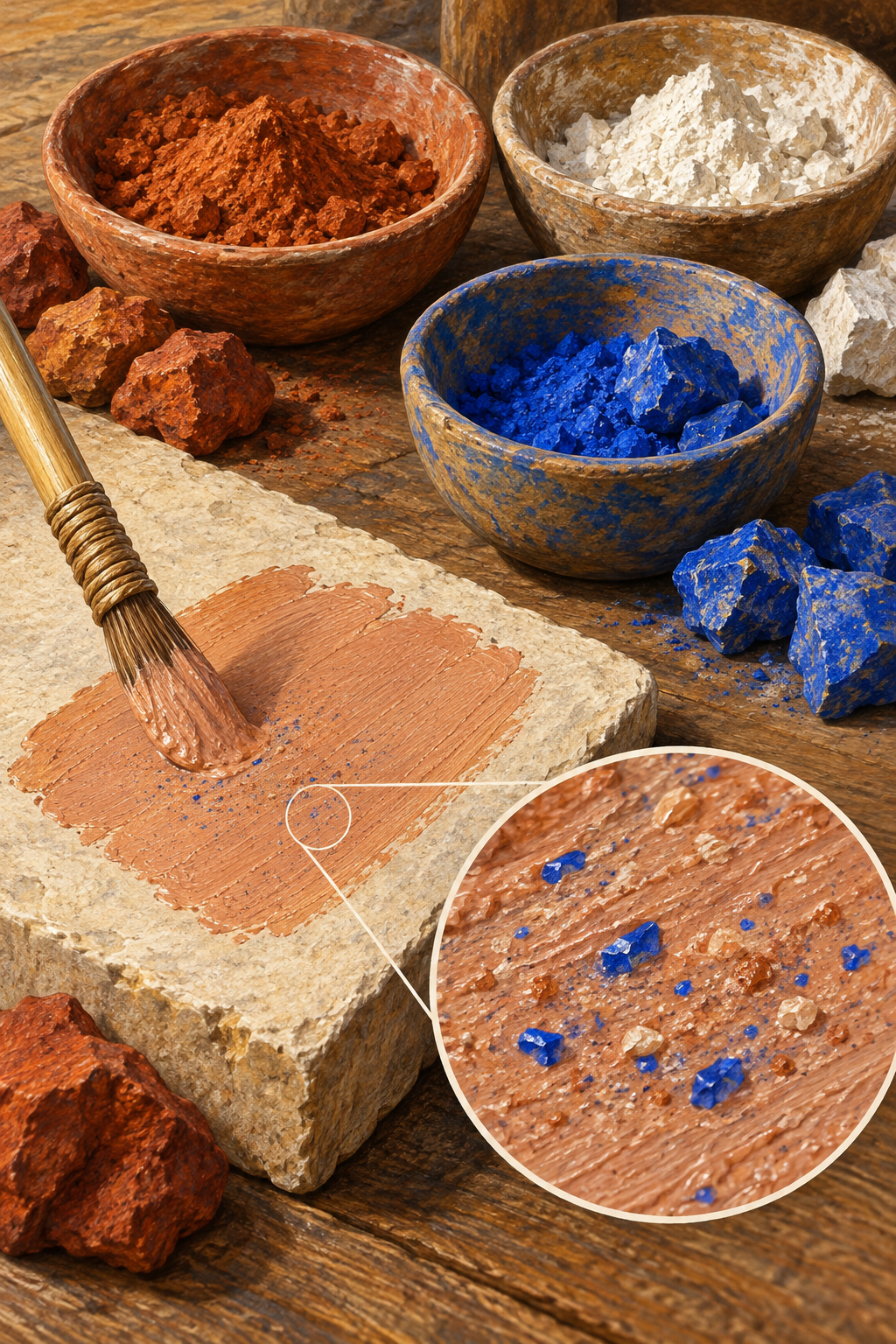
Research published by the Getty describes another surprising use in a Roman Egyptian portrait. VIL and complementary elemental mapping revealed Egyptian blue in parts of the sitter's face and neck. In some areas it helped modulate flesh tones even where an obvious blue hue could not be seen.
This turns pigment detection into evidence about artistic decisions. A painter could mix a small amount into another color for a subtle visual effect. Modern viewers who search only for bright blue patches might miss that skill.
The strongest interpretation combines techniques. Luminescence can locate a characteristic response, microscopy can examine particles, and elemental analysis can add information about composition. Each observation narrows the possibilities.
Egyptian blue connects two kinds of looking: the artist's sensitive handling of color and the scientist's ability to detect a signal beyond sight. A tiny grain of pigment can preserve both a material recipe and a clue to how a brush once moved.
Sources and further reading: Getty: Egyptian blue in Roman Egyptian portraits; British Museum: paint and the Parthenon; Getty: elemental mapping and luminescence imaging.
Find more art and unexpected ideas at Incoprea.