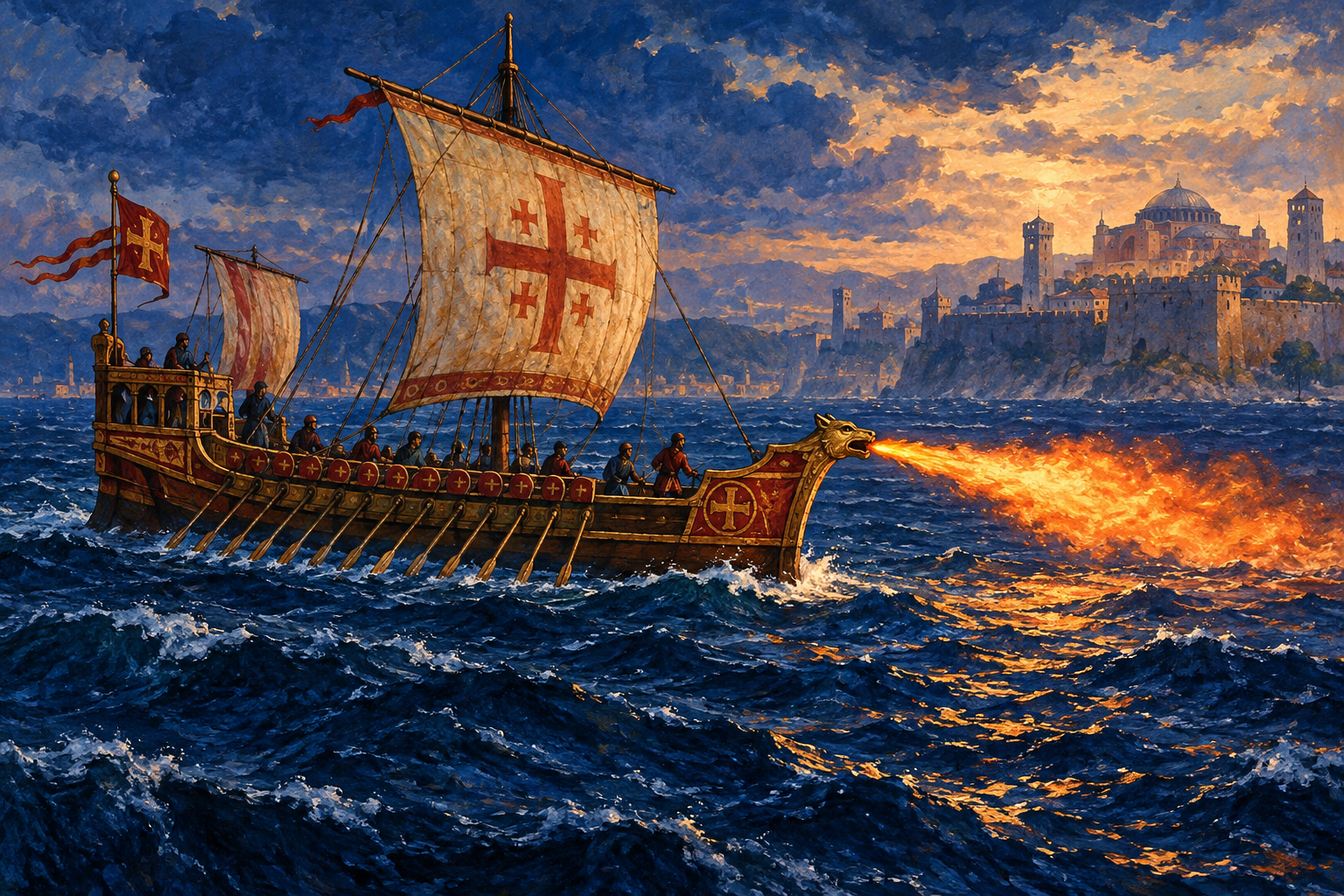
A flame reaching from the prow of a ship is an image that almost explains itself. The enemy vessel is close, the fire crosses the gap, and the outcome seems inevitable. Medieval pictures of Greek fire are memorable partly because they compress a complicated naval system into that one bright moment.
Expand the frame and the historical questions multiply. A combustible material needed ships, equipment, trained people and conditions in which it could be used. The lost recipe is an intriguing problem. The organisation around it is equally important to understanding why the weapon mattered.
Put the ship back into the story
The Byzantine dromon was an oared warship used within a developing naval tradition. Historian John Pryor studies its equipment together with the fleets and military setting in which it operated. A ship was a platform for specialised work, not merely a container transporting a remarkable substance.
Consider what a successful naval action implies at the broadest level. Equipment has to be supplied and maintained. Operators have to recognise the conditions and coordinate with the crew. The vessel must reach an effective position while remaining able to manoeuvre. None of these requirements is contained in an ingredient list.
The distinction is familiar in less violent technologies. Possessing ink does not establish a printing workshop. Knowing the composition of a pigment does not preserve a painter's training. A useful material becomes an effective practice through tools, procedures and people who know how to use them.
Follow one picture into its manuscript
The Madrid Skylitzes contains a famous scene in which Byzantine ships set fire to the vessels of Thomas the Rebel. The National Library of Spain identifies the image as folio 34v in its study of the manuscript. The scene is often detached from its page and circulated as if it were a technical drawing.
The manuscript itself was produced in twelfth-century Sicily and illustrates an account of earlier Byzantine history. The difference between the pictured event and the making of the picture matters. It is evidence of how that event was represented within a later illustrated chronicle.
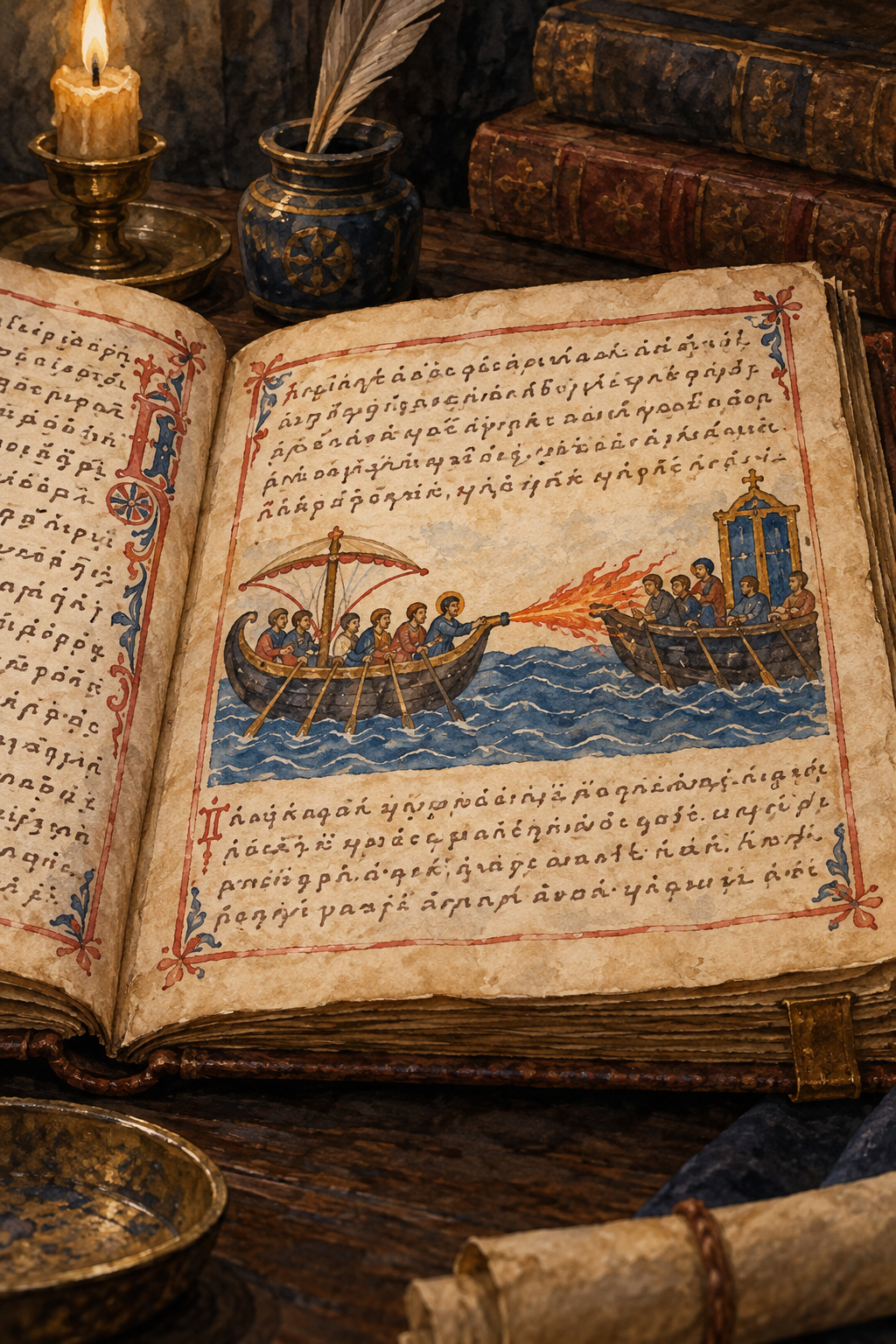
The interpretive page illustration here evokes that kind of source; it is not a facsimile. For the genuine manuscript, follow the National Library's catalogue and exhibition resources. The page around a miniature can tell you how the image belongs to a narrative.
Try a close-looking exercise with an actual reproduction. First describe only visible relationships: ships, people, the direction of the flame and the space between vessels. Then list the mechanisms you cannot verify from the image alone. A powerful narrative picture can communicate an attack clearly while leaving machinery unspecified.
Secrecy is evidence of power
Constantine VII's imperial advice presents knowledge of the fire as a secret that should not be shared with outsiders. His account connects its protection with divine authority. Southern Cross University's historical discussion draws attention to that rhetoric and its role in defending imperial advantage.
Such a passage tells us something important even without supplying a formula. It shows knowledge being represented as restricted, politically valuable and morally protected. The story of secrecy helped define who should control the technology.
But a text written to discourage disclosure is not the same kind of source as a workshop record explaining production. Its purpose influences what it says. Treating every dramatic claim as a literal specification would lose the political work the account is doing.
What would count as a recovered secret?
A modern experiment can show that a proposed material or apparatus produces an effect described in a historical account. That establishes a possibility. To identify it as the original, a stronger connection is needed between the proposed system and the surviving evidence.
Several different materials might share a conspicuous behaviour. Several apparatus designs might make a flame appear at a distance. Matching a famous description therefore does not uniquely determine the historical mechanism. A reconstruction earns confidence through the range of evidence it explains, not only through its dramatic result.
The name itself needs context. Incendiary technologies changed across periods, and later uses of a familiar label need not refer to one unchanged composition. Ask which author, event and century are involved before combining descriptions into a single device.
A historical evidence challenge
Suppose an experiment reproduces one feature in an illustration. What remains to be shown? Consider whether it fits the written descriptions, available materials, shipboard setting and chronology. This is a comparison of historical arguments, not an invitation to make an incendiary.
Read in three passes
Begin with the historian's overview at Southern Cross University. On the first pass, identify the dates of the events it describes. On the second, identify the dates and purposes of the sources telling those stories. On the third, note which operational details remain interpretations.
Then compare the National Library's discussion of the Skylitzes image with Pryor's account of the dromon. The sources illuminate different parts of the subject: representation and manuscript history on one side, ships and naval organisation on the other.
This wider view leaves Greek fire impressive without requiring an impossibly advanced lost substance. Skilled people developed an effective practice within a particular military world. When that working tradition disappeared, scattered texts and pictures preserved its reputation more completely than its operation. The surrounding system is what turns the bright flame back into history.




