The Comb-Maker’s Waste: How Antler Offcuts Rebuild a Viking Town
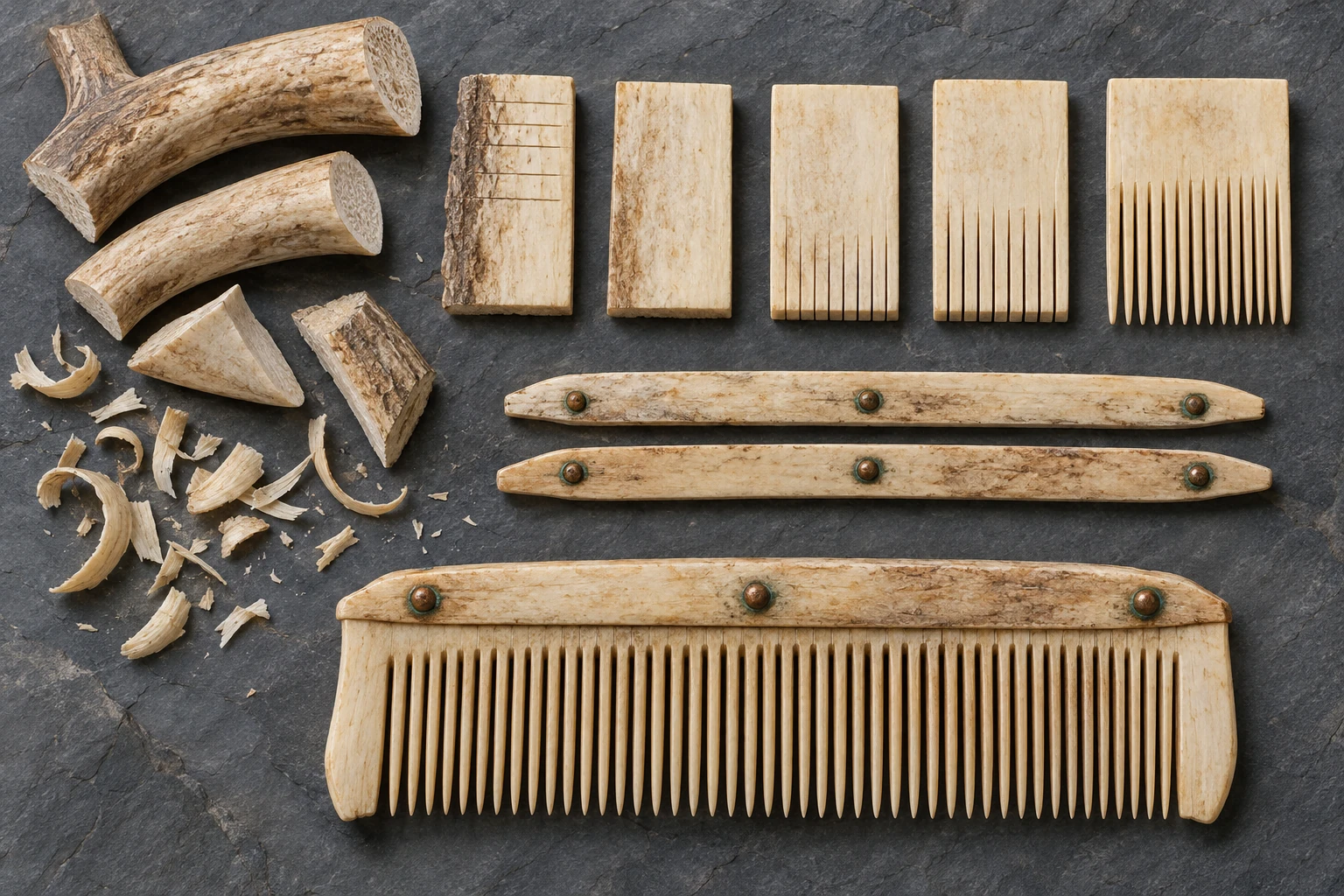
Conceptual craft illustration. The arranged stages are not excavated Ribe finds or a measured production diagram.
A finished comb is a personal object. The scraps left beside a comb-maker’s bench can describe an entire trading world. At Ribe in Denmark, fragments of antler, unfinished pieces, and discarded manufacturing waste help archaeologists separate two journeys that can look identical in a display case: a finished object arriving from elsewhere, and raw material arriving to be worked locally.
That distinction makes the waste unusually valuable. An imported comb proves that a comb moved. A scatter of antler offcuts can show that a material moved and was transformed at its destination. The scraps put a workshop back into the story.
Why a comb is not simply a carved outline
Early medieval composite antler combs were assembled objects. The 2015 study by Steven Ashby, Ashley Coutu, and Søren Sindbæk investigated combs, manufacturing waste, and raw antler from Ribe, Aarhus, and Aggersborg. The research concerned the supply networks behind a specialized urban craft, rather than treating attractive finished objects in isolation.
A useful way to look at a composite comb is to follow its joins. Where are the tooth plates? What holds them together? Do the cuts and rivets suggest a sequence of work? The answers depend on the actual object, but the questions draw your attention away from decoration alone. A comb embodies decisions about material thickness, assembly, and the danger of breaking a small tooth during manufacture or use.
The University of York’s Combs and Communities project places production and consumption together. That pairing matters: a craft object belongs both to the person making it and to the people who chose, carried, maintained, and eventually discarded it. Neither side of that relationship is fully recoverable from a pretty silhouette.
When a fragment stops looking like an animal
Once antler has been cut, smoothed, and worn, identifying its source animal by eye can become difficult. The 2015 investigation used ZooMS, a method of species identification through peptide mass fingerprinting. In accessible terms, surviving protein information offers another route to identifying material after its recognizable anatomical shape has been removed.
The study documented reindeer antler in Danish town assemblages by the 780s at the latest. Reindeer material connects those workshops with a supply area beyond Denmark. The Aarhus UrbNet research report stresses the implication: the activities sustaining an urban workshop need not all occur within the town. A resource landscape far away can be part of the town’s practical life.
It is tempting to draw one confident arrow on a map and label it “the route.” The identification itself does not supply that complete itinerary. Material could pass through several hands. A species identification is evidence about the substance, while a reconstructed journey requires additional reasoning about habitats, dates, other finds, and transport.
A later study makes the sequence sharper
A 2023 study of Ribe material dated 720–900 CE combined biomolecular approaches with archaeological context. Early combs made from non-local reindeer and moose antler could be distinguished from evidence for later local working of imported material. Reindeer appeared among workshop debris from the middle of the eighth century in the studied sequence. The authors also reported limits: insufficient preserved DNA prevented a finer geographic attribution of one reindeer comb.
That result is more interesting than a claim that “science proved where the Vikings came from.” It describes changes in the movement of objects and resources. It also shows different methods doing different jobs: an archaeological layer places a find in a sequence; protein or DNA helps identify material; the distribution of working debris helps identify an activity.
Three finds, three different claims
What you find
What it can support
What it cannot establish alone
A finished comb of non-local antler
Movement of the object or its material
The exact workshop or every stop on its journey
Offcuts from the same animal species
Working of that material near the deposit, subject to context
The identity or origin of the craftworker
Finds in carefully recorded successive layers
A changing local sequence
Every event between the surviving deposits
This table is a reading aid, not a catalog of specific Ribe specimens. Use it to test the wording of an archaeology headline. Does the evidence concern raw material, manufacture, a finished object, or the movement of a person? Those are not automatically the same story.
Count the joins before counting the teeth
Two Coppergate records offer a useful close comparison with the Ribe evidence. York Archaeology catalog 7557 describes an incomplete single-sided antler comb with six surviving tooth plates, two side plates, two surviving iron rivets, and detached components. Catalog 7583 records eight surviving tooth plates and five surviving rivets in another incomplete comb. The objects are dated differently in the catalog. Neither is a Ribe find, and neither should be inserted into Ribe’s stratigraphic sequence.
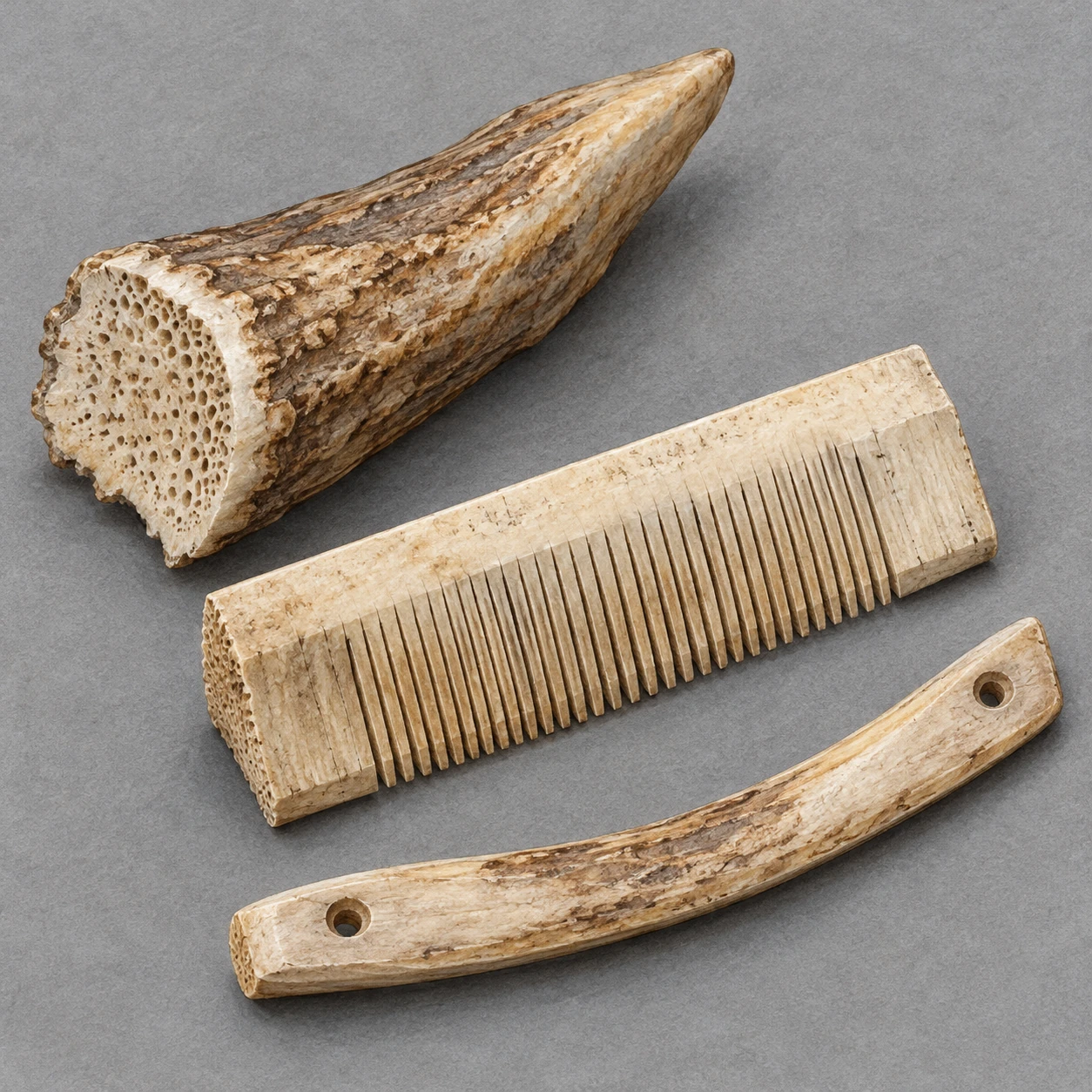
Interpretive component study, not excavated Ribe or Coppergate finds.
The value of the comparison lies in the word “surviving.” Six plates are six that can be counted now. They are not automatically the original total. The same applies to rivets. An inventory of what remains and a reconstruction of what once existed answer different questions, even when the numbers appear in adjacent sentences.
Open the first record and find the side plates in the photograph. These longer pieces gather shorter tooth plates into one object. Instead of following the comb’s decorative outline, follow the interfaces: plate against plate, antler against iron, tooth against gap. The finished implement distributes a repeated task across an assembly. Damage can make that assembly easier to notice than a complete, polished example does.
Here is a small evidence task with an answer you can test. Suppose a fragment has regularly spaced tooth cuts and a broken end. A second fragment has a smooth curved face and a rivet hole, but no teeth. Can the two fragments come from one category of composite object? Yes: different components perform different jobs. Can they be assigned to the same individual comb from that description alone? No. Shape, fit, dimensions, context, and perhaps material analysis would be needed to argue for a specific connection.
Now inspect the catalog’s detached rivet and teeth. Give each a sentence beginning “This can show…” and another beginning “This cannot establish alone…”. A loose tooth may help describe manufacture or damage. It cannot supply the owner’s name. A rivet documents fastening material; its existence does not date every nearby scrap to the moment it was installed.
This way of looking brings the workshop and the consumer closer without giving them invented biographies. A comb is both a designed assembly and an object with a later history of wear, breakage, loss, excavation, and cataloging. Every join belongs to the first story; every missing component raises a question about the second.
The floor is another kind of archive
The Northern Emporium project’s geoarchaeological work studied undisturbed soil blocks in thin section and chemical variation across occupation deposits. These approaches examine how a floor or layer formed and what activities may have contributed to it. A concentration of objects becomes more useful when the deposit around it is understood.
For your next museum visit, try spending two minutes with the least glamorous material in the case. Look for a broken mould, a sawn end, a failed casting, or a rough blank. Ask what stage of work it represents and which missing stages it implies. A polished artifact may show an achievement. A discarded fragment can reveal the system that made repeated achievement possible.
There is another productive question: what has not survived? A comb-maker’s work involved more than antler. Time, teaching, exchange, maintenance, and the gestures of a practiced hand are largely absent from the scraps. Even the distribution of debris can change when a floor is swept or a deposit disturbed. A careful interpretation therefore asks how material entered the ground, not simply what object category it resembles.
Try rewriting one confident headline as three sentences: the observation, the inference, and the remaining question. “Reindeer material occurs here” is an observation supported by identification. “It arrived through a supply network” is an interpretation of movement. “Who organized that supply?” is a question the material may help investigate without settling on its own. The rewritten version loses a little drama and gains a great deal of usable history.