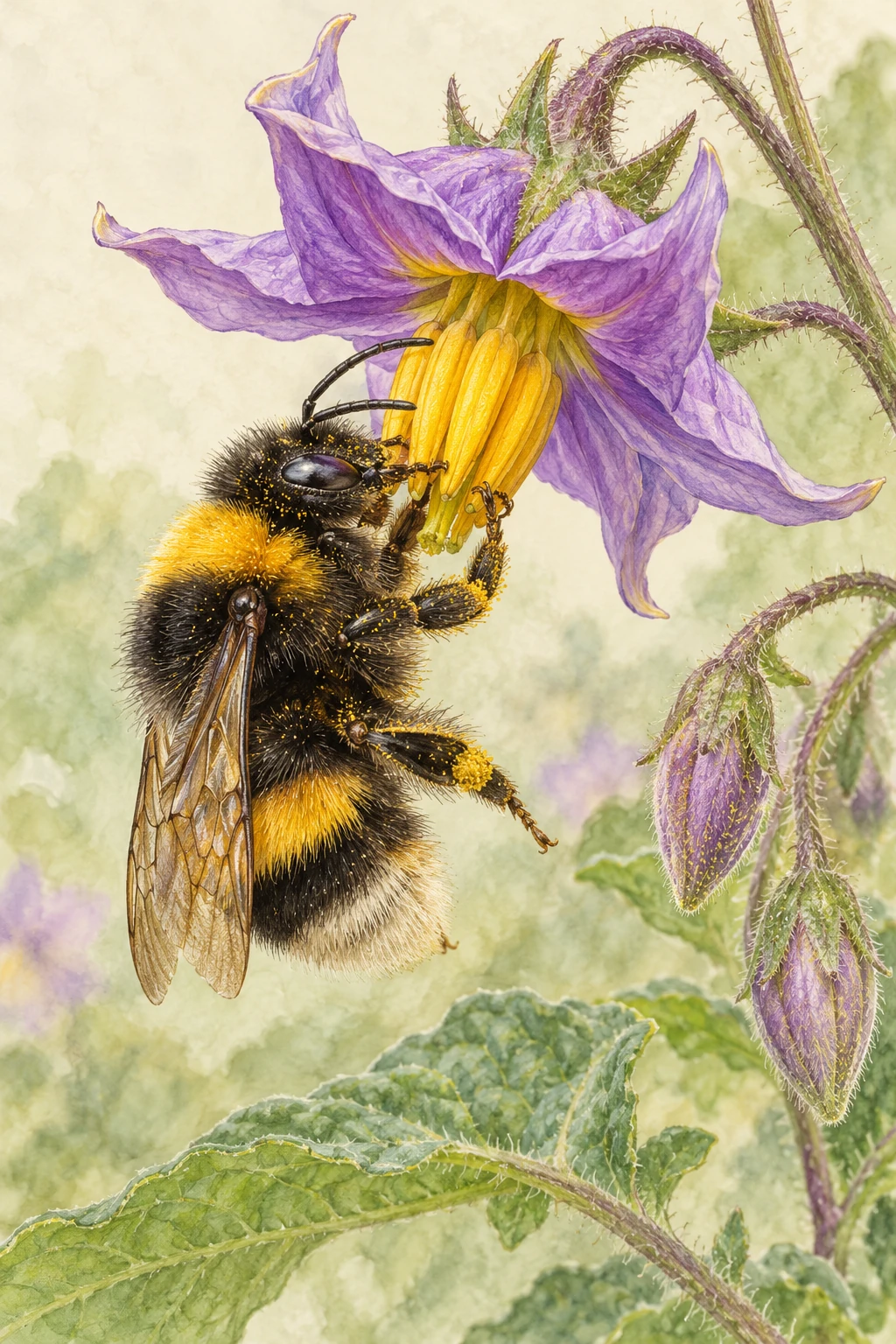
Watch a bumblebee at a suitable flower and the sound can change. The insect lands, grips the pollen-bearing structures, and produces a concentrated buzz with its wings no longer doing the work of flight. The flower is being shaken. Its pollen is not simply waiting on an exposed surface for a visitor to brush past.
This is buzz pollination, or floral sonication. In many flowers adapted to the interaction, pollen is enclosed in anthers and leaves through small openings. Vibrations applied by a bee move through the flower and help eject the grains. The bee is collecting food; some of the pollen it carries can later reach another flower. A practical feeding action becomes part of plant reproduction.
The flower is a mechanical structure
The pepper-pot analogy is useful: shaking can make particles leave a restricted opening. But a real flower is not a rigid kitchen container. Its anthers, petals, connections, and orientation influence how a vibration travels. The relevant motion is not captured by the audible note alone.
Nevard and colleagues' research dataset describes how bees often grasp one or more anthers with their mandibles and transmit thoracic vibrations through floral tissues. Different flower architectures can alter the transmission to neighboring anthers. A bee's grip is therefore part of the contact through which the mechanical signal enters the plant.
In a study of Solanum rostratum flower biomechanics, researchers used contactless laser vibrometry to measure movement in three spatial axes. The study found that dominant vibration frequency was conserved through the flower while other aspects of vibration transmission differed. The direction and magnitude of movement can matter even when the main frequency remains similar.
That is why “the bee hits the flower's magic note” is an incomplete explanation. Frequency tells us how often a motion repeats. Amplitude describes how large the movement is; velocity and acceleration describe other aspects of it. Two vibrations with the same audible pitch need not shake pollen loose equally well.
The bee can change its performance
Research reported by Stirling in 2016 followed inexperienced bumblebees on their first encounters with flowers requiring vibration. Bees began buzzing without needing to watch an expert, but their handling and vibrations changed with experience. They increasingly focused on the pollen-bearing parts rather than the petals. An evolved ability and learned refinement were both present.
Another study comparing buzzing tasks found stronger flower buzzes than those associated with defense or flight under the tested conditions. One insect can use the same general muscular apparatus in different ways. Treating every bee sound as the same motor behavior would miss that flexibility.
There is also an important distinction between a flower visit and effective pollination. An insect might reach nectar, collect exposed pollen, remove pollen through another route, or contact the stigma poorly. A photograph of a bee on a flower cannot establish all the steps. To evaluate a pollination relationship, researchers need to measure what the bee does and what happens to pollen.
Separating bee choices from flower responses
A live bee changes its grip, effort, posture, and visit duration. That flexibility makes natural behavior fascinating and controlled mechanical tests difficult. A research project described by Stirling in 2022 proposed small robotic devices to reproduce aspects of buzzing at a more useful scale. Such tools let researchers vary mechanical inputs systematically rather than depending entirely on what a bee chooses to do next.
A robot is not a complete replacement for a bee. It can isolate a physical relationship, while live-animal observations reveal how an organism actually exploits that relationship. The strongest explanation joins both: the flower's transmission properties and the bee's changing behavior.
This also gives a more precise meaning to pollinator diversity. Flowers do not all present the same task, and insects do not all perform the same actions. Maintaining a collection of visitors is not automatically equivalent to maintaining every specialized function. Which flowers need which behaviors is a question of biological compatibility, not only insect abundance.
The next time a bumblebee stops flying but keeps buzzing, listen for work rather than background noise. A small animal is applying a controlled mechanical action to a living structure. The flower filters and transmits that motion, pollen moves, and both participants' reproductive stories may change. The encounter is audible, but its essential exchange passes through contact.
Follow the evidence: University of Stirling: floral buzzing and experience; Pritchard and colleagues: task-specific bee buzzes; Nevard and colleagues: vibration transmission dataset; Brito and colleagues: flower biomechanics, data and code; University of Stirling: robotics for testing floral vibration.
More curious connections, art and independent projects at Incoprea.