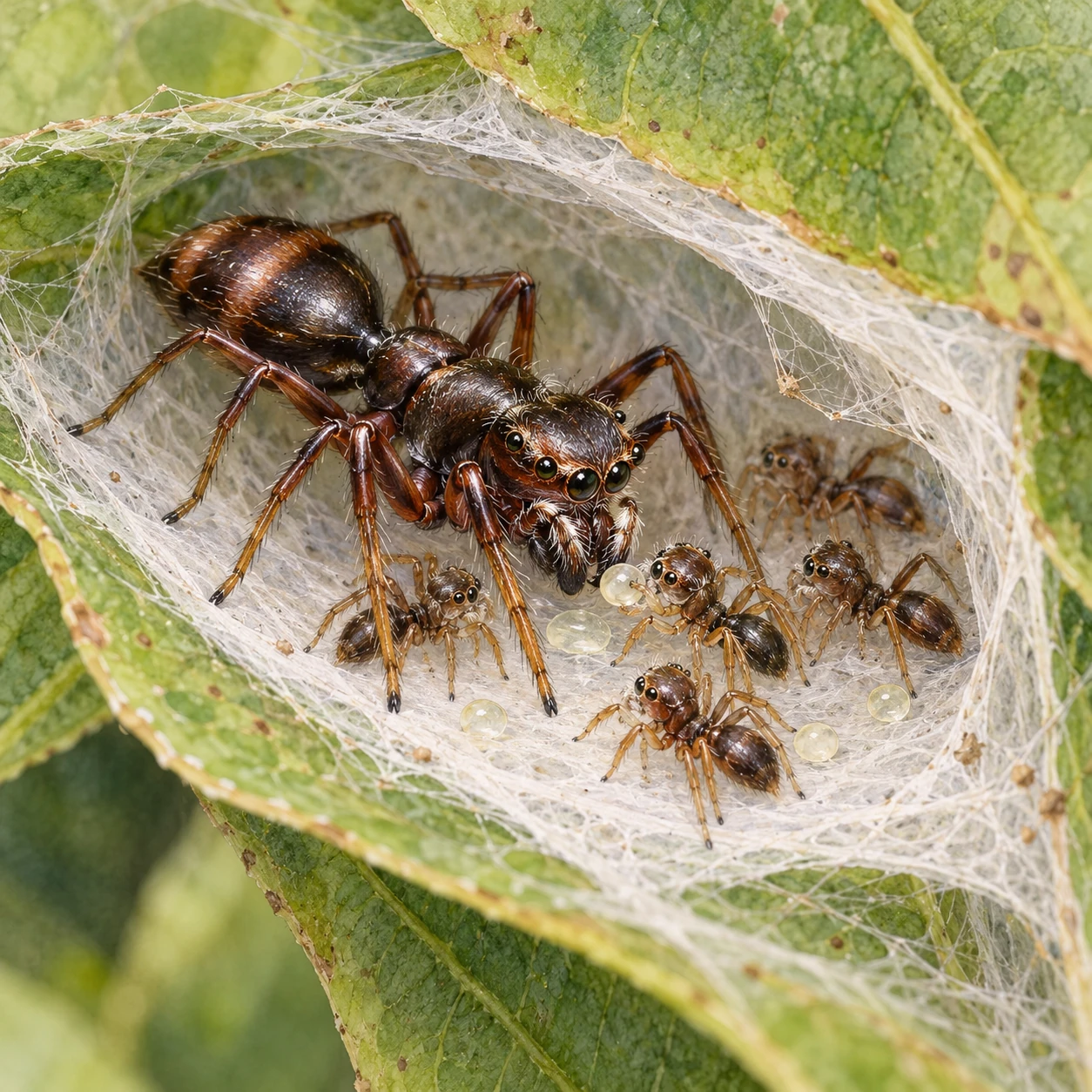
A small dark jumping spider shares a silk retreat with young that are growing into recognizable versions of her. The arrangement is unusual enough to invite a question: what keeps the family together, and how are the smallest spiderlings being fed? In Toxeus magnus, researchers found an answer that challenged a familiar association between milk and mammals.
The mother supplies a nutritious liquid secretion. Young spiderlings take droplets, and later continue feeding from her even after they begin foraging. Calling it “spider milk” captures a functional resemblance, but the underlying biology is not a mammary gland transplanted into a spider. The distinction makes the discovery more, rather than less, revealing.
First observe a family that should not fit the simple picture
The Chinese Academy of Sciences account identifies Toxeus magnus as an ant-mimicking jumping spider native to southeastern Asia. Its breeding retreats can contain an adult female and juveniles at different developmental stages. Such grouping suggested prolonged care or delayed dispersal, possibilities that needed observation rather than an assumption that all spiders lead the same solitary life.
A 2018 study in Science followed the provisioning behavior and tested its consequences. Mothers secreted droplets from the epigastric furrow on the underside of the body. The youngest spiderlings initially obtained food within the retreat; later they could feed directly from the mother. The secretion was indispensable early and supplemented independent foraging later.
This is more than discovering a white liquid. A strong provisioning claim connects the substance, the parent's behavior, the offspring's use of it, and the consequences of losing access. Appearance alone cannot establish nutritional function.
Food and care are related, but not identical
The experimental design distinguished access to the secretion from the mother's continued presence. Those are different resources. A mother can supply nutrition, maintain a retreat, affect safety, or influence the social conditions in which young develop. Removing her changes more than the amount of liquid available.
That separation is one reason the study is informative. If preventing feeding and removing the mother produced identical changes, nutrition might explain more of the result. If outcomes differed, other forms of care would also need consideration. The actual research found benefits of prolonged maternal association beyond the youngest, fully dependent phase.
It is also important to specify a developmental stage when saying the young “can feed themselves.” Beginning to forage does not mean parental food has become useless, and reaching a particular body size does not establish full independence in every dimension. Development can contain overlapping sources of support.
Ask about the mother as well as the young
Once a secretion is shown to help offspring, a second question follows: what does producing it cost the parent? The answer need not be captured by comparing a mother with a female that never reproduced. Reproduction includes mating, egg production, secretion and other forms of care that can have different associations with lifespan.
A 2024 Toxeus magnus study compared females in different reproductive and care conditions. Females caring for offspring lived longer in the reported comparison than non-caring females. A separate comparison suggested a cost associated with continued milk provisioning without the full package of offspring care. The authors proposed that non-nutritional nursing could offset some costs of provisioning.
That is not a general prescription that parenthood extends life. The study concerns laboratory spiders and defined groups. Some groups differed because of their reproductive histories, while egg removal was used in the provisioning-only condition. The group definitions are part of what a lifespan difference means, rather than interchangeable labels for “more” or “less” parenting.
The earlier researchers' discussion of the discovery already separated nutrition from extended maternal association. The later work turns attention back toward the parent's outcome. A mother can provide food and also maintain a retreat, guard young and interact with them. Removing one component does not simply subtract a fixed portion from an otherwise unchanged life.
Read the clock before the curve
In the 2024 figures, distinguish adult longevity from reproductive longevity. The first starts at the final molt; the second starts at production of the first egg clutch. A female's waiting time before reproduction enters one measure differently from the other. Two survival curves should not be compared as though they share a starting event unless they actually do.
A figure-reading task
For each curve, write four items: group membership, starting event, sample size and outcome. Then mark which groups were experimentally manipulated and how. This helps distinguish an observed group difference from a complete explanation of why the difference occurred.
The result deepens the original discovery because the family is now a two-way life-history question. The young's dependence is one outcome. The mother's survival and the work bundled into care are others. The silk retreat contains a relationship whose consequences cannot be reduced to the composition of one droplet.
The resemblance is functional, not evidence of one shared origin
In a 2019 discussion of the discovery, the researchers considered its biological implications and unanswered questions. The source and evolutionary origin of the secretion remain questions to investigate. Proposed relationships to other reproductive materials require evidence; they should not be presented as a settled explanation just because they sound plausible.
Different animal groups have evolved specialized ways of provisioning offspring. Similar functions can arise through different structures and histories. That is the value of the comparison: it helps us identify the repeated problem—supporting young through vulnerable development—while asking how each lineage solves it.
The same care is needed with “first.” The study did not discover that no nonmammal had ever supplied a specialized nutritive food. Its striking contribution was the combination and duration of milk-like provisioning and extended care in this spider. A narrower statement is both more accurate and more useful than a sweeping claim about the entire animal kingdom.
Reading the paper's figures, look for the age of the offspring, the treatment applied, and the outcome being compared. A survival curve and a photograph of feeding answer different questions. The first can reveal a dependency under defined conditions; the second documents an action and its context.
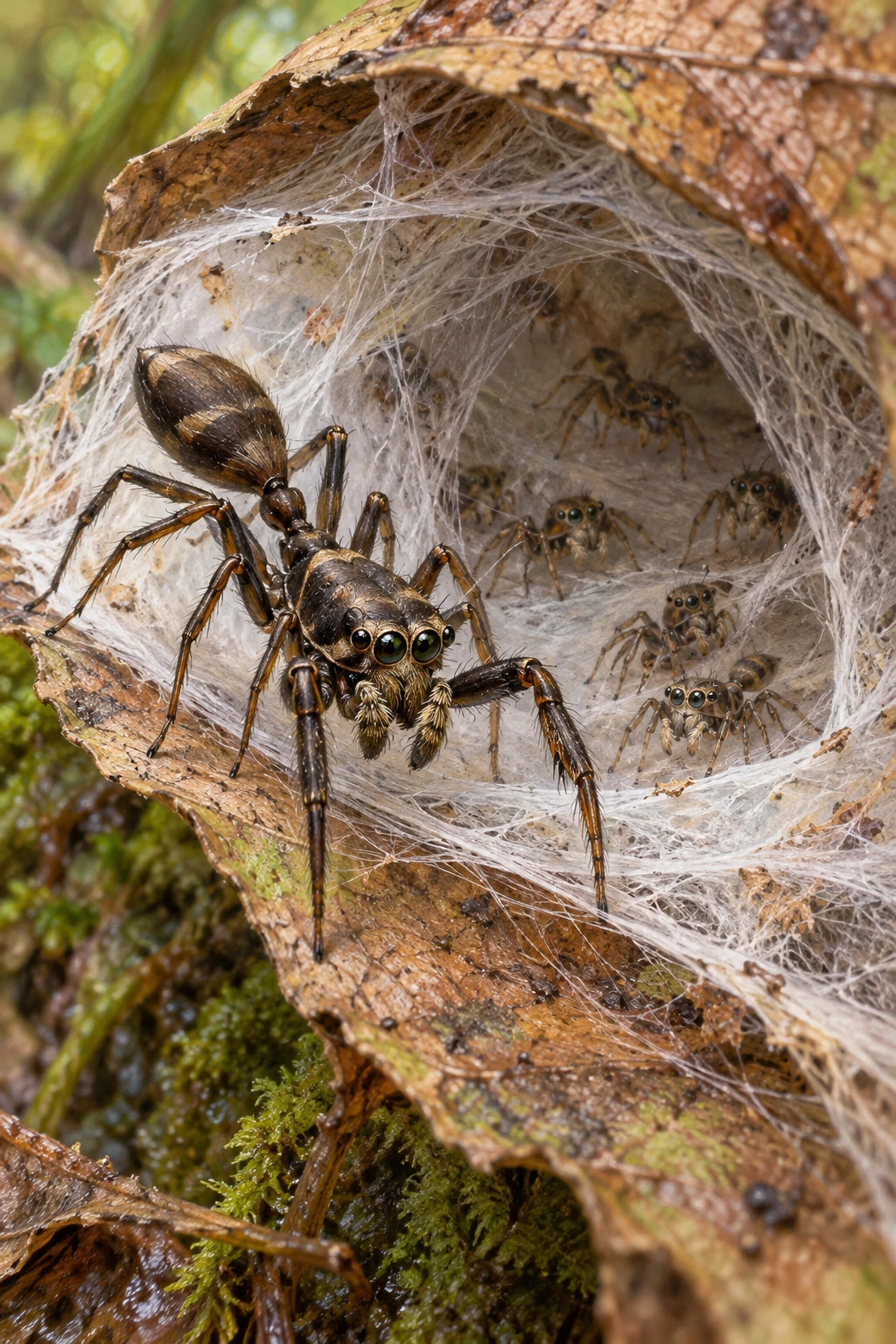
The generated illustration emphasizes the silk retreat and the size contrast between mother and young. Its droplets are conceptual. Their chemical composition and the anatomy of secretion come from the measurements and observations in the research, not from the picture.
The discovery changes a useful expectation. A jumping spider can be more than a solitary hunter whose parental contribution ends with eggs. In this species, the mother's body and behavior remain part of the young's food supply and developmental environment. The familiar word “milk” opens the door, but the lasting interest lies in the particular spider life behind it.
Follow the evidence: Chen and colleagues: prolonged milk provisioning in a jumping spider; Chinese Academy of Sciences: the discovery and study organism; Chen and colleagues: biological implications and unresolved questions.
More curious connections, art and independent projects at Incoprea.




