The usual answer to moving ice is to get away from it. Fram was built around a different intention: enter the pack, remain there, and survive long enough to be carried through an Arctic drift. The ship had to make confinement into a working condition.
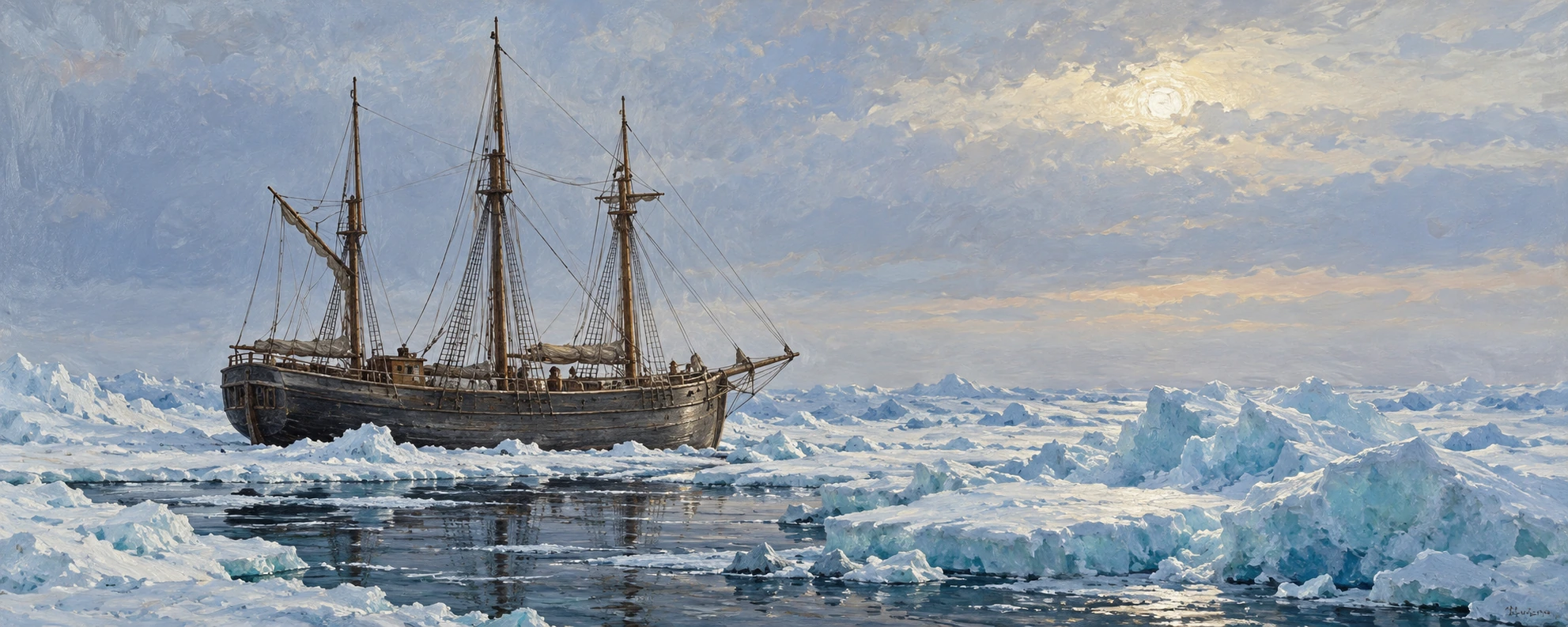
Its unusual shape was not an isolated flash of inspiration. The Fram Museum's ship history describes close collaboration among Fridtjof Nansen, Otto Sverdrup, and the builder Colin Archer. Launched in 1892 at Larvik, Fram combined a broad, rounded hull with heavy construction and arrangements for prolonged life aboard.
Look at the direction a force is allowed to act
The design aim was to let pressure from the ice push the vessel upward instead of gripping and crushing a more conventional hull. The rounded cross-section was part of that aim. It makes more sense when understood as a relationship between shape and contact, rather than as a magical property of exceptionally thick wood.
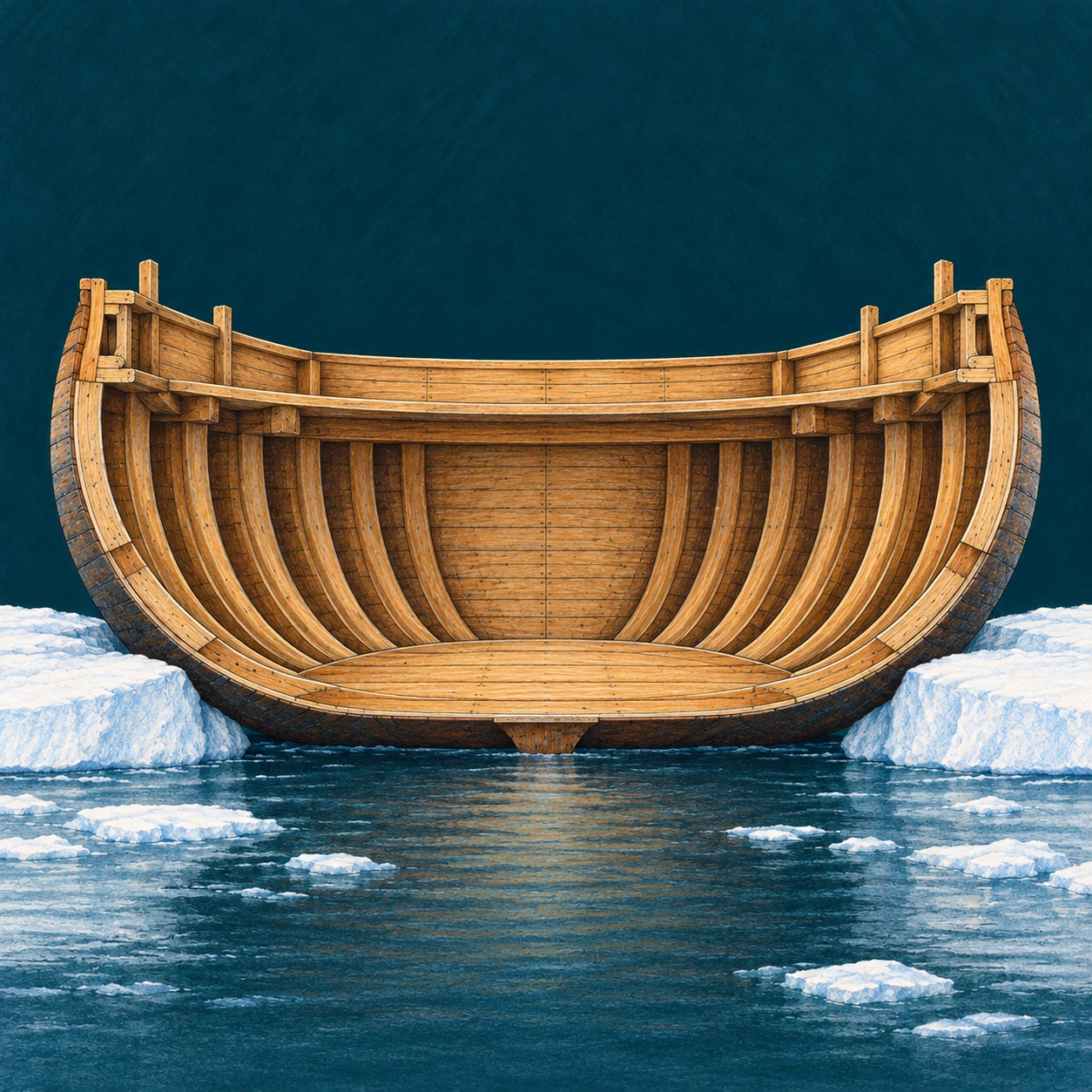
The enlarged section above is a qualitative study. It shows a broad hull between simplified ice blocks, without supplying timber dimensions or calculated loads. Real ice does not press as a neat pair of identical blocks, and no small diagram can establish how a ship responds to every combination of pressure, cracking, friction, and motion.
A useful comparison is to ask what a shape encourages, not what it guarantees. An inward-sloping contact surface may help convert sideways pressure into upward movement. Strength is still necessary. So are details that protect vulnerable components and a plan for living with conditions that cannot be commanded.
A good answer in ice can be an uncomfortable answer at sea
The museum's technical account notes a consequence of Fram's broad proportions: uncomfortable rolling in open water. That is an unusually useful detail because it prevents the design from turning into a simple story of perfect engineering. A feature can improve performance in one setting while imposing a cost in another.
Before you admire any specialized machine, make a list of the conditions it was built to face. Then ask which conditions have been left off the list. Speed, steering, comfort, draft, cargo, endurance, and survival may compete. A sensible design is a set of choices among those demands, not the winner of a single abstract contest.
Fram also needed to function as an inhabited space. Research and daily routines had to continue during a journey whose timing was uncertain. The hull's survival and the crew's ability to live aboard were related problems. A ship that remains afloat but cannot support its occupants has not solved the expedition's whole task.
Drifting did not mean moving straight toward the goal
The museum's Nansen account describes the 1893 departure and the deliberate entry into the pack. It also describes drift that sometimes carried the ship north and sometimes south. The plan depended on a large natural movement without allowing the crew to steer each day's progress.
This distinction is central to understanding the expedition as an experiment. The investigators could choose equipment, provisions, observations, and an initial strategy. They could not turn the Arctic into a conveyor belt with a guaranteed schedule. The uncertainty was not a decorative adventure element added afterward; it was built into the method.
| Requirement | Question to ask of the evidence |
|---|---|
| Survive ice pressure | Which features concern shape, and which concern strength? |
| Travel in open water | What compromises appear in handling or comfort? |
| Remain inhabited | Where are storage, insulation, work, and living arrangements? |
| Serve another expedition | Which parts were altered between journeys? |
The preserved ship is also a record of revision
The museum's exhibition account explains that Fram was modified for successive expeditions and is presented in the configuration associated with Sverdrup's second voyage. A preserved vessel is therefore not automatically an untouched snapshot of its first departure.
That later history adds value. Repairs and alterations show how experience changed the working object. Fram's story is strongest when it includes revision, discomfort, and uncertain movement alongside the rounded hull. The remarkable achievement was not a ship that abolished the Arctic's demands. It was a carefully developed way to keep working within them.
Sources and further exploration
Explore all 80 new articles · Browse the complete illustrated collection
Continue exploring art, ideas, and unexpected connections at Incoprea.




