A folding chair is easy to classify as convenient furniture. It can be carried, opened, used, and put away. But place one inside a Bronze Age coffin and convenience becomes only the beginning of the story. Why should this particular object accompany a dead person? What could sitting on it communicate that standing beside it could not?
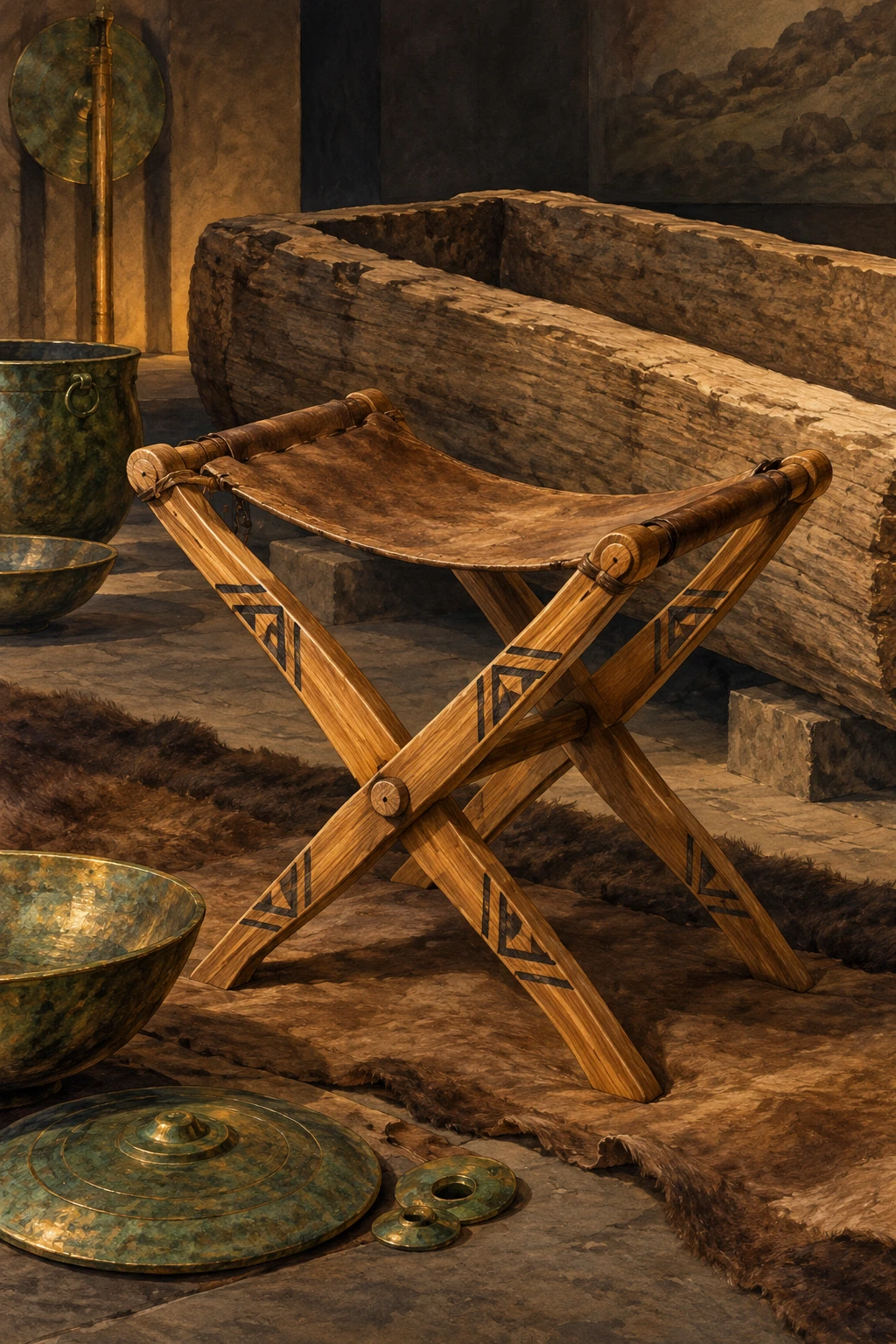
The chair from Guldhøj in southern Jutland offers a rare opportunity to ask those questions of surviving wood. The National Museum of Denmark records its discovery during the mound’s excavation in 1891, at the feet of a man in an oak coffin. Its ashwood frame carried carved decoration with black pitch inlay. Only a fragment of the otter-skin seat survives.
A complete idea with an incomplete seat
That last detail matters when the chair is described as completely preserved. The museum uses that phrase to distinguish its exceptional survival from other Bronze Age European chair finds. It does not mean that every original part remains intact. A full-looking reconstruction or display can conceal this difference unless we read the object’s material history.
Look first at the paired crossing supports. Their relationship allows a seat to open into a usable form and close into a narrower bundle. Next inspect the points that permit movement. Finally find the ornament. Its presence makes the frame more than a bare diagram of a folding mechanism.
A photograph can show those relationships without establishing exactly how the chair felt under a person or how smoothly it moved when new. We should not “test” an ancient object imaginatively and then report comfort as an observed fact. The surviving structure, the missing skin, and the present support used for display are separate parts of what we see.
Three dates that answer different questions
The museum places the chair in the second half of the fifteenth century BCE. Its account of the graves gives a dendrochronological date of 1389 BCE for the man’s oak coffin. And 1891 is the year of excavation. Those dates concern manufacture or attribution, the coffin’s timber chronology, and modern discovery, respectively. They should not be collapsed into one supposedly exact birthday for the chair.
The same grave account records a bronze dagger, axe and pin, wooden bowls, a bark box, a horn spoon, and textiles. The chair belonged to an assemblage. Its meaning is better considered alongside those objects than inferred from a modern habit of taking a folding seat camping.
Try writing three separate captions: “the chair is attributed to…,” “the coffin is tree-ring dated to…,” and “the burial was excavated in….” The exercise sounds pedantic until you see how easily a precise number migrates from one object to another in a shortened retelling.
A design can travel while its wood stays local
The museum’s design comparison identifies the Guldhøj chair as a Danish product while connecting its form to Mediterranean counterparts. Its argument concerns the movement of an idea, not the importation of this finished wooden object. It also shows later reinterpretations, including Poul Hundevad’s Guldhøj Stool and Ole Wanscher’s Egyptian-inspired model.
Similarity, however, is not an itinerary. A resemblance cannot name every intermediary, workshop, encounter, or journey through which a form might have become known. To draw an exact line across a map would require evidence beyond matching silhouettes.
That distinction opens a more interesting question: what must travel for a useful design to be reproduced? A finished example might be seen. A description might be explained. A craftsperson might move. Different combinations are possible. Here they remain possibilities for understanding transmission, not demonstrated episodes in the chair’s biography.
Portability can make rank visible
The museum interprets folding chairs as objects of high status, connecting northern examples with the ceremonial and elite contexts of Mediterranean comparisons. That is an archaeological interpretation supported by context and comparison. It does not identify the Guldhøj man’s exact title or reconstruct a particular ceremony.
Consider the social possibilities without turning them into a fictional scene. A portable seat allows a seated position to be created where permanent furniture is absent. Who sits and who remains standing can matter. Decoration can make the object recognizable before anyone uses it. Carrying it can involve other people’s labor. These are questions the form invites, not proof of a documented performance.
A practical object can therefore be prestigious partly through its practicality. There is no need to choose between “functional chair” and “symbol.” The ability to provide a particular place for a particular person may be part of what gives the object significance.
A pocket-size study of the crossing frame
Use two short strips of card and a paper fastener to make a flat crossing pair. Keep it on a tabletop; this is a drawing aid, not furniture. Rotate the strips around the fastener. Notice how changing the angle changes both height and width. Add a pencil line to represent a flexible seat between the upper ends.
Now draw the model open and nearly closed. Which dimensions change? Which remain fixed? What extra structure would be needed to stop a real three-dimensional chair twisting sideways? Those questions help distinguish a recognizable X-shape from a workable object with joints, material constraints, and a load path.
Return to the museum photographs afterward. You will have a clearer reason to look at the actual connections rather than letting a familiar silhouette do all the explaining. The paper model demonstrates a geometric relationship; it does not validate a reconstructed Bronze Age chair.
Guldhøj’s chair survives at the meeting of craft, movement, and burial choice. Its ingenious form can feel familiar, yet the coffin keeps that familiarity from becoming an easy answer. Someone chose to place a seat beside this man. The wood lets us investigate the choice while leaving the person’s unrecorded story open.
Sources and a closer look
National Museum of Denmark: Guldhøj folding chair; National Museum of Denmark: Graves and tree-ring date; National Museum of Denmark: Design through the ages; National Museum of Denmark: Chair as status symbol.
Find more art, ideas, and unexpected connections at Incoprea.