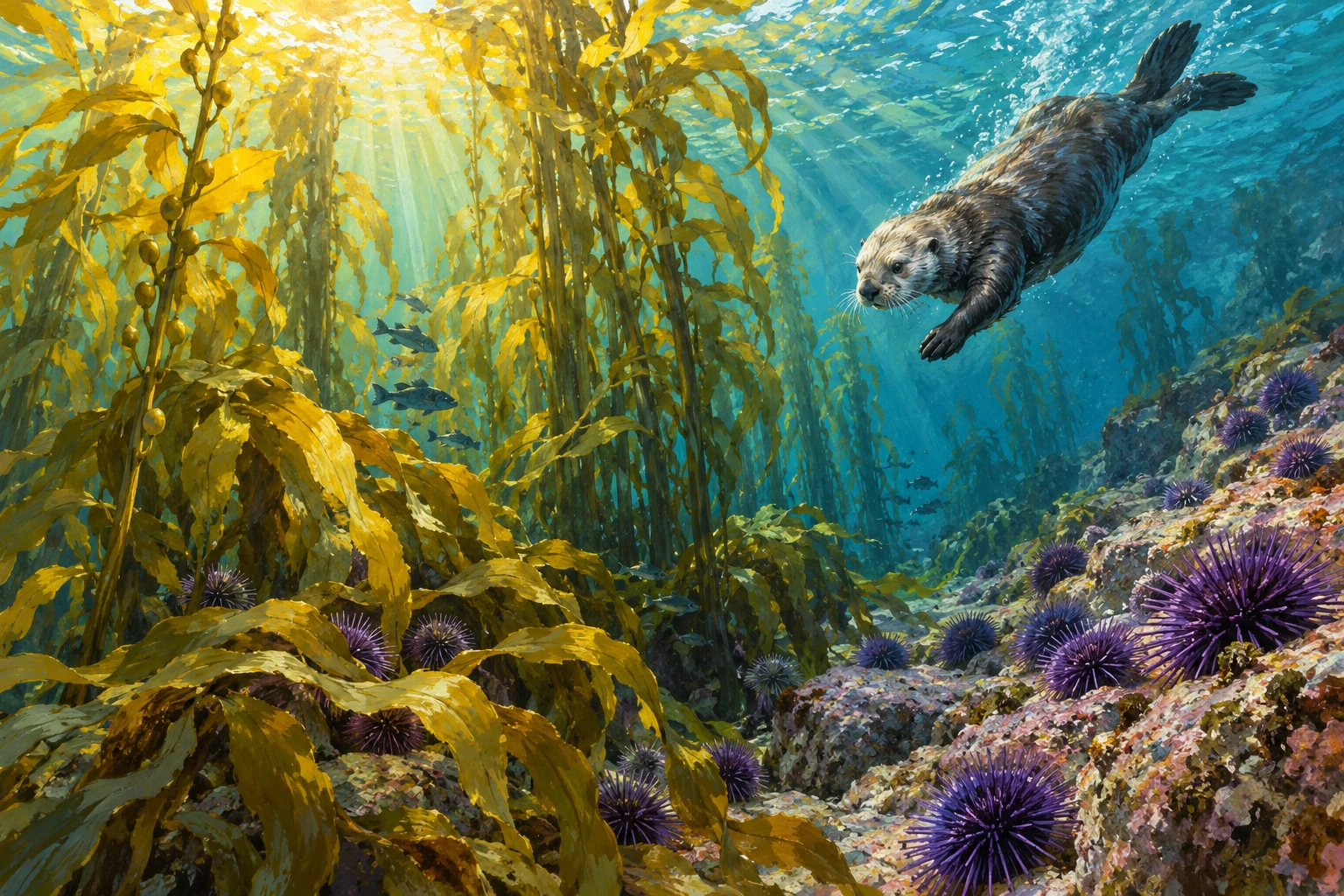
The familiar kelp-forest story fits neatly into three links: sea otters eat sea urchins; sea urchins eat kelp; otters therefore help kelp forests persist. It is a real and influential example of a trophic cascade. But imagine seeing healthy kelp beside an urchin-covered barren while otters remain in the same bay. The next question is not whether the textbook was entirely wrong. It is what those three links left out.
A predator does not consume an abstract unit labeled “urchin.” It encounters individual prey with different nutritional value in different places. An urchin does not always graze in the same way. It may remain sheltered while drifting food reaches it, or emerge when that supply declines. Once behavior and prey condition enter the picture, the food chain becomes a landscape of choices and feedbacks.
A useful first diagram, followed by a harder question
NOAA's aquatic-food-web introduction uses otters to explain how a predator can have indirect effects on organisms it does not eat. More grazing pressure can reduce the kelp that supplies structure and habitat. Reducing grazers can therefore have consequences well beyond the predator's immediate meal.
The diagram is a starting model. It directs attention to a mechanism and predicts a possible response. It does not say every kelp forest has the same species, temperature, disturbance history, or resource supply. It also does not specify whether the predator will spend equal effort in every patch after the ecosystem changes.
That distinction became especially useful in Monterey Bay. A 2021 PNAS study examined the mosaic of kelp patches and urchin barrens. Researchers combined underwater surveys, otter foraging observations, and long-term ecological information. Rather than treating otter presence as a simple yes-or-no variable, they asked how the animals responded to different states of the habitat.
Many urchins can make a poor buffet
The UC Santa Cruz account of the research describes a crucial result: urchins in remaining kelp forests could be more rewarding prey, while urchins in barrens were often nutritionally poor. Otters concentrated feeding where the return was worthwhile. This could help defend existing forest patches without automatically clearing neighboring barrens.
It is easy to see the mistaken assumption in hindsight. A patch carpeted with prey looks like an abundant food resource to a distant observer. But abundance is not equivalent to edible energy. An animal foraging for a living must encounter, capture, process, and digest food. The visible number of prey is only part of the return on that effort.
Now the persistence of the mosaic makes more sense. In a forest patch, otter predation can limit exposed, rewarding urchins. In a barren, hungry urchins may remain abundant while being unattractive to otters. The same predator can contribute to the survival of one state without readily reversing another. Maintaining a forest and restoring a forest are related but distinct ecological outcomes.
The average otter can be an animal that does not exist
A coast's otters may consume many prey types without every individual eating the same mixture. That distinction adds another layer to the patchwork of kelp and barrens. Knowing the population is present still leaves the question of which particular animals are doing the foraging.
In 2008 research comparing food-rich and food-poor conditions, greater population-level dietary diversity under food limitation was largely associated with differences among individuals. Otters specializing on particular prey also differed in related foraging behavior and handling efficiency. The population's broad menu did not simply mean every animal had expanded its own menu equally.
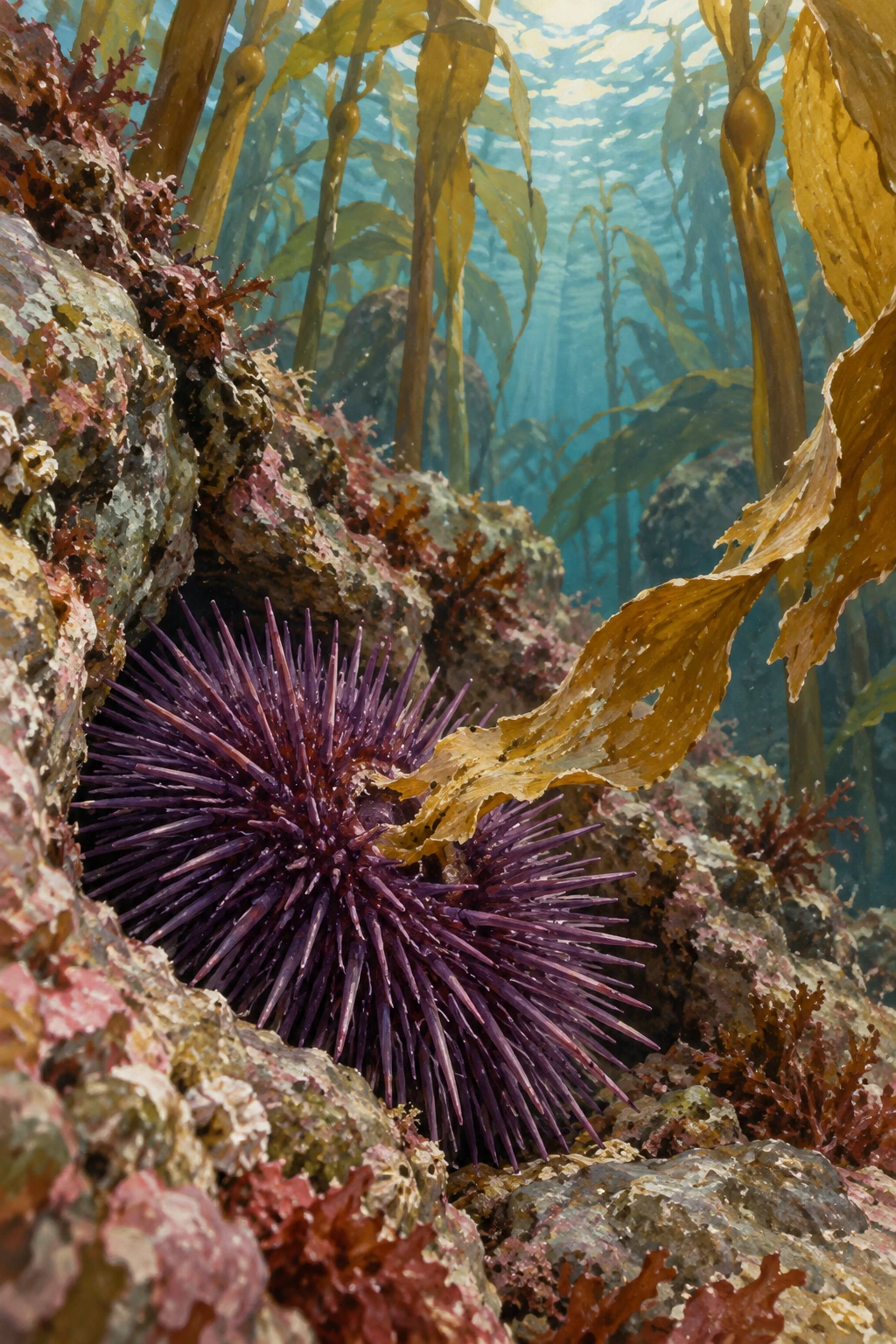
The USGS record of the study describes the comparison made possible by translocation and long-term records of recognizable individuals. Following an otter repeatedly matters because an isolated meal cannot distinguish a persistent specialization from an opportunistic choice.
Try two fictional observation books. Each records 100 meals from five otters. In Book A, every otter supplies 20 meals of one prey type: one animal takes only crabs, another only urchins, and the remaining three each specialize on a different prey. In Book B, each animal takes four meals of each of the five prey types.
Pool either book and every prey type represents 20 percent of the 100 meals. Yet the individual stories are entirely different. The pooled chart cannot tell us which book produced it. It follows that a population diet graph alone cannot establish how any one otter will respond when a particular prey declines.
One extra column changes the question
Add individual identity beside every fictional meal. Group records by animal before calculating the pooled average. Then add date and observation effort. You can now ask whether preferences persist and whether apparent specialists were simply watched in different places or seasons.
This exercise does not explain the kelp mosaic by itself, and the invented meals are not survey data. It shows why behavioral diversity deserves a place beside prey abundance and prey quality. A rich ecological account can need several scales at once: the contents of one urchin, the history of one forager and the condition of an entire reef.
When the next restoration report describes “otter predation,” look for how it was measured. The same count of predators can conceal different diets, different skills and different distributions of effort across the coast.
Context is something to measure
A 2025 study of two long-term datasets compared kelp-community changes during sea-otter recovery at Vancouver Island and San Nicolas Island. Its focus was the dynamic, context-dependent strength of the cascade. The comparison is valuable because a mechanism can operate differently across places and through time. “Keystone species” does not mean a species produces one identical outcome wherever it arrives.
Long-term monitoring is what makes those comparisons possible. The USGS San Nicolas Island report describes population, foraging, and habitat surveys. These answer complementary questions. Counting otters tracks a predator population. Watching dives and identifying prey investigates feeding. Subtidal surveys record the community in which that feeding occurs. None can substitute entirely for the others.
For a reader following restoration news, a practical set of questions follows. Is a report describing a remaining forest, a recovering forest, or a barren that has not recovered? Did it measure prey quality and behavior, or only abundance? Is the evidence a short before-and-after comparison or a sustained record? Those questions do not dismiss a hopeful result; they help identify what the result can support.
The painting accompanying this article brings a kelp patch and an urchin-rich rocky patch into one conceptual view. It is an invitation to see a mosaic, not a map of a particular survey site. Real surveys attach places, dates, depths, and methods to such contrasts.
The sea otter remains a powerful ecological actor. The richer story explains its power more accurately. An otter can alter the future of a forest through repeated decisions about dinner, while the forest's condition changes what counts as a worthwhile dinner. The relationship is a loop, unfolding through individual animals and particular patches of coast. That is why the three-link diagram is memorable—and why the living coast rewards a second look.
Follow the evidence: NOAA: direct and indirect effects in aquatic food webs; Smith and colleagues: behavioral responses across kelp and barrens; UC Santa Cruz: otters maintain remaining kelp patches; 2025 study: context-dependent keystone effects; USGS: San Nicolas Island monitoring and foraging surveys.
More curious connections, art and independent projects at Incoprea.