A fig looks like a sealed parcel. A bee cannot simply land on its surface and brush against an exposed flower. Yet inside that parcel is a whole inward-facing flowering structure, and for many wild figs the pollinator must enter through a narrow doorway. The result is one of the most intimate plant–insect partnerships on Earth: a nursery that is also a pollination chamber.
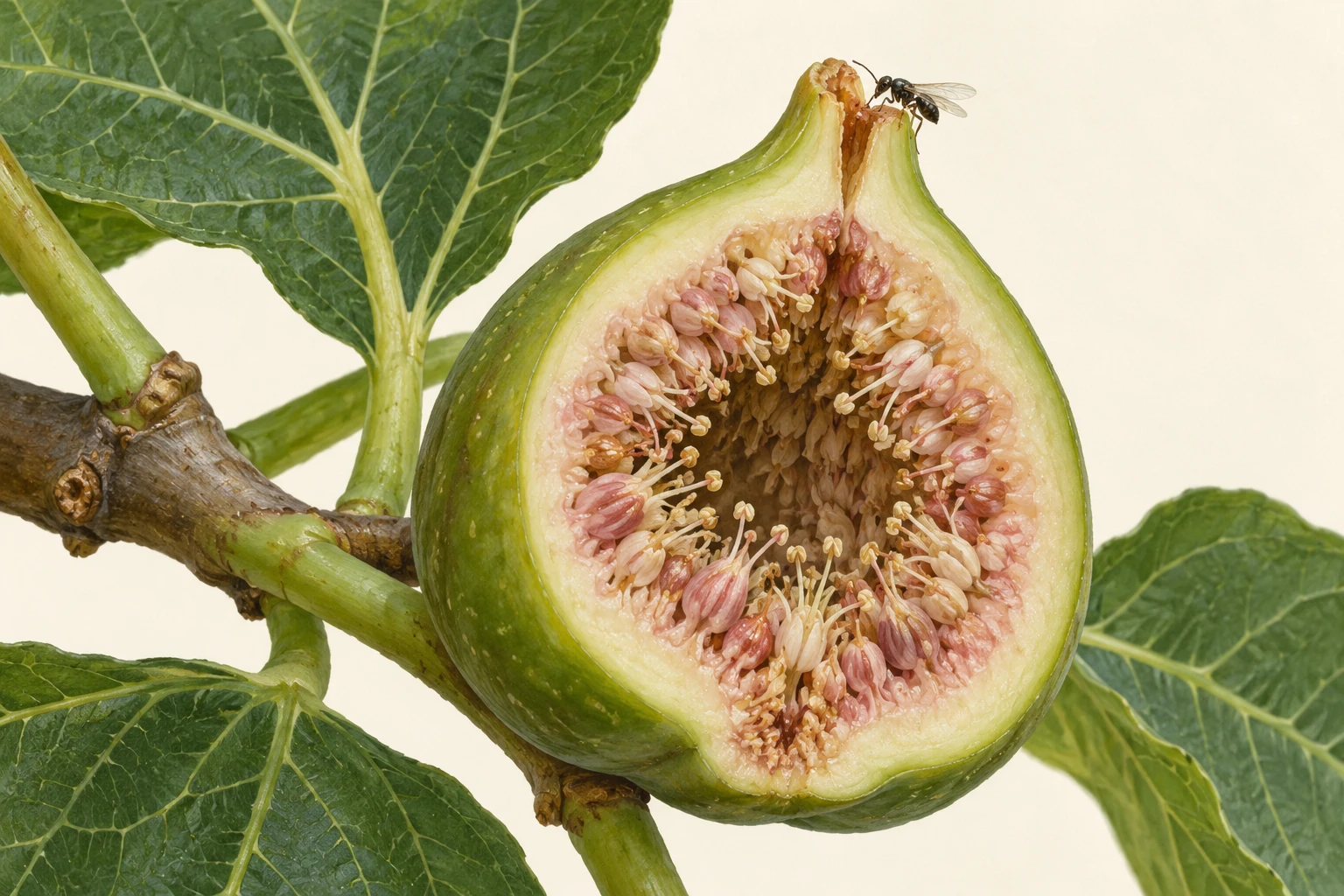
Cutting a ripe fig in half gives a useful first clue, although it does not reveal the whole life cycle. The little structures that seem like seeds belong to numerous tiny individual fruits. The surrounding fleshy structure encloses the flowers from which they develop. Botanists call that enclosed inflorescence a syconium. Kew's common-fig profile explains the arrangement. A fig is therefore not one oversized flower with its petals missing; it is a different way of organizing many flowers.
Finding an entrance to a hidden garden
Female pollinating fig wasps leave the fig in which they developed and search for receptive figs. According to the specialist FigWeb account, host-specific airborne chemicals help guide them. Their target has to be the right kind of fig at the right stage. Finding any green sphere on any tree is not enough.
The entry passage, the ostiole, is lined with tightly overlapping bracts. A female's flattened head and thorax help her negotiate it. Once inside, she can pollinate flowers and place eggs in suitable floral structures. This is an awkward place for our usual language of visitors: the insect is not casually stopping for nectar and flying away. Her reproductive future becomes bound to the developing fig, while the tree's reproductive future depends on pollen reaching its hidden flowers.
That dependency should not be flattened into the claim that every fig species has exactly one wasp species, forever paired with it. A comparative study of New World fig-wasp communities examines host specificity and the evolutionary relationships of pollinating and nonpollinating wasps. The system includes variation, multiple interacting lineages, and other wasps using the same resource. A famous mutualism is still an ecological community.
A partnership with an internal conflict
The tree needs seeds. A pollinator needs surviving offspring. A flower used for a wasp larva cannot also provide the same reproductive outcome as a flower that becomes a seed. The partners benefit from the relationship, but their interests are not identical. That is why figs are useful for studying cooperation without assuming either kindness or conscious agreement.
In experiments on four Panamanian fig species, researchers manipulated pollination and measured developing figs and wasp offspring. Unpollinated figs had less dry mass in their walls and in offspring, and fewer initiated galls produced live wasps. Jandér and Herre's 2016 study found selective resource allocation a more economical explanation of the combined results than the alternatives they evaluated. Better-pollinated figs received more resources; poor pollination could leave wasps with a poorer nursery.
The word “sanction” is used for consequences that reduce the success of an uncooperative partner. It does not mean a tree recognizes a villain. Resource allocation can produce an evolutionary incentive without a nervous system, a plan, or moral judgment. Describing the mechanism precisely makes the partnership more remarkable than imagining a miniature courtroom inside the fruit.
Does this mean every fig you eat contains a wasp?
No single answer applies to every common-fig cultivar or crop. The University of Florida extension explanation distinguishes common, Smyrna, and San Pedro types. Some familiar cultivated figs develop without pollination; other types or crops require it. A statement about a wild pollination partnership is not automatically a statement about a particular supermarket fig.
This is a helpful check on a viral fact. Start by asking whether the claim concerns the genus Ficus, the common fig Ficus carica, a named cultivar, or one particular harvest. Then ask whether it concerns pollen, seeds, larval development, or the remains of a pollinator. Those are related questions with different evidence. The sensational sentence often gains its certainty by sliding between them.
The deeper surprise is not a hidden ingredient in a snack. It is the organization of an exchange. A tree builds flowers in a protected chamber; an insect can reach that chamber and reproduce there; the consequences of successful or unsuccessful pollination affect the next generation. Neither participant needs to understand the system. The partnership persists through the reproductive results of what each does.
A fig therefore offers two kinds of hidden interior. One is anatomical: the garden folded inward. The other is evolutionary: competing interests held in a relationship that can benefit both sides. Looking beyond the sealed surface reveals both, and gives us better questions to ask about every other biological partnership described as perfectly harmonious.
Follow the evidence: Kew: edible fig anatomy; FigWeb: how fig wasps pollinate; Jandér and Herre: resource allocation and sanctions; University of Florida: common fig types; Host-specificity and coevolution among New World fig wasps.
More curious connections, art and independent projects at Incoprea.