A zipper asks your hand to make one simple movement while it quietly organizes hundreds of smaller ones. Pull upward on a jacket and two ragged edges become a reliable seam. The teeth do not individually know where to go. Their route has already been built into the small metal body under your fingers.
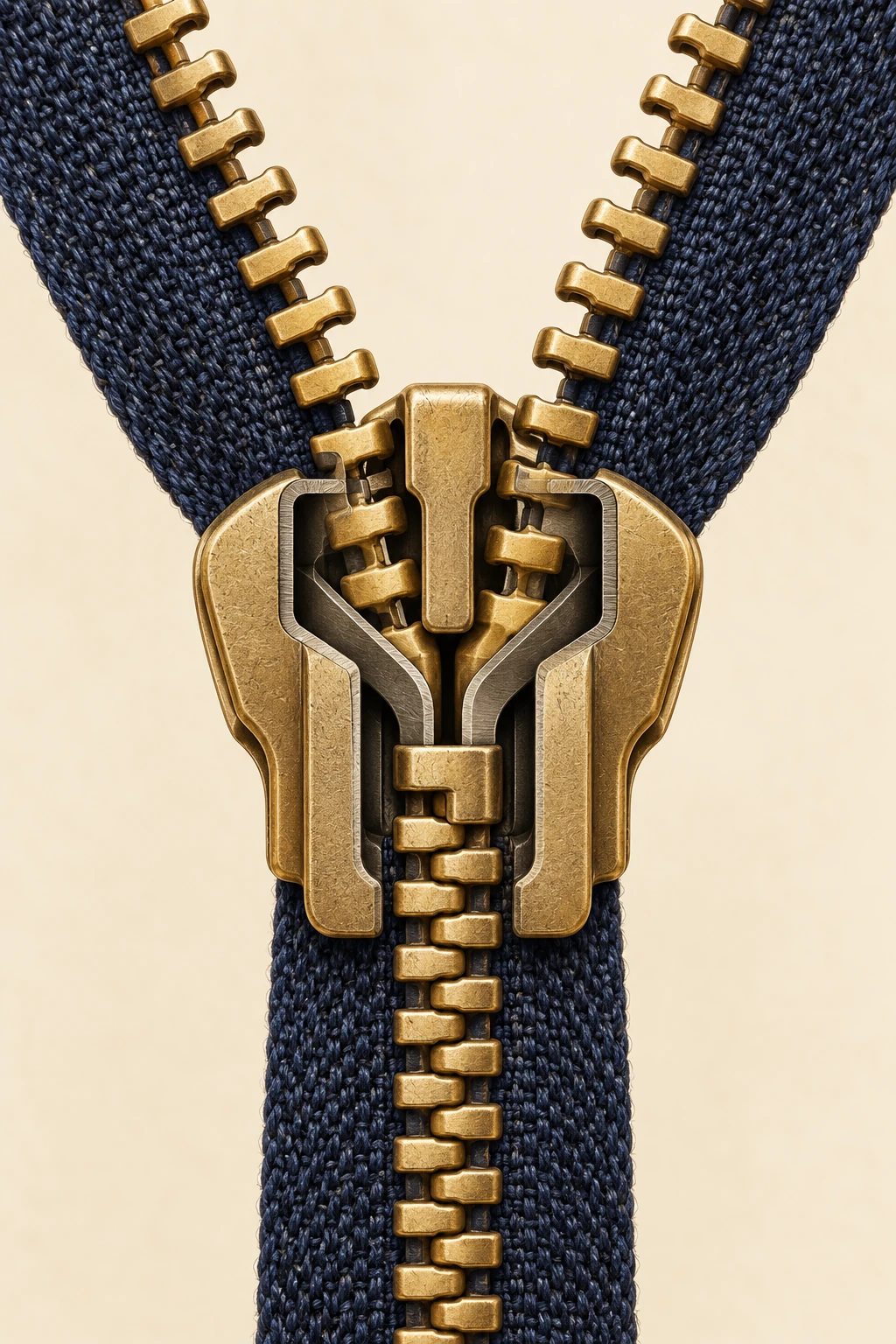
The most useful way to inspect a zipper is to stop looking at its pull tab. The tab is a handle. The actual machine is the slider beneath it: a compact guide that brings two rows together or separates one joined chain. Once you recognize that distinction, a familiar object becomes a miniature lesson in directing movement.
Follow one tooth through the junction
YKK's cutaway explanation identifies a Y-shaped channel inside the slider. In the closing direction, the two branches lead separate rows toward a common exit. The guide constrains the position of successive elements so their shaped surfaces engage. Reverse the motion and a divider leads the joined rows apart again.
Imagine marking one tooth with a removable paper pointer beside the fabric. As the slider passes it, the tooth is guided sideways into an engagement with its neighbors. Then the slider moves on. The tooth stays in the seam; it does not travel the length of the garment with the handle. You are moving the location where joining happens, rather than carrying the whole chain through a stationary machine.
That distinction is easy to miss because our attention follows the moving handle. Try describing the action without using the word “pull”: a traveling guide successively changes the arrangement of parts fixed to flexible edges. The longer description reveals why a short slider can organize a long closure.
The useful part can be the gap
A successful fastening is not necessarily an arrangement in which every surface presses tightly against its neighbor. A working zipper needs enough freedom for the elements to move through the guide and for the finished seam to bend.
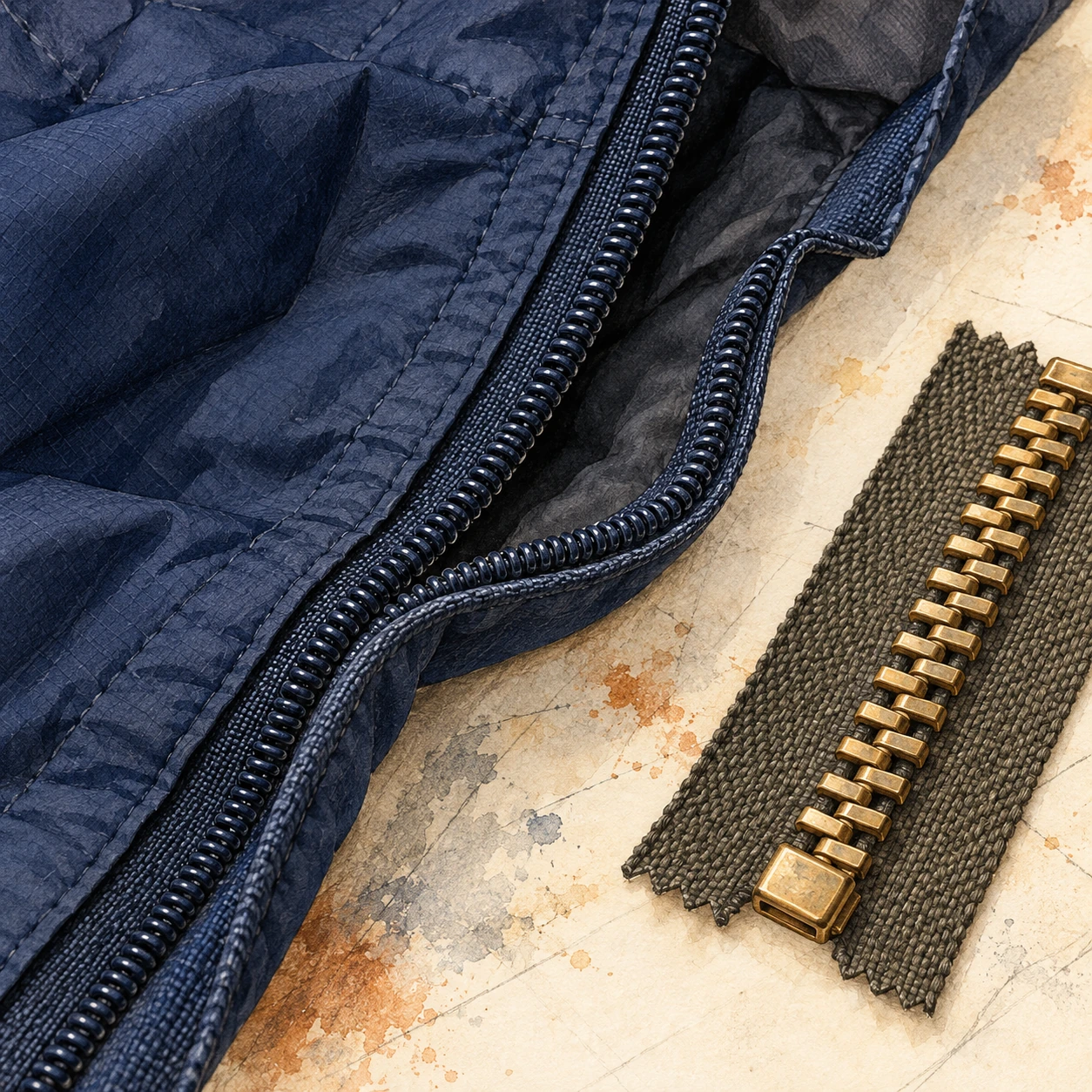
YKK's account of element spacing makes that compromise explicit. Gaps that are too large can permit misalignment; gaps that are too small make operation stiff. The empty intervals are designed parts of the closure, even though they are less conspicuous than the teeth.
The same page distinguishes repeated opening-and-closing tests under load from a lateral test that pulls a chain to failure. These ask different questions. Surviving one large sideways pull would not, by itself, establish how smoothly a closure works after many cycles. A durable product needs a history of operation as well as resistance to an extreme event.
There is an older version of the flexibility problem in Gideon Sundback's patent published in March 1917. Its interlocking members have projections and recesses that fit together while permitting relative rocking. The text also emphasizes making the members alike on both sides, connecting the fastening geometry to how the parts could be manufactured. This is one historical design, rather than a drawing of every modern coil or molded zipper.
Read a patent as a sequence of questions
Open its drawings and find one member before tracing the entire chain. Where is that member fixed to the fabric? Which surface engages another member? Which movement must be permitted for the seam to bend, and which movement must be resisted to keep it closed?
Then compare the two modern material samples in the illustration. Treat them as prompts to inspect a real closure, not as a technical drawing. A continuous coil and a row of separate metal elements can share the broad task while achieving it through different constructions.
The revealing question is no longer simply whether a zipper is tight. It is where the design allows movement, where it restricts movement, and how consistently that division survives use. The little traffic junction works because its passengers have carefully chosen room to maneuver.
The seam has three cooperating materials
The manufacturer's basic parts guide groups a zipper into elements, slider and textile tape. Those parts divide the labor. The elements provide repeatable engagement; the slider supplies the route; the tapes connect a precise chain to a much larger, flexible object.
It is tempting to dismiss the tape as ordinary backing. But YKK's description of its woven tape shows different zones for different jobs. The edge supporting the elements has a cord-like structure. A denser region withstands contact with the slider. Another region supports sewing into the finished garment.
This makes the zipper a useful counterexample to the idea that good engineering always replaces soft material with hard material. A jacket needs both. If the entire closure were rigid, it could not comfortably follow the fabric. If every part behaved like loose cloth, the slider would have no dependable sequence of elements to engage. The useful behavior comes from arranging unlike properties next to one another.
A second mechanism decides when movement is allowed
Guiding the teeth and preventing unwanted slider movement are separate tasks. YKK illustrates locking sliders with small pins that engage the elements. In a pin-lock example, lifting the tab releases the pin. In an automatic-lock design, a gentle pull operates a spring-related mechanism. The exact movement depends on the slider type.
Watch how that changes the role of the tab. It can communicate an intention to move as well as transmit force. A lock lets the closure remain where it was left, while the same hand movement that starts opening also releases the restraint. A part that looks like decoration may therefore be linked to another action hidden inside the body.
This is why a single confident repair trick cannot fit every zipper. A closure that separates behind the slider, one that will not move, and one whose insertion pin is damaged present different symptoms. The visible problem identifies a question, not an automatic diagnosis.
Why harder pulling is often the wrong experiment
The manufacturer's care guidance warns that forcing a reluctant slider can damage the elements. Before applying any product-specific remedy, release tension on the fabric and inspect for caught lining or an obvious obstruction. Follow the garment and zipper maker's care instructions; delicate fabrics and coated closures may need different treatment.
The usage manual adds another useful complication: the finished garment changes the operating conditions. Sewing, laundering, material compatibility and the open-end components can all affect performance. A zipper is tested as a mechanism, but it is used as part of something else.
Next time you close a bag, pause halfway. Above the slider are two possibilities; below it is one joined edge. The machine at the meeting point is small because the work is sequential. Its success lies in making the same controlled event happen again and again, while your hand experiences only one continuous motion.
Sources and a closer look: YKK: the Y-shaped slider channel; YKK: the three basic parts; YKK: the woven tape; YKK: locking sliders; YKK Americas: care and slider questions; YKK usage instruction manual.
Explore art, experiments and other unexpected connections at Incoprea.




