Stand below a hilltop tower and look at the sky around its mast. A large beam has moved. Two shorter arms have changed angle. To a traveler, the shape may look like a strange mechanical person. To an operator watching through a telescope at the next station, it can be a signal that needs to be copied accurately.
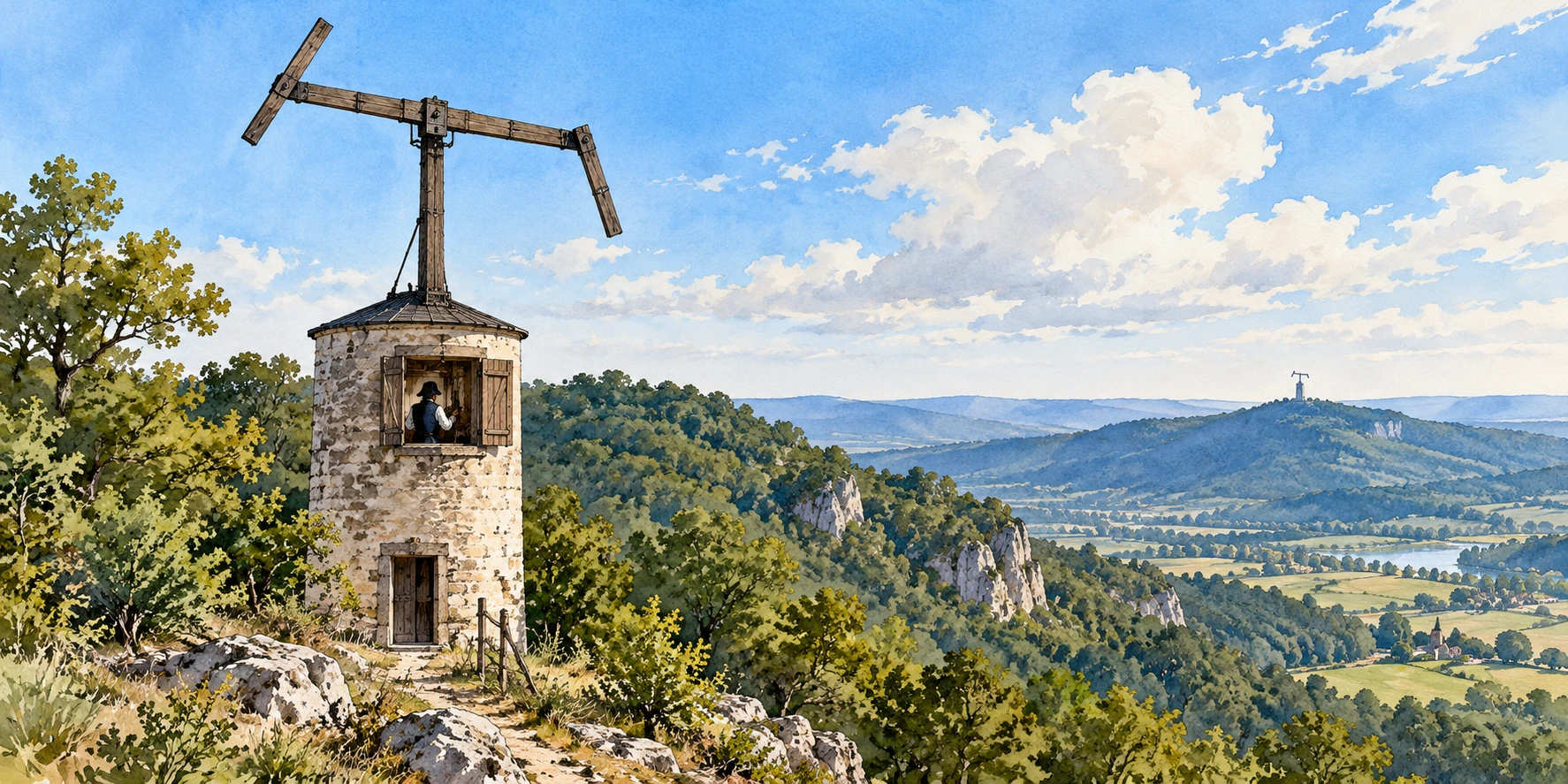
The Chappe optical telegraph makes a network visible. Its stations needed a view of one another, its moving parts needed recognizable positions, and its operators needed shared rules. The message traveled as a sequence of shapes, while the physical apparatus stayed on its hill.
Do not begin by guessing letters
The Musée des Arts et Métiers' explanation describes a succession of semaphores on towers or elevated points. The mechanism's central regulator and its shorter indicators could form distinguishable configurations. The system required both a visible signal and a convention for using it.
That does not mean every position simply stood for one letter of the alphabet. Historical optical telegraphy involved codes and operating signals as well as apparatus. A clear view of the arms would not automatically reveal a message to someone without the relevant code and procedure.
Imagine you and a friend agree that an upright hand means “ready,” a sideways hand means “repeat” and two hands mean “finished.” Those are instructions about the conversation itself. They do not belong inside the sentence being sent, but the sentence becomes difficult to send reliably without them.
Build a deliberately tiny relay
The interactive exercise uses invented symbols with an invented four-item vocabulary. It is not a reconstruction of Chappe's historical code. Choose a message, pass its symbols through a relay and decide what to do when one symbol becomes uncertain.
Send a message through a visible relay
An invented four-symbol relay shows why repeat and uncertainty rules matter.
Open send a message through a visible relay in its own window.
First, relay the sequence with every symbol visible. Next, hide the middle symbol. Notice the difference between “I saw a shape that means B” and “I think B would make sense here.” A plausible guess can produce a convincing wrong message. A request to repeat may feel slower, but it makes uncertainty explicit.
The model counts your transmissions, including repeats. It does not calculate a historical dispatch time. Real towers had distances, sightlines, mechanical movement and staffing conditions that the small demonstration omits.
Weather is part of the communications channel
The museum's Chappe model record places the optical apparatus within a broader history of telegraphy. Its preserved mechanism lets us study how movement became a reproducible signal. It does not remove the basic requirement that the next station must see that signal.
Fog, terrain and darkness are not decorative background in this story. They affect whether the channel is available. A beautifully articulated arm cannot solve a hidden horizon. Raising the station, improving observation and choosing a route are therefore parts of the technology just as surely as the gears are.
Try a paper planning exercise. Put three hills between two towns. Draw one line of sight that reaches every intermediate station. Then add a ridge that blocks the middle segment. Would a taller mast solve your drawing, or would you need another station? You have created a geometry problem before sending a single word.
A photograph is not a transmission
A Paris Musées record of a Chappe monument documents a later public image of the inventor and apparatus. That is evidence for commemoration, rather than a photograph of a working message on its way between stations. Museum objects and later monuments answer different questions.
The distinction matters when browsing historical images online. An engraving might simplify the mechanism so readers can recognize it. A restoration might choose one position for display. A model might expose parts normally hidden inside a tower. Ask what the image was made to show before using it as a record of operation.
One question to take outside
Find a distant building you can see clearly. Without approaching it, list which changes you could distinguish: a large flag, an open window, a hand gesture, a written word. Visibility has a scale. Designing a signal means choosing differences that survive that scale.
Chappe's towers are memorable because the message was briefly part of the skyline. Their deeper lesson is that communication needs more than a clever symbol. It needs a usable channel, a way to acknowledge doubt and people who agree when a shape has been seen well enough to pass onward.
Sources and further exploration: Musée des Arts et Métiers: how the Chappe telegraph works; Musée des Arts et Métiers: optical telegraph model; Paris Musées: Chappe monument record.
Explore all 50 new articles · Browse the complete illustrated collection
Explore more art, ideas, and independent projects at Incoprea.