Thursday, October 22, 2026

A Picture That Unrolls: How a Cylinder Seal Made a Claim

A little cylinder can hold a picture too long to see at once. Turn it in your fingers and one figure disappears while another emerges. Roll it across soft clay and the curved surface unfolds into a continuous scene. The image has changed medium, shape, and direction in a single controlled movement.
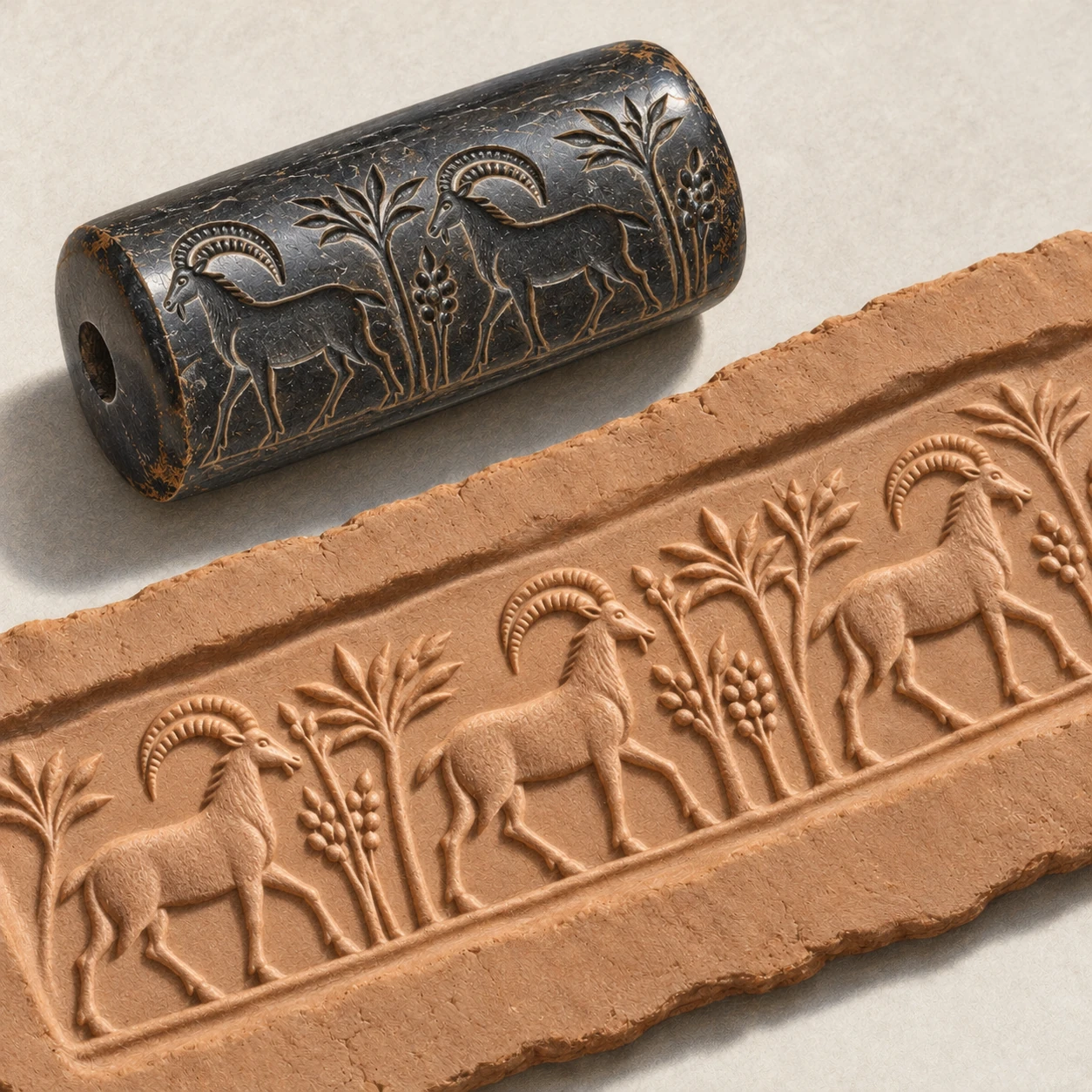
Conceptual dark cylinder seal beside a clay impression showing an original animal-and-plant pattern.
AI-generated conceptual seal and modern-style impression; the invented design is not an archaeological artifact.

Mesopotamian cylinder seals make that transformation useful as well as beautiful. They could leave recognizable impressions on clay associated with records, containers, and closures. The mark connected an object or action with an identity or authority. Calling it a signature is a helpful first comparison, provided we do not assume an ancient administrative world operated exactly like a modern bank.

Start with one small stone

The Metropolitan Museum’s hematite seal X.304.13 is approximately three centimeters high and dates to the Old Babylonian period, around the eighteenth to sixteenth centuries BCE. Its catalog presents the cylinder beside a modern impression. That pairing is essential: the ancient carved object and the present-day rolled image are two different things.

The record places cylinder seals’ emergence in the fourth millennium BCE and describes their use on clay closures and written records. It also notes possible amuletic significance. A seal could participate in more than one domain of life; an administrative function does not exclude religious meaning.

Keep the scale beside the enlarged image. Three centimeters is a short distance across which to organize bodies, gestures, headgear, and boundaries. A large screen can make the design look spacious. The physical object reminds us that carving and recognition operated at a different scale.

A hollow becomes a raised line

Curator Yelena Rakic’s Met introduction explains the reversal: an image cut into a cylinder appears in reverse when rolled, with the impression standing out from the clay. It also shows seals in different materials, including shell, carnelian, and chalcedony. The category is a working form, not a single substance or standardized size.

That reversal gives the maker two connected design problems. The carved surface must work on a curved body, and the resulting impression must remain intelligible on a flattened field. Our impression of a figure’s direction should therefore specify which surface we mean. A figure facing left on a modern roll may face right in the engraved matrix.

There is another problem at the edge. A cylinder has no natural left-hand margin. The beginning of a rolled picture depends partly on where the rolling starts. A museum photograph may choose a convenient boundary that makes a continuous scene look like a rectangular composition. That presentation helps us study it, but the original surface does not possess a paper page’s corners.

A mark needs a setting

Imagine three hypothetical finds. One is a seal on its own. Another is a clay impression detached from whatever it closed. The third is an impression still associated with a documented tablet. They offer different kinds of evidence.

EvidenceUseful questionLimit
Carved cylinderWhat image could it produce?It may not identify its user or a specific transaction.
Detached sealingWhat surface or cord traces survive?Its original container or location may be missing.
Impression and associated textHow does the mark relate to this record?The relationship still needs contextual interpretation.

This is an evidence-reading exercise, not a description of three particular excavated finds. It shows why a recognizable design cannot automatically tell us who personally held the seal at that moment. Possession, authorization, office, and identity are related questions rather than interchangeable answers.

The modern archive beside the ancient one

The Morgan Library’s research guide describes not only its ancient seals but also Edith Porada’s scholarly legacy: modern impressions, photographs, drawings, papers, and a major corpus first published in 1948. The history of studying these objects has produced its own material archive.

That archive matters when an object cannot be inspected directly. A drawing can clarify a faint contour; a photograph can preserve surface details that the drawing leaves out; a modern impression can make the whole design readable. Each medium selects information. Agreement between them is valuable, and disagreement is a reason to investigate.

The Morgan’s curator-led video, Rolling Stones, introduces its collection and the use of its online views. It makes a good companion to slow looking. Pause with the seal and impression visible together rather than allowing a succession of attractive scenes to replace close comparison.

When comparing two rolls, check whether either image has been mirrored for publication. The same engraved matrix can appear startlingly different after that simple transformation. Object number, orientation, and the label “modern impression” are small pieces of information that keep the comparison anchored.

A paper model of an image without corners

Take a narrow strip of paper and draw three original simple shapes along it: perhaps a circle, a stepped line, and a leaf. Join the short ends into a loose ring. This does not reproduce a seal’s mechanics, but it models the absence of an intrinsic starting edge.

Rotate the ring. Decide where you would place the beginning if you had to publish it as a flat illustration. Would you separate two related shapes? Could you show a little repeated overlap to make continuity clear? Now imagine that only half the strip survived. Which relationships would disappear?

For the reversal problem, draw a small arrow on a transparent scrap or trace it onto the back of thin paper. Turn it over. Direction changes while the underlying design remains related. These deliberately simple experiments are enough to make a real catalog’s distinctions easier to follow.

A cylinder seal compresses several achievements into a portable object: miniature carving, an image designed for transfer, and a mark that could enter a social system of claims and recognition. Its lasting fascination lies in that meeting. The picture can be admired by itself, but it becomes richer when we ask where, how, and on whose behalf it was made to appear.

Sources and a closer look

The Met: Old Babylonian hematite seal X.304.13; Yelena Rakic: Cylinder Seals, Met; Morgan Library: Seals and Tablets research guide; Morgan Library: Rolling Stones curator video.

Find more art, ideas, and unexpected connections at Incoprea.

The Elevator With Three Working Buttons

Case 50 · shortest-path challenge · Hard · About 10-15 minutes The archive elevator has a peculiar test mode. Its floor display works, but o...