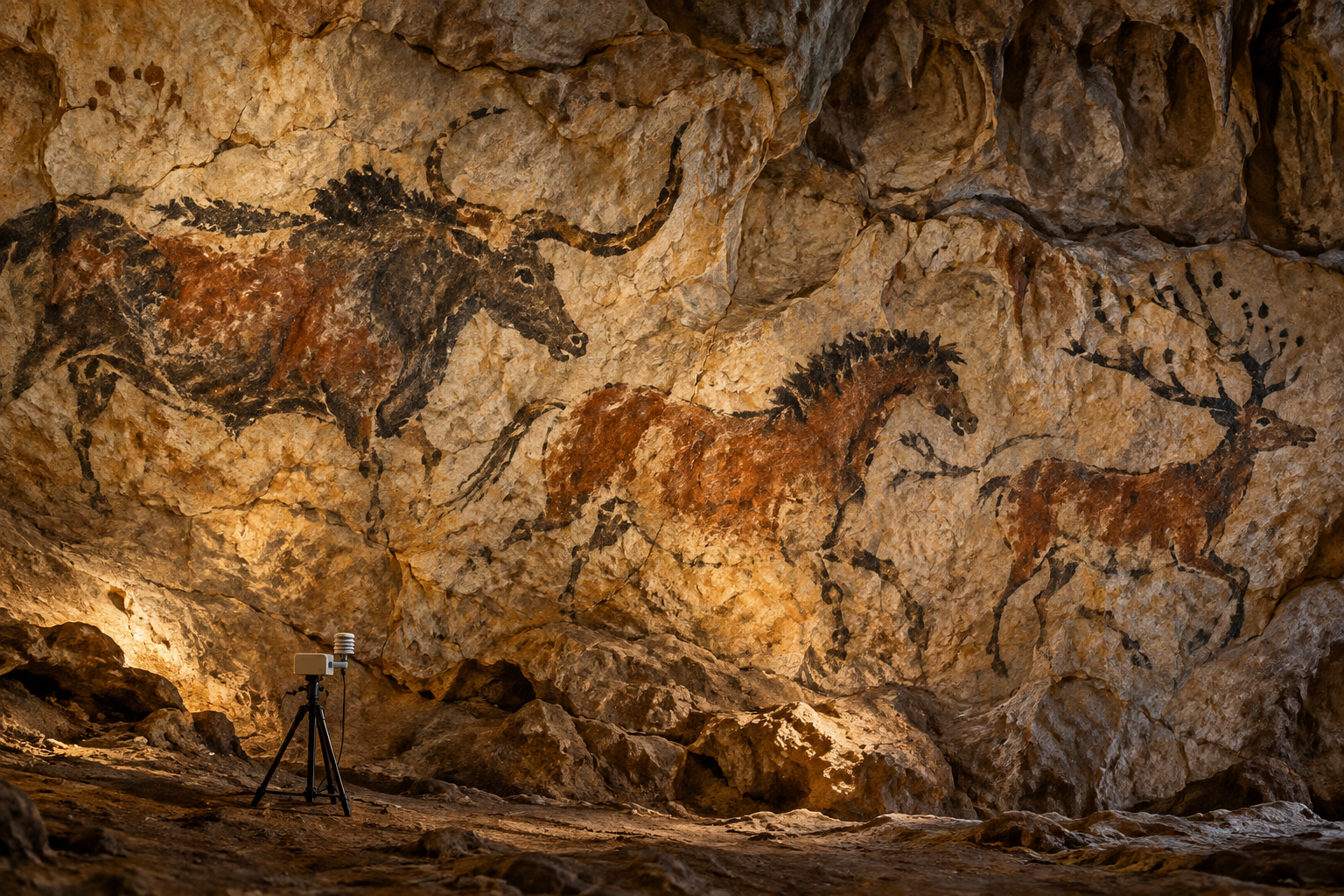
The animals at Lascaux seem to move with the wall. A curve in the limestone becomes part of a body; overlapping outlines suggest a lively visual world. Yet keeping this art available to future generations has required an unusual decision: visitors encounter reproductions and digital models while the original cave is protected.
Discovered in 1940 in southwestern France, Lascaux became a celebrated example of prehistoric art. The original was closed to the public in 1963. That closure is not the end of its story. It is the beginning of a long lesson in how difficult it can be to preserve an underground environment.
A cave is more than a display room
It is tempting to imagine conservation as repairing an individual patch of paint. In a cave, the surrounding system matters. Water moves through rock; air and gases circulate; temperature and moisture affect surfaces. A change somewhere else can alter conditions beside an image.
The Ministry of Culture's research pages describe investigations into transfers of water, carbon dioxide and other materials. This work examines relationships between the rock massif and the cave, rather than assuming that every environmental change has a single obvious cause.
A gallery can often be redesigned around an artwork. At Lascaux, the artwork is inseparable from its rock surface and underground setting. Instruments, restricted access and carefully assessed interventions are part of learning how that setting behaves.
Living communities on ancient surfaces
Microorganisms introduce another layer of complexity. The official account of Lascaux's microbial research describes an approach that studies communities and the balance between them. It seeks to understand the conditions that encourage imbalance, rather than simply eliminate whichever organism looks dominant.
That distinction is useful far beyond caves. Removing a visible symptom does not necessarily solve its cause. Scientific conservation asks what changed, which organisms are involved and how an intervention might affect the wider environment. Observation and caution can be active forms of care.
Reproductions as a form of access
Lascaux's replicas allow people to encounter the arrangement and scale of the paintings while reducing pressure on the original. They are openly presented as reproductions. Their value lies in interpretation, education and experience, supported by documentation of the protected cave.
Digital access adds another option. A three-dimensional model can help viewers follow passages and see how images relate to the rock. It cannot replace the original physical setting, but it can reveal relationships that a small photograph crops away.
Explore: The French Ministry of Culture's Lascaux 3D resource provides an official digital way into the cave.
Lascaux therefore asks an unusually practical question about cultural heritage: how can many people experience something that unlimited access might harm? Its continuing answer combines research, reproduction and a willingness to treat the surrounding environment as part of the artwork's survival.
Sources: French Ministry of Culture: Lascaux and its replicas · Lascaux: microbial ecology research · Lascaux: water and carbon-based material transfers
Explore more creative curiosities at Incoprea.




