A person speaks in a room. Sound takes the direct route to your ears, then arrives again after bouncing from walls, ceiling and furniture. Yet you usually hear a person in one place, rather than a crowd of equally convincing copies. The room supplies repeated arrivals; perception organizes them into a usable event.
The precedence effect describes how earlier arriving sound can dominate perceived location when closely followed by related sound. The later arrival is not simply deleted. It can affect loudness, spaciousness or other qualities even when it is not heard as a separate source.
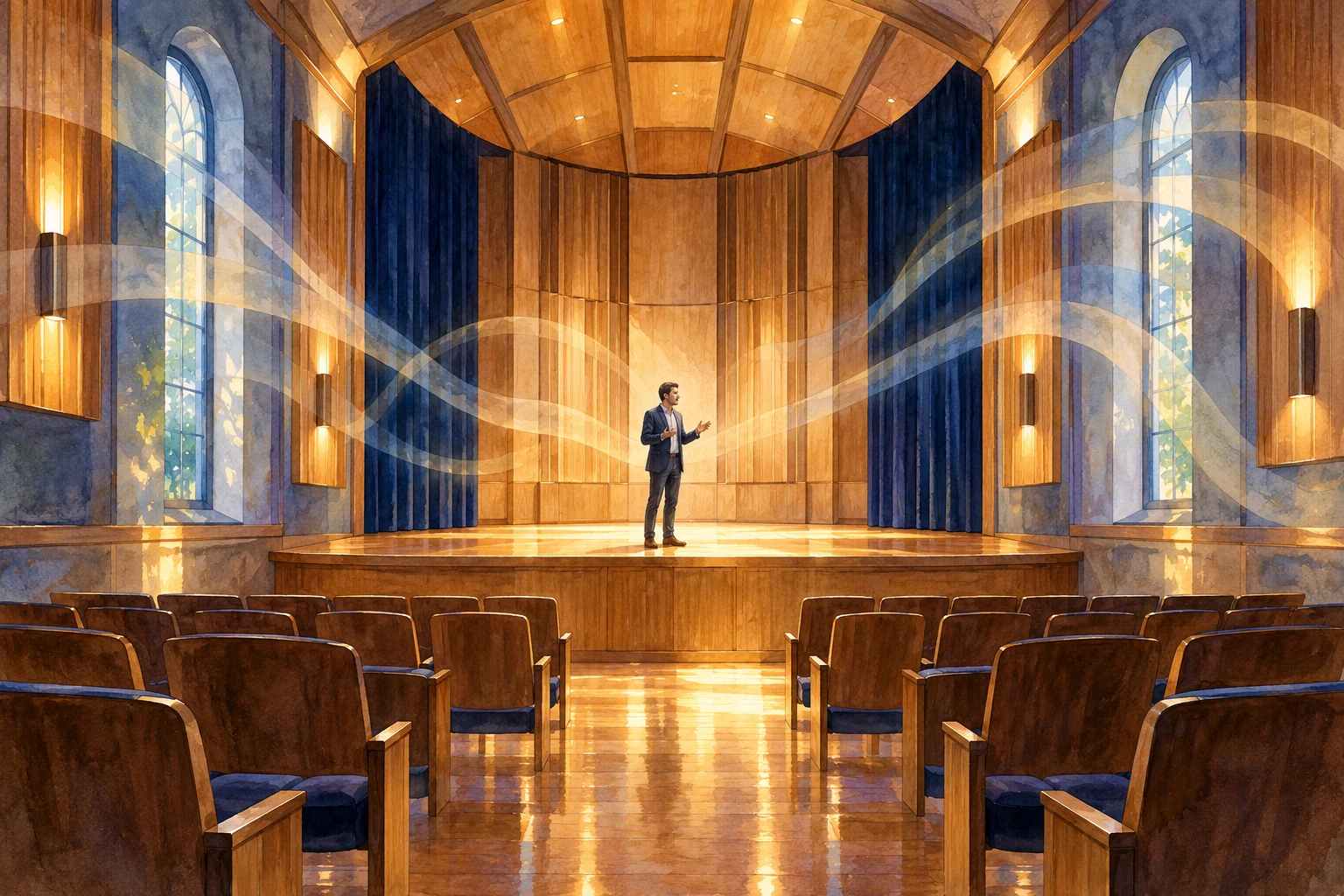
The room is full of extra paths
Start with a geometry example. If one reflection travels 3.43 meters farther than a direct sound, it arrives about ten milliseconds later using a rounded sound speed of 343 meters per second. The value changes with air conditions, and a real room offers many paths. The calculation shows that apparently simultaneous listening can include physically ordered arrivals.
Diana Deutsch's account of auditory illusions describes the classic two-loudspeaker arrangement: related signals arrive with a short delay, and listeners can perceive one event localized toward the leading source. Increase the delay sufficiently and a separate echo may become apparent. A specific transition depends on the signal and conditions; “the echo threshold is always X milliseconds” is an unsafe shortcut.
Fusion and location are different questions
The review by Ruth Litovsky and colleagues distinguishes aspects of precedence behavior rather than treating it as one switch. Whether two sounds fuse, where an event appears, and how well a listener can discriminate changes in a lagging source are related but different experimental questions.
Imagine answering three separate prompts after a paired sound: “How many events?” “Where?” and “Did the second source move?” A person might report one event, locate it near the first source, yet still retain some information about the later sound. The labels help prevent the misleading statement that the brain ignores everything after the first arrival.
That distinction is useful beyond the laboratory. A reflection can be perceptually bound to a voice and still alter the room's character. “I do not hear a separate echo” does not establish that the room has made no audible contribution.
Hear the timing ingredients
The following original stereo signals provide a timing comparison. They are not a replication of a free-field two-loudspeaker experiment. Headphones send channels to ears differently from loudspeakers in a room; a phone may sum both channels into one output. Start quietly. Each file contains three brief, gently faded noise-burst pairs.
Equal channel timing
Right channel delayed by 2 milliseconds
Right channel delayed by 10 milliseconds
Right channel delayed by 50 milliseconds
If you cannot distinguish positions, record that rather than infer a problem with your hearing. Check whether the playback actually has separate stereo channels. If you hear differences in texture but not event count, that is also a meaningful description of the demonstration. The physical delay is specified; your perceptual report is a separate observation.
The sound before the test is part of the test
A fixed delay does not always produce a fixed report. In Sanders and colleagues’ event-related-potential experiment, recent click sequences changed whether listeners reported a later test pair as one source or two. Crucially, the comparison could use physically identical test pairs. What changed was the listening context leading up to them.
The experiment separated a repeating lead–lag sequence from a context preceded by single-source clicks. The latter reduced the buildup of echo threshold. Changes in the recorded electrical response accompanied changes in the reported number of sources. The result connects recent auditory history, behavior, and a defined physiological measure; it does not identify a complete internal room map directly.
Make a listening-history ledger for the article’s existing files. Use one row for each attempt and columns for the file, preceding file, playback device, and your report. Do not merge a first encounter with a replay merely because the filename matches. This is an observation aid, not a replication: the original files do not supply the study’s conditioning sequences, loudspeaker arrangement, or electrical recording.
Why ask about history beyond clicks? In Brandewie and Zahorik’s 2010 virtual-room study, fourteen listeners heard target speech with or without preceding speech exposure to the simulated room. Prior exposure improved average intelligibility under the tested reverberant, binaural conditions. The benefit was absent in the anechoic comparison and greatly reduced during monaural listening.
Those controls distinguish a room-related benefit from the simpler claim that hearing any introductory sentence always makes the next one easier. They also keep the result tied to a specified task. The finding does not promise that waiting in a difficult hall will solve its acoustical problems.
For a final paper challenge, write two interpretations of a fictional observation: “The third sentence was clearer than the first.” One interpretation concerns familiarity with the words; another concerns adaptation to the listening environment. List a comparison that would help separate them. Holding the environment fixed while changing speech, or comparing consistent and changing environments, asks a more precise question than repeating the observation alone.
A room is present in the sound’s routes and in the listener’s recent experience. Following both makes the word “first” richer: it can refer to the earliest arrival within one event, while the events heard beforehand still influence how that arrival is organized.
A developing listener need not use the same cues identically
An experimental comparison of children and adults examined precedence behavior in complex localization tasks. The findings connect to development of spatial hearing, but they do not turn a home echo demonstration into an age test. The controlled task, comparison groups and stimuli are essential to interpreting a result.
This is a recurring strength of perception research. It can take a familiar ability—finding a speaker in a room—and separate it into conditions precise enough to reveal differences. It does not have to assume that the everyday success is produced by one unchanged rule across all people and environments.
The first arrival is valuable because it often offers a relatively direct clue to the source. But hearing has to operate in a world where reflections carry useful information too. The interesting achievement is not eliminating the room. It is keeping a voice locatable while still allowing the space around it to be heard.
Sources and a closer look: Litovsky and colleagues: the precedence effect review; Diana Deutsch: precedence and auditory illusions; Experimental comparison of children and adults.
Explore art, experiments and other unexpected connections at Incoprea.




