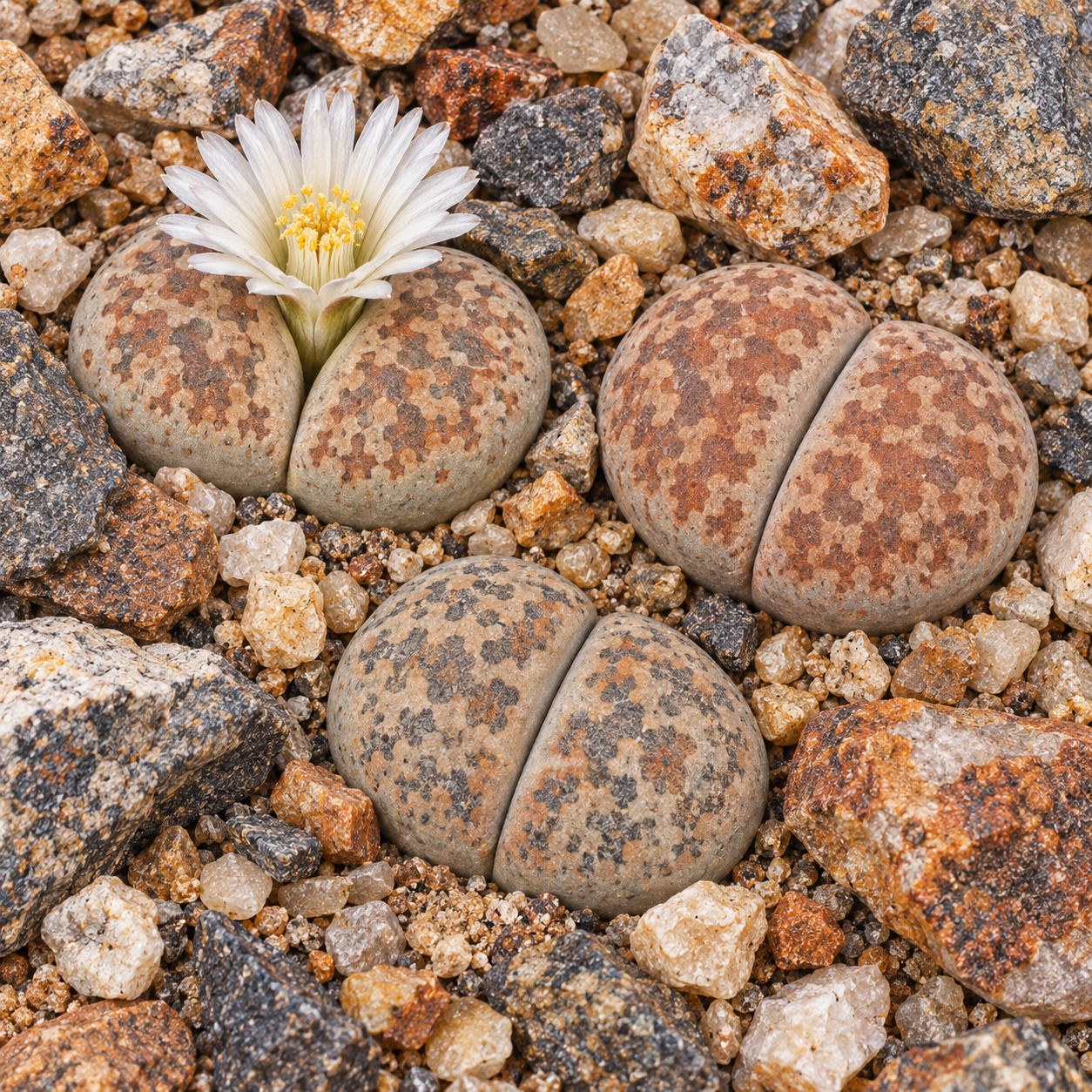
Look across a patch of gravel in southern Africa and a small plant may remain invisible in plain sight. Lithops, often called living stones, resemble rounded pebbles. Their muted colors and patterns make them easy to overlook until a flower emerges from the gap between their leaves.
The resemblance is only the beginning. These plants solve a difficult problem: how to conserve water and keep a low profile while still collecting the light needed for photosynthesis. Part of the answer is a leaf that acts as a window.
Two leaves, a very compact body
A typical Lithops body consists largely of a pair of thick succulent leaves, joined low down and separated by a fissure at the top. Much of that body sits below the surface in its natural habitat. The leaves store water, and their exposed tops blend with the surrounding stones.
That compact form reduces exposed surface area and helps the plant live in dry settings. It also places much of its green, photosynthetic tissue away from direct sunlight. A plant buried in gravel needs a route for light as well as a strategy for saving moisture.
A window with a complicated job
Translucent areas near the leaf tips let light reach internal tissues. They are called windows, but they are living structures rather than clear panes of glass. Patterns and differences in window size affect what enters the leaf.
Research by Charles Martin and colleagues examined window physiology across Lithops species. They found larger windows in plants from wetter, less intensely sunny regions, and smaller windows in plants from drier, more strongly illuminated habitats. Their experiments also showed that admitting light can increase internal thermal demands.
The lesson is a useful one: more sunlight is not always better. A leaf must gather enough energy without absorbing an excessive load. A feature that allows light into a sheltered body can also require limits on that light.
| Feature | Biological tradeoff |
|---|---|
| Low, partly buried body | Less exposure, but less direct light |
| Water-storing leaves | Reserves held in valuable living tissue |
| Leaf windows | Light access balanced against excess radiant energy |
A stone-like appearance is not stillness
A flower emerging between the leaves reveals the plant's identity dramatically. Growth also replaces an old leaf pair with a new one. The outwardly quiet shape belongs to a changing organism, with cycles that a quick glance cannot show.
Science & Plants for Schools uses Lithops to teach adaptation because several features can be considered together: camouflage, reduced exposure, water storage and translucent tissues. No single feature explains the whole plant.
The most interesting living stone is therefore not a plant pretending to be an object. It is a compact biological compromise, shaped by the demands of a dry environment. Looking closely turns a pebble into a lesson about light, water and the many ways a leaf can be a leaf.
Sources: University of Wisconsin: living stones · Martin and colleagues: leaf-window physiology · Science & Plants for Schools: Lithops adaptations
Explore more creative curiosities at Incoprea.




