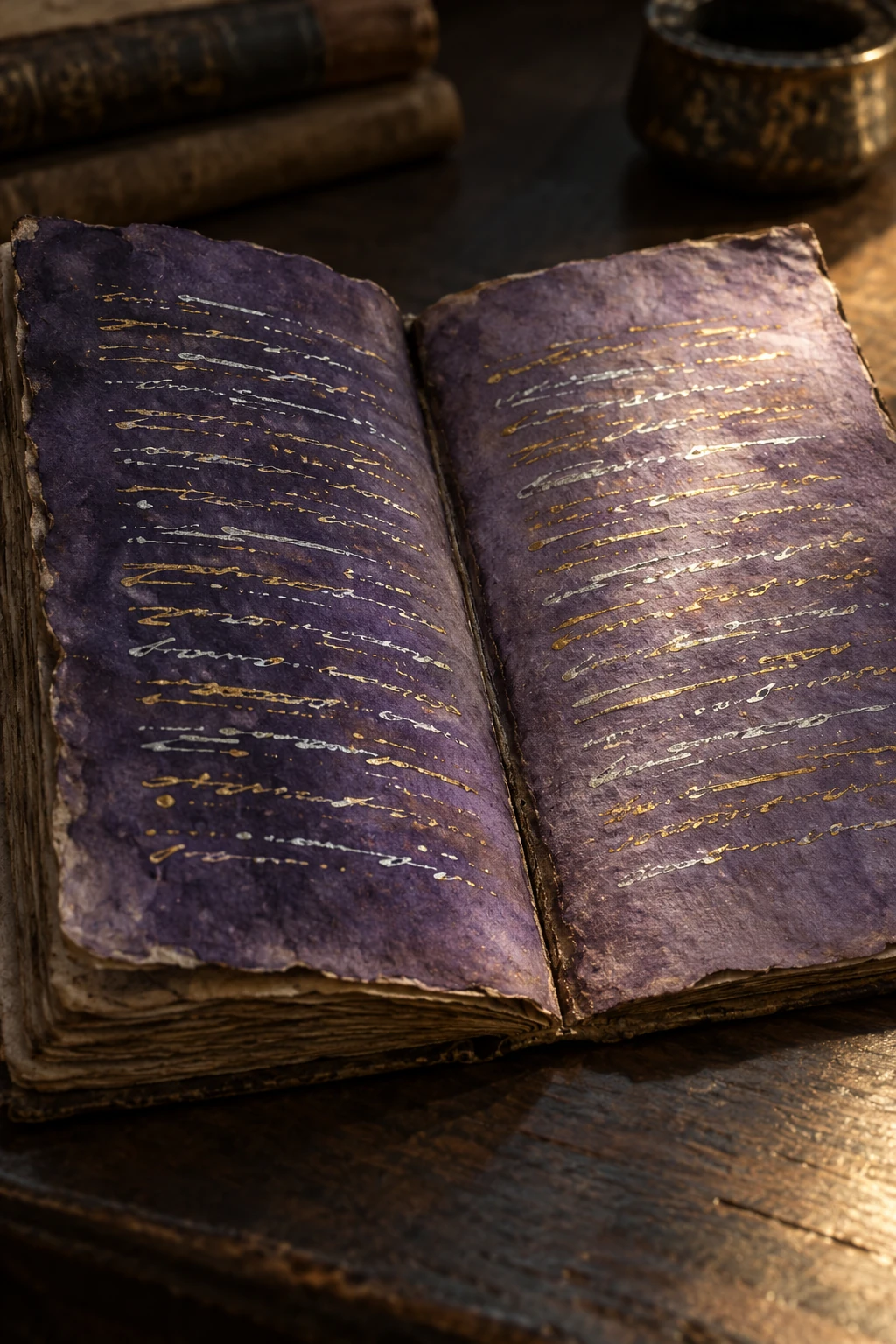
A page does not have to be white. In a luxury manuscript, the writing surface itself can be a deep purple, with letters in silver or gold. The book announces a material ambition before a reader identifies a single word.
Yet the color is a question, not an answer. Purple parchment does not automatically mean one particular dye. Metallic-looking writing does not explain itself from a photograph. A careful encounter with these books moves between appearance, catalog history, and material analysis.
Two books, several centuries apart
The Codex Argenteus at Uppsala University Library was written in Italy in the early sixth century in silver and gold ink on purple parchment. Its Gothic text is a major surviving source for that language. The book matters for what it says and for the unusually rich material form in which the words survive.
Compare it with the Golden Gospels of Henry VIII at the Morgan Library. Made in Trier around 980, it was copied by about sixteen scribes in gold on purple parchment. The Morgan identifies the coloring as orchil, a lichen-derived colorant. Its familiar title comes from an owner centuries after its manufacture. A book’s present name is not necessarily a description of who commissioned or made it.
Putting these manuscripts together does not make their materials, institutions, or circumstances identical. It reveals a recurring attraction to a richly colored page and luminous lettering, while leaving room for distinct choices in different workshops and periods.
What is the purple made of?
Because purple is associated with prestigious ancient dyes, it is easy to assume that every purple book used a rare shellfish colorant. Material evidence can complicate that assumption. A 2017 scientific-research conference abstract on Morgan manuscripts explicitly frames the question of whether costly traditional colorants or more readily available alternatives were used.
A spectroscopic study of the sixth-century Codex Rossanensis reported evidence for an elderberry-based lake among its purple materials. That result belongs to that studied manuscript. It is a reason to investigate, not a license to assign elderberry to every purple page in a museum case.
The useful lesson is about categories. “Purple” is a visual description. “Orchil” or “elderberry lake” is a material identification that needs a source and method. “Imperial” is a historical interpretation of use or symbolism. A single adjective should not silently perform all three jobs.
Metal letters change the act of looking
A bright letter can become dark when the viewing angle changes. A digital photograph freezes one combination of illumination, surface condition, and camera position. It can make a reflective mark seem like a flat patch of color. Without access to the actual book, the reader depends on careful photography and documentation to understand its surface.
The Library of Congress record for the Purple Gospel offers a digitized encounter with another manuscript written largely in gold and silver on purple-stained parchment. Such images are valuable because they permit repeated, close viewing. They still do not reproduce the weight, flexibility, reflectance, and scale of the physical leaves.
Try comparing two photographs of one manuscript page, if its holding institution provides them. Do apparent dark areas move? Does a line look interrupted in one image but continuous in another? Treat the variation as a question about the imaging and material surface before assuming damage or a change in the original text.
Read the page as a made object
A useful close-looking sequence starts at the margin and moves inward. First locate the edge of the leaf. Then find the text block. Notice how blank space, columns, line spacing, enlarged letters, and metallic emphasis organize the reader’s attention. Only after that should you ask what an individual word means.
This approach is useful even if you cannot read Gothic, Latin, or Greek. It gives you access to decisions about the physical page without pretending language does not matter. Layout can be observed; translation requires linguistic knowledge; identifying the materials may require scientific analysis. These routes complement one another.
Uppsala’s Codex Argenteus Online project also reminds us that a manuscript continues to acquire scholarly forms through editions and digitization. The ancient object and the modern tools for reading it have different histories.
When viewing a full opening, compare the left and right pages before enlarging a single letter. Does the color appear continuous across them? Are the text blocks balanced? A stain, different lighting, or a replacement image may interrupt that apparent unity. Noticing an interruption supplies a question for the catalog; it does not yet identify the cause.
A small experiment in attention
Use two sheets of ordinary colored paper, one pale and one dark. Write the same short original sentence on each with whatever light and dark pencils you already have. Do not use valuable materials or attempt historic dye recipes. The point is to compare reading, not reconstruct a manuscript workshop.
- View both pages from across a table. Which marks are legible first?
- Move closer and compare whether the background feels empty or visually active.
- Change the lighting direction. If a pencil has any sheen, notice how its appearance shifts.
- Leave a wide margin on one version and a narrow margin on another. Observe how the material and spacing work together.
The result is not evidence about medieval readers’ feelings. It is an exercise in noticing how a writing surface participates in the presentation of words. A color that looks sumptuous may also make an unusual demand on contrast and light.
The purple page is therefore more than a lavish container for a text. It is the outcome of decisions about skin, color, metal, labor, authority, and reading. The strongest museum question is wonderfully simple: which of those decisions can this particular book still help us understand?
Sources and a closer look
Uppsala University Library: Codex Argenteus; Morgan Library: Golden Gospels of Henry VIII; Scientific research abstract: Royal Purple and Burgundian Black; Codex Rossanensis spectroscopic study; Library of Congress: Purple Gospel; Uppsala: Codex Argenteus Online project.
Find more art, ideas, and unexpected connections at Incoprea.