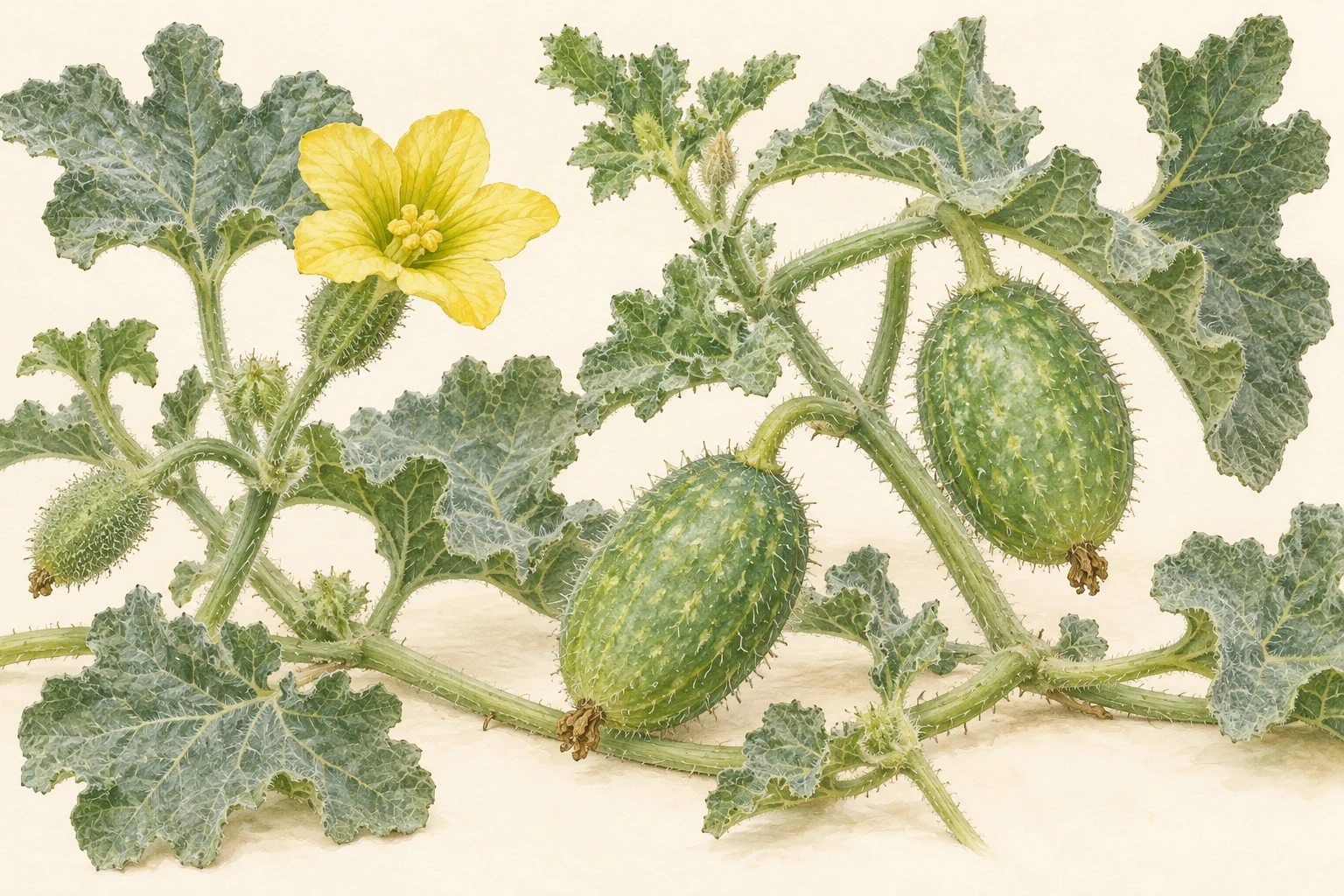
The fruit looks uneventful: a small hairy green oval on a sprawling plant. Then it separates from its stalk and ejects seeds in a brief stream of mucilage. The squirting cucumber, Ecballium elaterium, makes seed dispersal look like a sudden prank. The more interesting discovery is how much preparation takes place before that visible instant.
A launch needs stored energy, an opening, and a useful orientation. It also needs to distribute offspring rather than simply drop them into one pile. Studying the fruit as a whole mechanism reveals how slow changes in fluid and stem structure help set up an event too fast to follow with an unaided eye.
Days of preparation, milliseconds of release
A 2024 PNAS study combined high-speed recording, imaging, experiments, and mathematical modeling. The Oxford research account describes a multistage system. The ripening fruit accumulates pressurized fluid. In the days before dispersal, fluid redistribution changes the stem's dimensions and stiffness, altering the fruit's position. When the attachment gives way, the opening releases the seed-bearing jet.
That sequence means pressure alone is not the full explanation. A pressurized container aimed at the ground and one oriented into open space can release the same kind of jet with very different consequences. The support structure is part of the dispersal system, not merely a convenient place to hang the fruit.
The researchers also considered motion during the release. As the fruit changes orientation, seeds do not all leave under an identical set of conditions. The changing launch can spread seeds over an area. A plant's dispersal performance depends on the distribution of trajectories, not only the furthest seed.
Slow motion is evidence, not merely spectacle
Oxford's account reports an ejection lasting about 30 milliseconds, with seed speeds around 20 meters per second in the described observations. At an ordinary 30 frames per second, one frame interval is roughly 33 milliseconds. The entire fast event can therefore occur in about the time between two ordinary frames.
That comparison explains why high-speed recording changes the question we can answer. A normal video can show that a fruit was attached and then released material. A sequence with many observations during the release can help track where the opening points and when seeds leave it. Better temporal resolution can expose structure in what first looked instantaneous.
What counts as a successful dispersal?
A long flight may reduce competition with the parent or nearby siblings, but distance alone cannot establish eventual reproductive success. A seed must land in a suitable place, remain viable, germinate under useful conditions, survive, and eventually reproduce. A mechanical study can show how the launch shapes the starting distribution without measuring every later stage.
The paper's modeling compared the observed system with altered scenarios to investigate the contribution of its parts. Such comparisons are stronger than merely declaring the plant “perfectly designed.” They ask how performance changes when orientation, pressure-related conditions, or other features differ within a specified model.
A near-optimal result within that model does not prove that no alternative organism could disperse farther, or that every real fruit achieves the same range. It tells us that the arrangement can make mechanical sense under the assumptions and conditions evaluated. The limits make the conclusion more useful, because they show what was tested.
For plant identity, the Kew profile provides a botanical starting point. Despite its common name, this is not an invitation to treat the plant as an edible garden cucumber. The RHS profile includes hazard information. Watch the research footage rather than handling or triggering unfamiliar fruits near the face.
The mechanism also offers a good antidote to the idea that plants move only slowly. Growth and fluid redistribution can prepare stored energy over a long interval; release can then be rapid. The visible speed does not imply a hidden muscle. It reflects a change in how previously stored energy is constrained.
Seen this way, the little fruit contains a coordinated history. The stem changes before the fruit lets go. The opening directs a jet. Motion during the jet helps shape where successive seeds travel. A brief squirt is the readable end of several interacting processes—and the beginning of many uncertain journeys across the ground.
Follow the evidence: Box and colleagues: mechanics of seed ejection; Oxford: experiments, videos and the launch sequence; Kew: squirting cucumber plant profile; Royal Horticultural Society: plant identification and hazards.
More curious connections, art and independent projects at Incoprea.