The Unlikely Record · Episode 29 · Twelve stories
Twelve encounters between official ritual and practical reality
A ceremony promises that everyone knows where to stand, what to say and what will happen next. The surviving records often reveal something less settled: a disputed credential, a revised invitation, an accommodation, or a moment remembered differently from the way it occurred. These twelve stories follow the people and decisions behind public ritual, keeping the documented sequence separate from the polished anecdote.
Story 01
One Flag, Two Different Salutes
At the opening of the London Olympics, Ralph Rose carried the American flag before King Edward VII. The familiar version gives him one defiant action: refusing to lower it. But the ceremony contained two separate opportunities to salute, and treating them as one helped turn a complicated record into a patriotic anecdote.
The teams first stood in formation facing the royal box. Later, they marched past it. Newspaper descriptions did not always distinguish those moments, and reports also confused the man carrying the national nameboard with the flag-bearer. In 1999, Olympic historians Bill Mallon and Ian Buchanan compared the accounts and suggested that Rose might have acted differently at each salute.
Bob Wilcock’s 2011 study supplied photographic evidence for that distinction. During the stationary salute, Rose lowered the flag with the others. During the march-past, he held it upright while American teammates removed their caps. The pictures allow both observations to be true without requiring the ceremony to happen twice.
The accompanying quotation about a flag dipping to no earthly king has a shakier history. Mallon and Buchanan found no 1908 source for Sheridan’s supposed words. The missing American flag among the stadium decorations was a real, separately corrected grievance. Later retelling compressed decoration, gesture, motive and quotation into a single dramatic scene that the surviving evidence does not support.
Evidence and sources
Photographs distinguish two moments often collapsed into a single story. The famous declaration attributed to Martin Sheridan lacks a contemporary source.
- To No Earthly King: The United States Flag-Bearing Incident at the 1908 Olympic Games Opening Ceremony — Bill Mallon and Ian Buchanan; Journal of Olympic History 7(3), September 1999
Printed pp. 21–28; contemporary reports, competing salutes, Sheridan quotation and conclusion - This Flag Dips to No Earthly King: The 1908 Olympic Opening Ceremony: Fresh Evidence — Bob Wilcock; Journal of Olympic History 19(1), March 2011; LA84 Foundation
Complete article, printed pp. 39–45
Story 02
The Credentials Needed Another Ocean Crossing
The Iwakura Mission arrived in Washington carrying a letter from Japan’s emperor and ambitions far larger than a courtesy call. Its members hoped to study foreign institutions and improve the unequal treaties governing Japan’s relations with Western powers. Formal reception did not settle whether they could actually sign a new agreement.
At the first official negotiating meeting on 11 March 1872, the Japanese representatives maintained that they possessed that authority. Secretary of State Hamilton Fish disagreed. They could discuss revision, he said, but lacked the necessary plenary powers to conclude it. The meeting’s practical business became a disagreement about what their credentials permitted.
The mission decided to pursue formal negotiations. Itō Hirobumi and Ōkubo Toshimichi returned to Japan to obtain additional authority, extending what had begun as preliminary discussions into months of waiting. They reached Washington again on 22 July with the new powers. By then, the obstacle was larger than paperwork: the two sides still disagreed about the proposed treaty.
The negotiations ended without an agreement. Emperor Meiji’s introductory letter had spoken of consultation, institutional reform and a future revision after the embassy returned. Washington exposed the distance between those broad purposes and a document authorizing signatures. Crossing the ocean again could repair the credential problem, but it could not compel the other government to surrender privileges.
Evidence and sources
Japanese archival records distinguish diplomatic introduction from authority to sign a revised treaty.
- Treaty Revision Negotiations by the Iwakura Mission and Their Legacy — Japan Center for Asian Historical Records, National Archives of Japan
Complete first essay, through conclusion on treaty revision; later essays on education and students were not used - Letter from Emperor Meiji to President Ulysses S. Grant, on the Iwakura Mission, 1871 — Emperor Meiji; Asia for Educators, Columbia University
Complete two-page teaching document
Story 03
The Portrait Offered a Diplomatic Compromise
A portrait of George III became part of an argument about how far his ambassador should bow. Lord Macartney had brought British gifts to the Qianlong emperor, including scientific instruments and images of the royal family. Their intended message of wealth and standing encountered a different ceremonial understanding of the visit.
Macartney objected to performing the kowtow because he believed it would show greater submission than he offered his own king. The Royal Collection records his proposed compromise: a Chinese official of equivalent rank would perform the same ceremony before George’s portrait. Reciprocity might make a physical gesture acceptable to both courts. The proposal itself does not establish that the bargain was accepted.
Qianlong received the delegation at Chengde on 14 September 1793, and gifts passed in both directions. Britain sought wider commercial access, an offshore trading base and diplomatic representation in Beijing. The emperor’s responses rejected those requests and described the embassy through the language of tribute and imperial favour.
The surviving edicts make the disagreement more substantial than a dispute about etiquette. Each government approached the exchange with assumptions about authority, trade and the proper place of a foreign representative. An ingenious suggestion involving a painted king could address the appearance of respect. It could not, by itself, create agreement about the political relationship that respect was supposed to express.
Evidence and sources
The audience, exchanged gifts and rejected trade demands are documented. The reciprocal bow was a reported proposal, not an established agreement.
- George III: Portraits and Protocol in the Macartney Embassy — Royal Collection Trust
- Two Edicts from the Qianlong Emperor on the Occasion of Lord Macartney’s Mission, September 1793 — Qianlong Emperor; Asia for Educators, Columbia University
Introduction and translated excerpts, pp. 1–2 - The Macartney Embassy Having an Audience at the Garden of Ten Thousand Trees — National Palace Museum, The Chengde Summer Resort
Receiving Foreign Dignitaries: Macartney audience and tribute-list sections
Story 04
The Audience Moved Before It Happened
Li Hongzhang’s American visit depended on meeting a president who was away from Washington. The Chinese statesman carried an autograph letter from his emperor, and presenting it was the central formal purpose of his journey. Waiting indefinitely in the capital would interfere with his return to China before winter disrupted navigation.
In July 1896, Chinese minister Yang Yü explained the problem to the State Department. Li could visit the president at his summer residence or another convenient place. The request made room for an audience outside the customary setting, allowing ceremony to follow the traveller’s timetable rather than force the traveller to wait for the setting.
An August letter fixed the meeting in New York for the thirty-first. It also offered a special train to Washington and onward toward Canada, with an army officer detailed to attend Li. Then, on 25 August, another letter changed the appointment: President Grover Cleveland would receive the party on the twenty-ninth at eleven in the morning, at 2 West Fifty-seventh Street.
The correspondence preserves diplomacy as a practical chain of adjustments: location, date, transport and escort. Before sailing from Vancouver on 13 September, Li sent formal thanks for the welcome and the officers’ attention. The grandeur of an imperial letter still required someone to solve the much smaller problem of getting its bearer and its recipient into the same room.
Evidence and sources
A sequence of diplomatic letters records changes to the audience’s location and date; the farewell telegram records Li’s expressed thanks.
- Yang Yü to Richard Olney, July 18, 1896 — Chinese Legation; United States Department of State, FRUS 1896, document 64
- William W. Rockhill to Yang Yü, August 12, 1896 — United States Department of State, FRUS 1896, document 67
- William W. Rockhill to Yang Yü, August 25, 1896 — United States Department of State, FRUS 1896, document 68
- Li Hung Chang to Yang Yü, September 13, 1896 — Li Hongzhang; United States Department of State, FRUS 1896, document 69
Story 05
The Surprise Had Been Negotiated
.jpg)
Napoleon placing a crown on his own head looks like the perfect unscripted interruption. In popular retelling, the pope is about to crown him when the emperor seizes control. The ceremonial history describes something more deliberate: French and papal negotiators had already worked through the actions and prayers.
The service at Notre-Dame on 2 December 1804 combined elements of French royal coronations, papal imperial rites and newly designed imperial ceremony. Pius VII anointed Napoleon and Joséphine. At the appropriate point, Napoleon took the crown from the altar and placed it on his head. He then crowned Joséphine, who knelt before him.
The political boundaries extended beyond the crowning moment. After the mass, the pope withdrew to the sacristy before Napoleon pronounced the constitutional oath. That oath upheld arrangements, including the civil code and the disposal of former church property, with which papal teaching conflicted. The order of the service made space for those disagreements without requiring their resolution.
Jacques-Louis David’s great painting added another layer of arrangement. It shows Joséphine’s coronation rather than Napoleon’s self-crowning and includes his mother, who had not attended. Neither the painting nor the famous anecdote is a neutral replay. The event’s drama came from carefully negotiated assertions of power, later reorganized into images and stories that looked more immediate than the planning behind them.
Evidence and sources
The self-coronation is documented; its familiar portrayal as a spontaneous affront to a surprised pope is contradicted by the negotiated ritual.
- Napoleon’s Consecration and Coronation — Peter Hicks; Fondation Napoléon
Napoleon crowns himself; surrounding discussion of the hybrid liturgy - The Day of Napoleon’s Coronation and Consecration, 2 December 1804 — Fondation Napoléon
The ceremony: anointing, crowns, enthronement and constitutional oath - The Sacre or Coronation — Fondation Napoléon
Story 06
The Patron Could Not Choose Every Picture
John Quinn helped make the Armory Show possible, but even its powerful patron could not make the selection committee accept everything he wanted. When he gave the opening speech in February 1913, the exhibition already contained the results of arguments, negotiations and refusals that its formal welcome could conceal.
Quinn was a lawyer, collector and honorary member of the Association of American Painters and Sculptors. He incorporated the association, helped secure the exhibition space and contacted people in Europe about loans. He hoped to promote English and Irish artists in particular. Yet his letters list works by several artists that the committee declined, alongside the pictures it accepted.
The show opened at the 69th Regiment Armory on 17 February and ran in New York until 15 March before travelling to Chicago and Boston. Its European experiments became a focus of enthusiastic and hostile commentary. The Smithsonian’s surviving records show that publicity was actively organized, rather than simply arriving as an accidental reward for artistic daring.
Quinn also changed through the exhibition he promoted. He bought works by Paris-based artists and later developed a collection more committed to modern European experiments. His opening role makes him look like the man announcing a settled programme. His correspondence shows a patron working within a committee’s decisions and then discovering that the event could alter his own judgement as well as the audience’s.
Evidence and sources
Quinn’s correspondence documents promotion, rejected loans and changing purchases. The story concerns the opening and its immediate collecting consequences.
- John Quinn and the 1913 Armory Show — Tal Nadan, Manuscripts and Archives Division; New York Public Library
- About the 1913 Armory Show — Kelly Quinn; Archives of American Art, Smithsonian Institution
Story 07
The Cameras Were Invited Back
The coronation that became a landmark television event was initially going to keep most of its ceremony off the screen. On 20 October 1952, Buckingham Palace announced that television coverage would be restricted to the procession entering and leaving Westminster Abbey. The BBC’s proposal for wider access had encountered resistance over equipment, strain and the sacred character of the service.
The exclusion prompted complaints in newspapers and Parliament. Discussions reopened, and on 8 December the decision to televise the ceremony was announced. The change still had boundaries: the anointing and communion would remain concealed, and camera access was not permission to treat every moment as a close-up spectacle.
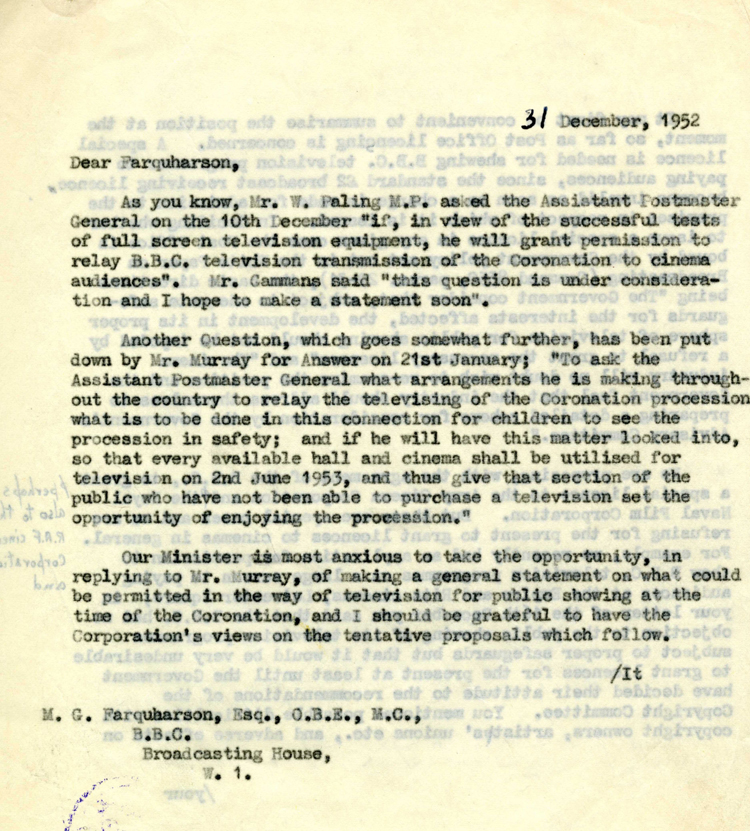
Agreement about the cameras created another problem: access to the picture. A government letter to the BBC on 31 December asked about relaying the coronation to cinema audiences. It also quoted a parliamentary question concerning halls, children’s safety and people who could not afford a television set. The audience was being planned alongside the ceremony.
Elizabeth II was crowned on 2 June 1953. The broadcast’s eventual familiarity can make its existence seem inevitable. The retained correspondence shows a succession of decisions instead: whether to transmit, what to conceal, and where people could gather to watch. A ceremony built around controlled admission now required officials to think about participation far beyond the doors of the abbey.
Evidence and sources
Committee records and government correspondence trace a reversal over television access and continuing questions about public screenings.
- The Television Broadcast of the 1953 Coronation, The Family Firm, chapter 6 — Edward Owens; University of London Press
Opening analysis and television negotiations from June to December 1952 - Screening the Coronation: Letter to the BBC, December 31, 1952 — Overseas Telecommunications Department; The National Archives, HO 256/323
Story 08
The Cathedral Service Came Down the Steps
_-_Queen_Victoria%27s_Diamond_Jubilee_Service,_22_June_1897_-_613_-_Guildhall_Art_Gallery.jpg)
Queen Victoria arrived at St Paul’s Cathedral for her Diamond Jubilee and stayed in the carriage. This was an accommodation built into the ceremony. By 1897, walking was difficult for her, and the cathedral’s stairs presented a practical obstacle to the national service of thanksgiving.
The solution moved the gathering outside. Clergy, choir and dignitaries assembled around the west steps while the queen remained seated below. The Royal Collection’s photograph catalogue explicitly connects that arrangement with her difficulty mounting the stairs. Ceremonial authority did not depend on making her complete a painful climb.
The procession on 22 June brought seventeen carriages through London. Victoria travelled with her daughter Helena and the Princess of Wales, behind eight cream horses. The cathedral records a service lasting about twenty minutes, with music, prayers and a blessing. Afterwards, the queen continued her tour through the city rather than entering the building to complete a second version of the event.
The arrangement joined a vast imperial celebration to a very ordinary human limitation. Crowds, troops and carefully placed seating made the day expansive, but its central ritual was adjusted around one person’s mobility. The records of the outdoor service show how those needs were joined: a monarch travelling through the city, and a ceremony brought to the place where she could take part.
Evidence and sources
The cathedral and Royal Collection record a service arranged outdoors so Victoria could remain in her carriage.
- Queen Victoria’s Diamond Jubilee Service in Front of St Paul’s Cathedral, June 22, 1897 — Royal Collection Trust, RCIN 2942076
- Royal Jubilees: Queen Victoria’s Diamond Jubilee — St Paul’s Cathedral
Complete Queen Victoria subsection
Story 09
The Emperor Listened to an Unfinished Invention
Before the emperor heard the telephone, Alexander Graham Bell was worried about the demonstration. In a letter of 21 June 1876, he described an invitation to exhibit alongside Elisha Gray on the coming Sunday. Gray had substantial equipment and battery power. Bell felt hurried, poorly assisted and uneasy about the direct comparison.
On 25 June, Emperor Pedro II of Brazil and scientist William Thomson attended the exhibits at Philadelphia’s Centennial Exhibition. Bell’s letter to his parents two days later describes the emperor recognizing him from an earlier introduction in Boston. After Gray’s demonstration, the visitors examined Bell’s apparatus and tried signalling with it.
Bell then offered to transmit the human voice, describing his invention as still developing. He went to another room to sing and speak. His account carefully identifies Willie Hubbard as the source for some of what the listeners did while he was absent. Thomson recognized words, and the emperor expressed surprise that he could hear.
The familiar polished version often supplies a different memorable exclamation for Pedro. Bell’s immediate letter is more useful for the uncertainty it preserves: preparation, rivalry, partial expectations and reports passed between rooms. A royal visitor did not transform a finished consumer product into an attraction. He helped make an experimental demonstration conspicuous at the moment its inventor was still explaining how much he hoped it would do.
Evidence and sources
Bell’s contemporary letters document nervous preparation and success. Some listeners’ reactions reached him through Willie Hubbard.
- Alexander Graham Bell to Mabel Hubbard, June 21, 1876 — Library of Congress, Alexander Graham Bell Family Papers
Complete transcript; planned Sunday demonstration and concerns about competing equipment - Alexander Graham Bell to His Parents, June 27, 1876 — Library of Congress, Alexander Graham Bell Family Papers
Complete two-page transcript - 1870 to 1879: Alexander Graham Bell Timeline — Library of Congress
Story 10
The Officer’s Task Went to a Sergeant
Four identical caskets stood in a French city hall, and someone had to choose the American Unknown Soldier. The original instructions assigned the task to a commissioned officer. Shortly before the ceremony, the plan changed: the Americans learned that France had given the equivalent honour to an enlisted man.
Major General Harry Rogers authorized a similar choice. Major Robert Harbold selected Sergeant Edward Younger, one of the soldiers attending from the American occupation force in Germany. On 24 October 1921, Younger entered the room at Châlons-sur-Marne and placed white roses on one casket.
The Army had taken precautions against identification. The remains came from four American military cemeteries in France, and the caskets had been rearranged onto different shipping cases. Younger was choosing a representative for the nation’s unidentifiable war dead, not deciding which individual life deserved greater recognition. The selected casket travelled through Le Havre to the United States and ultimately Arlington.
Younger later returned to civilian work in Chicago. When a newspaper found him in 1930, he had not yet been able to afford a visit to the tomb. It paid for the journey, and he again laid roses there. The ceremonial decision had briefly made one sergeant indispensable, then left him living an ordinary life at a distance from the memorial with which his name would remain linked.
Evidence and sources
Official records establish the changed selection protocol and choice by roses. The sergeant’s internal experience is known through later recollections.
- A Humble Sergeant: Edward F. Younger and the Unknown Soldier — Tim Frank, historian; Arlington National Cemetery
- Tomb of the Unknown Soldier: The World War I Unknown — Arlington National Cemetery
October 1921 selection and journey to Arlington
Story 11
The Interpreter Recorded a Joke About Interpreters
At lunch during the Vienna summit, Nikita Khrushchev praised direct conversation between leaders and joked about the disadvantages of love conducted through interpreters. We know the remark through an interpreter’s record. Alexander Akalovsky drafted the American memorandum of the meeting, preserving a joke that playfully diminished the work making the exchange possible.
The luncheon on 4 June 1961 followed difficult discussions with President John F. Kennedy. Khrushchev’s toast acknowledged that the two sides had not reached an understanding. He argued that personal meetings were still preferable to leaving every difficult question to ambassadors and lower officials, even while Berlin remained a source of dangerous disagreement.
Kennedy’s reply also combined courtesy with warning. Modern war, he said, could affect succeeding generations. Near the end, he recalled asking what position Khrushchev had held at forty-four, Kennedy’s own age. Kennedy joked that at sixty-seven he hoped to head Boston’s planning commission. Khrushchev suggested a worldwide version; Kennedy kept the ambition local.
The memorandum records humour without turning it into evidence of agreement. Its provenance matters: Akalovsky drafted it, and the White House approved it later that month. The summit’s toasts could sound companionable while the political positions remained far apart. Behind the apparent ease of a personal encounter stood interpreters, notes and subsequent approval—the machinery through which the conversation became a historical record.
Evidence and sources
An interpreter-drafted memorandum preserves the luncheon toasts. It is an official reconstructed record, not a verbatim sound recording.
- Editorial Note on the Vienna Summit, June 3–4, 1961 — United States Department of State, FRUS 1961–1963, Volume V, document 82
- Memorandum of Conversation at Lunch, Vienna, June 4, 1961 — Alexander Akalovsky; United States Department of State, FRUS 1961–1963, Volume V, document 88
Story 12
The Toast Reached the Pianist
A formal dinner at Potsdam reached the point where Joseph Stalin raised a toast to the pianist. Harry Truman described the evening in a letter to his wife, Bess, on 20 July 1945. The previous night, he had hosted Winston Churchill on his right and Stalin on his left after another difficult day of meetings.
The dinner included a succession of toasts to heads of state, honoured guests and foreign ministers. Music then gave Stalin an additional subject. Truman wrote that the pianist had played Tchaikovsky especially for him, and Stalin responded by saying he would bring a leading Russian pianist to perform for the American president.
The performer was Eugene List, an American soldier and accomplished pianist. Truman praised the range of music he played, including Chopin, Weber and Schubert. A later photograph catalogue records List presenting the president with music from the Potsdam performance in January 1946. It provides a quiet documentary continuation to the evening’s more theatrical exchange of hospitality.
Truman’s letter reports that his guests left in a happy mood; the same letter makes his impatience with the negotiations plain. The music offered a temporary shared experience within a meeting full of incompatible demands. It did not supply a political settlement. In the private account, the formal sequence of honouring leaders briefly expanded to include the enlisted musician whose performance had altered the tone of the room.
Evidence and sources
Truman’s letter the next day records the dinner and Eugene List’s performance. Its description of Stalin’s mood is Truman’s observation.
- Harry S. Truman to Bess W. Truman, July 20, 1945 — Harry S. Truman; Truman Presidential Library
Source 7: complete July 20 letter - President Truman Meets with Staff Sergeant Eugene List, January 4, 1946 — Truman Presidential Library, photograph 64-166
Protocol can make a gathering appear inevitable. Letters, photographs and meeting notes return the choices to view: who was included, what was changed, and which later story displaced the record. The most revealing moment is often the practical decision that the ceremony was designed to make invisible.
About the evidence labels
Documented identifies a supported historical event. Disputed marks an account whose explanation or details remain contested. Folklore identifies a recorded tradition; its inclusion does not establish that a supernatural event occurred.