The Unlikely Record · Episode 28 · Twelve stories
Twelve haunting reports, investigations and contested explanations
A noise, a movement or an unfamiliar figure can become a story before anyone agrees what happened. These cases follow the records left behind: a court transcript, a newspaper report, laboratory measurements, diaries and memories written down later. Some describe documented human consequences; others preserve disputed experiences or folklore. Their interest lies as much in the questions people asked as in the answers they wanted.
Story 01
The Ghost Made an Accusation
A tapping sound could become an accusation when listeners agreed on a code. In the Cock Lane affair, one knock meant yes and two meant no. Questions addressed to the alleged spirit produced a charge that William Kent had poisoned Fanny, his deceased partner.
The noises centred on Elizabeth Parsons, the daughter of Kent’s former landlord. By early 1762 the affair had drawn crowds and newspaper attention. The Wellcome Collection still holds contemporary press material and satirical engravings: the disturbance had become a public spectacle with an audience far beyond the bedroom.
Samuel Johnson joined an inquiry on 1 February. Its account described a period of silence, then renewed noises reported while some observers were downstairs. When the company returned and required the child’s hands to remain outside the bedclothes, nothing followed. The group also went to the burial vault where the supposed spirit had promised another signal. That promise produced silence too.
The investigators concluded that the noises were counterfeit. Later that year, several adults were convicted of conspiracy. Yet historical discussion continued over whether one exposed method explained all the earlier reports. For Kent, the urgent issue had been simpler: a roomful of people was treating noises as testimony against a living man.
Evidence and sources
The inquiry and public controversy are documented. The supposed ghost’s accusation of murder was rejected, and the surviving accounts disagree about how every noise was made.
- Cock Lane and Common-Sense, first published 1894; text with later preface — Andrew Lang / Project Gutenberg
Cock Lane and Common-Sense chapter, Cock Lane case before the comparative Irish account - Complete contemp. history of Cock Lane Ghost — Wellcome Collection
Wellcome work ygan4b8r - Cock Lane Ghost — Society for Psychical Research
Background: William Kent, Richard and Elizabeth Parsons
Story 02
A Confession Followed by a Retraction
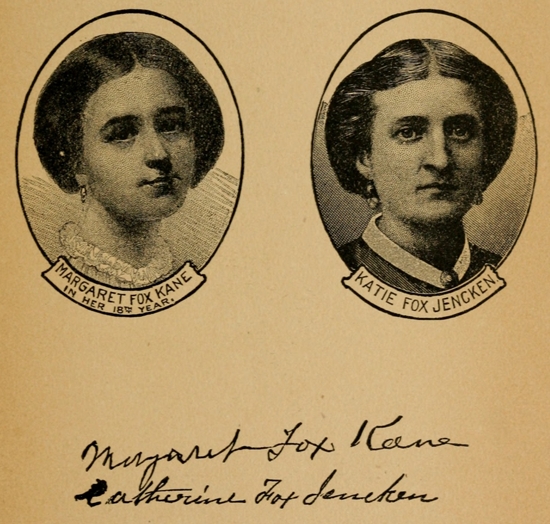
The Fox family’s reported knocks at Hydesville helped launch a public movement. Margaret and Catherine Fox became associated with communications supposedly received from spirits, turning sounds in a rural New York home into a subject for performances, investigations and belief.
On 21 October 1888, Margaret appeared at New York’s Academy of Music with a very different account. She denounced the mediumship as deception and demonstrated sounds attributed to movement of a toe joint. Catherine was present. Reuben Briggs Davenport’s book celebrated the appearance as a decisive exposure, printing the sisters’ authorization and presenting the demonstration as the end of the controversy.
It was not the end of Margaret’s public statements. In November 1889, the Religio-Philosophical Journal reported that she had withdrawn her confession. Its account reproduced an interview in which she blamed people hostile to Spiritualism and described a wish to return to the platform. The newspaper approached her reversal from a very different position than Davenport’s denunciation.
The printed record therefore preserves a demonstration, a confession, a recantation and opposing attempts to explain them. It offers no reason to pretend the contradictions disappeared. The same woman whom rival audiences treated as decisive evidence could make a later statement that unsettled their preferred conclusion.
Evidence and sources
The sisters’ public career, Margaret’s 1888 confession and her subsequent recantation are documented. The competing statements do not establish a supernatural explanation.
- The Death-Blow to Spiritualism: 1888 text, 1897 edition — Reuben Briggs Davenport / Project Gutenberg
Preface; pages 73–82 and plate vii - Religio-Philosophical Journal, 30 November 1889 — Religio-Philosophical Journal / IAPSOP
Religio-Philosophical Journal, 30 November 1889, first page, final column
Story 03
The Haunted House Had an Archive
Harry Price rented Borley Rectory in 1937 for a year of investigation. The red-brick house had already attracted reports of footsteps, moving objects and a spectral nun. Price’s involvement turned a collection of local stories into an organized and highly publicized inquiry.
The surviving University of London catalogue gives that project a tangible shape. There are observer reports, correspondence, photographs and drawings. Sidney Glanville’s material includes a locked book, while a village-fête poster advertises conducted tours. The same location could be a place to watch for an unexplained event and a place visitors wanted to see.
A fire badly damaged the rectory in February 1939. Investigations continued among the ruins before demolition in 1944. The loss of the building did not end the argument. A critical report published in 1956 by Eric Dingwall, Mollie Goldney and Trevor Hall challenged Price’s reliability and proposed ordinary explanations for the incidents.
Robert Hastings later disputed important parts of that criticism. Borley consequently left two overlapping records: accounts of things allegedly happening inside a house, and a prolonged argument about the people who recorded them. Its archive remains useful precisely because it preserves reports and disagreements as distinct things. A locked notebook is evidence of an investigator’s work; its lock cannot guarantee the truth of every entry.
Evidence and sources
Reports, organized observation and later critical investigations survive. Neither the archive’s size nor its vivid allegations establishes a haunting.
- Borley Rectory — Society for Psychical Research
Investigations by Harry Price from 1937; SPR Investigation; Vindication of Price - Harry Price archive catalogue — Senate House Library, University of London
HPC/3F; HPC/3G5–6; HPI/2/7 - Harry Price archive HP — Senate House Library, University of London
Harry Price archive HP
Story 04
The Chair Stayed on the Floor
In a much-retold Enfield police statement, a chair moved. The detail matters: Constable Caroline Heeps described it wobbling and sliding several feet across the floor. She explicitly said that it did not leave the floor. A later image of flying furniture would be a different claim.
The reported disturbances began in the Hodgson household in 1977. Maurice Grosse and Guy Lyon Playfair spent extensive time investigating, accumulating recordings, witness accounts and descriptions of knocks, moving objects and an unusual voice. Their long involvement gave the case an unusually large documentary record.
It also produced disagreements about what that record could establish. The investigators acknowledged that some incidents involved tricks, while maintaining that others resisted such an explanation. Later critics, including Joe Nickell, emphasized observation gaps and the possibility that apparently airborne figures in photographs could be children jumping.
An admission of some trickery cannot by itself reconstruct every reported event. An unexplained remainder cannot by itself establish a ghost. Enfield is most revealing when individual claims keep their original shape: who was present, what they described and what a recording actually captures. Heeps’s qualification is a small example of the difference. Her statement contains a startling movement and a firm limit, both of which belong to the story.
Evidence and sources
Witness statements and recordings are documented, but their interpretation remains disputed. The police statement describes a chair sliding, not levitating.
- Enfield Poltergeist — Society for Psychical Research
PC Caroline Heeps; investigation and criticism sections - Enfield Poltergeist (2012), complete article PDF — Joe Nickell / Committee for Skeptical Inquiry
Skeptical Inquirer, July/August 2012, pages 12–14
Story 05
The Recorder Drew a Mystery
The disturbance in a Rosenheim law office acquired a particularly persuasive prop: a measuring instrument. In late 1967, reports of troublesome lights, telephone activity and moving objects brought utility workers and investigators to an ordinary workplace. Large deflections on a recorder seemed to offer something firmer than a recollection.
Physicists Friedbert Karger and Gerhard Zicha compared the recorder with other equipment. Their report described occasions when the trace deflected without a corresponding increase in mains voltage on the checking oscilloscope. The dramatic line on the paper was therefore not simply a measured surge in the electrical supply.
That distinction did not settle the cause. The physicists investigated possible interference and manipulation, eventually arguing that familiar physical explanations were inadequate. Their paper also contained a practical limitation: they generally inspected the resulting trace rather than directly watching the pen at the instant it moved.
Hans Bender’s accompanying report connected the disturbances with an employee’s presence and interpreted the case as psychokinesis. He acknowledged that continuous observation could not be maintained. Read together, the papers preserve a real investigation, disputed interpretations and gaps in observation. The office became famous because instruments seemed to bring precision to an elusive event. The surviving technical account is also where some of the most consequential uncertainties are recorded.
Evidence and sources
The original investigators published measurements and their interpretation. Recorder deflections were distinguished from actual voltage surges; the reports do not independently prove psychokinesis.
- Der Rosenheimer Spuk – ein Fall spontaner Psychokinese (1968), pp. 104–112 — Hans Bender / University Library Freiburg
Hans Bender, Der Rosenheimer Spuk – ein Fall spontaner Psychokinese, 1968, pages 104–112 - Physikalische Untersuchung des Spukfalles in Rosenheim 1967, pp. 113–131 — F. Karger and G. Zicha / University Library Freiburg
Friedbert Karger and Gerhard Zicha, Physikalische Untersuchung des Spukfalls in Rosenheim, 1968, pages 113–116 and 131
Story 06
The Mongoose Left Paperwork
At a remote Isle of Man farmhouse, the Irving family said they shared their home with a remarkable animal. Gef, as they called it, was described as a mongoose that spoke, supplied gossip and behaved with an unsettling independence. The claim attracted investigators who were accustomed to unusual testimony, but this was an unusually talkative subject.
Much of what remains is paper. The Harry Price archive contains copies of James Irving’s diaries beginning in 1932, letters, interview material and reports from visitors. Price and Richard S. Lambert’s visit is dated in the catalogue to 30 July through 1 August 1935. They subsequently published The Haunting of Cashen’s Gap in 1936.
The catalogue also lists hair samples with different labels. Some are associated with Gef; others carry the name Mona. A label records what someone said a sample was. It does not, without examination and analysis, turn that identification into a biological finding.
These small objects give the affair a different texture from a simple tale about an impossible pet. Diaries show a claim developing over time; correspondence shows outsiders trying to engage with it. The archive securely preserves that activity. It leaves Gef’s extraordinary identity on the other side of the distinction between an account of a creature and a creature independently established.
Evidence and sources
The Irving family’s claims and investigators’ papers survive. Catalogue descriptions and labelled samples do not independently establish a talking animal.
- Gef! The Strange Tale of an Extra-Special Talking Mongoose — Christopher Josiffe, archival researcher
Introduction to Gef and the Irving family - Harry Price archive catalogue — Senate House Library, University of London
HPC/3F; HPC/3G5–6; HPI/2/7 - Harry Price archive HP — Senate House Library, University of London
Harry Price archive HP
Story 07
The Woman Only One Visitor Saw
Two visitors lost their way near the Petit Trianon on 10 August 1901. Charlotte Moberly and Eleanor Jourdain later described an oppressive stillness, oddly dressed people and a route that seemed difficult to recover. Their 1911 book, An Adventure, transformed the walk into a proposed encounter with an earlier Versailles.
One of its strongest details is also one of its clearest disagreements. Moberly remembered a woman holding a paper, apparently sketching near the house. At the time she thought the woman might be a tourist in unusual clothes. Jourdain said she had seen no such person.
According to the book, that difference emerged when the women discussed the visit on 10 November, three months after the walk. They then resolved to write separate accounts and investigate the place’s history. The printed narrative therefore contains both a remembered experience and the later research through which they tried to make sense of it.
The eventual interpretation connected the scene with Marie Antoinette’s world. But a historical identification developed afterward is not the same thing as an identification made during the walk. Their own account preserves this distance. Before there was a celebrated story of time displaced, there were two visitors comparing memories and discovering that they had not seen precisely the same scene.
Evidence and sources
The visitors published retrospective accounts and interpreted them as an encounter with the past. Their own book records differences between what they remembered seeing.
- An Adventure (1911) — C. A. E. Moberly and E. F. Jourdain / Project Gutenberg
Preface; pages 1–26, especially pages 13–14 - The ghosts of Trianon — Château de Versailles
The ghosts of Trianon; 10 August 1901 and 1911
Story 08
The Official Asked Not to Be Blamed


The report ended with an appeal to the authorities: if anything improper had occurred, the official asked that the blame fall on the frightened villagers rather than himself. That administrative concern survives beside one of Europe’s early printed vampire accounts.
In 1725, an imperial administrator known as Frombald reported events at Kisilova. A man named Peter Plogojoviz in the newspaper had been dead for about ten weeks. Villagers said several subsequent deaths followed nighttime visits in which he had attacked the living. Those were their explanations for the deaths, relayed by the official.
The community demanded that the body be exhumed and dealt with according to local practice. Frombald wanted instructions from the administration in Belgrade. The villagers threatened to leave their homes if he delayed. He attended with an Orthodox priest and described the corpse’s appearance in terms he believed supported their fear. The body was staked and burned.
The Wienerisches Diarium printed the report on 21 July. Its two surviving newspaper pages preserve more than a monster story. They show a local official caught between procedure and a community unwilling to wait. His testimony documents the action and the pressure he described; it does not establish the dead man’s alleged return.
Evidence and sources
A contemporary administrative report describes exhumation under community pressure. Its claims about a returning dead man are reported beliefs, not evidence that a vampire existed.
- Copia eines Schreibens aus dem Gradisker District (1725) — Wienerisches Diarium / Austrian National Library / Wikisource
Wienerisches Diarium, 21 July 1725, pages 11–12 - Doubt and diagnosis: Medical experts and the returning dead of the southern Habsburg borderland (1718–1766) — Ádám Mézes / Central European University
Title page; printed page 7 - Wienerisches Diarium, 21 July 1725, page 11 — Austrian National Library scan / Wikimedia Commons
Page 11; report begins in page 11 right column and ends in page 12 left column - Wienerisches Diarium, 21 July 1725, page 12 — Austrian National Library scan / Wikimedia Commons
Page 12; report begins in page 11 right column and ends in page 12 left column
Story 09
The Missing Diary Behind the Witch
In the most influential printed Bell Witch account, a family’s trouble begins with sounds around a house. Knocks at doors and walls become part of a much larger story of voices, physical attacks and an unseen presence. John Bell’s death in December 1820 supplies the narrative with a fearful climax.
The detailed book appeared in 1894, more than seventy years after that death. Martin Van Buren Ingram presented it as an authenticated history, drawing on family material and stories associated with the Tennessee community. Its chapter headed Our Family Trouble attributes a long account to Bell’s son, Richard Williams Bell.
That attribution is central to the book’s authority. A son remembering his own household seems to bring the reader much closer to the events. Yet the original earlier manuscript claimed behind the printed text has not surfaced in a form that resolves the problem. The modern North Carolina state history explicitly draws attention to this evidentiary gap.
The surviving book is therefore secure evidence of how the Bell Witch story was assembled and circulated in the late nineteenth century. Its title cannot make the alleged supernatural episodes independently authenticated. The unsettling feature of this case is not only the voice said to come from nowhere. It is how much of the familiar narrative rests on another voice that reaches us through a later compiler.
Evidence and sources
The Bell Witch is a folklore tradition. Ingram’s detailed 1894 account relies partly on a claimed earlier family manuscript whose original has not been independently established here.
- An Authenticated History of the Famous Bell Witch (1894), full OCR — M. V. Ingram / Internet Archive
An Authenticated History of the Famous Bell Witch, 1894; introduction and chapter VIII - Bewitched in Tennessee — North Carolina Department of Natural and Cultural Resources
Bewitched in Tennessee, 20 December 2016
Story 10
The Ghost Wore Working Clothes
Thomas Millwood wore the white working clothes of a bricklayer: linen trousers, a waistcoat and an apron. In a neighbourhood frightened by ghost reports, that ordinary clothing became dangerous.
On 3 January 1804, Francis Smith went out armed to look for the supposed apparition. He shot Millwood in a dark Hammersmith lane. At the Old Bailey, Millwood’s sister Ann described hearing a challenge and the gunshot shortly after her brother left their parents’ house. When others did not believe her alarm, she went out and found him dead.
Witnesses described earlier reports of a figure in white, sometimes supposedly wearing an animal disguise. Another witness had urged Millwood to put on a greatcoat because someone had already mistaken his clothes for the ghost. None of that made him the person responsible for the earlier appearances.
Smith said he had been frightened and had not intended to kill. The jury initially returned manslaughter, but the judge told it that verdict was unavailable. The recorded result was a murder conviction and death sentence. The most certain presence in this ghost story is consequently a named working man, whose death could not be undone by explaining how afraid his killer had been.
Evidence and sources
The shooting and trial are documented in the Old Bailey proceeding. Reports of an earlier disguised figure do not establish that the victim was impersonating a ghost.
- Trial of Francis Smith t18040111-79: full public record API — Old Bailey Proceedings Online / University of Sheffield
Old Bailey t18040111-79, Francis Smith, January 1804 session
Story 11
The Investigator Became the Narrator
Walter Hubbell arrived in Amherst on 21 June 1879 with an intention to expose the reported disturbances around Esther Cox. He was an actor, and the book he soon published described an investigator becoming convinced by the very subject he had come to challenge.
Hubbell said that he spent six weeks in the household. In his account, ordinary belongings became the instruments of extraordinary events: an umbrella moved, objects shifted and sounds arrived without an evident human cause. He repeatedly emphasized where Cox’s hands and feet were while incidents occurred, presenting his attention to them as a safeguard against deception.
The narrative’s confidence should remain attached to its narrator. Hubbell wrote as a participant and advocate, sometimes referring to himself in the third person as the author. Later criticism questioned the quality of the observation and the possibility of tricks. Neither dramatic assurance nor a later speculative diagnosis can substitute for evidence that was never securely recorded.
His final chapter offers a quieter scene. Visiting Cox at friends’ farm on 1 August, he described her peacefully occupied with quilting and no longer tormented. The book’s last insistence that it was a true ghost story sits beside that ordinary activity. The surviving document tells us most securely how Hubbell shaped an elusive household disturbance into a compelling public narrative.
Evidence and sources
Hubbell’s stay and published account are documented. The spectacular movements he describes remain his claims; later criticism does not establish a retrospective diagnosis of Esther Cox.
- The Haunted House: A True Ghost Story (1879) — Walter Hubbell / Project Gutenberg
The Haunted House: A True Ghost Story, 1879, pages 50–60 - The Amherst Poltergeist — Deborah Hyde / The Skeptic
Deborah Hyde, The Amherst Poltergeist, 2021
Story 12
The Same House Held Different Stories
In accounts of the Baldoon disturbance, a marked piece of lead was thrown into the river and then supposedly returned to the troubled house. Such details made the McDonald family’s experience near the St. Clair River unusually memorable. The later tradition places the disturbance in 1829, and successive versions added increasingly elaborate explanations.
The surviving tradition does not speak with one voice. In his 1861 history, the Methodist missionary Peter Jones dated the disturbance to 1824 and recalled visiting the house while travelling in the region. He stated that he saw nothing unusual. He also recorded other people’s testimony, keeping his own visit distinct from events he had only heard described.
An Anishinaabe chief offered Jones another explanation. The house, the chief said, occupied a place formerly associated with small spirit beings. Its owners had cut and burned a poplar grove, and the disturbance was their retaliation. In that telling, the consequential act was the clearing of a place that already had inhabitants and meaning.
Later witch stories and accounts of flying objects are only part of Baldoon’s record. Jones’s passage preserves a different relationship between land, settlement and unseen presence. It is a particular explanation transmitted through a missionary’s writing, not a universal Indigenous belief. Alongside the tale of returning lead sits a more grounded historical question: whose understanding of the place was heard when settlers called it haunted?
Evidence and sources
The disturbances generated reports and later folklore. Peter Jones records both his own uneventful visit and a particular Anishinaabe explanation, without independently establishing supernatural activity.
- Baldoon Mystery — Rick Fehr / Society for Psychical Research
Rick Fehr, Baldoon Mystery - History of the Ojebway Indians (1861) — Peter Jones / University of Pittsburgh / Internet Archive
History of the Ojebway Indians, 1861, pages 157–159
A report can be vivid without being conclusive, and an investigation can matter without resolving its subject. These cases leave behind precise observations, contradictory memories and consequences that were entirely human. Keeping those differences intact allows the stories to remain strange without asking uncertainty to serve as proof.
About the evidence labels
Documented identifies a supported historical event. Disputed marks an account whose explanation or details remain contested. Folklore identifies a recorded tradition; its inclusion does not establish that a supernatural event occurred.


