The Unlikely Record · Episode 04 · Twelve stories
Twelve stories of forged objects, persuasive claims and the tests that changed their meaning
A real book can carry a false signature. A genuine photograph can record a staged scene. A scientific instrument can seem to report something after its crucial component has been removed. These twelve episodes follow claims through the objects and institutions that made them persuasive. Some involved deliberate deception; another grew from mistaken observation. The strange part often appears where confidence meets a surviving detail that refuses to cooperate.
Story 01
The Ancestor Made from Two Species

The skull seemed to arrive with the answer already inside it. In 1912, Charles Dawson brought human-looking fragments from Piltdown to Arthur Smith Woodward of the Natural History Museum. Further finds included a jaw, teeth and tools. Reassembled and announced at the Geological Society, they were presented as evidence of an ancient human ancestor.
The proposed individual joined a large braincase to an apelike jaw. Its apparent combination made the fragments compelling, but their association was precisely what needed testing. Being found near one another did not establish that they had belonged to the same creature, or even to the same period.
Kenneth Oakley’s fluorine testing in 1949 undermined the claimed antiquity. Further investigation with Joseph Weiner and Wilfrid Le Gros Clark revealed a human skull joined to an ape’s jaw. Microscopic scratches showed that teeth had been filed. Artificial staining helped unlike materials resemble the gravel in which they supposedly belonged.
The 1953 exposure changed the object’s meaning without changing its pieces. The remains still deserved preservation, now as evidence of manufacture and misplaced confidence. The decisive story lay in the marks left on their surfaces: traces of someone making the past look the way it was expected to look.
Evidence and sources
The forgery and its physical tests are established. The identity of every person involved is a separate question.
- Piltdown Man — Natural History Museum
Story 02
The Stones Came with Writing

The stones delivered to Johann Beringer in 1725 offered an unusually generous natural history. They showed plants and animals, but also celestial forms and writing. A professor investigating figured stones near Würzburg now possessed objects that seemed to demand explanations beyond ordinary fossilization. He prepared an illustrated book, published in 1726.
The finds were manufactured. Smithsonian Libraries traces the deception to colleagues who arranged carved stones for Beringer’s diggers to find. Genuine fossils in the same collecting ground helped make the false ones harder to dismiss. Even an excavation witnessed by another person could verify only where an object lay, not how it got there.
The familiar ending is almost too perfectly shaped: Beringer supposedly found his own name on a stone, realized everything, and bankrupted himself buying back his book. The Smithsonian account identifies the name incident as inherited lore and finds no evidence for the bankruptcy. A 1726 court case belongs to the firmer record.
Beringer continued at the university and published further work. His illustrated volume also survived, eventually becoming collectible for the very error it recorded. A forged fossil could lose its authority as geology while gaining another kind of value: a durable record of an argument over how nature should be read.
Evidence and sources
The fabricated stones and1726publication are documented; the famous own-name discovery and bankruptcy ending are not established.
- A Heavy Hoax: The Lying Stones of Johann Beringer — Smithsonian Libraries
- Würzburger Lügensteine — University of Würzburg Library
Story 03
The Fake Acquired a Rival Fake

Workers digging a well on William Newell’s farm uncovered a gigantic stone figure on October 16, 1869. Visitors came to Cardiff to inspect it, and an admission charge did little to discourage them. Some argued that it was a petrified person. Others preferred an ancient statue. Either explanation gave the object an impressive past.
Its recent past was more useful to its promoters. George Hull had arranged for a block of gypsum to be carved, transported and buried. The apparent discovery converted a manufactured object into an attraction. The museum that now holds it traces Hull’s plan to 1868, before the crowds reached the farm.
Inspection threatened the performance. Yale paleontologist Othniel Marsh identified visible tool marks, and Hull eventually acknowledged the deception. Yet the figure continued drawing spectators. P.T. Barnum sought access to the attraction; after his offer was refused, he commissioned a plaster counterpart and exhibited that instead.
Now the owners of a fake faced competition from a fake of their fake. The episode exposes an awkward difference between believing an object and wanting to see it. Once the giant became famous, even its dishonesty could sell a visit. The object had entered history through a false antiquity and remained there through the very public story of its manufacture.
Evidence and sources
The carved giant, staged discovery and competing replica are documented; publicity should not be read as evidence of an ancient body.
- The Cardiff Giant — Fenimore Farm, formerly The Farmers’ Museum
- The Cardiff Giant and CNY’s Biggest Hoax — Onondaga Historical Association
Story 04
A Telescope Reported an Inhabited Moon

In August 1835, readers of The Sun encountered a report with the reassuring shape of scientific news. A series of six articles described discoveries supposedly made by the astronomer John Herschel at the Cape of Good Hope. The account also invoked the Edinburgh Journal of Science, giving a newspaper sensation the appearance of an academic route into print.
Its instrument was as remarkable as its findings. An extraordinary telescope allegedly projected detailed lunar views for several observers to examine together. Forests, rivers and animals filled the moon. Winged, humanlike inhabitants supplied an especially memorable discovery. Readers were being invited into an observation room that the report itself had invented.
Herschel was a real astronomer. That genuine name helped support an imaginary apparatus and imaginary discoveries. The Cooper Hewitt account also preserves an essential complication: some readers accepted the news, some questioned it, and others were skeptical from the beginning. The audience was never a single mind waiting to be fooled.
The series became known as the Great Moon Hoax. Its lasting device was a chain of borrowed credibility, leading from a familiar newspaper through a scientific journal to a distinguished observer. Every link sounded plausible until someone asked whether the reported observation had actually happened.
Evidence and sources
The newspaper series is real; its lunar creatures and extraordinary telescope were inventions. Contemporary readers did not all react alike.
- The Great Moon Hoax of 1835 — Cooper Hewitt, Smithsonian Design Museum
Story 05
The Specimen Invited an Argument

The mermaid was difficult to believe and apparently worth seeing. In 1842, P.T. Barnum agreed to display a specimen recently acquired by the Boston showman Moses Kimball. The National Register history of the Barnum Museum describes this arrangement as the beginning of a professional relationship built partly around sharing attractions.
The object combined animal remains into a creature that nature had not supplied. For Barnum, public doubt presented a practical opportunity. A visitor could pay to examine the thing and decide whether it deserved belief. Curiosity did not require advance agreement that mermaids existed; disagreement could provide its own reason to enter.
A Feejee Mermaid later associated with Harvard’s Peabody Museum complicates the surviving trail. Harvard describes its origins as unknown and identifies it as one of several versions believed to have been made around the same period. Its materials include monkey and fish parts, other animal details, and clay and papier-mâché filler. That description does not establish it as the exact 1842 exhibit.
The label therefore carries two different stories: a documented business arrangement and an object with an incomplete biography. Its physical construction can be explained more confidently than its entire itinerary. Even a famous fake needs careful identification before it can serve as evidence of the performance that made its name familiar.
Evidence and sources
The1842display agreement is documented. Harvard’s specimen has an uncertain origin and is not identified here as Barnum’s original.
- Barnum Museum National Register nomination amendment — National Park Service
- A haunting tale — Harvard Gazette
Story 06
Shakespeare’s Library Went Shopping
William Henry Ireland did not merely discover a Shakespeare signature. Starting in 1794, he produced a growing world of documents supposedly left by the playwright. His father Samuel wanted a Shakespeare relic, and the younger Ireland supplied an explanation for abundance: an old chest belonging to a mysterious owner known as Mr.H.
The discoveries expanded to letters, manuscripts and books from Shakespeare’s own library. Those books had a much more ordinary source. Folger research traces purchases to London booksellers, followed by forged signatures and occasional marginal comments. An old printed volume could be authentic while the handwritten evidence of its ownership was entirely new.
Ireland also manufactured a catalogue of Shakespeare’s supposed library. The surviving catalogue and the surviving annotated books did not fit neatly together, but attention was drawn toward more spectacular documents. A newly attributed play, Vortigern, eventually reached the Drury Lane stage, where its reception helped collapse the enterprise.
The books remain useful objects. They preserve the seams between a real publication and a false biography, and between a collector’s desire and the evidence offered to satisfy it. The elaborate personal library was assembled through small purchases and fresh ink. What looked like an intimate route into Shakespeare’s mind instead revealed another reader’s power to manufacture an owner.
Evidence and sources
Ireland’s forged annotations, claimed provenance and manufactured Shakespeare documents are established through surviving collection material.
- Shakespeare’s personal library, as curated by William Henry Ireland — Folger Shakespeare Library
- Fakes, Forgeries and Facsimiles — Folger Shakespeare Library
Story 07
The Spectrum Survived the Missing Prism
The new rays were said to be difficult to see. René Prosper Blondlot announced them in 1903 after experiments at Nancy, and the city supplied their name: N-rays. Observers reported tiny changes in brightness. Papers multiplied, while other physicists found they could detect no corresponding phenomenon at all.
Robert Wood visited the laboratory in 1904. One demonstration used an aluminum prism to spread the supposed radiation into a spectrum. Blondlot identified changes along a phosphorescent strip. Wood could not see them. Because the experiment took place in darkness, he was able to remove the prism without announcing what he had done.
The reported pattern remained. The apparatus had lost the component meant to produce its spectrum, yet the observation continued. Wood described the visit in a letter published in Nature on September 29, 1904. His report helped bring the wider scientific enthusiasm for N-rays to an end, though Blondlot continued his work.
The episode is sharper than a joke about a gullible scientist. It asks what happens when an expected result approaches the limits of perception. Wood changed the experimental conditions without changing the observer’s expectation. The missing prism made those two things diverge, leaving an explanation that could no longer rest on the confidence of the person looking.
Evidence and sources
The failed observations and Wood’s test are documented. The account does not diagnose the researchers or assume deliberate fraud.
- 1904: Robert Wood Debunks N-rays — American Physical Society
Story 08
The Camera Recorded the Cutouts
The camera belonged to a household, and the setting was a beck near the garden. In 1917, Elsie Wright and Frances Griffiths made two photographs showing fairy figures beside them. The images later reached the Theosophical Society and Arthur Conan Doyle. What began at Cottingley acquired authorities far beyond the village.
Further proof was requested. Edward Gardner supplied new cameras and secretly marked plates, hoping to guard against interference. Three more images followed. But precautions aimed at photographic tampering could miss a simpler possibility: the figures themselves were objects arranged in front of the lens, where an ordinary camera would faithfully record them.
In 1983, Elsie wrote to photographic journalist Geoffrey Crawley about the making of the pictures. The fairies in the first four were drawn, cut out and supported with pins. Frances later maintained that the fifth image was genuine; Elsie said all five were fabricated. Their later accounts should not be compressed into an identical confession.
The surviving cameras, correspondence and artwork preserve the human work behind the sensation. They also show the limits of authenticating a photograph as a photograph. A plate could be unaltered while its subject was staged. To understand the image, investigators needed to ask about the scene in front of the instrument as well as the instrument itself.
Evidence and sources
The first four images were admitted fabrications. The cousins later disagreed about the fifth; their disagreement is not evidence of supernatural beings.
- Midg camera used to make the first two Cottingley fairies photographs — Science Museum Group
- The story of the Cottingley Fairies shows that image manipulation is nothing new — National Science and Media Museum
- Power at play in paranormal history — Science Museum Group Journal
Story 09
The Ancient Crown Had a Living Maker

In 1896, the Louvre acquired a gold tiara with a dedication to the Scythian king Saitapharnes. Its decoration assembled an impressive ancient world: warriors, mythological scenes, ornament and a Greek inscription. The object seemed capable of placing a named ruler, a city and a skilled goldsmith into the same historical encounter.
The goldsmith belonged to a much later period. Israël Rouchomowsky had made the tiara in Odessa near the end of the nineteenth century. In 1903, he was summoned to Paris to demonstrate his authorship. The British Museum’s record of a miniature copy connects that smaller work directly to the investigation and to his subsequent exhibitions.
The Louvre’s own catalogue now gives the larger object its modern identity. It names Rouchomowsky, records the 1896 purchase, and describes the inscription as modern. Its material is still gold. Its elaborate decoration remains. What has changed is the time and circumstance to which those physical features can legitimately testify.
The maker’s appearance supplied a particularly uncomfortable form of evidence: an ancient treasure could be explained by a living craftsperson. The correction did not make the workmanship disappear. It transferred attention from a supposed royal gift to the much more recent networks through which impressive objects acquired prestigious histories and entered museums.
Evidence and sources
The tiara is catalogued as a modern work by Israël Rouchomowsky. The maker’s intent is not inferred from the later false sale.
- Tiare de Saitapharnes — Musée du Louvre
- Tiara and case, 1986,1021.1.a-b — British Museum
Story 10
Every Objection Produced Another Letter
Michel Chasles brought remarkable letters before his fellow scholars. They appeared to show that Blaise Pascal had understood universal attraction before Isaac Newton. Another document, supposedly from Galileo, helped support the claim. The mathematician’s historical argument depended on a source who seemed able to locate exactly the missing evidence.
That supplier was Denis Vrain-Lucas. When doubts arose, more famous handwriting arrived to answer them. BnF’s account of the contemporary press describes an expanding reinforcement system: a challenged document could be defended with another document, and the new one came from the same manufacturer as the first.
Vrain-Lucas was arrested in 1869 and tried for fraud in 1870. The exposed production extended far beyond Pascal and Newton. Among the supposed documents were ancient letters and a pass attributed to Vercingetorix. He received a two-year prison sentence. A selection of the forged material survived and is now available through Gallica.
The collection’s survival reverses its evidentiary purpose. These pages can no longer settle the scientific priorities they were written to rearrange. They can show how a plausible sequence of supporting documents was constructed for a willing customer. The problem was not simply that one letter lied: apparent corroboration had been supplied by the same hand, again and again.
Evidence and sources
Vrain-Lucas’s fraud and trial are documented. The supposed historical letters are evidence of forgery, not of their purported authors’ actions.
- Vrain-Lucas, histoire d’un faussaire littéraire d’exception — BnF RetroNews
Story 11
The Doctors Published Their Explanations
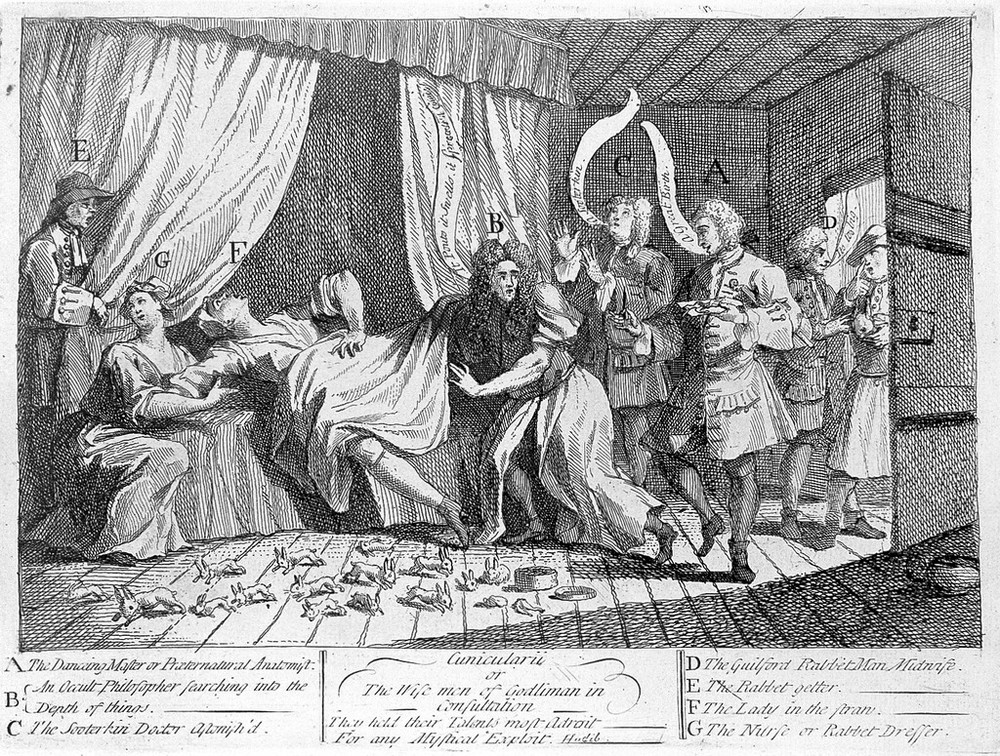
In 1726, Mary Toft’s claim that she had given birth to rabbits drew medical attention from far beyond Godalming. A local practitioner became involved, and physicians associated with the royal household investigated. The Royal College of Surgeons preserves pamphlets from an affair in which professional authority helped an impossible account travel.
Toft was taken to London for further examination. The College’s history describes a confession obtained under threat of an operation. That pressure matters to the record. It does not make the rabbit claim true, but it prevents the inquiry from becoming a comfortable comedy in which everyone enjoyed equal freedom to explain what happened.
The printed aftermath multiplied voices. Wellcome holds depositions taken on December 3 and 4, 1726, and catalogues Richard Manningham’s diary of his attendance from November 28 to December 7. Their titles identify witnesses, dates and an investigation already concerned with a confession. They preserve accounts produced around the controversy, each with its own author and purpose.
Caricatures and mocking pamphlets made the doctors’ embarrassment public. Toft became a spectacle within a dispute partly about their credibility. The bizarre claim remains the most portable detail, but the documents show a wider contest over who could describe a woman’s body, whose explanation would be printed, and how professional certainty could unravel before an audience.
Evidence and sources
The extraordinary claim was fraudulent. Surviving depositions and medical accounts require attention to pressure, authorship and reputation rather than retrospective diagnosis.
- A hare-raising tale — Royal College of Surgeons of England
- Mary Toft depositions — Wellcome Collection
- Manningham diary of the investigation — Wellcome Collection
Story 12
A Telegram Opened the Warship

A forged telegram announced distinguished visitors to HMS Dreadnought. On February 7, 1910, Horace de Vere Cole and five companions gained access to the Royal Navy’s advanced battleship by presenting themselves as an official delegation. Cole played a Foreign Office representative, while others acted as an interpreter and Abyssinian dignitaries.
The disguise depended on racist theatrical conventions. Members of the party wore blackface and elaborate costumes, and their supposed language mixed invented sounds with borrowed words. Virginia Stephen, later Virginia Woolf, appeared as a man with a false beard. The ship’s reception gave the performance the official recognition its creators needed.
Before traveling, the party had posed at Lafayette’s London studio. The National Portrait Gallery preserves that photograph and identifies the participants. When Cole exposed the deception, images from the sitting circulated in the press. The prepared portrait helped turn a private breach of protocol into a public humiliation for the Navy.
The warship’s technology could not authenticate the people being welcomed aboard. A telegram, a claimed office and a costume had passed through a social system of recognition. The surviving photograph records both the successful imposture and the assumptions that made it possible. The joke worked at the expense of naval confidence while also drawing on a caricature of the people the visitors pretended to be.
Evidence and sources
The false delegation and its reception are documented. The episode included racist impersonation, which is described as part of its method.
- The Dreadnought Hoax, NPG P1293 — National Portrait Gallery
The surviving objects still have stories to tell after their first explanations collapse. Their scratches, annotations, materials and accompanying papers can reveal the work of making a claim persuasive—and the patient work of testing it.
About the evidence labels
Documented identifies a supported historical event. Disputed marks an account whose explanation or details remain contested. Folklore identifies a recorded tradition; its inclusion does not establish that a supernatural event occurred.