The Unlikely Record · Episode 10 · Twelve stories
Twelve histories of failure, recovery and demonstrations with uncertain futures
A bridge moves in the wind, an airliner loses power, and a spacecraft arrives with the wrong trajectory. These twelve histories follow the people who designed, operated and investigated machines when events departed from the plan. Some ended in tragedy. Others reached safety, or worked as demonstrations without becoming permanent systems. The records reveal physical forces, inherited assumptions and the practical work of understanding what happened.
Story 01
The Roadway Began to Twist
The Tacoma Narrows Bridge was already moving before its collapse made it famous. During the final stages of construction in 1940, workers saw the suspended roadway rise and fall in waves. Attempts to steady it included buffers and cables. The bridge had become an engineering problem while it was still a new crossing.
On 7 November, the motion changed. Vertical undulations gave way to a violent twisting movement, with opposite sides of the roadway rising and falling. Professor Frederick Farquharson, who had been studying the bridge in a wind tunnel, came to observe and record it. By late morning, sections of the deck were falling into the water.
The inquiry examined a structure whose lightness and narrow deck had once seemed economical and elegant. Its 1941 findings emphasised excessive flexibility and the aerodynamic behaviour of the solid girders and roadway. Wind did more than push sideways against a static object; the movement of the structure and the forces acting on it had become inseparable.
The surviving film made that interaction visible to people far outside engineering. Yet the lesson required more than a memorable image of a buckling road. Designers had to investigate how a proposed bridge would move in air, using models and experiments alongside calculations of the loads it was meant to carry.
Evidence and sources
Documented collapse and contemporary investigation; familiar resonance shorthand is not presented as the whole explanation.
- Collapse of the 1940 bridge — Washington State Department of Transportation
- Why did Galloping Gertie collapse? — Washington State Department of Transportation
Story 02
The Numbers Arrived Without Agreement
Mars Climate Orbiter travelled for nine months before its intended arrival became a disappearance. Launched in December 1998, the spacecraft was meant to study the Martian atmosphere and help relay communications. On 23 September 1999, its signal vanished during the manoeuvre intended to place it in orbit.
The failure investigation traced a crucial mismatch to software on Earth. One application reported small thruster impulses in pound-seconds. The interface specification required newton-seconds, and the navigation calculations treated the numbers as if that requirement had been followed. The figures could be transferred successfully while carrying the wrong physical meaning.
Small errors accumulated in the estimated trajectory. The board concluded that the spacecraft passed much lower than planned. It could have been destroyed in the atmosphere or emerged into an orbit around the Sun; investigators did not recover it to settle that final question. The scientific mission was lost either way.
The report also identified missed opportunities in communication, staffing, training and verification. This was not a contest between two systems of measurement. A team needed to know what another team’s numbers represented, and the checks that should have established that agreement failed. A spacecraft crossing interplanetary distance had depended on an unfulfilled promise inside a file exchanged on the ground.
Evidence and sources
The board identified incorrect units in ground-software output and multiple organisational contributors. The spacecraft’s exact final fate was not observed.
- Mars Climate Orbiter — NASA
- Mars Climate Orbiter Mishap Investigation Board Phase II Report, March 2000 — NASA
Appendix B: Phase I report printed pp. 6–7, 16
Story 03
The Backup Had the Same Assumption
Ariane 5 began its first flight carrying four Cluster science satellites. Less than a minute later, the launcher had broken apart. The inquiry that followed the 4 June 1996 loss found a failure inside a system intended to tell the rocket how it was moving.
Two inertial reference units operated in parallel, one active and one available as backup. Both used the same software. A calculation tried to convert a number into an integer representation too small to contain it. The exception stopped a unit; its duplicate had already stopped for the same reason. Redundancy could not rescue two machines sharing the same mistaken assumption.
The troublesome calculation belonged to an alignment function inherited from Ariane 4. It continued running after launch even though Ariane 5 no longer needed it. The newer rocket’s early trajectory produced values outside the range that the older design had led engineers to expect. The onboard computer then treated diagnostic information as if it described the flight.
Investigators recovered the units and reproduced the failure. Their recommendations reached beyond correcting one conversion: unnecessary functions should stop, operating limits should be explicit, and testing should include the actual conditions of the new launcher. Reusing proven equipment had also reused assumptions whose original setting no longer applied.
Evidence and sources
The original inquiry establishes the repeated software failure, unnecessary alignment operation and limitations of testing.
- Ariane 5 Flight 501 Failure: Report by the Inquiry Board, 19 July 1996 — ESA/CNES; report mirror at Bielefeld University research group
- Ariane-5: Learning from Flight 501 and Preparing for 502 — European Space Agency
Story 04
The Operator Was Faster Than the Test
Between June 1985 and January 1987, six known accidents involving Therac-25 radiation machines caused massive overdoses, with deaths and serious injuries. The equipment was intended to treat cancer. Understanding why it could instead harm patients required listening to experiences that its normal controls and displays did not adequately explain.
At a clinic in Tyler, Texas, an experienced operator could enter and correct treatment settings quickly. Changing a selection from X-rays to electrons was an ordinary editing action. Under a particular rapid sequence, however, the software and machine configuration could become dangerously inconsistent. An error message did not convey the true seriousness of what had happened.
After a second Tyler accident, physicist Fritz Hager and the operator worked to reproduce the behaviour. Speed mattered: the sequence had to be performed rapidly enough. Once they could repeat it, investigators had a way to demonstrate a defect that slower attempts had missed. Familiarity with the keyboard had exposed a hazard rather than created one.
The later investigation described a combination of software problems, inadequate safeguards and failures to connect reports across institutions. Earlier machines had retained hardware protections that the Therac-25 relied more heavily on software to provide. The history concerns the whole arrangement around treatment: design, testing, warnings, communication and the duty to take a patient’s report seriously.
Evidence and sources
Six known serious overdose accidents were documented. The Tyler sequence is one mechanism within a wider system failure, not the explanation for every accident.
- An Investigation of the Therac-25 Accidents — Nancy Leveson and Clark Turner, IEEE Computer, hosted by MIT
- An Investigation of the Therac-25 Accidents, Part II — Leveson and Turner, IEEE Computer, hosted by MIT
Story 05
The Giant Would Not Leave the Bank
Great Eastern was designed to carry passengers and cargo over exceptional distances. Before it could do that, its builders had to move it a much shorter distance: sideways from the riverbank into the Thames. The vast iron ship lay parallel to the water at Millwall, making its first journey a construction problem of its own.
On 3 November 1857, the intended launch did not send the vessel afloat. Its size and weight made the movement more difficult than expected. The ceremony also introduced a new name, Leviathan, although Great Eastern was already familiar. The ship remained associated with an unfinished departure through the following winter.
It finally floated on 31 January 1858, helped by spring tides, and moved to Deptford for fitting out. By July, the name Great Eastern was being restored. A painting in the National Maritime Museum combines the ship on the stocks with details apparently referring to a later royal visit, compressing the prolonged construction story into one view.
The vessel’s later career also departed from its initial purpose. It proved commercially unsuccessful as a passenger ship and was converted for laying telegraph cables. A surviving model shows the specialised equipment of that second life. The extraordinary capacity that was difficult to launch and difficult to fill eventually served a different kind of connection across the ocean.
Evidence and sources
The failed November launch and January flotation are documented; later cable service is distinguished from the original passenger plan.
- Building the 'Great Leviathan' (the 'Great Eastern') — Royal Museums Greenwich
- Great Eastern model, circa 1865 — Royal Museums Greenwich
Story 06
The Replacement Had to Answer the Ruins
A railway bridge over the Tay promised a direct connection to Dundee and a stronger position for the North British Railway. Thomas Bouch’s bridge opened amid celebration in 1878. On the stormy night of 28 December 1879, its central high spans collapsed while a train was crossing. The route had become the site of a disaster.
The design had changed during construction. Braced cast-iron columns replaced planned brick piers, and fewer spans meant longer gaps to bridge. The Court of Inquiry placed responsibility for the collapse on the design and on Bouch. Rebuilding could no longer be treated as simply putting the missing pieces back.
William Henry Barlow recommended a separate, double-track replacement. It stood parallel to the earlier crossing, while usable girders from the old bridge were incorporated into the new work. Weight and wind loading received stringent tests. The replacement opened to traffic on 20 June 1887, without a ceremony.
The consequences reached another Scottish estuary. Bouch’s proposed crossing of the Forth was suspended, and a different scheme by John Fowler and Benjamin Baker was adopted. One bridge’s failure had changed the questions asked of another bridge before it was built. The demand for reliable connections remained, but confidence now had to be rebuilt alongside the physical structures.
Evidence and sources
Collapse, inquiry and replacement designs are documented; exact casualty totals and fine-grained disputed failure sequences are omitted.
- The history of the Tay Bridge, Dundee — Network Rail
- The Forth Bridge: Portraits of a Scottish Icon — National Records of Scotland
- Tay Bridge disaster documents, GD1/558 — National Records of Scotland
Story 07
A Bug Before the Bug Story

The insect taped into a Harvard computer logbook was an unusually literal example of an existing problem. In 1947, engineers working on the Mark II found a moth stuck in one of its components. They preserved it on the page and added a note celebrating the discovery of an actual bug.
The joke depended on language that was already familiar. Engineers had been calling faults bugs long before this moth entered a computer. Thomas Edison used the term for problems in electrical circuits in the nineteenth century. Early computing inherited that vocabulary for difficulties in both equipment and programs.
Grace Hopper worked with the Mark II team and later became closely associated with the story. The Smithsonian’s catalogue is more careful than many retellings: the book was probably not hers. It credits Hopper and the team with helping popularise the terminology, rather than saying that she personally discovered the moth or invented the expression.
The preserved page is memorable because two kinds of record meet there. It contains a specimen that can still be seen, and a small workplace joke that travelled far beyond its original audience. The moth explains the joke; it does not explain the origin of every computer bug. That longer history was already underway before the insect reached the machine.
Evidence and sources
The preserved logbook and museum account document an actual moth and earlier engineering terminology; finder and ownership are not overclaimed.
- Log Book With Computer Bug — Smithsonian National Museum of American History
- Naval Historical Center photograph NH 96566-KN: the Mark II log page — U.S. Naval Historical Center; reproduction and provenance at Wikimedia Commons
Story 08
The Airliner Became a Glider
Air Canada Flight 143 was travelling toward Edmonton when both engines stopped on 23 July 1983. A fuel-quantity miscalculation involving imperial and metric units had left the Boeing 767 without enough fuel. The crew now had to bring an airliner down without the engine power on which an ordinary arrival depended.
Winnipeg was considered, but the remaining height and distance made it unreachable. First Officer Maurice Quintal knew the former military airfield at Gimli. Captain Robert Pearson had experience flying gliders. Their combination of local knowledge and flying skill provided an alternative destination and a way to reach it.
The landing brought the aircraft onto a former base whose uses had changed since Quintal’s service there. The pilots could not assume that the ground below still matched the airfield they remembered. They nevertheless brought the aircraft down, and everyone aboard survived. The event became known through a name that described both the machine’s unexpected role and its destination: the Gimli Glider.
The aircraft returned to airline service and was not retired until 2008. Parts later entered a local museum, including a ram air turbine, fuelling equipment and passenger seats. Those ordinary components give the celebrated landing a material history. They belonged to a working aircraft whose service continued for years after the emergency that made it famous.
Evidence and sources
Landing and survival are documented by institutional accounts. Fuel-unit error is described generally; the original inquiry has not been personally read.
- Debates of the Senate, 18 June 2013: Gimli Glider anniversary — Parliament of Canada
- Aviation visitor guide: Gimli Glider Exhibit — Royal Aviation Museum of Western Canada
Story 09
The Train Appeared Above the Street

A locomotive hanging from an upstairs opening is the image that made the Montparnasse accident last. On 22 October 1895, the express from Granville failed to stop on entering the Paris terminus. It crossed the arrival hall and broke through the station front, leaving the engine down toward the square below.
The photograph makes the railway’s levels suddenly visible. Tracks and platforms were above the street; the locomotive joined those spaces by falling through the building between them. In the Neurdein Frères print preserved by the Musée Carnavalet, broken masonry surrounds the engine while the station’s tall windows remain above it.
The spectacular view can obscure the human cost. A woman helping her husband sell newspapers died when part of the façade fell on her. She had not been travelling on the train. The accident reached beyond the passengers and railway workers into the ordinary activity taking place outside the station.
Several photographers recorded the scene, so familiar reproductions do not all have the same maker or history. This albumen print survives mounted on card, with its title written above the image and a Paris collection stamp below. The object preserves more than the impossible-looking position of an engine: it records how a sudden disaster became a photograph that could be collected, copied and repeatedly seen.
Evidence and sources
Museum catalogues establish the date, route, overrun and fatality. The included CC0 photograph has its own verified maker and object identity.
- L'accident de la gare Montparnasse — Musée Carnavalet / Paris Musées
- Accident à la gare de l'Ouest, Léopold Mercier, 1895 — Musée d'Orsay
Story 10
A Small Switch During a Large Ascent
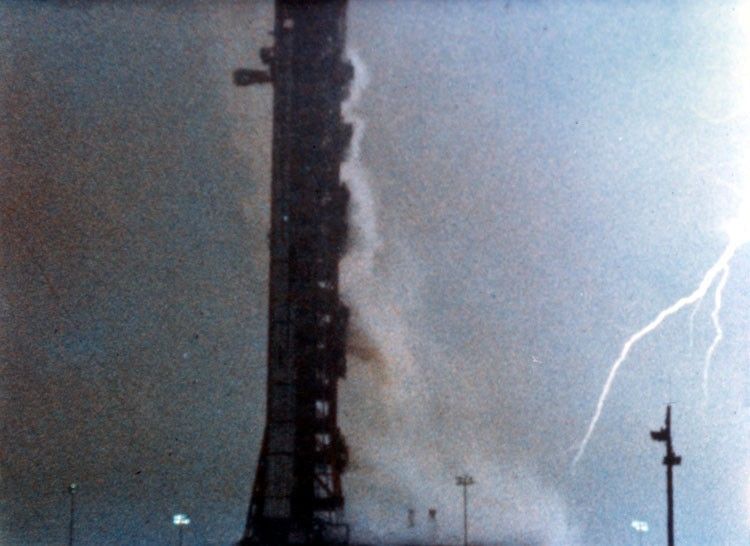
Apollo 12 was less than a minute into its journey when lightning disrupted the spacecraft’s electrical systems. A second strike followed at about fifty-two seconds. The launch continued while the crew and Mission Control faced warning lights and confusing readings instead of the orderly information expected during ascent.
Flight controller John Aaron recognised a problem with the signal-conditioning system. He recommended switching SCE from its normal setting to auxiliary. Alan Bean knew where the switch was and carried out the instruction. Restoring that information made it possible to assess the spacecraft rather than interpret a stream of misleading indications.
The voice transcript preserves the recovery as a sequence, not an instantaneous cure. After the SCE instruction came a request to reset the fuel cells. The astronauts reported electrical buses restored while still dealing with the guidance platform. They were solving several consequences of the strikes as the launch proceeded.
Apollo 12 reached Earth orbit, where checks confirmed that the mission could continue toward the Moon. The crew eventually landed and returned safely. A NASA photograph shows lightning beside the launch tower, but the decisive work was less visible: recognising a familiar pattern in abnormal readings, communicating a specific action, and checking the remaining systems before committing to the next stage of the journey.
Evidence and sources
Original NASA photograph, mission account and contemporary transcript establish the two strikes and staged recovery.
Story 11
The Missing Mark Was Not a Hyphen
Mariner 1 was meant to pass Venus and send measurements back across interplanetary space. The plan called for infrared and microwave observations, along with instruments studying the journey itself. It carried no camera. Its distant destination was to become information returned by radio rather than a sequence of planetary photographs.
The spacecraft never reached that part of its flight. After launch on 22 July 1962, the rocket veered from its intended course. The range safety officer sent a destruction command less than five minutes after lift-off, ending the flight before the vehicle could continue along an unsafe path.
NASA’s account identifies a guidance-antenna problem and an error in the software’s underlying equation. An overbar had been omitted from a mathematical symbol. The familiar story about a missing hyphen changes the nature of that mark and makes a more complicated guidance failure sound like a piece of punctuation falling out of an ordinary sentence.
The programme had a second spacecraft ready for the same launch opportunity. Engineers corrected the problems, and Mariner 2 departed on 27 August. It reached Venus in December and returned the measurements that its predecessor had been intended to collect. The first mission’s loss was therefore followed quickly by another attempt, built around the same scientific destination and a corrected route toward it.
Evidence and sources
NASA identifies an antenna fault and missing mathematical overbar in the guidance system; the popular hyphen retelling is corrected.
- Mariner 1 — NASA
- Mariner Spacecraft, 19 July 1962 — NASA Jet Propulsion Laboratory
Story 12
The Carriage Travelled on Air

Visitors to the Crystal Palace gardens in 1864 could encounter a railway carriage whose motive power stood outside it. Thomas Webster Rammell’s experimental passenger line used air pressure to move the vehicle through a tunnel. A large fan, driven by a stationary engine, did the work normally associated with a locomotive travelling ahead of the passengers.
A contemporary technical description explains a fringe of bristles around the carriage acting as a partial seal against the tunnel. By forcing air in or drawing it out, the machinery created the pressure difference that moved the car. The illustrated press showed passengers gathering beside a vehicle and tunnel entrance that made this unfamiliar arrangement look like a public attraction.
The demonstration had a larger proposed destination. Rammell’s Waterloo and Whitehall scheme would have carried passengers beneath the Thames between Waterloo and the Charing Cross area. Crystal Palace offered an operating example of the principle before that more demanding urban crossing could be completed.
The river scheme was halted amid financial difficulties, with construction ceasing in 1868. The garden experiment had shown that a carriage could move this way; that success did not supply the money and organisation needed for a permanent transport system. Its short life illustrates a different kind of technological ending from a crash: a working demonstration whose proposed future did not arrive.
Evidence and sources
The passenger demonstration operated. Exact dimensions and timings vary in the reproduced account and are omitted; later tunnel legends are not repeated.
- Capsule Pipelines — Railway and Canal Historical Society
- Contemporary description attributed to The Mechanics Magazine, circa 1865 — The Mechanics Magazine, transcription by Frédéric Delaitre
- Pneumatic Railway for Passengers at the Crystal Palace, Illustrated London News, 10 September 1864 — Illustrated London News, reproduction at Wikimedia Commons
A dramatic failure can leave a famous image or a convenient phrase. The fuller record asks more precise questions: what was measured, what was assumed, what could an operator know, and which checks actually worked? These machines left different answers, preserved in reports, photographs, recovered objects and the next designs built in their wake.
About the evidence labels
Documented identifies a supported historical event. Disputed marks an account whose explanation or details remain contested. Folklore identifies a recorded tradition; its inclusion does not establish that a supernatural event occurred.