The Unlikely Record · Episode 13 · Twelve stories
Twelve records of coins, promises and unexpected changes of value
A denomination seems to tell us what an object is worth. These records show how much more can matter: its material, its history, the authority behind it and the people willing to accept it. A copper plate could become cargo, a playing card could pay a soldier, and an ordinary ledger could expose a convincing fake. Each case follows a specific change in what money meant or how it worked.
Story 01
The Fortune Nobody Could Lift
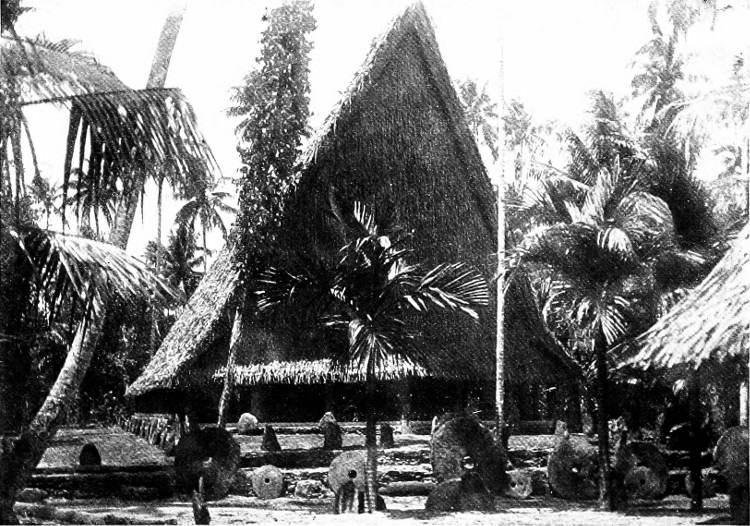
William Henry Furness heard about a family on Yap whose wealth lay where nobody could inspect it. According to his informant Fatumak, an ancestor had obtained an unusually large stone used as money. While it was being towed home on a raft, a storm forced the voyagers to release their burden. The stone disappeared beneath the sea.
The survivors reported its size and quality, and said the loss had not been the owner’s fault. In the account Furness published in 1910, the family retained its acknowledged wealth for generations. Physical recovery was unnecessary because other people accepted the history attached to the stone.
Furness also described transactions involving large stones that remained in the former owner’s yard. Ownership could change through public acknowledgement without a difficult journey across the island. Actual surviving rai stones, including a nineteenth-century example in the Smithsonian, preserve evidence of the material currency.
The underwater fortune has a different evidential status. Furness did not witness the storm, identify a recovered object or provide a date for the voyage. His story records what Fatumak told him. That distinction leaves its central question intact: how much of possessing something depends on its location, and how much depends on other people recognizing a claim?
Evidence and sources
The sunken stone is an oral account Furness attributes to Fatumak. Surviving stone money confirms the material tradition, not this particular loss.
- The Island of Stone Money: Uap of the Carolines — William Henry Furness / Project Gutenberg
Chapter VII, Money and Currency, printed pages 92–106; reported sunken stone at pages 97–98 - Stone Money, Yap Island — Smithsonian National Museum of American History
Story 02
The Coins Travelled as Copper

The Nicobar was a Danish ship heading toward India with a cargo that looked like an awkward cash payment: thousands of large Swedish copper plates stamped as coins. In the summer of 1783, the ship sank off the southern coast of Africa. More than five thousand old plate coins were recovered in 1987.
One surviving plate, now in Sweden’s economic-history museum, was struck at Avesta in 1727 under Fredrik the First. Its stated value was one daler silvermynt, although its material was copper. The name on the denomination described a system of reckoning rather than the metal someone would find by examining the object.
The plates had another complication. The museum’s catalogue says they had ceased to be legal tender in 1778, before this voyage. Yet the copper still had uses and a market. When the metal became more valuable than the denomination suggested, a cumbersome coin could become a commodity for international trade.
The wreck therefore preserved money after it had changed jobs. A stamp that once helped a plate circulate in Sweden remained visible while the object travelled toward another market. Its history connects a mint, a ship and a recovery operation, with each treating the same heavy piece of copper as something different.
Evidence and sources
The wreck and recovered plates are documented. Their stamped money value is distinguished from their later value as copper cargo.
- 1 daler silvermynt, Fredrik I, Avesta, 1727 — Ekonomiska museet / National Historical Museums
The Nicobar Hoard, object 123216_KMK - Världens största mynt – plåtmyntet — Ekonomiska museet / National Historical Museums
Story 03
The Last Twenty Dollars Mattered
A gold coin marked twenty dollars could be valuable without having been lawfully released as money. The American Double Eagles dated 1933 were caught in the change to federal gold policy. Most were destroyed, while two went to the Smithsonian. Other surviving pieces became the subjects of investigations and ownership disputes.
One coin resurfaced in 1996 when a dealer attempted to sell it to undercover Secret Service agents. An out-of-court settlement in 2001 allowed an auction to proceed. The Mint’s annual report records a winning bid of six million six hundred thousand dollars, followed by the auction fee.
Then came another charge: twenty dollars to monetize the coin’s face value. The final total was seven million five hundred ninety thousand and twenty dollars. That small last payment addressed a legal condition which the millions already offered did not satisfy. The coin’s appearance had not changed, but the transaction changed its permitted status.
The arrangement did not settle the future of every surviving 1933 Double Eagle. In August 2016, the government reported an appellate ruling confirming its ownership of ten other examples. A date and a denomination stamped in gold were therefore only part of the identity that mattered. The route out of the Mint, and the legal history afterward, mattered too.
Evidence and sources
The Mint’s annual report establishes the auction accounting; the later government release concerns a different group of ten coins.
- United States Mint 2002 Annual Report — United States Mint / FRASER, Federal Reserve Bank of St. Louis
Printed page 24, Double Eagle Gold Coin Auction - Third Circuit Affirms United States’ Forfeiture and Ownership of Double Eagle Coins — United States Department of Justice
Release dated 2 August 2016, reporting the decision of 1 August
Story 04
The Penny Sent People to the Telephone
In 1943, most American cents changed their material. Copper was needed for the war effort, so the familiar small coin was made from steel coated with zinc. A limited number nevertheless appeared in copper alloy, creating an exception that would attract attention long after the emergency had passed.
By March 1999, news coverage of those pennies had generated thousands of calls to the United States Mint. Its public response corrected two impressions: the government was not conducting the search suggested by the reports, and the sensational price quoted for a single coin was inaccurate. A story about an unusual object had become a much wider story about imagined value.
The Mint also explained the proposed production accident. Experts thought copper-alloy blanks left from the previous year might have remained in equipment when steel-cent production began. Its release presented that explanation as speculation, together with a contemporary estimate of how many pieces had been made.
The distinction is useful. The existence of a material anomaly does not establish every claim attached to it. The penny’s date was easy to read; its authenticity, production history and significance required different evidence. In this case, the institution that made the ordinary coins found itself answering for the excitement surrounding the extraordinary ones.
Evidence and sources
The wartime alloy change and later public correction are documented. The Mint described the leftover-blank explanation as expert speculation.
- 1943 Cent Story Prompts Thousands of Calls to Mint — United States Mint
- Penny: history and unusual pennies — United States Mint
Story 05
The Emergency Money Became a Souvenir
Bielefeld’s anniversary celebrations in July 1921 began with unusual demand at the municipal savings bank. People wanted the commemorative emergency-money issues associated with the festivities. The notes offered local pictures and stories, and some were printed on silk or linen rather than paper.
The institution had been issuing small-denomination emergency money since 1917 to address a shortage of change. Under its director, Paul Hanke, the programme acquired an elaborate visual life. For the anniversary, artist Karl Muggly designed notes referring to episodes from the city’s past, while other designs used silhouettes and local names.
The city archive identifies a change of purpose. By 1921, these issues were intended increasingly as collectible objects that purchasers would keep. An unredeemed note brought income to the savings bank. The transaction depended on people wanting to retain the money rather than spend it or return it for payment.
Collectors and dealers noticed each new issue. The anniversary thus exposed a peculiar relationship between a currency’s usefulness and its appeal as an object. The designs encouraged people to look closely at the notes, remember them and put them aside. Money originally associated with keeping transactions moving could generate revenue by remaining in somebody’s collection.
Evidence and sources
The city archive distinguishes genuine small-change relief from later issues intended for collectors. The pictures on the notes are evidence of commemoration.
- 16./17. Juli 1921: Bielefeld feiert das 700. (oder 707.) Stadtjubiläum — Stadtarchiv und Landesgeschichtliche Bibliothek Bielefeld
Anniversary weekend and Notgeld paragraphs; author Jochen Rath, 1 July 2021
Story 06
The Coin Was Made of Paper

The object is round, impressed with a design and dated 1574. Its shape invites the expectation of metal. The catalogue of Museum De Lakenhal identifies something else: paper, struck into an emergency coin during the siege of Leiden.
Spanish troops had surrounded the city during the Eighty Years’ War. Hunger and disease made the siege an ordeal for its inhabitants before relief arrived on 3 October 1574. Against that background, the little surviving object belongs to the practical work of maintaining a community under pressure.
The museum’s example measures about three centimetres across and weighs one gram. A standing lion and Leiden’s arms occupy one side, surrounded by lettering. The design gives a fragile material the recognizable form of civic money. Its survival lets us examine that substitution directly, without assuming a story about exactly which book or sheet supplied the paper.
The money also acquired a later public life. In 1630, a printed sheet paired images of Leiden’s paper coins with a poem by Joost van den Vondel. An improvised instrument from a wartime emergency had become an object of praise and historical memory. The small disc preserves one moment; the later print shows people deciding what that moment should mean.
Evidence and sources
Surviving objects establish struck paper emergency money. Later commemoration is distinct from the original siege evidence.
- Papieren noodmunt uit het beleg van Leiden, 1574, 3309 — Museum De Lakenhal
Collection 3309, manufacture and rights fields - Siege and Relief of Leiden — Museum De Lakenhal
- Lofdicht uit 1630 op het papieren noodgeld uit het beleg van Leiden, 1574 — Rijksmuseum
RP-P-OB-79.593, description and 1630 dating
Story 07
A New Name Had to Hold Its Value
In postwar Hungary, a banknote could remain intact while the amount it bought changed drastically. The central bank’s historical study places the worst monthly inflation in July 1946 and gives an estimated price-doubling time of about fifteen hours. Printed numbers struggled to keep pace with ordinary purchases.
Earlier attempts to contain the crisis had changed the way money was used. A stamping measure in December 1945 reduced the effective cash left with holders of affected notes. In January 1946, the tax pengő introduced an accounting unit linked to a price index. That experiment also failed to provide lasting stability.
On 1 August 1946, the forint became the new national currency. Even its name had been debated. The central bank’s study describes alternatives, including tallér, before the authorities chose a name with a much older Hungarian history. The official currency catalogue separately confirms the issue date.
The change required more than replacing one word with another. Stocks of goods were assembled for release, and prices and wages were reorganized under difficult conditions. The new money was part of reconstruction, with burdens that a neat banknote could not show. After the race through larger numbers, the essential task was making a unit dependable enough for people to use again.
Evidence and sources
The currency change and preceding experiments are documented. A new name was only one part of a wider and costly stabilization programme.
- 70 Years of the Forint: Road from Hyperinflation to Price Stability — Magyar Nemzeti Bank
Zoltán Eperjesi, Zoltán Horváth and Kitti Vajda, Post-war inflation and the introduction of forint, especially printed pages 17–22 and 34–35 - Elévült bankjegyek 1946-tól — Magyar Nemzeti Bank
Story 08
The Soldiers Were Paid from a Pack of Cards
In 1685, New France lacked enough coin to pay its troops. The colony’s financial administrator, Jacques de Meulles, turned to an available supply of stiff paper: playing cards. Their plain backs could carry written values and official signatures, turning gaming equipment into certificates of payment.
The suits did not set the exchange rate. A card’s monetary identity came from the value and authorization added to it. Different sizes helped distinguish denominations. The Bank of Canada’s historical account records issues worth fifteen sols, forty sols and four livres, with a promise of redemption when funds arrived from France.
Acceptance involved more than goodwill. The same account notes a penalty for refusing the cards. They nevertheless answered a practical shortage, and the first issue was redeemed later that year. Further shortages brought further issues, extending what had begun as an emergency arrangement.
A familiar illustration of this money needs a careful caption. The Bank of Canada Museum identifies its displayed example as a later reproduction based on archival descriptions, rather than an original playing card that survived from 1685. The historical innovation is well documented without pretending that every picture is a surviving specimen. A written promise and a system for accepting it had temporarily supplied what the missing coins could not.
Evidence and sources
Institutional histories document the emergency issue and redemption. Surviving later card money and modern reproductions are not original 1685 playing cards.
- A Good Deal — Bank of Canada Museum / David Bergeron
- The Quest for Confidence: 400 Years of Money – from La Nouvelle France to Canada Today — Bank of Canada / Pierre Duguay
Story 09
The Promise Stopped at the Counter
A Bank of England note had offered its holder a route from paper to gold. In February 1797, wartime pressure and an invasion scare brought that arrangement to a crisis. People seeking gold could rapidly reduce the reserves that stood behind the notes.
On Sunday 26 February, the Privy Council ordered the Bank to stop cash payments while Parliament considered the situation. The Bank announced the suspension the following morning. The point was to preserve reserves, but the immediate consequence for a holder was concrete: presenting the paper no longer secured the expected metal.
The Bank issued one-pound and two-pound notes as small gold payments became unavailable. These notes reached people unfamiliar with paper currency, creating opportunities for counterfeiters. A surviving counterfeit in the Bank’s museum bears an official mark identifying it as forged.
The restriction lasted until 1821. In the meantime, artist George Cruikshank used an imitation banknote in 1819 to attack the harsh punishments imposed for forgery. The altered monetary system had reached well beyond a ledger of reserves. It affected what people handled, what they trusted and how the state punished deception. A promise printed on paper still depended on the conditions under which institutions would honour it.
Evidence and sources
The emergency order suspended redemption in gold. Paper notes continued to circulate; the promise was not converted into an immediate payout.
- From Gold to Paper and Back Again — Gresham College / Professor Jagjit Chadha
1797 suspension passage and Message from the King, 26 February 1797 - Counterfeit and imitation notes — Bank of England Museum
Story 10
The Note Had Already Been Paid
Operation Bernhard used expertise extracted through imprisonment. In 1942, the Nazis assembled Jewish prisoners with printing, engraving, graphic and banking knowledge at Sachsenhausen concentration camp. Their forced task was to produce false British banknotes for Nazi purposes, including financing intelligence operations.
The notes could look convincing. The Bank of England Museum describes a team of 142 prisoners working on the project. Yet a note also had a history inside the institution that supposedly issued it, and the counterfeiters had reused numbers from genuine examples.
In 1943, a suspicious note that had passed through a British bank in Morocco reached a decisive comparison. The Bank’s records showed its number as already paid. A convincing piece of paper could not undo that earlier entry. The ledger exposed a contradiction that appearance alone had failed to reveal.
The Bank subsequently withdrew notes above five pounds as the extent of the problem became known. The prisoners were moved to Austria as the war approached its end and were liberated by American forces on 6 May 1945. The surviving record connects technical deception with the people forced to carry it out. Its revealing object is also the mundane ledger that made the duplicate visible.
Evidence and sources
The operation relied on imprisoned Jewish specialists under Nazi coercion. The museum records the detection through a duplicated number, not a visible flaw alone.
- Operation Bernhard — Bank of England Museum / Alison Cook
- A Genuine Forgery — Sachsenhausen Memorial and Museum
Story 11
The New Coin Named the Wrong Islands
New Zealand’s decimal changeover had been prepared through advertisements, school lessons and practice money. On 10 July 1967, people began using dollars and cents. Some encountered a two-cent piece that offered an unexpected geography lesson: one side named the Bahama Islands.
The Royal Mint had combined the New Zealand reverse with the obverse intended for a Bahamian five-cent coin. The two coin types were very close in diameter and were being made at the same institution. Collectors call such mismatched pieces mules.
Four were reported on the first day, according to the Reserve Bank’s museum account. The mistake was much larger than those initial finds. Manual inspection of about six hundred thousand two-cent pieces identified roughly sixty thousand mismatches, which were melted down in Auckland. Officials arranged replacement, although collector interest encouraged some holders to retain the odd coins.
The investigation considered sabotage as well as failures in supervision and checking. Its eventual explanation favoured human error and faulty procedures; no individual was held responsible. The episode sits beside the extensive public education campaign as a reminder that learning the new currency was only one part of the change. The objects arriving in people’s hands also had to be the objects the authorities intended.
Evidence and sources
The mismatched coins and investigation are documented. Sabotage was considered but not established, and estimated production totals are not exact counts.
- Problems with the 1967 decimal coinage — Reserve Bank of New Zealand Museum
Faulty coins go into circulation; Royal Mint investigates; Outcome of the investigation - Preparing New Zealand for decimal currency — Reserve Bank of New Zealand Museum
Story 12
Decimal Day Had Already Begun
When Britain reached Decimal Day on 15 February 1971, part of the new money was already familiar. Five-pence and ten-pence coins had entered circulation in April 1968, matching the size and value of the shilling and florin. The fifty-pence coin followed in October 1969.
That early exposure was deliberate. The Decimal Currency Board aimed to leave as little as possible to be changed on the day itself. Businesses adapted equipment, retailers prepared prices and the public received explanations and conversion tables. A national alteration in arithmetic depended on thousands of smaller practical decisions.
Banks closed on the preceding Wednesday afternoon to clear work and convert accounts. When ordinary trading resumed under the new system, a pound contained one hundred new pence. The pound itself remained the familiar reference point, even as the smaller units changed their relationships.
Old pennies and threepenny pieces could initially still be used, but that transition ended on 31 August 1971. Other familiar coins had different afterlives, so decimalization was not the instant disappearance of every old object. The apparent simplicity of the new calculation concealed years of preparation. People woke to a dated national change whose success depended partly on how much had quietly happened already.
Evidence and sources
The change was deliberately phased. The pound remained the main unit, while the number and meaning of its smaller divisions changed.
- Decimalisation — Royal Mint Museum
- Decimal Posters — Royal Mint Museum
These objects travelled through more than markets. They passed into courtrooms, museums, collections and stories, acquiring meanings their makers had not necessarily intended. Their histories leave us with useful distinctions between possession and recognition, a printed amount and a practical value, a surviving object and an account remembered about it.
About the evidence labels
Documented identifies a supported historical event. Disputed marks an account whose explanation or details remain contested. Folklore identifies a recorded tradition; its inclusion does not establish that a supernatural event occurred.