SCIENCE · TECHNOLOGY · POSSIBLE FUTURES
AI at the Edge
of Discovery
What artificial intelligence is doing in laboratories, hospitals, software, and the wider world—and three very different ways the next year could unfold.

Imagine a laboratory at 2:17 in the morning. A machine has just rejected its forty-third idea. It has not become discouraged. It proposes a forty-fourth, checks the available equipment, and places another experiment in the queue. A human scientist will arrive at breakfast and decide whether the results mean anything.
That opening is an imagined scene, but it captures a real shift: computers are moving deeper into the work of discovery. They can help search the possibilities, and in some carefully constructed systems they can help decide what to try next. The extraordinary part is not that a machine appears to know everything. It is that it can help us investigate things we do not yet know.
AI is already useful enough to matter, unreliable enough to require care, and powerful enough to make the next year difficult to predict. Its future contains genuine hope: better forecasts, new treatments, more accessible technical tools. It also contains bad science at scale, concentrated power, damaged trust, and systems given more responsibility than their reliability deserves.
01 / THE BASICS
What is AI, in ordinary language?
Artificial intelligence is a broad label for computer systems that perform tasks associated with intelligence: recognizing patterns, making predictions, generating possible answers, planning actions, or adapting from experience. It is a family of methods, not a single machine sitting somewhere with a plan for humanity.
Much of the AI used today is machine learning. Instead of a programmer spelling out every rule, a system is trained on examples. It adjusts internal numerical settings until it becomes better at a task. Imagine teaching someone to recognize a bird by showing many birds, rather than handing over a perfect written definition of every possible beak, feather, and wing.
A model is the trained system. Training is the learning stage; inference is using the trained system on a new input. A generative model produces something—a paragraph, image, piece of code, or proposed molecule. A prediction model might estimate tomorrow’s temperature without writing a single sentence. An AI agent connects a model to tools so it can attempt several steps toward a goal.
These distinctions matter. A system that predicts protein structures is not automatically capable of managing a hospital. A language model that explains physics fluently has not necessarily solved the experiment in front of it. The word “AI” can hide enormous differences in purpose, evidence, and reliability.
Nor does any of this require us to assume that the system is conscious. Useful performance, humanlike conversation, understanding, and subjective experience are different questions. A machine can help identify a promising experiment without settling any philosophical argument about whether it has an inner life.
In science, the essential distinction is simpler: a plausible answer is a starting point; evidence decides what survives.
02 / THE WORK ALREADY UNDER WAY
What is AI being used for in science and technology?
The examples below sit at different stages of maturity. Some are operating services. Others are research demonstrations, candidate-discovery systems, or tools whose usefulness depends heavily on the setting. Calling all of them “breakthroughs” would erase the differences that make them understandable.
Proteins and drug research: narrowing the enormous search
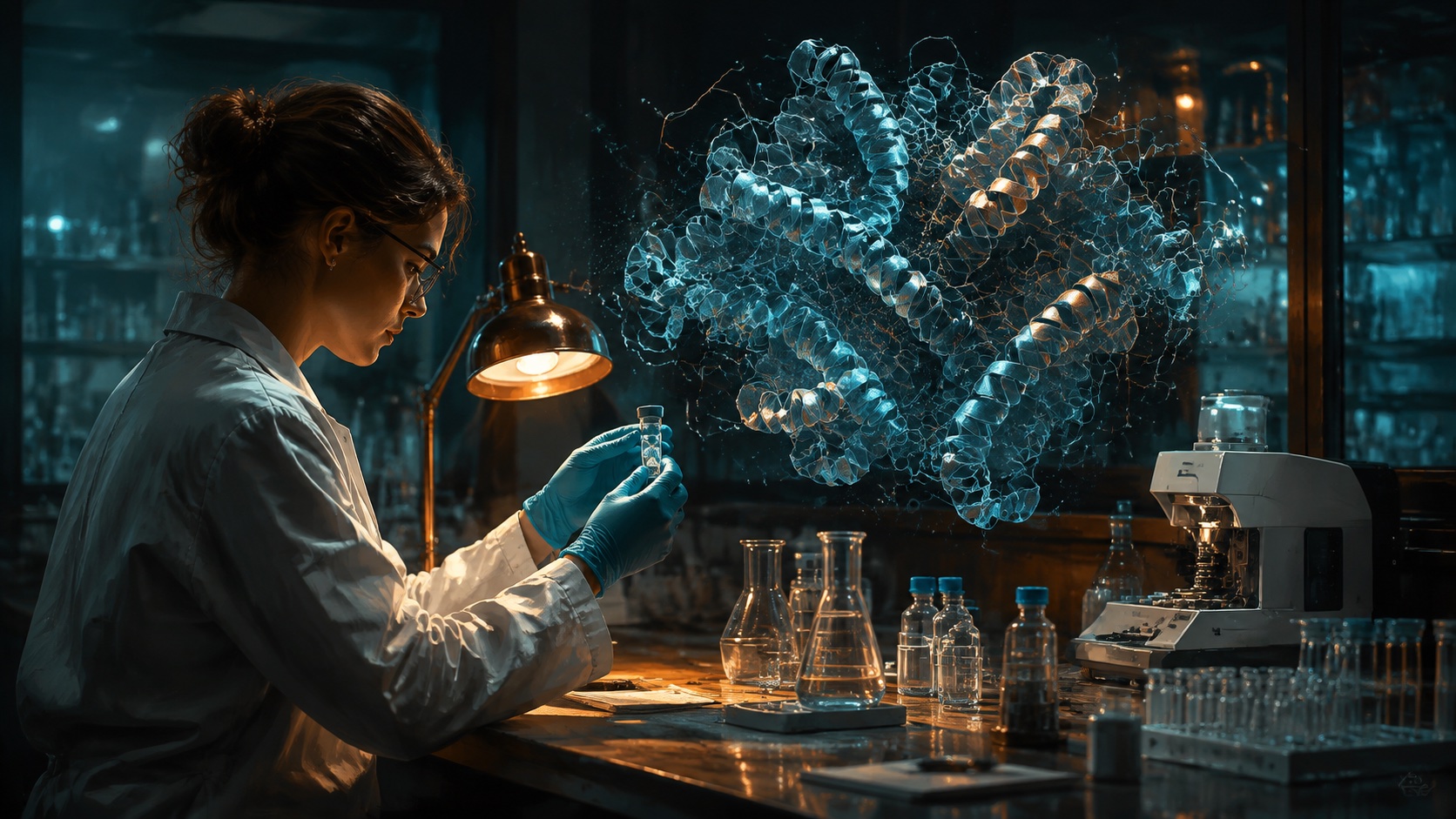
Proteins are the working molecules of life. Their shapes help determine what they do and how they interact. For a researcher, predicting a shape can be like receiving a useful map before setting out across unfamiliar terrain.
AlphaFold 3, described in a 2024 Nature paper, extended structure prediction to complexes involving proteins and other molecules, including nucleic acids and small molecules. This can help researchers investigate how biological components might fit together. Its benchmark performance is evidence about structure prediction; it is not evidence that every proposed interaction happens inside a living person. Read the AlphaFold 3 research.
In drug development, AI can help prioritize targets, screen or generate candidate molecules, and organize evidence. The practical attraction is easy to understand: if there are too many possibilities to test, a better shortlist can save work. But a promising molecular fit does not establish a safe dose, long-term safety, or a meaningful improvement in patients. Those are different questions requiring different evidence.
Think of AI here as improving the invitation list for an extremely demanding audition. Being invited is valuable. It is a long way from winning the role.
Genomics: reading the switches behind the instructions

DNA contains more than instructions for making proteins. Its regulatory machinery influences when, where, and how strongly genes are used. A change in those controls can matter even when it does not alter a protein’s recipe.
AlphaGenome, published in Nature in January 2026, takes about a million DNA letters at a time and predicts several kinds of molecular activity. Comparing predictions for an original sequence and a changed version can help researchers prioritize variants for investigation. The paper reports matching or exceeding comparison models in 25 of 26 variant-effect evaluations. Read the AlphaGenome study.
Those are research benchmarks, not a personal health forecast. The authors describe difficulties with distant regulatory influences and cell-specific effects; they did not benchmark personal-genome prediction. A predicted molecular consequence is also only one part of explaining a complex disease, which can involve development, environment, and many interacting biological processes.
A real drug trial shows both the promise and the distance left
There is a concrete example beyond virtual molecules. A Nature Medicine paper published in June 2025 reported a trial of rentosertib, developed using AI to help identify a biological target and design a compound for idiopathic pulmonary fibrosis, a serious lung-scarring disease.
The randomized phase 2a study involved 71 patients over 12 weeks. Researchers reported an encouraging signal in a measure of lung function in one treatment group. Safety was the primary endpoint; the lung-function measure was secondary. Some participants stopped treatment because of adverse events, including liver toxicity. The researchers called for larger studies lasting longer. Read the rentosertib trial.
This shows an AI-assisted discovery process reaching actual human testing. It does not establish a cure, a survival benefit, or a general rule that AI-designed drugs succeed. The computer’s contribution is meaningful, and the medicine still has to earn its place through evidence.
Healthcare: specific assistance, with specific limits

The FDA maintains a public list of AI-enabled medical devices authorized for marketing in the United States. It offers concrete examples of AI entering medicine through defined products and intended uses. The list is not a blanket endorsement of chatbots as doctors, and the FDA notes that it is not comprehensive. See the FDA device list and its limitations.
AI can assist tasks such as analyzing medical images or drawing attention to a feature that deserves review. Separately, language systems can help draft and summarize text. These jobs have different failure modes: overlooking an image finding is not the same as inventing a fact in a summary.
Consider an illustrative clinic that uses software to flag an unusual scan. The useful outcome is an appropriately reviewed finding that improves care. A flag by itself is not the outcome. A system also needs to work with the clinic’s patients, equipment, staff, and follow-up process. A tool that performs well in one setting can be less useful when those conditions change.
The hopeful direction is more time and better support for clinicians, earlier attention to some problems, and access to expertise in places that lack it. The dangerous shortcut is turning a probability into an unquestionable verdict.
Weather and climate: learning the atmosphere’s patterns

Weather prediction is a particularly concrete example because forecasts meet reality quickly. A system says where the rain will be; tomorrow arrives. ECMWF put its Artificial Intelligence Forecasting System into operations in February 2025 and upgraded the operational deterministic system in May 2026. AI forecasting is therefore already part of a major forecasting organization’s working toolkit. See ECMWF’s AIFS update.
The broad idea is to learn relationships in past atmospheric states and use them to help predict how conditions will evolve. This complements a much wider system of observations, conventional numerical models, evaluation, and professional judgment. It does not make satellites, weather stations, or meteorologists unnecessary. ECMWF explains how its AI and physics-based systems work alongside one another.
The potential benefit is better or more affordable guidance for planning around weather. A farmer, port operator, or emergency manager needs useful lead time, not just an impressive demonstration. Local extremes, uncertainty, and how warnings reach people remain crucial.
Weather and climate also need separating. Predicting next week’s atmosphere is different from estimating changes over decades. An improved weather model does not, by itself, solve climate change or tell a government which policy to choose.
Watching Earth: turning pictures into timely information

Earth-observation satellites supply a stream of images. Making those images useful requires identifying what has changed and separating a meaningful signal from clouds, shadows, and other complications.
In May 2026, NASA described an orbital demonstration of the Prithvi Geospatial model it developed with IBM. Researchers tested a compressed version on a satellite and an International Space Station payload, including flood and cloud detection. Processing information before sending it to the ground could help shorten the route from observation to useful analysis. Read NASA’s Prithvi demonstration.
This is an early demonstration, not evidence that satellites can independently manage disasters. A flood map still needs suitable observations, checks, delivery to the right people, and a response on the ground. The prospect is useful because those minutes and decisions can matter, even when the model itself is only one part of a much larger service.
Materials: searching for better ingredients for the physical world

A battery, solar panel, or industrial catalyst depends on what its materials can do. Researchers face a vast range of possible chemical compositions and structures. AI can help search that range before every possibility has to be made and measured.
The GNoME work published in Nature in 2023 used deep learning to predict large numbers of potentially stable crystal structures. The key word is “predict.” A computationally promising crystal is not automatically a cheap, durable, manufacturable product. Read the materials-discovery paper.
That gap is where the story becomes interesting. A suggested material must be synthesized, characterized, tested, and compared with alternatives. It may need scarce ingredients. It may fail after repeated use. It may work beautifully in a tiny sample and become troublesome in a factory.
AI can help us choose more intelligently which doors to open. Engineering determines whether there is a usable road on the other side.
Robotic laboratories: when predictions meet experiments
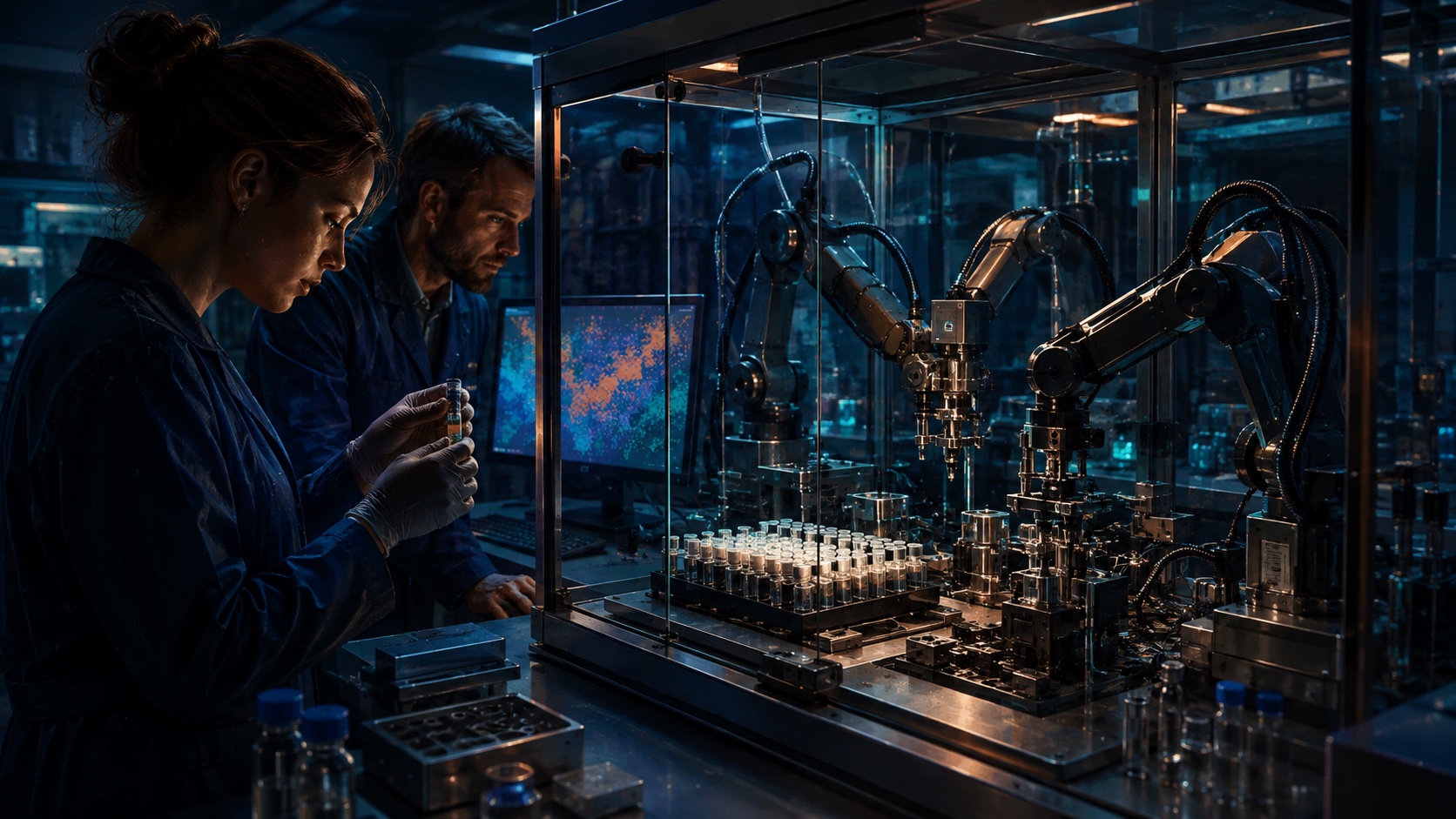
A stronger form of research automation connects planning to equipment. The system proposes an experiment, the apparatus performs it, measurements return, and the next experiment is selected using the new information. This is often called a closed loop.
A June 2026 Nature Communications paper described Flex-Cat, an autonomous platform for catalysis research, reporting 680 experiments. That is an example of physical experimentation in a defined research setting, not just a model writing plausible laboratory instructions. Read the Flex-Cat study.
A catalyst helps a chemical reaction proceed. Searching for a better one often involves changing conditions and comparing results. A well-designed automated platform can keep track of those changes and explore methodically. But it remains dependent on its equipment, measurements, permitted actions, and the scientific questions built into the experiment.
“Autonomous laboratory” therefore does not mean “a machine that can do any science.” It can mean a highly capable system operating within a carefully constructed patch of the world. That is still a significant development.
Astronomy: finding the interesting needles

Modern astronomy produces more observations than humans can inspect individually. AI can help sort them and identify candidates for closer study. NASA reported in January 2026 that ExoMiner++ identified around 7,000 potential planet candidates in TESS data. Candidates are leads, not thousands of newly confirmed planets. Read NASA’s ExoMiner++ report.
For example, a repeated dimming of a star might suggest a planet crossing in front of it. Other effects can imitate a planet’s signal. The work includes separating possibilities and deciding what deserves more observations.
Here the value of AI is neither mystical nor small. It can help researchers spend scarce attention where it is most useful. A telescope still gathers the light; additional investigation still has to establish what caused it.
Software: helping people build the tools everything else uses

AI coding tools can propose code, explain unfamiliar programs, draft tests, and attempt repairs. Software is involved in almost every other field discussed here, so improvements in its development could spread widely. Yet a working-looking answer can conceal an insecure assumption, a broken edge case, or a change that solves the wrong problem.
The evidence also resists easy slogans. METR’s early-2025 study found that experienced developers working on familiar open-source projects took 19% longer with the tested AI tools. In February 2026, METR said newer results were difficult to interpret because participation and task-selection biases had changed; it believed speedups had likely improved but could not reliably quantify the effect. Neither result supports a universal claim that AI always helps or always slows programming. Read METR’s 2026 explanation.
The practical measure is a dependable improvement delivered to users, including review, repair, and maintenance. The number of generated lines is a poor substitute.
Algorithms: improving the machinery inside the machinery
An algorithm is a method for carrying out a task. Changing that method can make a computer do less work to obtain the same useful result.
Google’s May 2026 AlphaEvolve update reports algorithm improvements deployed in its computing infrastructure, including work on chip design and storage. One reported optimization reduced “write amplification” in its Spanner database by 20%: less extra data written behind the scenes for the amount a user requested. Read Google’s AlphaEvolve deployment report.
That is a company-reported result for a specific metric, not a 20% improvement in every computer or a 20% reduction in all energy use. It illustrates an important possibility: AI can help improve the infrastructure on which other AI runs. Whether such improvements produce modest efficiencies or a much faster development cycle remains an open question.
Research assistants and robots: from answering to attempting

Research agents are being explored as systems that search literature, propose hypotheses, compare ideas, and use scientific tools. Google’s 2025 AI co-scientist announcement described a research system designed to support scientists in developing hypotheses and proposals. It was presented as a collaborative research tool, not an independently certified replacement for scientific judgment. Read the research announcement.
Robotics adds another dimension: a system must connect perception and instructions to actions in the physical world. Google DeepMind’s Gemini Robotics research in 2025 explored that connection. Such demonstrations show a direction of travel, but do not establish that an affordable, general-purpose household robot can handle every unexpected situation. See the robotics research.
A robot reaching for a cup encounters lighting, friction, an unfamiliar object, and possibly a person’s hand. The physical world is less forgiving than a text box. Reliability needs to be measured across those conditions, not inferred from a beautifully selected video.
03 / THE DIRECTION OF TRAVEL
From giving answers to organizing work
The larger change is the joining-up of activities that used to happen separately. One model may interpret an image; another tool runs a calculation; an agent organizes the sequence; a person judges whether the results justify the next step.
A single faster step does not automatically make the whole process faster. Imagine an airport that halves the time needed to print a boarding pass while leaving one security lane open. Research has its own security lanes: access to clean data, scarce instruments, experimental replication, clinical testing, manufacturing, and the attention of people qualified to evaluate the result.
My expectation is that the next wave will be shaped by how successfully organizations connect AI to these bottlenecks. A system that generates fifty hypotheses a minute could create a useful queue—or bury a small laboratory under proposals it cannot test. The important improvement may be choosing five better experiments, not producing five thousand impressive suggestions.
Another likely direction is more specialized systems. A smaller tool built for a particular instrument or dataset may be easier to evaluate and operate than a general system asked to do everything. A spectacular conversational model is not always the right answer to an engineering problem.
Finally, the systems are becoming easier to address in ordinary language. That could let more people participate in technical work. It also creates a trap: an easy interface can make a difficult underlying task feel solved. Explaining what you want is only one part of knowing whether you got it.
A CLOSER LOOK / HOW WE KNOW
Why a convincing result is not always a convincing explanation

Imagine an invented factory study. Machines painted blue break down less often. A model notices the pattern and recommends painting every machine blue. But the blue machines might simply be newer. Their paint predicts reliability in the dataset without causing it. Repainting an old machine would leave its worn bearings exactly as they were.
This is the difference between correlation, things moving together, and causation, one thing changing another. Prediction can be useful without a complete causal explanation. The trouble begins when someone turns a prediction into an intervention without checking that the connection will hold.
A randomized experiment can help separate an intervention’s effect from other differences by allocating comparable subjects or tasks by chance. Randomization does not guarantee a flawless study: samples can be small, measurements poor, and people can drop out. But it makes “the groups differed before we started” a less persuasive explanation of the result.
Then there is data leakage. Suppose a student sees the answer key before an exam. Their excellent score says little about how they will handle an unseen question. A model can benefit from a less obvious equivalent when test information slips into training, when near-duplicate examples appear on both sides, or when a supposedly meaningful clue secretly encodes the answer.
Even a clean test covers only what it covers. Imagine a sensor checked on a sunny afternoon and sold for use through winter nights. The original test might be honest and accurate, yet inadequate for the new setting. In AI this change of conditions is often called distribution shift. New patients, instruments, languages, weather patterns, or user behavior can expose weaknesses that were invisible during development.
Percentages also need their denominators. In an invented screening example, a system that labels everything “normal” could be 99% accurate if only one in a hundred cases contains the problem. It would still miss every important case. The useful questions include how many real problems it catches and how many false alarms it creates.
False alarms have a cost. A person must investigate them, another instrument may be needed, and attention spent on them cannot be spent elsewhere. Missed cases have costs too. The right balance depends on the consequences and the available response. A single attractive score can conceal that tradeoff.
Scientific confidence therefore grows through several kinds of checking: fresh data, sensible comparisons, independent teams, meaningful outcomes, and clear records of failures. This can sound slower than the sales pitch. It is how a promising pattern becomes knowledge that other people can safely build on.
04 / WHAT COULD GO RIGHT
The good: more discovery, more access, less wasted effort
A better chance of noticing what we have missed
Many useful discoveries begin with a pattern nobody recognized. AI gives researchers another way to search complicated measurements, enormous archives, and unfamiliar combinations. Its contribution may be a modest clue that becomes important after a human follows it up. Progress does not need to arrive wearing the label “artificial general intelligence.”
More people able to ask serious technical questions
Imagine a small environmental group building a tool to examine local measurements, or a student testing a mathematical idea without first mastering several software packages. These are possible benefits of lower technical barriers. They would be especially valuable when tools are affordable, accessible, and accompanied by enough education to question their answers.
Access is more than a free chat box. It includes reliable connectivity, useful local-language support, appropriate data, and the ability to inspect or export work. If these conditions improve, AI could widen participation in science and technology instead of simply speeding up the best-funded organizations.
Less time lost to routine work
Reading, formatting, organizing records, comparing files, and writing ordinary software glue are necessary, but they can consume the energy needed for deeper work. If AI handles some of that reliably, the reward could be attention returned to a difficult question, a patient, or a new design.
The word “if” does real work here. Time saved before review must exceed time spent fixing errors. The best outcome is not a busier-looking office. It is more worthwhile work completed well.
Experiments we would otherwise never attempt
A laboratory has a limited budget. If each informative experiment becomes cheaper to plan and perform, the team might investigate more unusual ideas. Some will fail. A carefully measured failure can still eliminate an appealing dead end.
This is a quieter vision of an AI revolution: fewer duplicated mistakes, better use of equipment, clearer negative results, and discoveries that emerge from hundreds of small improvements. It is less cinematic than a computer announcing a cure at midnight. It may be more valuable.
05 / WHAT COULD GO WRONG
The bad: errors, incentives, and power
Confident mistakes can travel very far
NIST’s generative-AI risk profile identifies issues including confabulation, harmful bias, privacy, and information integrity. A system can produce convincing false material, repeat distortions in its training data, or expose information that should remain protected. Fluency is not an accuracy certificate. Read NIST’s risk profile.
Consider an invented but ordinary-looking failure: a research assistant supplies a reference that does not exist. A busy writer copies it. Another system summarizes the writer’s text. The claim begins to look established because several pages repeat it, even though no experiment supports it. The danger comes from the chain, not only the first error.
We may automate the wrong objective
A system asked to maximize the number of completed tickets may learn to close easy tickets while important problems wait. A laboratory rewarded for novel-looking results may generate more novelty than knowledge. A business measuring calls handled may overlook customers whose problem remains unresolved.
These are illustrative incentive problems. AI can amplify them by making a narrow target easier to pursue at scale. Good design needs a clear account of what success means, who checks it, and what happens when the measure stops matching the purpose.
People can use powerful tools maliciously
The International AI Safety Report 2026 reviews evidence about misuse, including cyber threats, as well as the uncertain effectiveness of safeguards. It also discusses serious possible loss-of-control scenarios and substantial expert disagreement about their likelihood and timing. These are reasons for careful evaluation; they are not evidence that a particular catastrophe is scheduled for next year. Read the 2026 safety report.
For this article’s one-year horizon, a practical concern is that more capable systems could make some deception and harmful technical work cheaper. Defenders may gain tools too. The balance depends on capability, access, monitoring, and how quickly organizations respond. The speculative crisis later in this post explores that tension without assuming a machine suddenly becomes an evil person.
The gains could concentrate while the disruption spreads
The ILO’s 2025 assessment estimated that about one in four jobs worldwide had some potential exposure to generative AI. Exposure means tasks could be affected; it is not a prediction that a quarter of workers will lose their jobs. The ILO emphasized transformation and the continuing need for human input. Read the ILO assessment.
My concern is how that transformation is managed. A company could use better tools to give its staff more time and training. It could also demand more output from fewer people, remove entry-level opportunities, or make workers responsible for checking systems they have little power to challenge.
There is a long-term skill question hiding in a short-term efficiency question: if beginners stop doing the work through which experts learn, where will the next generation of experts come from? Supervision is not sustainable if nobody is being trained to supervise.
The cloud has a physical footprint
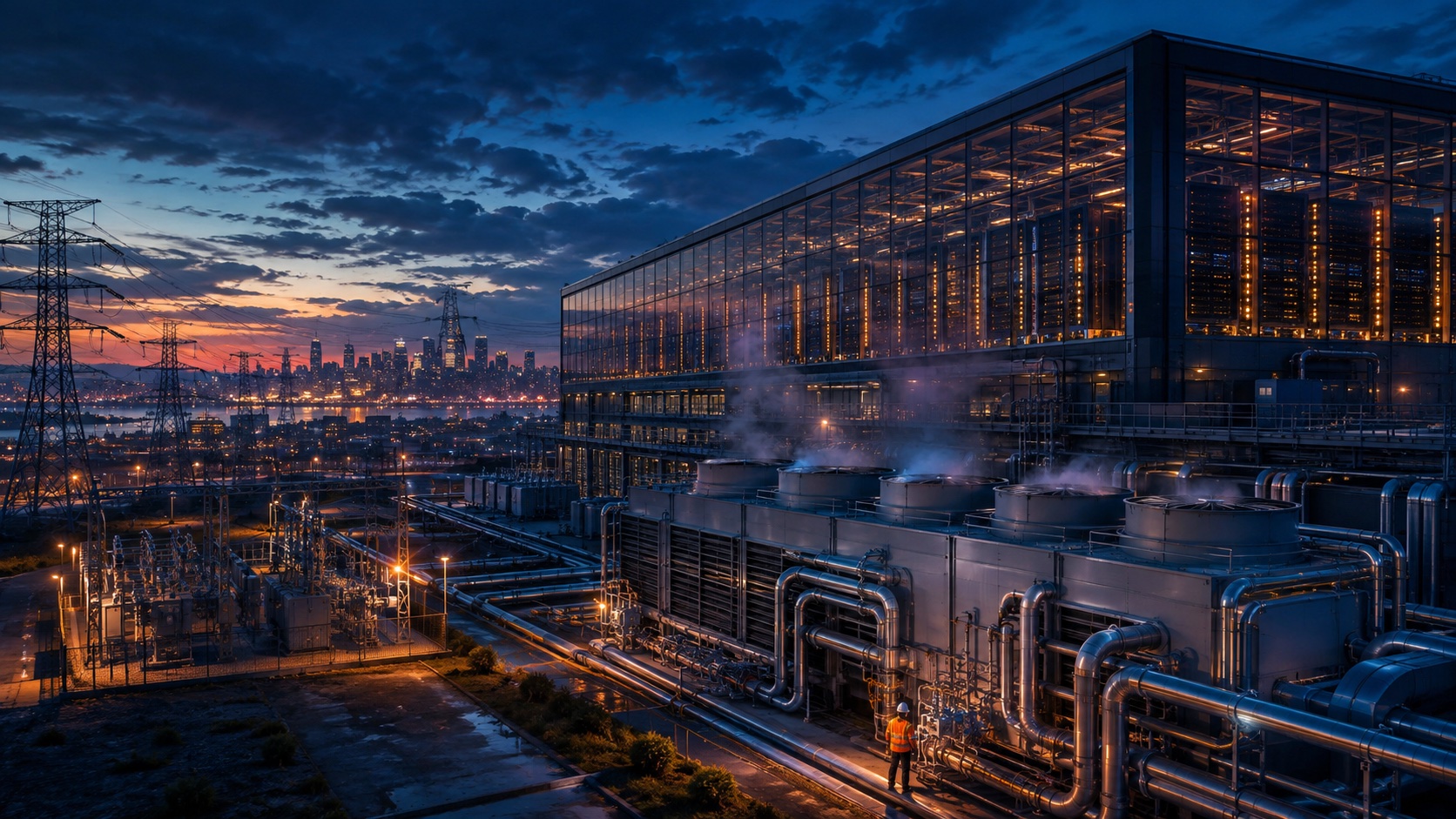
The IEA’s April 2026 outlook projects global data-centre electricity consumption rising from about 485 terawatt-hours in 2025 to about 950 in 2030. Those figures cover data centres broadly, not AI alone, and the 2030 figure is a projection. Its report also explains that efficiency improvements can coexist with rising demand as usage and more intensive applications expand. Read the IEA’s updated analysis.
Hardware, electricity supply, cooling, and local infrastructure belong in the discussion. The environmental result depends on where systems run, how they are powered, what they replace, and how much use grows. “AI will solve the environment” and “every AI use is equally wasteful” both flatten the problem beyond usefulness.
Dependency can arrive before we notice
If a school, laboratory, or company loses the ability to operate without one provider, an outage or policy change becomes more than an inconvenience. A tool has become part of the institution’s nervous system.
The danger is not only a spectacular collapse. It is the gradual loss of alternatives: knowledge stored in inaccessible formats, procedures nobody understands, and staff too rushed to question an answer. Resilience needs maintenance while everything is still working.
06 / THE NEXT TWELVE MONTHS
What can realistically change by September 6, 2027?
A year is a long time for a software release and a short time for a new hospital, power line, or medicine. That mismatch should shape any forecast.
My baseline expectation is more AI inside existing products and workflows, more systems attempting multi-step tasks, and stronger pressure to demonstrate real savings. I would expect uneven results: noticeable improvements in some narrow tasks, disappointing deployments elsewhere, and continued argument over how to measure the difference.
What could move quickly: interfaces, code assistance, document workflows, data analysis, candidate screening, and access to remote tools. Software can spread rapidly when it fits a real need and organizations can afford it.
What is likely to remain slower: physical deployment, broad reliability testing, manufacturing changes, medical evidence, institutional procurement, and training people to use new systems well. A successful demonstration can shorten one stage without eliminating the rest.
What would surprise me in this period: dependable robots in nearly every home, fully automated medicine across routine practice, or a clean transformation of the entire economy into either abundance or mass redundancy. These are editorial judgments, not impossibility claims. Extraordinary events can happen; they deserve extraordinary evidence before they become the expected story.
Instead of assigning made-up percentages, the following scenarios use different assumptions about reliability, access, incentives, and trust. They are three possible paths, not an exhaustive menu. Different sectors—and different neighborhoods—could experience pieces of all three at once.
07 / THREE POSSIBLE FUTURES
September 2027: three doors from the same present
Fiction begins here. The people, institutions, dialogue, incidents, and outcomes in the next three scenarios are invented. Their purpose is to make plausible mechanisms vivid, not to disguise predictions as reporting.
SCENARIO ONE · THE HOPEFUL PATH
The Year the Small Labs Caught Up
Reliable assistance improves faster than expectations rise, and the benefits reach beyond the biggest institutions.

September 6, 2027. 7:40 a.m. Mara unlocks the laboratory and finds a small green light above the overnight experiment station. Six runs completed. Two rejected for unreliable measurements. One result worth repeating.
There is no announcement that science has ended. There is a note: the temperature sensor drifted during the fourth run. Mara smiles at that note more than she smiles at the promising result. Last year’s software would have given her an elegant explanation of bad data. This year’s system caught the fault and stopped.
Her team works at a regional college. They are investigating a more durable coating for equipment used in a local water-treatment plant. They do not have a private supercomputer. They have shared computing access, a modest automated bench, and a grant that pays for independent replication.
By lunchtime, another laboratory has received the protocol and the raw measurements. The AI assistant has prepared the package, but Mara signs off only after inspecting the uncertain parts. In the afternoon, a technician from the plant points out that the candidate coating may be awkward to repair. The team adds that constraint before choosing its next experiment.
Across town, a clinic’s AI-supported paperwork system has finally become good enough that staff are spending less time correcting it. Patients notice something almost embarrassingly ordinary: the person speaking to them is looking at them.
The public story is a research breakthrough. The deeper story is a collection of less glamorous improvements: clear records, cheaper tools, paid training, and permission to stop a system when it behaves strangely.
How this future happens
In this scenario, progress in models is matched by progress in evaluation and deployment. Organizations reward verified results rather than demonstration videos. Shared facilities and affordable tools let smaller teams participate. Staff learn how to challenge outputs, and independent testing is treated as part of innovation rather than a delay.
The gains compound. Better software reduces routine friction; clearer data makes experiments easier to compare; more people can contribute; useful failures are recorded instead of buried. A year later, no one has solved everything, but many teams can investigate more of what matters.
What gets better—and what still hurts
Some work becomes faster and more satisfying. A few promising discoveries advance. Forecasting and technical services improve in specific places. The biggest success may be that reliable assistance becomes ordinary.
Costs and inequality remain. Some organizations still cannot afford equipment. Some jobs change painfully. A successful experiment is still not a mass-produced solution. Even this hopeful future requires choices about who benefits and who pays for the transition.
Clues we would see beforehand: independently replicated gains, successful use outside showcase sites, affordable access, fewer corrections per task, and staff reporting that they have more capacity rather than simply higher quotas.
The miracle is not that the machine knows everything. It is that more people can find out.
SCENARIO TWO · THE UNEVEN PATH
Everything Is Faster. Nothing Feels Finished.
Capabilities advance, but institutions struggle to turn abundant output into dependable results.

September 6, 2027. 9:12 a.m. Jonah’s dashboard says his team has become dramatically more productive. It measures completed drafts, generated tests, and tickets closed. It does not measure how many tickets return wearing different names.
He works for a small technology supplier to hospitals. The AI tools are undeniably useful. They explain old code, find certain mistakes, and build prototypes that once took days. They also occasionally produce a repair that passes the immediate test while making a neighboring system less stable.
Jonah spends his morning deciding which changes deserve a person’s full attention. The company has saved money on one kind of work and discovered a shortage of another: people who understand the whole system.
At a nearby university, an automated research assistant has produced a queue of interesting proposals. A graduate student has time to test three. The instrument needed for the fourth is booked for six weeks. The most exciting hypothesis depends on data the team cannot access.
Meanwhile, a wealthy research centre across the country is doing excellent work with similar models. It has better data, better equipment, and enough experienced staff to check the results. The technology is spreading; the full conditions needed to benefit from it are spreading more slowly.
That evening, Jonah helps his daughter build a small astronomy project. An AI explains a difficult concept in language that finally makes sense to her. He realizes he is grateful for the same technology that has made his workday exhausting.
How this future happens
This scenario combines real capability gains with incomplete organizational change. Managers buy tools before deciding how to measure quality. Review becomes a bottleneck. Licensing and integration costs absorb some savings. Institutions with clean data and strong teams pull ahead.
Nothing needs to fail spectacularly. A thousand small mismatches are enough: an impressive model connected to a messy record system, a useful assistant given an unrealistic quota, a promising experiment trapped behind equipment access.
Who wins, who waits
People who can evaluate outputs gain powerful assistance. Beginners can create more, but may struggle to recognize hidden defects. Some workers move into better roles; others face unstable expectations and fewer opportunities to learn.
Consumers receive convenient services alongside new friction: synthetic messages, automated misunderstandings, and the growing difficulty of reaching a person when the unusual case arrives.
This is the scenario I would use as a planning baseline: meaningful progress distributed unevenly, with success depending heavily on implementation. That is a judgment about plausible conditions, not a claim that the future has already been measured.
Clues we would see beforehand: strong demonstration results alongside mixed workplace outcomes, growing demand for reviewers and integration specialists, more output without proportional improvement in final quality, and widening differences between well-supported and poorly supported teams.
The machine has become faster than the organization around it.
SCENARIO THREE · THE DARK PATH
The Week Nobody Trusted the Screen
A combination of deception, hurried deployment, and weak verification turns a manageable failure into a crisis of confidence.

September 6, 2027. 6:03 a.m. The warning appears on three different screens. It seems to come from three different sources. At first, that makes it look more convincing.
Leena, a hospital operations coordinator, asks for the original notice. One system points to a summary. The summary points to a copied bulletin. The bulletin contains a link to a page that has disappeared.
The warning concerns a widely used service. Some of the concern is real; much of the circulating explanation is false. An ordinary technical incident has been surrounded by fabricated updates, convincing audio, and automatically repeated claims. Several organizations rely on the same suppliers, so the confusion travels quickly.
Staff pause selected automated workflows. They start confirming important instructions through known contacts and established channels. Queues lengthen. People who were told the new systems would save time now have to spend time establishing which messages deserve belief.
Outside the hospital, the situation becomes a story about everything. A forged clip appears to show a scientist admitting that recent results were invented. A genuine correction is dismissed as another fake. An unrelated service failure is added to the same narrative. Real problems become harder to solve because attention is trapped in sorting authentic information from imitation.
By evening, parts of the original fault are understood. The broader damage is slower to repair. Leena’s team has kept essential work moving, but nobody is impressed by the previous month’s chart showing how many human checks were removed.
The most disturbing detail is that no machine needed to hate anyone. People rushed systems into important roles, incentives rewarded speed, malicious actors exploited the opening, and institutions discovered too late that they had confused repetition with independent confirmation.
How this future happens
This is a conditional stress scenario. It assumes capable imitation and automation combine with shared dependencies, weak source checking, and inadequate fallbacks. One incident becomes several because systems copy or act on information before its origin is established.
The crisis could be bounded rather than civilization-ending. Even a temporary disruption can harm people, waste resources, and trigger indiscriminate restrictions that also remove useful tools.
What keeps it from becoming worse
Organizations that retain trained staff, verified communication channels, understandable records, and practiced alternatives recover more effectively in this story. Teams that can isolate a questionable function avoid stopping everything. Public explanations name what is known, what remains uncertain, and how to check an update.
The long-term cost is a trust debt. Legitimate discoveries meet greater suspicion. Smaller organizations face new compliance costs. Providers may consolidate as institutions seek someone large enough to blame or rely on.
Clues we would see beforehand: autonomous permissions expanding faster than evaluation, disappearing manual alternatives, repeated failures to trace claims to originals, organizations sharing brittle dependencies, and incident reports that cannot clearly reconstruct what happened.
The disaster begins when the answer becomes easier to produce than the evidence behind it.
BEYOND THE HORIZON / OPEN POSSIBILITIES
Where could this eventually lead?
The possibilities below are longer-range speculation, with no promised timetable. They extend the mechanisms in the three fictional scenarios; they do not follow automatically from today’s research. A field can advance quickly in one dimension and remain stubbornly difficult in another.
The hopeful extreme: an abundant capacity to investigate
Imagine asking a research service why a local crop fails during a particular combination of heat and rainfall. Instead of returning only a summary, it helps assemble evidence, exposes uncertainty, compares explanations, and proposes affordable tests. Nearby growers contribute observations. A university checks the analysis. The result remains an accountable collaboration, even though computers perform much of the organizing.
Extend that pattern across water, construction, manufacturing, education, and medicine. The remarkable change would be that serious investigation becomes available to more people. Problems that once looked too small for a major institution could receive sustained attention. A rare disease or a rural infrastructure problem might benefit from better tools without becoming a fashionable investment story.
Another possibility is much richer simulation. Researchers might build increasingly useful models of cells, materials, ecosystems, and engineered systems, then use them to choose real-world experiments. The attraction is obvious: learn more before spending scarce resources or exposing people to risk. The hard question is whether the simulation captures what matters. A beautifully detailed model can still be wrong in a decisive way.
The troubling extreme: technical power becomes difficult to challenge
Now imagine the same research capacity concentrated in a few organizations. Access depends on contracts, priorities, and opaque decisions. A small laboratory can rent answers but cannot inspect the evidence or move its work elsewhere. Discoveries increase while the freedom to investigate narrows.
Other institutions might become dependent on systems they can no longer meaningfully evaluate. Humans would still appear in the organization chart, but their approval could become ceremonial: too many decisions arrive too quickly, and the explanation looks convincing enough. The loss would be practical authority, even without a machine developing personal ambitions.
More capable scientific tools could also increase the reach of malicious actors. This does not mean every advance should stop. It means that an eventual world with much cheaper technical capability would need equally serious work on resilience, detection, responsible access, and recovery. The balance between beneficial and harmful use is a social and engineering problem, not a property guaranteed by the word “intelligence.”
The unsettled question: could improvement feed on itself?
AI helping to improve software, experiments, and computing creates the possibility of feedback: better tools help make still better tools. The dramatic version is a rapid acceleration that institutions cannot match. A more ordinary version is a sequence of useful gains repeatedly limited by equipment, energy, evaluation, budgets, and difficult science.
We cannot establish which version wins simply by extending a line on a chart. Improvements may transfer poorly between tasks, meet new bottlenecks, or become harder to verify. Conversely, removing an unexpected bottleneck could create a burst of progress. Both acceleration and disappointment deserve room in the forecast.
The most desirable endpoint is not just more discoveries per hour. It is a world in which people can ask better questions, obtain evidence they can examine, share the benefits, and retain meaningful choices about what happens next. Technical capability could help build that world. It cannot decide, on its own, that this is the world we ought to build.
08 / KEEPING SCORE
What to watch between now and September 2027
The following comparison condenses the fictional mechanisms. It is a thinking aid, not a model with measured probabilities.
| Question | Shared breakthrough | Uneven acceleration | Trust crisis |
|---|---|---|---|
| What improves fastest? | Reliable, accessible work | Output and isolated tasks | Imitation and poorly checked automation |
| Main bottleneck | Physical testing and wider access | Review, integration, and skills | Authenticity and recovery |
| Human role | Better-supported investigator | Overloaded evaluator | Verifier and emergency fallback |
| Most useful response | Broaden what works | Measure completed quality | Restore trustworthy evidence and control |
When the next extraordinary AI claim arrives, five questions will tell you more than a dramatic headline:
- What exactly did it do? Predict a candidate, pass a benchmark, perform an experiment, or improve a real service?
- Who checked it? The creator, an independent team, or people using it under ordinary conditions?
- What did the comparison include? Review, failures, costs, and maintenance—or only the fastest successful attempt?
- Who can benefit? A handful of well-equipped organizations, or people with ordinary budgets and imperfect infrastructure?
- What happens when it fails? Can someone notice, challenge, stop, and repair it?
The future is partly a design decision
AI does not arrive in an empty world. It arrives in clinics with waiting lists, laboratories with budgets, workplaces with incentives, and societies with unequal access to power. Those conditions will help decide what its abilities become.
We can imagine a year in which AI makes discovery more open. We can imagine a year in which it fills every queue with more work than people can evaluate. We can imagine a week in which its ability to imitate certainty makes genuine knowledge harder to recognize.
The question worth carrying into the next year is not simply whether machines become more capable. It is whether we become better at turning that capability into things we can test, understand, share, and trust.
At 2:17 tomorrow morning, another system may propose its forty-fourth idea. The future will depend on what we do with it when the laboratory opens.
A small glossary for a very large subject
- Benchmark
- A defined test used to compare systems. Useful evidence about that test; broader claims need broader checks.
- Inference
- Using a trained model to produce an output. It can mean generating text, estimating a structure, or making a prediction.
- Foundation model
- A model trained broadly enough to be adapted to several tasks. The name does not guarantee that every adaptation will work well.
- Agent
- A system that uses a model with tools and a workflow to attempt steps toward a goal. Its permitted actions matter as much as its answers.
- In vitro
- Studied outside a living organism, such as in a dish of cells. A useful result can still fail to translate into a patient benefit.
- Clinical trial
- A structured study involving people. Its size, design, duration, and chosen outcomes determine what conclusions it can support.
- Uncertainty
- The limits of what is known or predicted. Expressing it honestly helps people decide when another measurement or a human review is needed.
- Replication
- Repeating an investigation to see whether its result holds. Fresh equipment, data, or investigators can reveal problems the original team missed.
THE EVIDENCE TRAIL
Sources and further reading
Selected primary research, official operational updates, and institutional assessments. Dates identify the cited material; research milestones from earlier years are not presented as new 2026 discoveries. The fictional scenarios are the article’s own speculation and are not forecasts endorsed by these sources.
- AlphaFold 3: structure prediction of biomolecular interactions. Nature · May 8, 2024. Molecular-structure prediction and its limitations.
- Advancing regulatory variant effect prediction with AlphaGenome. Nature · January 28, 2026. Genomic research benchmarks; not a universal diagnostic test.
- A generative AI-discovered TNIK inhibitor: a randomized phase 2a trial. Nature Medicine · June 3, 2025. Early human evidence, safety findings, and remaining trial needs.
- Artificial Intelligence-Enabled Medical Devices. US FDA · Accessed September 6, 2026. Device-specific marketing authorizations; a non-comprehensive list.
- AIFS Machine Learning data. ECMWF · Operational documentation; version 2 upgrade May 12, 2026. Operational forecast systems and real-time data.
- ECMWF's ensemble AI forecasts become operational. ECMWF · July 1, 2025. AI and physics-based forecasting used together.
- NASA's Prithvi Becomes First AI Geospatial Foundation Model In Orbit. NASA Science · May 7, 2026. A demonstrated deployment for Earth-observation research.
- Scaling deep learning for materials discovery. Nature · November 29, 2023. Predicted crystal structures, with synthesis and practical testing still needed.
- An autonomous lab for data-driven homogeneous catalysis. Nature Communications · June 20, 2026. 680 physical experiments within a defined chemical research system.
- NASA AI Model That Found 370 Exoplanets Now Digs Into TESS Data. NASA Science · January 22, 2026. ExoMiner++ candidate identification; follow-up is required.
- AlphaEvolve: scaling impact across fields. Google DeepMind · May 7, 2026. Company-reported algorithm improvements in specific deployed systems.
- Gemini Robotics On-Device brings AI to local robotic devices. Google DeepMind · June 24, 2025. A dated robotics demonstration; not a claim of general household reliability.
- Accelerating scientific breakthroughs with an AI co-scientist. Google Research · February 19, 2025. Expert-guided hypothesis generation and selected experimental checks.
- We are Changing our Developer Productivity Experiment Design. METR · February 24, 2026. Why newer productivity estimates are difficult to interpret.
- Generative Artificial Intelligence Profile. NIST · July 26, 2024. An institutional framework for identifying and managing generative-AI risks.
- International AI Safety Report 2026. International AI Safety Report · February 2026. Evidence and uncertainty about general-purpose AI capabilities, misuse, and safety.
- Generative AI and jobs: A 2025 update. International Labour Organization · May 20, 2025. Occupational exposure is not a count or forecast of job losses.
- Key Questions on Energy and AI: executive summary. International Energy Agency · April 16, 2026. Updated electricity estimates, infrastructure constraints, and conditional projections.
Production note: This article was prepared with AI assistance. Sixteen original illustrations were generated for the post with AI. They are conceptual artwork, not photographs, diagrams to scale, or evidence of a real experiment. The fictional characters and incidents do not represent actual people or institutions.