The Unlikely Record · Episode 02 · Twelve stories
Twelve histories of testimony, confinement and the struggle to be heard
An official record can make a complicated life look settled. A name, a diagnosis, a date of admission: the columns seem to explain everything. These twelve histories begin where that confidence breaks down. A woman reads her own essay to a jury. A seamstress writes in thread. A hospital patient helps assemble a dictionary. The surviving evidence does not make every disagreement easy to resolve, but it lets us hear more than one voice. Historical labels appear here only when the records require them; they are not diagnoses made by this series.
Story 01
The Essay That Entered the Witness Box

Elizabeth Packard's religious opinions became evidence against her. Her husband, a Calvinist minister, objected to views she expressed about religion, women's rights and slavery. Illinois law gave married women an especially precarious position: a husband could arrange a wife's admission to the state asylum without the jury protection available in other cases. Packard was confined in Jacksonville in 1860.
Release from the asylum did not bring freedom. Her husband subsequently held her inside their home while planning another commitment. Friends sought a writ of habeas corpus. In Kankakee, the question of her confinement finally reached a courtroom, where witnesses described disagreement and disobedience as signs of insanity.
Packard answered in part by reading an essay she had prepared for her Bible study group. A physician who also understood theology testified that disagreement was not a sufficient reason to call someone insane. On January 18, 1864, the jury found her sane; the Illinois courts' historical account reports a deliberation of seven minutes.
She then turned experience into a legislative campaign. In 1867, Illinois passed the personal-liberty law she had championed, extending jury protection to married women accused of insanity. The same opinions once used to silence her had become part of a public argument for changing the rules.
Evidence and sources
The commitment, trial and reform campaign are documented. The verdict is a historical legal finding, not a modern diagnosis.
- Elizabeth Packard and mental health laws — Illinois Supreme Court Historic Preservation Commission
- Elizabeth Packard — National Women's History Museum
Story 02
Getting In Was Easier Than Getting Out

For her investigation of the women's asylum on Blackwell's Island, Nellie Bly needed the authorities to believe a story about her. Working for the New York World, she pretended to be mentally unwell and entered the system she intended to report on. The newspaper would have to help secure her release.
Inside, the practical details mattered more than the performance that had brought her there. Bly described cold bathing, spoiled food, dirty conditions and rough treatment. She also reported meeting women whose limited English made it difficult for them to explain themselves to the staff. Being unable to make oneself understood could have enormous consequences in a place where other people controlled the explanation.
Her account appeared as Ten Days in a Madhouse in 1887. The book offered readers an unusually direct view of daily life behind the institution's doors. Its force came from concrete observations: what a person was given to eat, how a nurse spoke to her, and how little control she had over the next hour.
Bly's reporting helped drive scrutiny and reform. Her own stay ended, and she could address a large newspaper audience. The women she described had no equivalent assurance that someone outside was waiting to retrieve them. That unequal access to an exit was one of the investigation's most disturbing discoveries.
Evidence and sources
An undercover investigation, not evidence that Bly had a psychiatric illness. Patient encounters are attributed to her reporting.
- Nellie Bly — National Park Service
- Ten Days in a Madhouse — University of Pennsylvania digital library
Introduction and chapters XVI–XVII - Ten Days in a Madhouse: The Woman Who Got Herself Committed — Library of Congress
Story 03
The Book His Friends Did Not Know How to Ask About
When Clifford Beers returned to ordinary life after psychiatric hospitalization, his friends tried to be considerate. In his memoir, he remembered their careful avoidance of the subject. He responded by bringing it up himself. Silence could make a return to society feel like another kind of separation.
Beers was discharged from the Connecticut State Hospital in September 1903. He eventually rejoined a former employer, finding work that left room for reading and writing. His employer's willingness to treat psychiatric illness as an illness, rather than a permanent disqualification, became one of the experiences he wanted other people to understand.
Then a reading of Victor Hugo's Les Misérables sharpened an ambition: he wanted a book of his own to move readers toward reform. He did not present the process as a smooth recovery story. His account describes renewed excitement, family concern and arguments over how quickly his plans should proceed.
A Mind That Found Itself appeared in 1908. That year Beers helped establish the Connecticut Society for Mental Hygiene; the National Committee followed in 1909. Yale's archive preserves eleven versions of his manuscript. The finished public testimony had required revision, criticism and work. A man whom acquaintances had feared to question had produced a book intended to make difficult conversations unavoidable.
Evidence and sources
Personal experiences are presented as Beers's memoir testimony; publication and organizational dates are independently catalogued.
- A Mind That Found Itself — Project Gutenberg
Chapters XXVII–XXIX - Clifford Whittingham Beers papers, MS 612 — Yale University Library
Story 04
A Life Written on the Inside of a Jacket
A little linen jacket entered public view with remarkably little explanation. When it appeared in a major exhibition of the Prinzhorn Collection in 1980 and 1981, its accompanying note named Agnes Richter, gave the date 1895 and described her habit of sewing memories into clothing. The jacket was covered with words, many of them on the inside.
Richter had worked as a seamstress. In preparing a later exhibition, researchers located two medical files at Hubertusburg: two women with her name had lived there. Neither file described the jacket. One, however, contained a laundry slip bearing the number 583, which also appeared in the embroidery. An ordinary mark for returning clothes to their owner helped distinguish one woman's history from another's.
The writing uses old German cursive, and much has become illegible through wear. Repeated personal pronouns and the surviving record support an autobiographical reading, but the garment cannot responsibly be translated into a tidy, fully recovered diary. Its construction has also changed: seams and sleeves raise questions that curators have explored through the physical evidence of wear.
The small object thus preserves both testimony and uncertainty. A hospital record assigned a number; a skilled maker filled cloth with her own words. Enough survives to establish that she was telling something about her life, even where the precise sentences can no longer be read.
Evidence and sources
The garment and records survive. Most embroidered text is difficult to read; explanations of its altered construction remain interpretations.
- The Little Jacket (1895) by Agnes Richter — Prinzhorn Collection, Heidelberg University Hospital
- Agnes Richter's jacket — Thomas Röske, Epidemiology and Psychiatric Sciences
Pages227–229
Story 05
The Letter Too Long for an Envelope
Lorina Bulwer made sure that the reader knew who was speaking. Her embroidered text repeatedly gives her name. Across pieced fabric, capital letters carry memories, grievances, family names and claims about the world beyond Great Yarmouth Workhouse. The material was domestic; the scale and insistence were extraordinary.
When a sampler reached the Norfolk museum collection, its accompanying story lacked supporting references. Curator Ruth Burwood began checking the words against census returns and other records. Bulwer's references to relatives and addresses gave the investigation a route through a life that might otherwise have remained difficult to trace.
The 1901 census places her in the workhouse and uses the period's institutional label for mental illness. Precisely how and when she entered remains unclear, because few relevant workhouse records survived. Even the dates of the embroidery could be approached indirectly: a nephew's stated age offered one clue, and references to another resident's death helped date a related sampler.
The result was a peculiar reversal. Statements stitched by a woman inside an institution became tools for interrogating the paperwork outside it. They did not prove every accusation she made. They did establish names, connections and a determined speaking voice, on a surface that could survive long after an ordinary letter might have disappeared.
Evidence and sources
The textiles and census evidence survive. Their allegations are Bulwer's statements; her exact admission circumstances are uncertain.
- Looking for Lorina — Ruth Burwood, Norwich Castle Museum and Art Gallery; Time and Tide exhibition
- Transforming the decorative into dissent — Wellcome Collection
Story 06
The Expensive Asylum and the Patient's Review
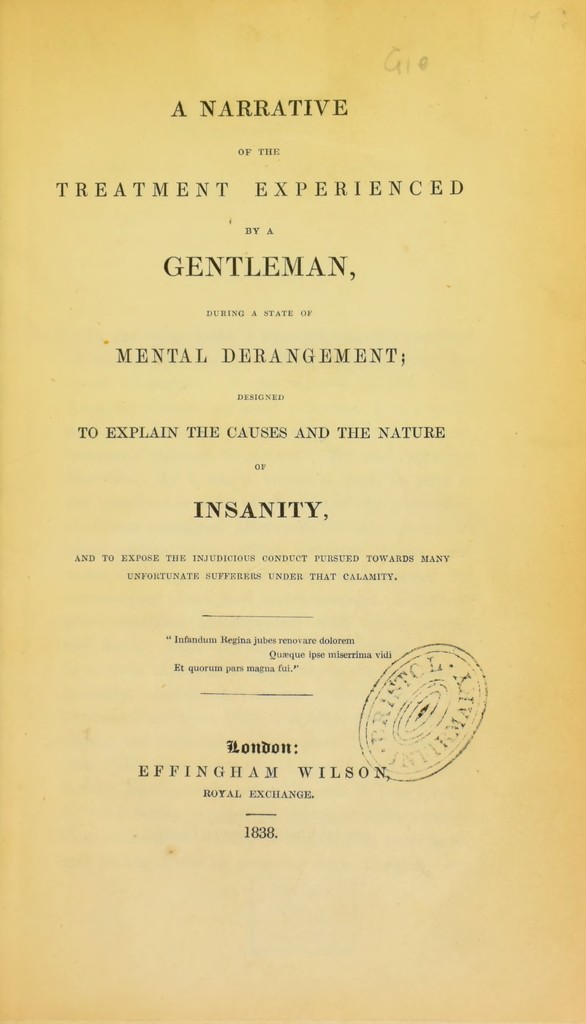
An expensive private asylum could promise an impressive standard of care. John Thomas Perceval's family placed him in two such institutions, Brislington House and Ticehurst House, where he spent about three years. He later published an account that challenged what the price and reputation might have led outsiders to expect.
His Narrative of 1838 described the restraints and cold baths he experienced at Brislington, as well as a medical intervention involving his temporal artery. The Library Company of Philadelphia places the book beside institutional rules and other patient narratives, allowing the language of proper management to be read against descriptions of what treatment felt like to its recipients.
Perceval's testimony matters in part because he did not have to deny that he had experienced profound mental disturbance in order to criticize his care. The question of illness and the question of mistreatment could both be examined. Treating one as a complete answer to the other would erase the central argument of a patient's account.
After his discharge in 1834, he became involved in campaigning for changes to the law and in the Alleged Lunatics' Friend Society. His long-titled book survives in digitized collections. The institution could produce a record about its patient; the former patient could also publish a record about the institution.
Evidence and sources
Confinement, publication and advocacy are documented. Descriptions of treatment are attributed to Perceval's published account.
- A narrative of the treatment experienced by a gentleman (1838) — Wellcome Collection / University of Bristol Library
- Hearing Voices: Department for Males — Library Company of Philadelphia
- John Perceval's account of his psychosis, 1830–1832 — Femi Oyebode, BJPsych Advances
Story 07
The Patient Who Drew Another Hospital
James Tilly Matthews is often remembered for a machine that did not exist: the Air Loom, which he believed was being used to influence minds and politics. His detailed account became a famous part of psychiatric history. Yet Bethlem's archive preserves another kind of design associated with him—plans for a new hospital.
Correspondence from 1809 to 1811 links disputes about his confinement with his proposals for the building at St George's Fields. Here was a person held within an institution who was also thinking about how an institution might be arranged. Wellcome's exhibition on the history of the asylum highlighted those plans alongside the much more familiar story of the imagined machine.
Accounts given to the parliamentary Committee on Madhouses complicate a one-note portrait of Matthews. Bethlem's head keeper, James Simmonds, described him as quiet and gentle, remembered helping him with clean clothing, and said he wrote a great deal. Simmonds also criticized his treatment and attributed restraints to conflict with the hospital apothecary. These are witness statements, not a complete independent account of every encounter.
Matthews's relatives fought to move him, and he eventually left Bethlem for a private house in Hackney. His surviving designs invite attention to an overlooked ability: while others debated his state of mind, he was capable of giving sustained thought to the walls around patients.
Evidence and sources
Plans and correspondence survive. The Air Loom was Matthews's reported belief, not a verified machine.
- PPJ-01: correspondence and hospital designs of James Tilly Matthews — Bethlem Museum of the Mind
- Bedlam: the asylum and beyond — Wellcome Collection
- 200 Years Ago Today 13 — Bethlem Museum of the Mind
- The Air Loom, A Human Influencing Machine — Bethlem Museum of the Mind
Story 08
The Print That Made a Hidden Patient Visible
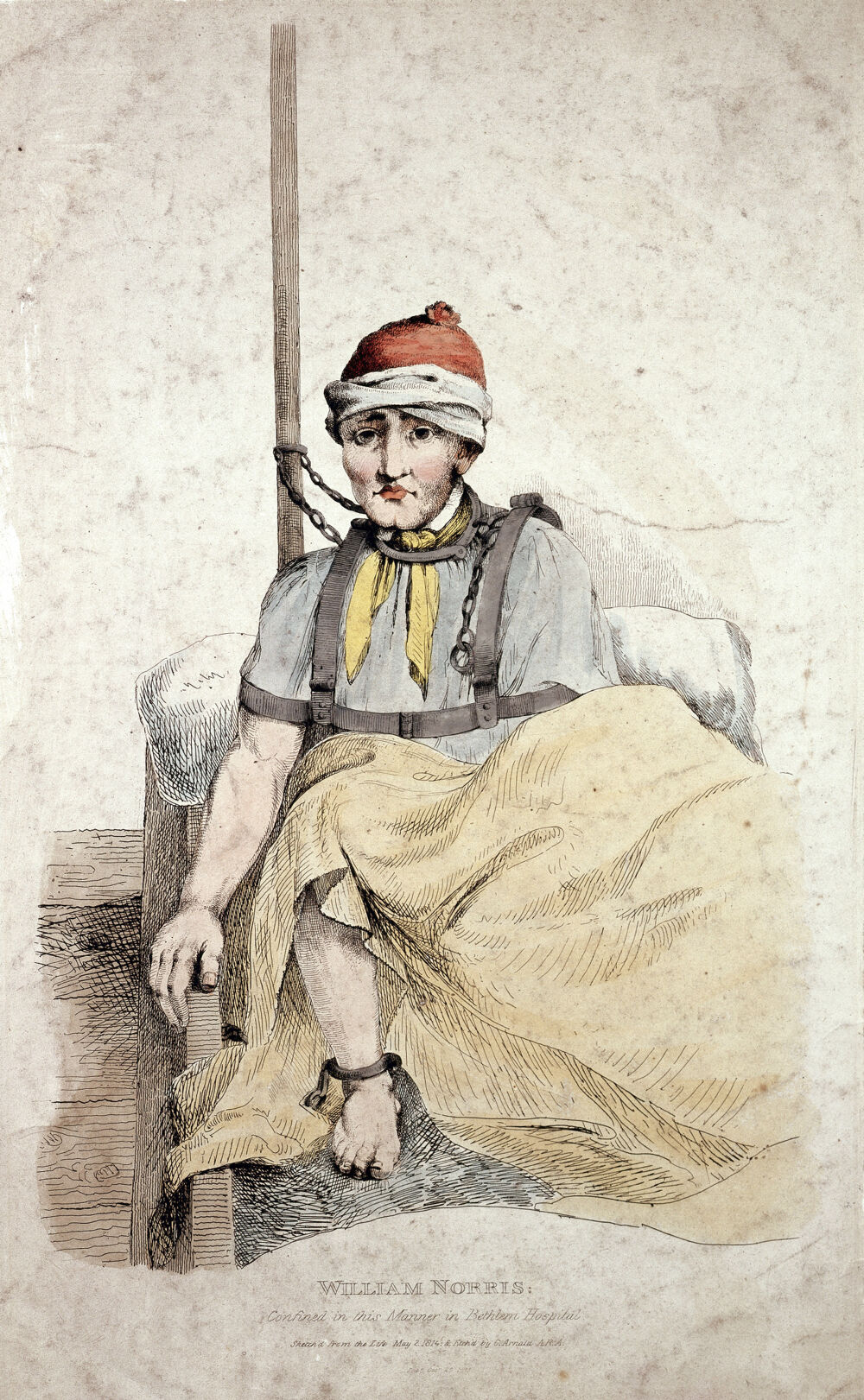
The name on the print is William Norris. Bethlem's own archive calls the patient James Norris. Even this much-reproduced image carries a warning about how easily a detail can harden into historical certainty. What it depicts is less ambiguous: a man held in an elaborate iron restraint inside Bethlem Hospital.
George Arnald's print states that its drawing was made from life on May 2, 1814. A colored version in the Wellcome Collection was published in October 1815. Bethlem also preserves an engraving surrounded by extracts from the evidence heard by the parliamentary Committee on Madhouses. Image and testimony could now travel together beyond the ward.
A later historical study, drawing on apothecary John Haslam's account, traces Norris's admission to 1800 and the proposal for an iron apparatus to 1804. Officials had presented restraints as a response to dangerous behavior. In 1814, however, his confinement attracted visitors, newspaper attention and political scrutiny. He was finally released from the apparatus that year.
The engraving did not show an anonymous emblem of suffering. It showed a particular man whose treatment had become a public controversy. Reproducing it responsibly means keeping his identity and the surviving evidence attached, instead of turning a record of restraint into a decorative image of horror.
Evidence and sources
The engraving and inquiry record survive. Historic prints call him William; Bethlem's archive identifies him as James Norris.
- Norris restrained in Bethlem: etching by George Arnald, 1815 — Wellcome Collection
- EO-049: James Norris with committee evidence extracts — Bethlem Museum of the Mind
- The Creation of the Padded Room, by Andrew Howe — Royal College of Psychiatrists, History of Psychiatry SIG
Page2
Story 09
The Woman Denied a Law Career Who Helped Open a Door
_-_Brady_LCCN2008680392.jpg)
In 1875, Mary Lincoln was sent to Bellevue sanitarium in Batavia after proceedings arranged by her surviving son, Robert. She had endured repeated bereavements and was the subject of intense public judgment. The trial made a legal finding about her condition, but it did not put an end to her efforts to regain control of her life.
From Bellevue she reached Myra Bradwell. Bradwell had studied law and was an energetic legal publisher, yet had been denied permission to practice because she was a woman. The person Lincoln turned to therefore had her own experience of an official boundary drawn around women's authority.
Bradwell brought public attention to the case, pressed for Lincoln's release and helped arrange a place for her with her sister in Springfield. According to the Abraham Lincoln Presidential Library and Museum, Lincoln had cooperated with the sanitarium's staff and did not require the restraints or drugs used for many other patients there. She was released after less than four months.
The episode contains a pointed historical connection: a woman excluded from the legal profession helped another woman contest the practical consequences of a legal judgment. The surviving account supports that intervention without requiring a simple verdict on every family motive or an easy modern explanation for all of Lincoln's distress.
Evidence and sources
The commitment and release campaign are documented. This story does not retrospectively diagnose Mary Lincoln or settle every dispute about Robert's intentions.
- Remembering Mary Lincoln and Tad Lincoln — Abraham Lincoln Presidential Library and Museum
- Illinois Supreme Court history: Myra Bradwell — Illinois Supreme Court Historic Preservation Commission
Story 10
The Visit That Was Refused
Hannah Mills's family could not easily visit her in the York Asylum, so fellow Quakers in the city tried to go in their place. They were refused access. Mills died there in 1790, after a stay that the Borthwick Institute's account describes as six weeks. People who had wanted to offer ordinary companionship had been unable even to see the conditions in which she lived.
That absence of a visit had consequences beyond one family. William Tuke and other Quakers began working toward a different institution, where patients could remain connected to a familiar religious community and where kindness would be part of care. The resulting York Retreat opened in 1796.
The founders did not have modern psychiatric knowledge. Their approach belonged to its own period and included assumptions about religion, conduct and recovery that deserve examination. But it challenged the idea that mental disturbance removed a person's claim to humane treatment. The Retreat subsequently influenced institutions elsewhere, including the Friends' Asylum in Philadelphia.
Mills is often a brief name in a larger history of reform. Her own experience is much harder to recover. The surviving story should not be enlarged into a proven account of murder or a precisely known medical cause. Its documented starting point is already serious: people tried to visit, the institution kept them out, and their unanswered concern helped produce an alternative.
Evidence and sources
The refused access, death and founding response are documented. Her precise cause of death is not established here.
- The York Lunatic Asylum Scandal — Borthwick Institute for Archives, University of York
- The York Retreat & American Asylums — Haverford College Libraries
- Photographs of documents relating to Hannah Mills, died1790 — Wellcome Collection / Borthwick Institute
Story 11
The Dictionary's Remote Researcher

Among the people helping editors trace the history of English words was a reader working inside Broadmoor. William Chester Minor owned antiquarian books and had time to examine them closely. Rather than simply sending interesting passages whenever he encountered them, he developed a system that made his reading useful at the moment an editor needed it.
For each book he compiled a small index of words and page numbers. When the dictionary team was working on particular entries, he could search his own records and supply relevant quotations. Oxford University Press's archive preserves forty-two of these indexes, covering subjects from medicine to travel. Over his years of work, Minor provided tens of thousands of quotations.
There is a grave event behind his confinement. In 1872, he shot and killed George Merritt, a man on his way to work in Lambeth. Minor was found not guilty by reason of insanity and sent to Broadmoor. His later scholarship does not undo Merritt's death or make the victim a minor character in an inspiring recovery tale.
It does reveal a remarkable working connection. Historical examples gathered in a secure hospital became part of an international reference work. The surviving indexes show how it happened: small, disciplined acts of reading, arranged so that distant collaborators could find the evidence they needed.
Evidence and sources
Minor's confinement and contributions are documented. The often-dramatized surprise meeting with Murray is not used.
- #EYACrime: William Chester Minor's OED work — Oxford University Press Archives
- 10 things you may not know about the making of the OED, Part2 — Peter Gilliver, Oxford University Press
Story 12
The Patient Painted the Caregiver
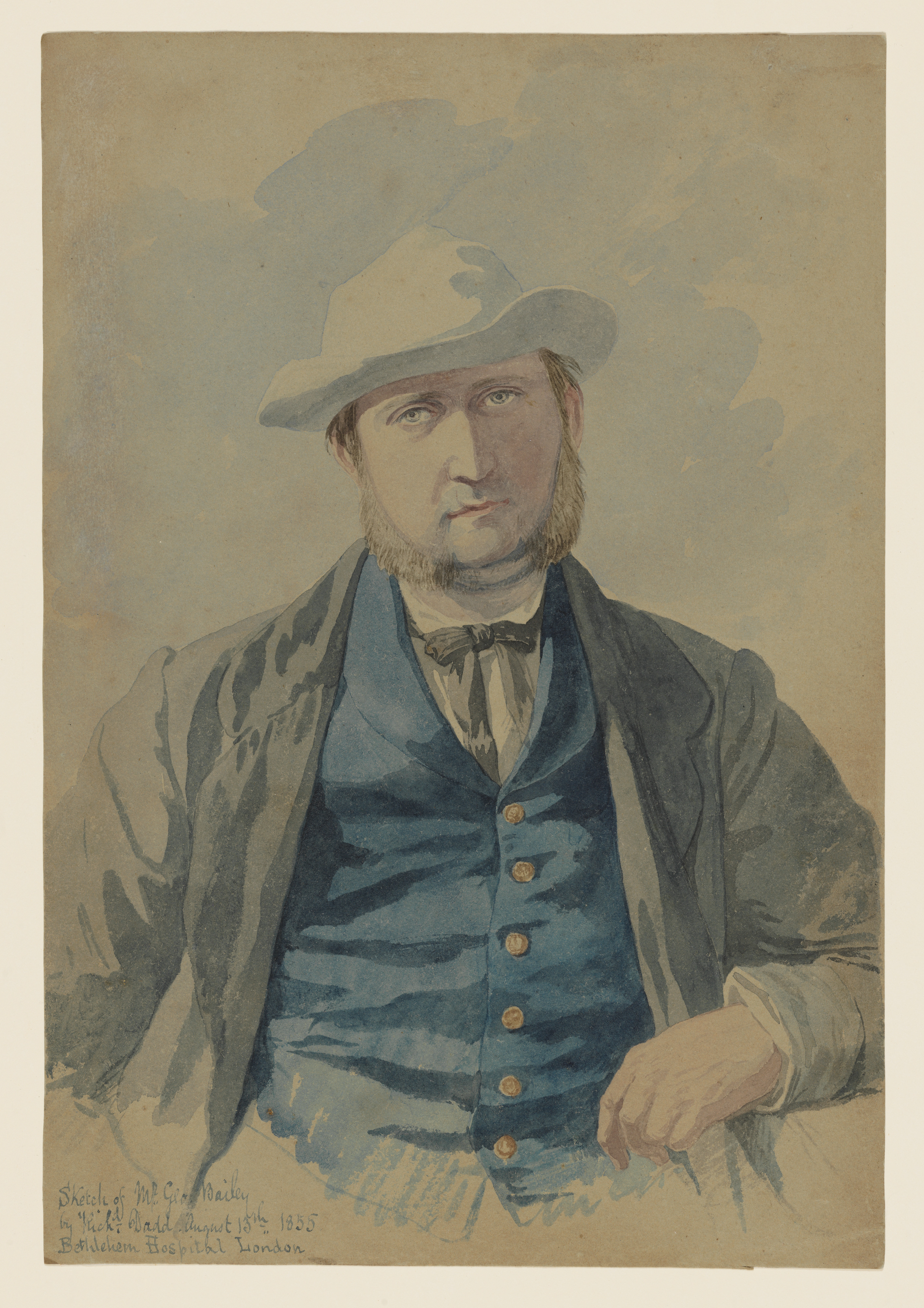
In August 1855, Richard Dadd painted George Bailey, an attendant at Bethlem Hospital. Bailey sat for a watercolor that preserves a quiet encounter between two people on different sides of institutional authority. Dadd was a patient. Bailey was one of the men employed to care for him.
The artist had been confined after killing his father in 1843. He continued to paint, producing portraits as well as the intricate imaginary worlds for which he became known. Bailey, meanwhile, had arrived at Bethlem in 1848 as an unskilled attendant and developed into an experienced caregiver. The Metropolitan Museum's research places their portrait within superintendent William Charles Hood's efforts to improve conditions.
In 1857, Dadd and fifty-nine other patients moved into a ward with a library and brighter common rooms. Bailey was among the staff selected to look after them. He later transferred to Broadmoor, and Dadd followed to the same institution in 1864. The museum describes a relationship extending across thirty-six years.
The watercolor offers a different scale of history from a sensational case summary. Its subject is a specific caregiver, observed by a specific artist who knew him. Before the portrait entered a major museum, it recorded the fact that a hospital patient could also be the person looking carefully, making choices and giving someone else a lasting image.
Evidence and sources
The dated portrait and sitter's career are documented by the holding museum. Readings of light and expression are curatorial interpretations.
- Richard Dadd, Portrait of Mr. George Bailey, 2013.74 — The Metropolitan Museum of Art
The unexpected objects in these histories have survived in different ways: a published memoir, an official catalogue, a portrait, a laundry number and densely stitched words. Together they show how much can disappear when a person becomes only a case. They also leave questions open. A record of confinement cannot, by itself, tell us whether the confinement was justified, and a powerful personal account still deserves careful reading. The sources below let you follow each history beyond its familiar shorthand.
About the evidence labels
Documented identifies a supported historical event. Disputed marks an account whose explanation or details remain contested. Folklore identifies a recorded tradition; its inclusion does not establish that a supernatural event occurred.