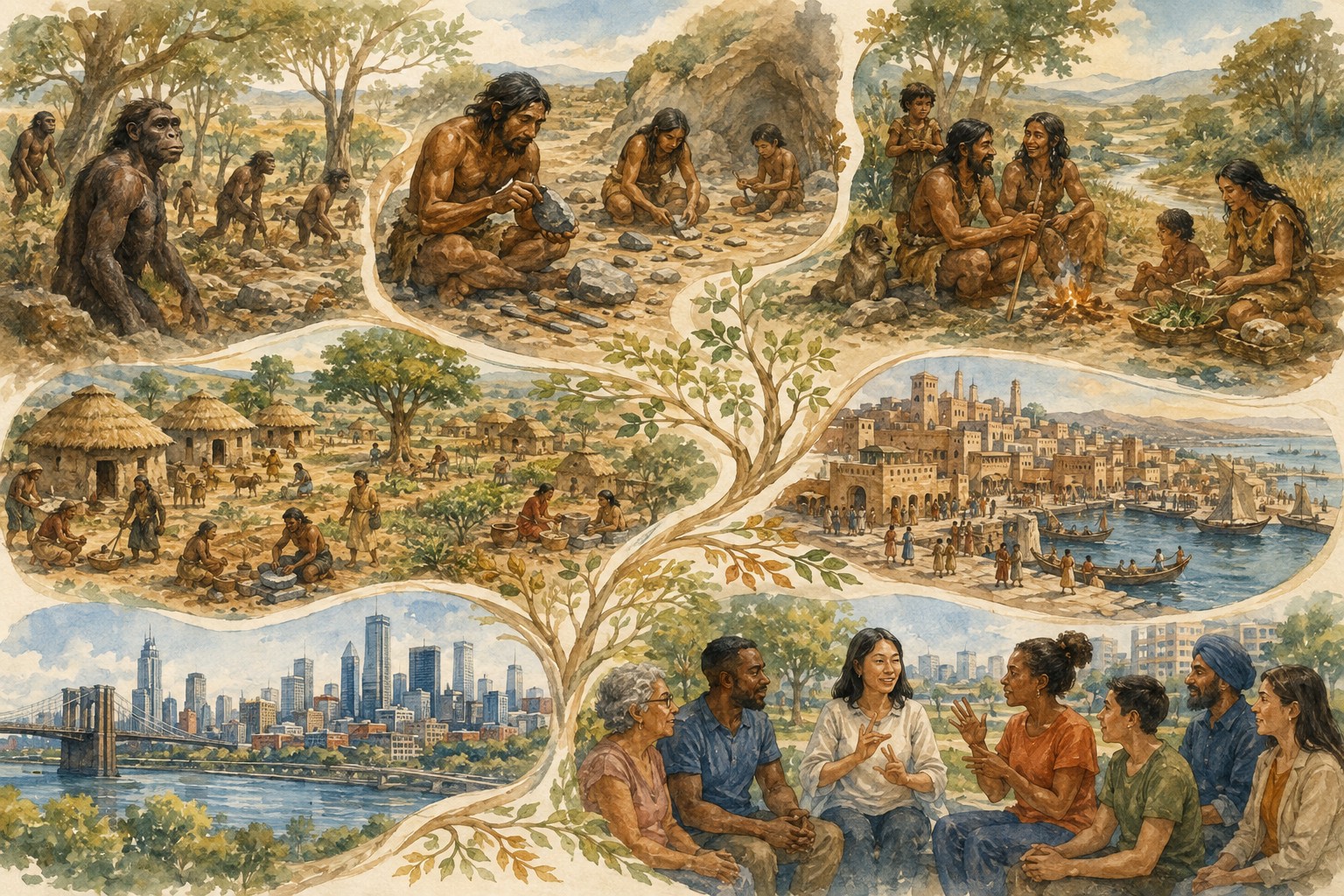
We are a species that can ask where it came from. To answer, we have learned to read several very different kinds of record: rocks, bones, tools, DNA, spoken traditions, inscriptions, books, and the traces people leave in their surroundings. None contains the whole story. Together, they reveal a past far longer, stranger, and more connected than a simple sequence of famous civilizations.
This is a long, accessible journey through that past. It begins before humans—and before primates—then follows our many relatives, the mystery of language, the first farming communities, and the growth of organized knowledge. Ancient Greece receives particular attention, but Greek thinkers belong within a larger world of exchange. The journey continues through Asian, African, Islamic, American, and European traditions to modern science, computing, and AI.
How to read this history. Dates are approximate unless a specific event is recorded. “BCE” means before the Common Era; “CE” uses the same year numbering as AD. For deep prehistory, “million years ago” is clearer. Fossils establish that a population existed at a particular time; they rarely reveal its exact beginning or end. The linked sources beside each topic let you follow the evidence.
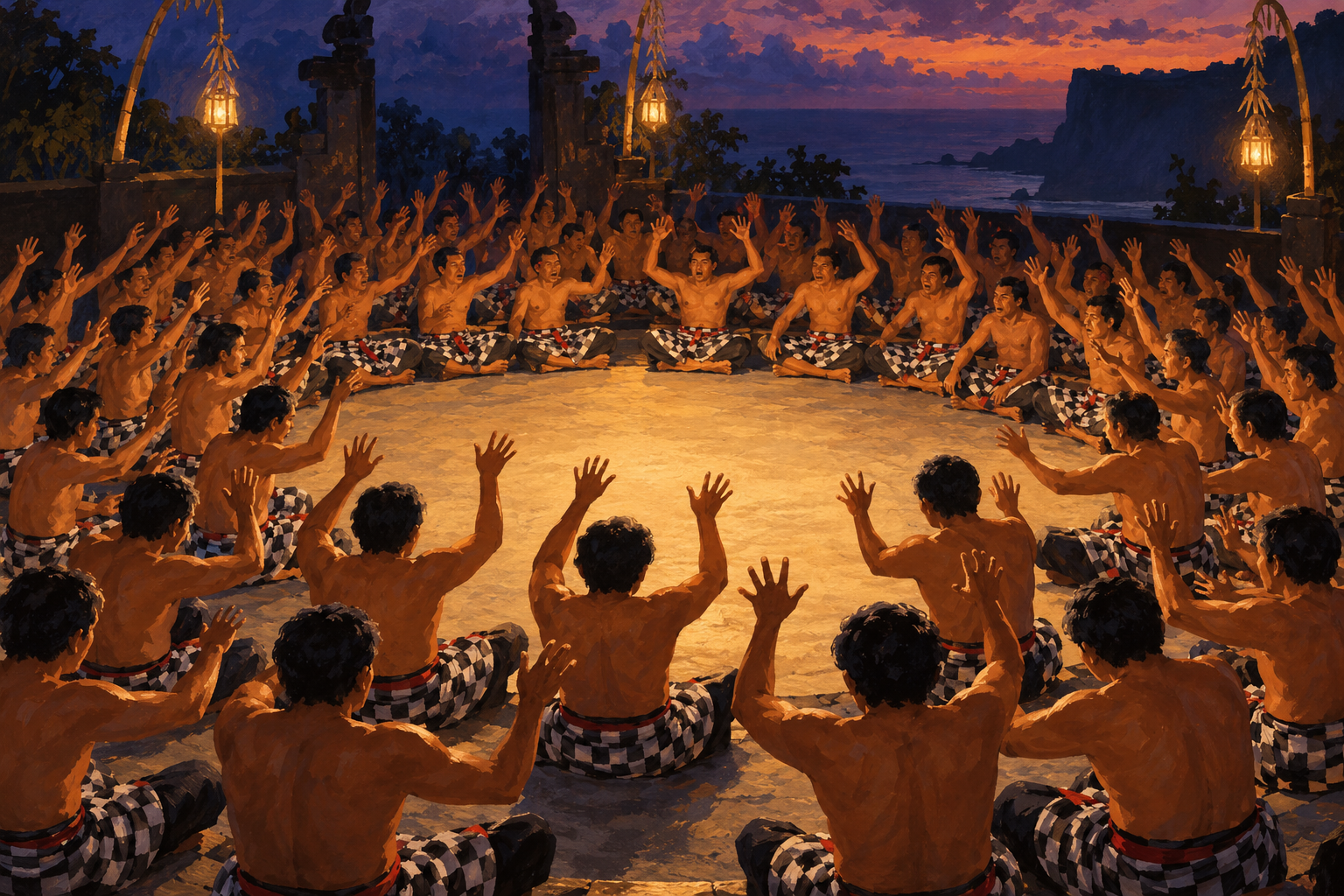
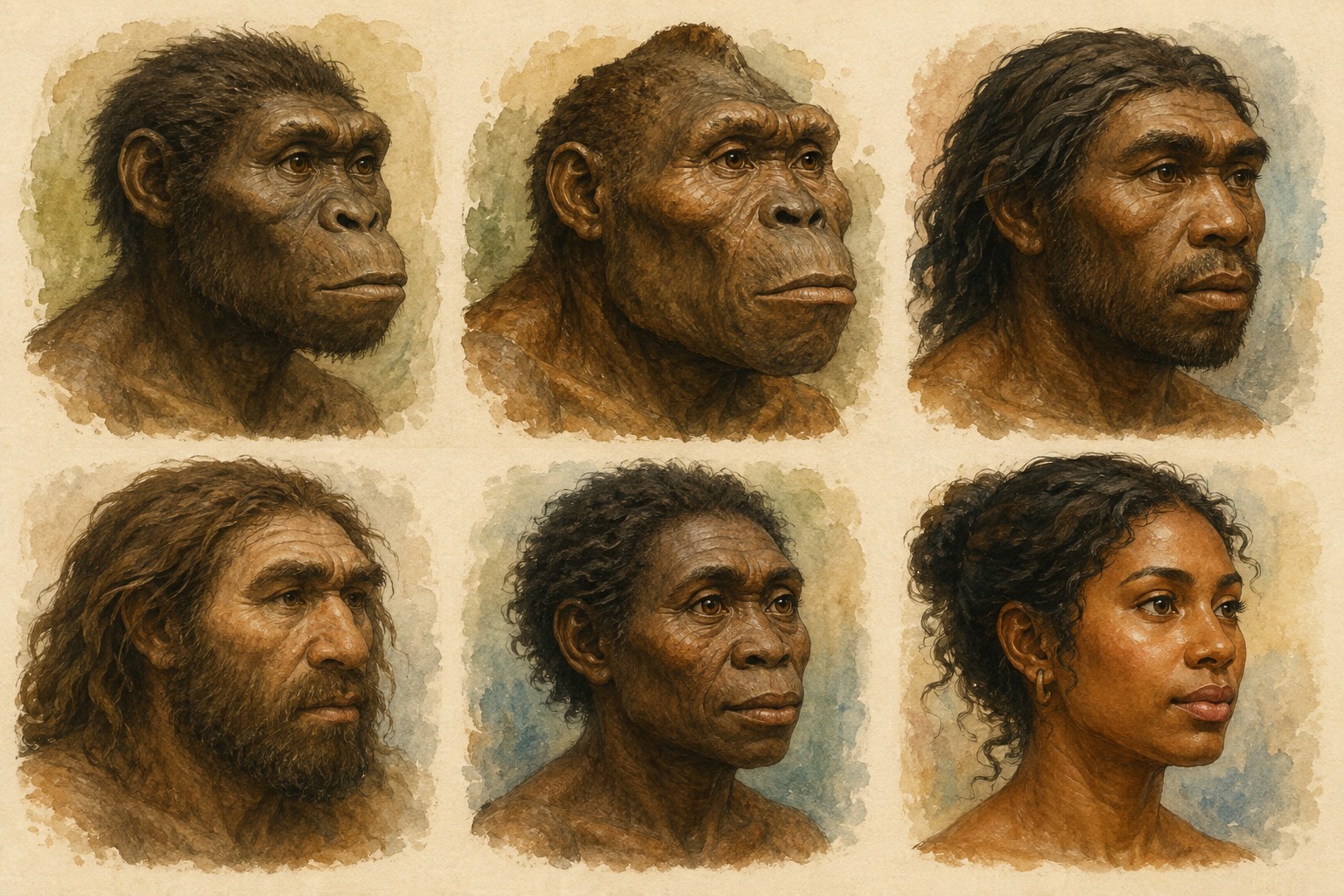
About the pictures. The illustrations were generated with AI for this article. They are imaginative reconstructions and conceptual montages, not photographs, excavated evidence, exact portraits, or authoritative reconstructions of ancient speech, clothing, appearance, and social roles. Separate eras shown together did not necessarily coexist.
- 1. Before anything human: Earth, life, and deep time
- 2. Apes, ancestors, and what “human” means
- 3. The many branches of the human family
- 4. Homo sapiens in a world of other humans
- 5. Language, memory, and the first shared knowledge
- 6. Farming: many beginnings and new ways of living
- 7. Cities, states, and the invention of writing
- 8. Knowledge before and beside Greece
- 9. Greek language and a new culture of argument
- 10. Socrates, Plato, and Aristotle
- 11. Greek mathematics, medicine, and the Hellenistic world
- 12. Knowledge across Asia, Africa, and the medieval world
- 13. Printing, universities, and the changing rules of evidence
- 14. Societies connected by roads, seas, belief, and power
- 15. Industry, public education, and struggles over society
- 16. Modern science changes our picture of life and the universe
- 17. Computers, the Internet, and a new scale of shared information
- 18. AI and the unfinished history of knowledge
- 19. The long view: what changed, and what connects us
1. Before anything human: Earth, life, and deep time
Earth formed about 4.54 billion years ago. Geologists estimate this age using radioactive decay in ancient material, including meteorites. This is very different from dating a king's reign or reading an inscription: atoms themselves provide clocks, although each method has conditions and uncertainty. US Geological Survey: Age of the Earth
Evidence of life reaches back at least about 3.5 billion years. For much of Earth's history, living things were microscopic. Microbial communities altered their environment, including the atmosphere; complex cells and, much later, multicellular animals emerged. The Cambrian diversification, more than 500 million years ago, belongs to a world already ancient by the time animals became abundant in the fossil record. Scientists continue to debate the interpretation of the oldest claimed traces of life. Smithsonian: History of Life on Earth
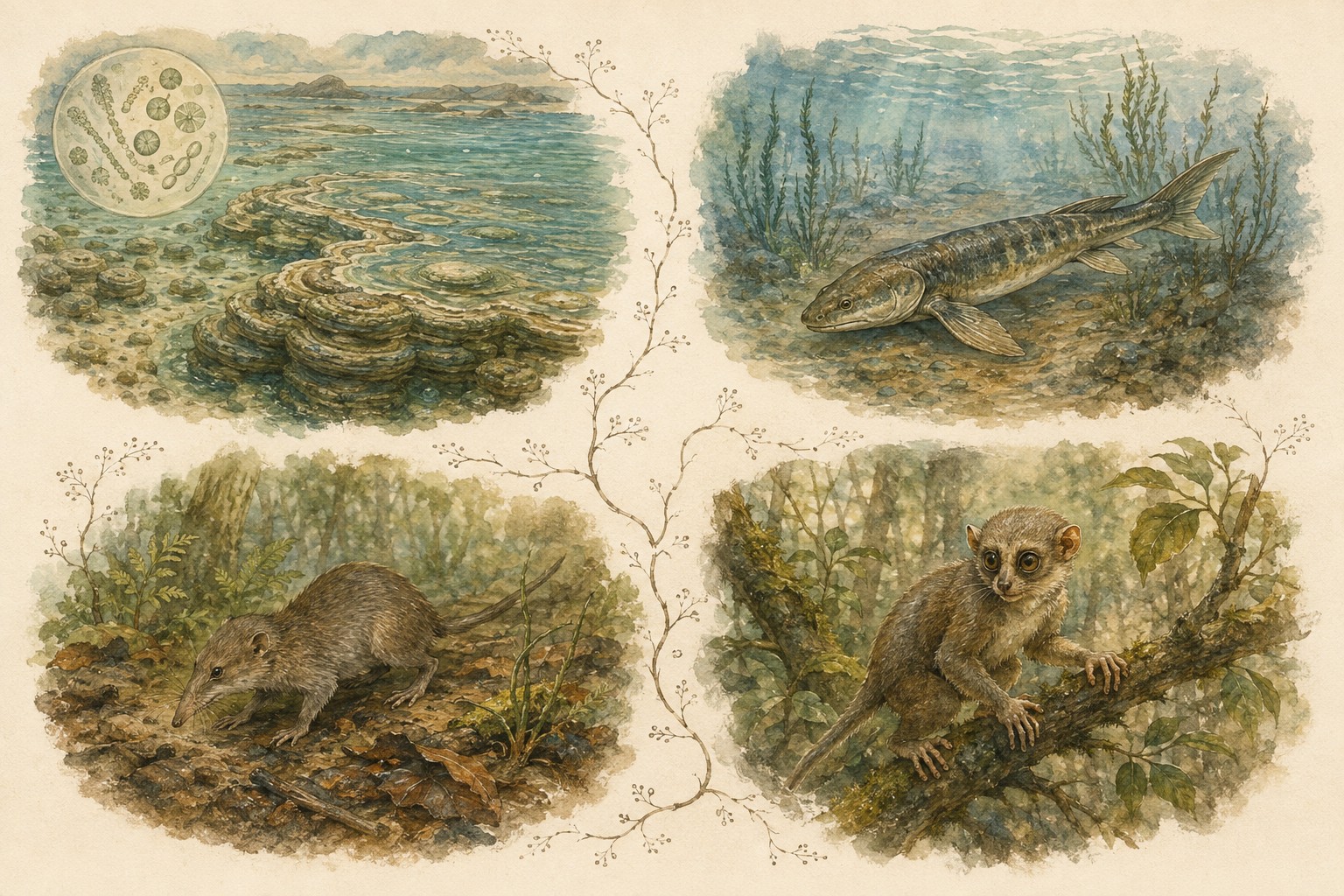
The point is not that a microbe somehow knew it was on its way to becoming a person. Evolution has no planned destination. Populations change as inherited variation interacts with reproduction, environments, chance, and movement between groups. Most branches of life's history do not lead to humans, and they are no less real or successful for that.
Our ancestry passes through ancient vertebrates, land-dwelling ancestors of mammals, and early mammals. Mammals were already present in the age of dinosaurs; the disappearance of the non-avian dinosaurs around 66 million years ago was followed by major diversification among surviving mammal lineages. We did not descend from the dinosaurs depicted in popular dinosaur books. Nor did every early mammal lie on our direct ancestral line. Natural History Museum: Mammalian evolution across the mass extinction
By about 56 million years ago, small primates such as Teilhardina were living in forests. Their fossils help researchers investigate the early history of the group that eventually included lemurs, tarsiers, monkeys, apes, and us. Grasping limbs and sensory adaptations developed in varied ways; the familiar human combination did not arrive in a single step. Calling a fossil an “early relative” is usually safer than claiming it was a particular person's direct ancestor. Florida Museum: Early primates and Teilhardina
2. Apes, ancestors, and what “human” means
Humans are mammals, primates, and great apes. Those categories fit inside one another: becoming human did not mean ceasing to be an animal. Our closest living relatives are chimpanzees and bonobos. We share ancestors with them; we did not evolve from the chimpanzees or monkeys alive today. A commonly used estimate places the shared ancestral population of the human and chimpanzee lineages roughly 8–6 million years ago. The exact identity and appearance of that population remain uncertain. Smithsonian: Genetics and human ancestry
Several words cause avoidable confusion:
- Primate is the broad group including lemurs, monkeys, and apes.
- Hominoid means an ape, including humans. It does not mean an almost-human creature.
- Hominin, as used here, refers to humans and extinct relatives on our side of the split from the chimpanzee lineage.
- Homo is our genus, a narrower grouping containing our species and several extinct forms.
- Homo sapiens is the species to which every living human belongs.
“Humanoid” is a loose description of a humanlike shape, not the scientific name for this family. “Human” itself can mean only Homo sapiens, the genus Homo, or a broader set of early relatives, depending on the author. This is one reason different books appear to give different answers about the “first human.”
The family history resembles a branching and sometimes reconnecting network. Different forms overlapped in time. Some were close to our ancestry; others were cousins whose lineages ended. Fossils are incomplete, and scientists disagree about whether some differences indicate separate species, regional populations, sexes, ages, or individual variation. A new species name is a testable proposal, not a permanent declaration that everyone accepts. Smithsonian: Frequently Asked Questions
Walking on two legs was one early part of this history. It developed long before brains reached the average size found in people today. Some early hominins combined upright walking with climbing. Rather than acquiring a ready-made human package, their bodies displayed different mixtures of traits. Smithsonian: Walking Upright
3. The many branches of the human family
Our family history includes far more than a single sequence of increasingly modern-looking creatures. Different hominins lived at the same time. Some occupied neighboring habitats; others were separated by continents. A successful species could survive for hundreds of thousands of years and still leave no living descendants.
Three terms help keep the story clear. Hominins means our branch of the family and its extinct relatives after separation from the chimpanzee and bonobo lineage. Homo is the genus that includes us and several other human forms. Homo sapiens is our own species. These categories describe evolutionary relationships, rather than degrees of intelligence or importance. Scientists continue to debate both the number of species and their relationships. Smithsonian: introduction to human evolution.
The catalog below covers the principal named hominins and several important disputed names. It is broader than lists of eight or nine later human types. It does not pretend that every name represents an independently agreed species.
How to read the dates: “m” means million years ago; “k” means thousand years ago. Dates are rounded ages of known fossils or archaeological evidence. They are not exact species birthdays or extinction dates. Localities describe where evidence has been found, which may be only a small part of a population's former range.
The earliest candidates
Walking on two legs developed before our large brains. These early forms preserve different combinations of climbing and upright-walking anatomy. Their exact positions near the beginning of the human branch remain uncertain.
| Name | Approximate evidence; locality | What makes it interesting |
|---|---|---|
| Sahelanthropus tchadensis | 7–6m; Chad | One of the earliest candidates near the human branch; its relationship to later hominins remains debated. |
| Orrorin tugenensis | 6.2–5.8m; Kenya | Thigh-bone anatomy suggests upright walking, while other features indicate climbing. |
| Ardipithecus kadabba | 5.8–5.2m; Ethiopia | Known from teeth and fragmentary bones; evidence for walking behavior is limited. |
| Ardipithecus ramidus | About 4.4m; Ethiopia | “Ardi” combines climbing adaptations with features associated with movement on two legs. |
Australopithecus and related forms
These hominins had small brains compared with ours, but many regularly walked upright. They were adapted to their own environments. “Lucy” is the nickname of one famous fossil individual, not a species name or proof that she was our direct ancestor.
| Name | Approximate evidence; locality | What makes it interesting |
|---|---|---|
| Australopithecus anamensis | 4.2–3.8m; Kenya and Ethiopia | Early Australopithecus with evidence of regular bipedal walking and retained climbing abilities. |
| Australopithecus afarensis | 3.85–2.95m; East Africa | Lucy's species; a well-documented combination of upright walking, long arms and small brains. |
| Kenyanthropus platyops | About 3.5m; Kenya | A flat-faced fossil form whose separation from other australopiths is debated. |
| Australopithecus bahrelghazali | About 3.5m; Chad | The “Abel” finds show australopiths far west of the better-known East African sites. |
| Australopithecus deyiremeda | About 3.5–3.3m; Ethiopia | A contemporary of afarensis; a 2025 study links additional teeth and the Burtele foot to this species. |
| Australopithecus africanus | Conventionally about 3.3–2.1m; South Africa | Includes the Taung child; dates of some South African deposits remain disputed. |
| Australopithecus garhi | About 2.5m; Ethiopia | Known from a limited fossil sample, with a mixture of older and later-looking features. |
| Australopithecus sediba | About 1.98m; South Africa | Malapa skeletons combine australopith features with traits resembling those of Homo. |
The dating uncertainty is real: one study places important Sterkfontein deposits containing australopiths around 3.4–3.6 million years ago, older than conventional ranges. Changing a deposit's age can change interpretations of which populations could have met or been ancestral to others. CNRS: revised Sterkfontein dating.
Paranthropus: another way to survive
Paranthropus is generally treated as a side branch with distinctive teeth, jaws and chewing muscles. Some classifications include these species within Australopithecus. Their large back teeth tell us about feeding adaptations; they do not tell us that these were unintelligent creatures.
| Name | Approximate evidence; locality | What makes it interesting |
|---|---|---|
| Paranthropus aethiopicus | 2.7–2.3m; East Africa | Includes the “Black Skull,” with a projecting face and powerful chewing anatomy. |
| Paranthropus boisei | 2.3–1.2m; East Africa | Exceptionally large back teeth and broad cheekbones; nicknames such as “Nutcracker Man” can oversimplify diet. |
| Paranthropus robustus | Roughly 2–1.2m; South Africa | A southern African form that overlapped with early Homo; newer fossils extend its early record. |
| Paranthropus capensis — proposed reassignment | About 1.4m; South Africa | A 2025 study reassigns the SK 15 jaw from Homo to a more lightly built Paranthropus species. |
Homo: our genus and its many neighbors
The oldest currently known evidence assigned to Homo is about 2.8 million years old, from Ethiopia. That early jaw and related teeth have not been securely assigned to a named species. They should not automatically be called Homo habilis. Arizona State University: Ledi-Geraru research.
Tools are another reminder that evolution did not arrive as a complete package. The earliest known stone tools are older than the earliest known Homo fossils. Finding a tool near a fossil site does not always identify its maker, especially when several hominins lived in the region. Walking, changes in teeth and bodies, toolmaking and larger brains have histories that overlap without sharing one starting date. Smithsonian: the evidence surrounding Homo habilis.
| Name | Approximate evidence; locality | What makes it interesting |
|---|---|---|
| Homo habilis | About 2.4–1.4m; Africa | Early Homo with a modestly enlarged braincase. Its name does not prove that it invented stone tools. |
| Homo rudolfensis | Well-known fossils about 1.9–1.8m; East Africa | A larger-faced early Homo grouping; distinctions from habilis remain debated. |
| Homo erectus | By about 1.9m to 110k; Africa and Asia | A remarkably long-lived, widespread lineage with more familiar human body proportions. |
| Homo ergaster | Core fossils about 1.9–1.5m; especially Africa | Often used for African early erectus; researchers differ over whether it is a separate species. |
| Homo antecessor | Well-established material about 800k; Spain | An early European population; assignment of older Spanish fossils to this species is uncertain. |
| Homo heidelbergensis | Traditionally about 700–200k; Europe and Africa | A disputed grouping whose geographic and biological boundaries depend on the classification used. |
| Homo naledi | 335–236k; South Africa | A late-surviving, small-brained human form with an unusual combination of skeletal traits. |
| Homo neanderthalensis | About 400–40k; Europe and western/central Asia | Neanderthals made sophisticated tools, used fire and lived through demanding environments. |
| Denisovans, linked to Homo longi | Middle and Late Pleistocene; Asia | Ancient DNA revealed this lineage; Harbin's skull, at least 146k old, is now linked to it. |
| Homo floresiensis | Main fossils about 100–60k; tools to about 50k; Flores | A small-bodied island form. Older Flores relatives mean these dates do not mark the lineage's beginning. |
| Homo luzonensis | Originally dated to at least about 67k; potentially 130k or older; Philippines | A small fossil sample with uncertain ancestry. Its extinction date is unknown. |
| Homo sapiens | About 300k to today; African origins, now worldwide | Every living human belongs to this species. Differences among us are variation within a shared species. |
Erectus, habilis, rudolfensis and Paranthropus boisei overlapped in East Africa. This is one concrete reason the familiar picture of one human type replacing the previous type is misleading. A branching diagram better represents what fossils show. Smithsonian: Homo erectus.
Names that need extra care
Homo rhodesiensis and the proposed Homo bodoensis concern parts of the African record often placed in heidelbergensis. Kabwe in Zambia is about 300,000 years old; Bodo in Ethiopia is about 600,000. These names are competing ways to organize fossils, not automatically two additional settled species. Kabwe dating, the bodoensis proposal and criticism.
Australopithecus prometheus is a contested name used by some researchers for South African fossils including “Little Foot.” Homo georgicus has been proposed for Dmanisi fossils that other researchers group with early erectus or ergaster. Homo juluensis, proposed in 2024 for a grouping of East Asian remains, also overlaps debates about Denisovans. Counting every alternative label as another firmly established species would exaggerate certainty. Research using the prometheus classification, Australian Museum: Dmanisi classifications, University of Hawaiʻi: juluensis proposal.
Two uncertainties should be kept separate. Researchers can agree that a fossil is real and ancient while disagreeing about which species name fits it. They can also accept a species while remaining unsure which other species it descended from. The catalog therefore works as a guide to the evidence and its vocabulary, rather than a settled genealogy. A new discovery may add a branch, join names previously kept apart, or reveal that apparently successive populations actually overlapped. Smithsonian: species and classification.
4. Homo sapiens in a world of other humans
Our species emerged in Africa about 300,000 years ago. The process involved populations over many generations, rather than one identifiable first person. Fossils from Jebel Irhoud in Morocco helped show that early sapiens history was geographically broader than older accounts centered on one small East African homeland. Researchers investigate how populations across Africa separated, adapted and reconnected. Max Planck: Jebel Irhoud, research on shared African origins.
When sapiens populations spread into Eurasia, the land was already inhabited. Neanderthals and Denisovans were relatives with their own long histories. Encounters included interbreeding: ancient DNA shows that ancestry from these groups persists in people today. Neanderthal ancestry also reached African populations through later movement and gene flow. Human history was never permanently divided into sealed biological compartments. Smithsonian: ancient DNA and interbreeding.
One remarkable fossil makes that connection personal. Researchers sequenced DNA from a young individual found in Denisova Cave and discovered that her mother was Neanderthal and her father Denisovan. Two names on a scientific family tree had become one actual family. Max Planck: the Neanderthal–Denisovan child.
The Denisovan story is still changing. In 2025, molecular studies connected the Harbin skull, previously named Homo longi, with Denisovans. This supplied a much more complete view of a group initially recognized from fragmentary remains and DNA. It did not instantly settle every question about the group's boundaries or the identity of other Asian fossils. Original Harbin protein study.
Why did only sapiens survive as a living species? There is no single established answer. Researchers examine population size, isolation, environmental change, competition and interbreeding. Neanderthals had survived many earlier hardships; their eventual disappearance is not proof that they were simply incapable or unintelligent. Different processes may have mattered in different places. Natural History Museum: Neanderthal survival and extinction.
“Extinct” therefore needs a little care here. Neanderthals and Denisovans no longer exist as separate living populations, yet some of their inherited DNA remains. Their story is both a story of disappearance and part of our own ancestry.
Tools, fire, and journeys across the world
The people in this catalog were not just skull shapes. They lived by finding food, avoiding danger, raising young, moving through landscapes, and learning from others. Archaeology offers glimpses of those lives. Stone tools at Lomekwi 3 in Kenya date to about 3.3 million years ago, before the earliest known Homo fossils. Their makers are uncertain. Much early technology probably used materials that preserve poorly, so the surviving stone record is only part of the story. Original Lomekwi study
Fire added possibilities for warmth, protection, and cooking. Evidence for using, maintaining, and deliberately making fire concerns different abilities, and their earliest dates are debated. Hearths at least 790,000 years old show that this history long predates our species. A burned object alone is not proof of human fire use: researchers must distinguish human activity from natural burning. Smithsonian: Hearths and Shelters
Over tens of thousands of years, sapiens populations spread across much of the inhabited world. That required adapting to different coasts, forests, grasslands, and cold environments. Their journeys were many movements of families and populations, not one planned expedition out of Africa.
At Madjedbebe in northern Australia, a major study dated occupation to around 65,000 years ago, although the earliest arrival chronology remains debated. Its archaeological record includes stone tools and worked pigments. These finds belong to the deep history of First Nations peoples, whose living cultures have continued to change and develop. Madjedbebe excavation and dating study
The Americas likewise have a much deeper history than older schoolbook accounts allowed. Research at White Sands, New Mexico, places human footprints around 23,000–21,000 years ago, with follow-up work supporting an early presence. Dating and migration routes continue to be investigated. Footprints are a particularly direct reminder that this history concerns people walking through real places, not just arrows on a map. National Park Service: White Sands Footprints
By the time farming developed in several regions, people had already built diverse ways of living, learning, making art, and maintaining relationships across environments. Human society did not begin with the first city.
5. Language, memory, and the first shared knowledge
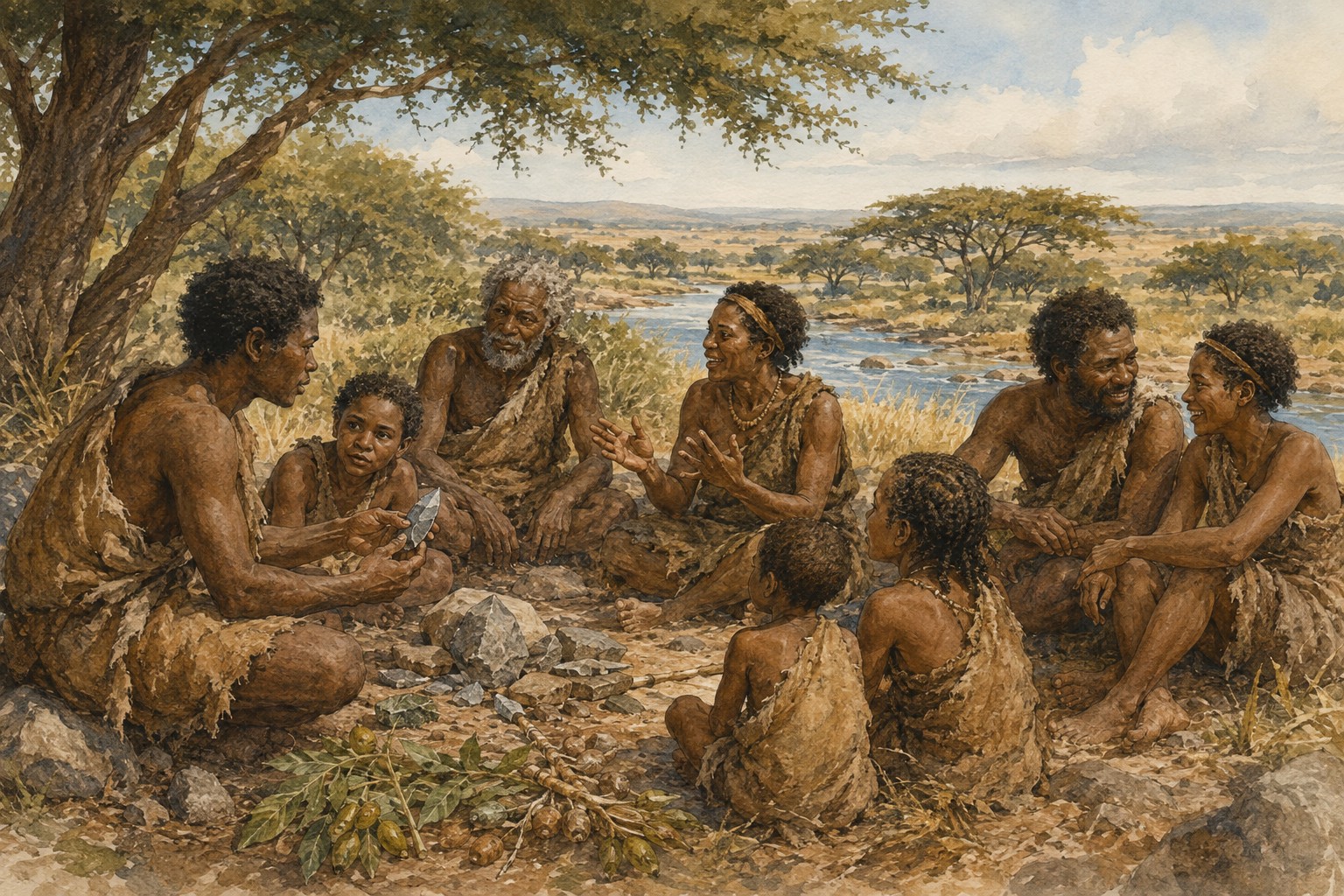
We can date a tooth or a buried hearth. We cannot excavate an ancient conversation. Nobody knows the name, sound or grammar of the first human language, or a precise date when full language began. Bones, genes, tools and symbolic objects offer indirect clues, but none records a sentence spoken hundreds of thousands of years ago. Smithsonian: language and symbols.
That uncertainty leaves several possibilities open. Abilities used in language may have developed gradually, with different components emerging at different times. Researchers debate the contributions of vocal communication, gesture, social learning and changes in the brain. Assigning modern grammar to a particular fossil species remains much harder than identifying the shape of its teeth.
Language is more than speech
Speech uses the voice; language is the system that lets people combine meaningful signs according to shared patterns. Natural signed languages demonstrate that human language does not require spoken sound. American Sign Language, for example, has its own grammar and is distinct from English. British Sign Language is different again: there is no single universal sign language. Hands, facial expressions and body movement can carry the same depth of communication that spoken languages carry through sound. US National Institute on Deafness and Other Communication Disorders: ASL.
This distinction matters when studying fossils. A reconstructed throat might tell researchers something about possible sounds, but it cannot by itself establish whether a population had complex language. Likewise, an object that looks symbolic is evidence to investigate, rather than a translation of what its maker thought.
There was no known genetic switch that simply turned language on. FOXP2, often misleadingly called “the language gene,” contributes to processes involved in speech and language, but versions occur in many animals. Its effects involve the functioning and development of cells, rather than a stored instruction for grammar. Human language depends on biological systems interacting with learning and social experience. Max Planck Institute for Psycholinguistics: the language-gene question.
Knowledge that could outlive its discoverer
Language allows people to refer to things beyond the immediate moment: yesterday's journey, a distant relative, tomorrow's plan or an imagined danger. As an everyday example, teaching someone where to find seasonal food can spare them from having to rediscover it through trial and error. A community can remember more than any one member.
Archaeological traces show increasingly elaborate ways of expressing meaning: worked pigments, ornaments, repeated marks and images. Their interpretation must remain careful. A bead might have signaled identity, membership or something else; we usually cannot recover its exact message. These objects reveal parts of an expanding social world, while leaving much of it invisible. Smithsonian: symbolic objects and their interpretation.
Oral knowledge is not an incomplete version of writing. Stories, songs, proverbs and performances can preserve collective memory, practical knowledge and social values. Some communities recognize specialist storytellers and performers whose work requires considerable training. Traditions can also change as people retell them, adapting to new situations. Living oral cultures belong fully to the present; they are not surviving exhibits of an earlier stage of humanity. UNESCO: oral traditions and expressions.
Languages have histories of their own
Languages change when generations learn them, communities separate and speakers meet. A language family groups languages inferred to descend from a shared ancestral language. This is a history of communication, which can overlap with population history without matching it exactly. Glottolog: Language Classification
People can adopt a new language without replacing their ancestry. They can also remain multilingual, borrow words and expressions, or pass different languages to different generations. Migration, marriage, trade and political institutions can therefore reshape language maps in ways that a DNA map alone cannot explain. A person's language does not identify a separate biological kind of human. Max Planck: comparing genes and languages.
Writing would later make certain messages durable and portable across distances and generations. But people already had meaningful lives, shared memories and systems for teaching one another. The invention of writing changed how knowledge could be stored; it did not mark the invention of language or society.
6. Farming: many beginnings and new ways of living
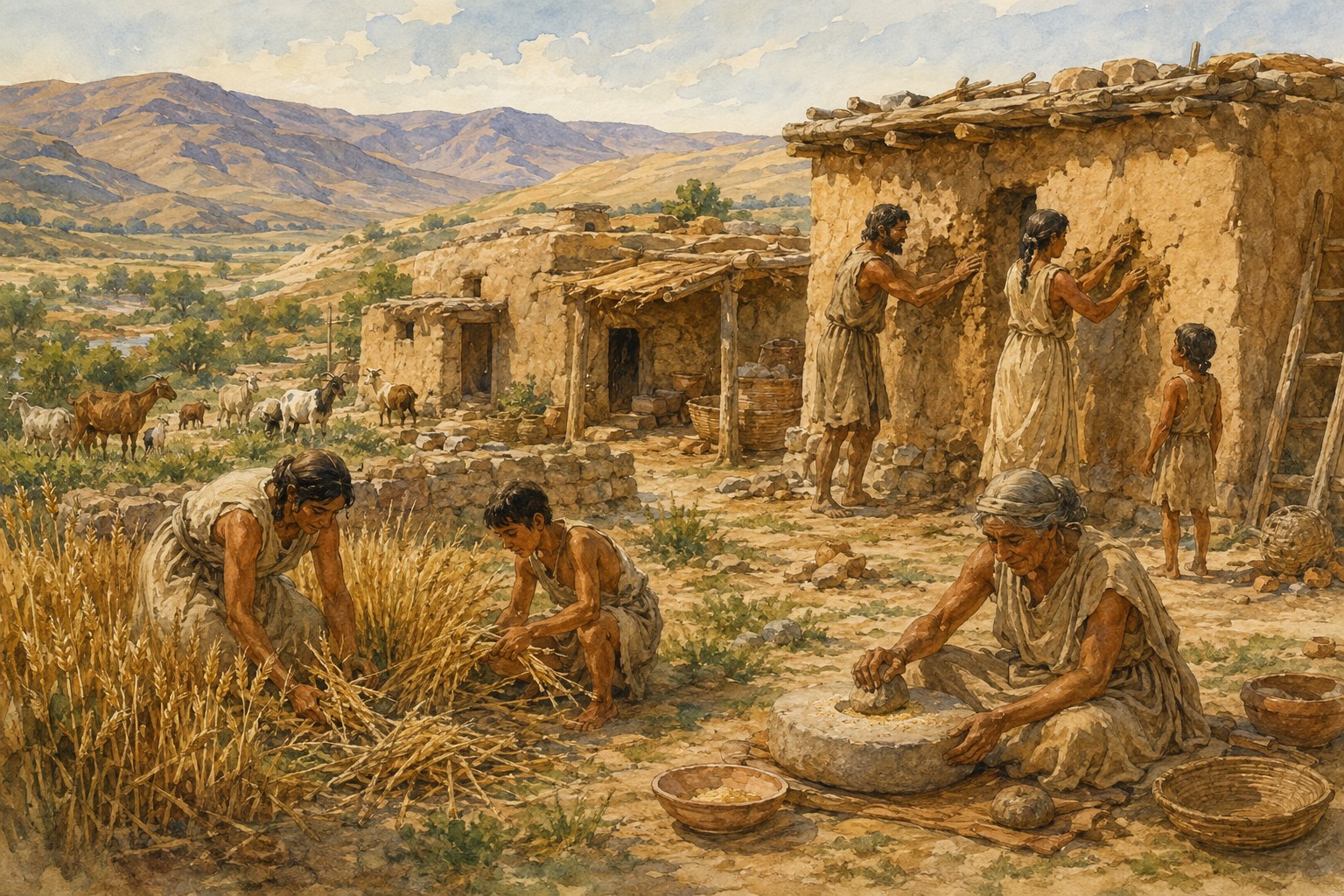
For most of the existence of Homo sapiens, people obtained food by gathering, hunting, fishing, and related activities. The transition toward farming, especially from roughly 12,000 years ago, did not happen everywhere at once. Nor did a council of humanity decide to abandon its old life. Communities experimented with plants, landscapes, seasonal movement, and animals over many generations.
Domestication means inherited changes in populations of plants or animals arising through their relationship with people. Cultivation—planting or tending—can begin before a fully domesticated crop exists. Those distinctions matter because the earliest evidence is often gradual rather than a clean switch. Southwest Asian wheat and barley, East Asian rice and millet, African crops, and American maize, potatoes, and other domesticates belong to several regional histories. UCL: Origins and Spread of Agriculture
New Guinea offers an especially useful reminder of independent invention. At Kuk, archaeological evidence records a long history of managing wet environments for cultivation. Clearer evidence of agriculture dates to around 7,000–6,400 years ago, within a much longer sequence of landscape use. The crops, terrain, and practices differed from those of Southwest Asia. Farming was a collection of solutions, not one exported instruction manual. UNESCO: Kuk Early Agricultural Site
Farming could support larger populations and more permanent settlements, but it also created dependencies. Stored harvests could feed specialists or be lost. Fields required labor and access to land. People had to negotiate inheritance, water, boundaries, storage, and obligations. These are reasons to ask how a particular community organized itself, rather than assume every farming village immediately produced a king.
Mobile herders, fishing communities, foragers, gardeners, and urban residents continued to interact. Their relationships included trade, marriage, conflict, and exchange of skills. Settled life was not a test of intelligence, and living people whose livelihoods involve hunting or herding are not unchanged representatives of the Stone Age. They have histories as long and eventful as anyone else's.
The knowledge change: knowing a useful wild plant is not the same as managing a crop across seasons. Farming added demanding forms of collective memory: when to sow, how to maintain soil or waterworks, which seed to save, and what to do when ordinary weather patterns failed. The knowledge remained embodied in practice, conversation, and observation long before most farmers could read.
7. Cities, states, and the invention of writing
By the fourth millennium BCE, parts of Southwest Asia contained large settlements with monumental buildings and extensive administration. Uruk, in present-day Iraq, was one of the earliest great cities. Around 3200 BCE, its administrators used clay records to track goods and labor. Such practices formed part of the development of writing. The surviving tablets can be more revealing about everyday power than a royal monument: someone was counting food, workers, and obligations. Metropolitan Museum: Uruk
A city brought people with different occupations into sustained contact. A state added institutions able to make and enforce claims over a territory and population. These developments could support construction, defense, exchange, and redistribution; they could also concentrate wealth and impose labor. A palace's ability to organize a canal and its ability to compel people to dig it were connected questions.
Writing was not the invention of language. It was a new way of making some language and information durable outside a person's memory. Early writing emerged in Mesopotamia and Egypt more than 5,000 years ago; independent traditions also developed in China and Mesoamerica. Its beginnings and influences are subjects of research, so neat claims about a single universal inventor are misleading. British Museum: Egyptian writing and decipherment
“Cuneiform” describes a wedge-shaped writing tradition, not one language. A script can serve different languages, just as the Latin alphabet serves English, Spanish, and many others. Conversely, one language can be written in more than one script. Pictures, counting marks, mathematical notation, and full writing systems have overlapping histories, but they are not interchangeable categories.
Written records changed what people could do across distance and time. A message could outlive its speaker. A ruler could send orders; a merchant could record debts; a scribe could copy a story or compare a list of observations with an older one. Writing also created new inequalities when access to literacy and archives was restricted.
Urban experiments were not confined to one region. Egypt, the Indus region, and China developed their own major traditions of organized settlement. Across the ocean, Caral-Supe in present-day Peru, around 5,000 years old, belonged to an independent Andean history of monumental centers. Its plazas and buildings remind us that a history organized only around the Mediterranean leaves out entire worlds. UNESCO: Sacred City of Caral-Supe
8. Knowledge before and beside Greece
Long before the best-known Greek philosophers, people were solving problems in measurement, construction, calendars, medicine, administration, and navigation. This was not “mere practical knowledge” waiting for philosophy to rescue it. Measuring a field, managing a season's water, or identifying a dangerous plant can demand careful observation, memory, and reasoning.
The Egyptian Rhind Mathematical Papyrus, more than 3,500 years old, preserves worked problems involving arithmetic, fractions, and geometry, probably used in training scribes. A student learning to divide quantities or calculate areas was participating in a formal tradition of instruction. British Museum: Rhind Mathematical Papyrus
Babylonian tablets also record mathematical relationships involving right triangles long before Pythagoras. Knowing useful numerical relationships and constructing a general deductive proof are related but distinct achievements. The familiar Greek name attached to a theorem should not make earlier mathematics disappear. University of St Andrews: Babylonian Mathematics and Pythagoras's Theorem
Religious and practical knowledge often belonged to the same institutions. A specialist might observe the sky for calendrical and ritual reasons; a healer might combine a useful treatment with a religious explanation. Modern subject boundaries—astronomy here, religion there, medicine somewhere else—should not simply be projected backward.
One useful distinction is between a successful procedure and an explanation of why it works. A person can reliably perform a calculation without possessing a general proof, or preserve food without a theory of microorganisms. Over history, procedures and explanations repeatedly stimulated each other. Neither always came first.
This will be important when we reach Greece. Greek writers developed influential forms of argument, proof, and systematic inquiry, but they worked in a Mediterranean and Near Eastern world that already possessed deep traditions of learning. Their achievements become more understandable, not less impressive, when we see the exchanges and institutions around them.
9. Greek language and a new culture of argument
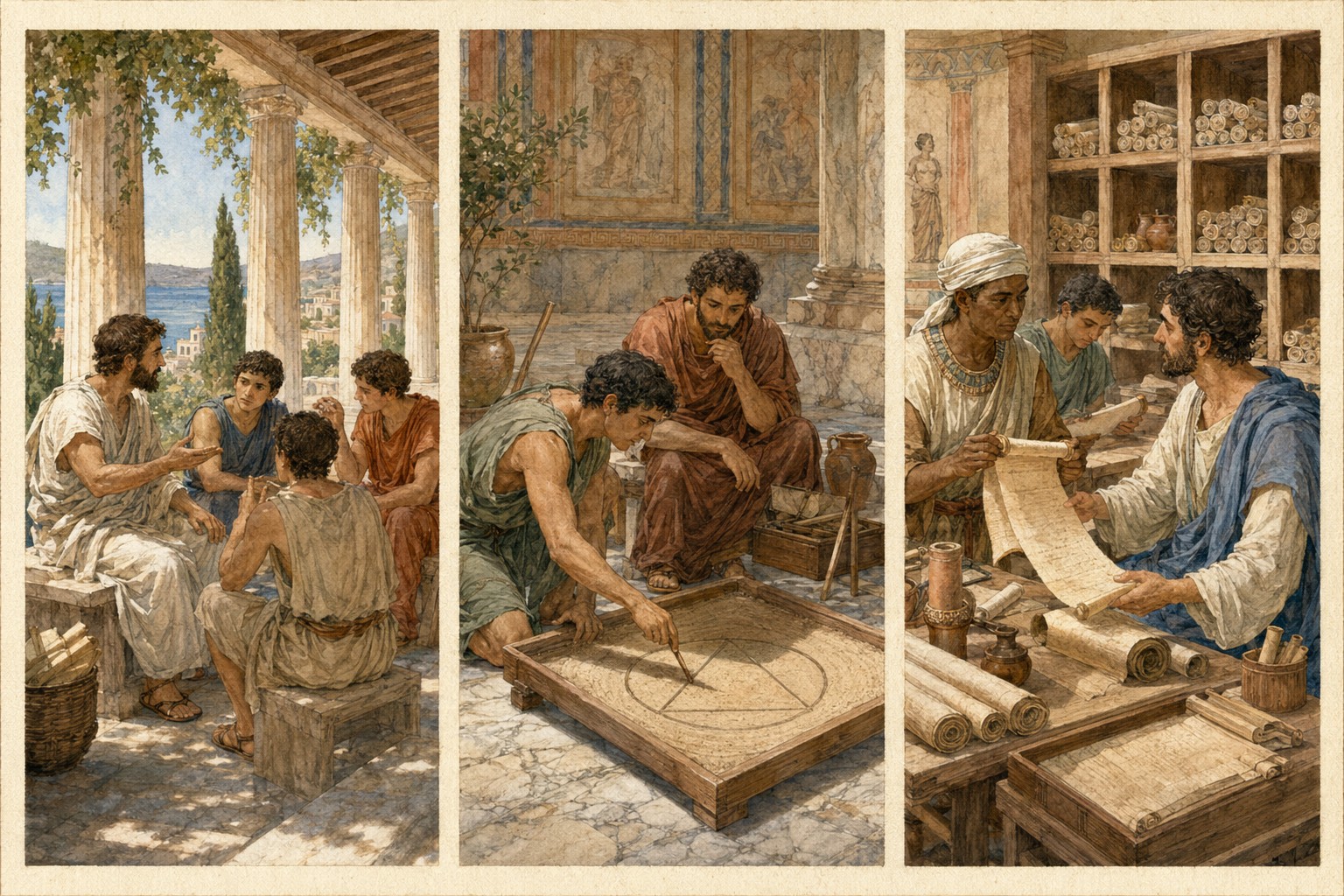
Ancient Greece deserves a substantial place in the history of knowledge. Its thinkers developed influential ways to question claims, construct arguments and organize inquiry. Their achievements grew within a world of travelers, traders, competing cities and older centers of learning. Greek-speaking communities extended around the Mediterranean; the story reaches far beyond the borders of modern Greece.
The Greek alphabet itself shows how useful ideas cross boundaries. Greeks adapted an alphabetic tradition transmitted by Phoenicians, whose script belonged to a longer eastern Mediterranean history. Greek letters later influenced Etruscan and Latin writing. Even the word alphabet comes from the names alpha and beta. This was a powerful tool reshaped for another language, then reshaped again by other communities. Metropolitan Museum: the alphabet's origins
Writing joined an already rich culture of spoken performance. The Iliad and Odyssey, associated with Homer, emerged from traditions in which singers used rhythm, repeated phrases and familiar narrative patterns to compose and perform long poems. These techniques supported both continuity and variation. Scholars still debate how the poems became the written texts we know. Their history demonstrates how sophisticated storytelling can flourish through trained memory and performance. Harvard Center for Hellenic Studies: Homer Multitext
During the sixth and fifth centuries BCE, thinkers conventionally called the Presocratics explored questions about nature, change and knowledge. Thales asked whether the world's diversity could be explained through an underlying substance. Heraclitus and Parmenides examined change and permanence in very different ways. Atomists proposed that matter consisted of tiny bodies moving through empty space.
These proposals were not modern experimental discoveries. Ancient atoms were a philosophical hypothesis, and many conclusions were wrong. Yet the questions encouraged a lasting habit: seek general explanations, examine their consequences and argue about alternatives. Religious ideas and natural explanations continued to coexist. Much of this early thought survives only in fragments quoted by later writers, so our picture remains incomplete. Stanford Encyclopedia of Philosophy: Presocratic philosophy
10. Socrates, Plato, and Aristotle
Three famous thinkers make this culture of questioning easier to understand. Each asked how people could reason more carefully, but they approached that task in different ways.
Socrates: examine the answer. Socrates, who lived in Athens in the fifth century BCE, became famous for questioning people about courage, justice, virtue and how to live. A confident answer was a starting point for investigation. Could the speaker define a term clearly? Would that definition still work in a difficult case?
Imagine someone saying that courage means never retreating. We might then ask whether a deliberate retreat could save other people. If so, courage must involve more than staying in place. This is an illustration of the method, not a recorded conversation: questioning reveals that a familiar word can conceal an uncertain idea.
Socrates left no writings. We encounter him through authors such as Plato, Xenophon and Aristophanes, whose portraits differ. Athens tried and executed him in 399 BCE, a reminder that intellectual questioning could carry grave political and religious consequences. His enduring challenge is to recognize when confidence exceeds understanding. Stanford Encyclopedia of Philosophy: Socrates
Plato: ask what would make a belief knowledge. Plato explored philosophy through dialogues, often placing Socrates among the speakers. A conversation could begin with an ordinary disagreement and grow into a difficult question: What is justice? What makes a life good? How can we tell understanding from mere opinion?
In the famous cave allegory in the Republic, people mistake shadows for the whole of reality. The image dramatizes how difficult education can be: learning may require revising assumptions that once seemed obvious. It also raises a question for anyone who has discovered that a convincing story was incomplete: how do we justify the new explanation?
Plato's discussions of Forms sought stable objects of understanding behind the changing examples we encounter. We can debate particular just actions while still asking what justice itself means. These were philosophical proposals, and their interpretation remains contested. Plato's dialogues also investigate politics and education; the ideal society of the Republic differs sharply from modern democratic ideals. Stanford Encyclopedia of Philosophy: Plato
Aristotle: compare, classify and explain. Aristotle studied at Plato's Academy and later established his own school, the Lyceum. His inquiries ranged across animals, logic, ethics, politics, poetry and the natural world. He examined observations and previous arguments, organized distinctions and asked what would count as an adequate explanation.
His work on logic made patterns of reasoning explicit. For example: if all A are B, and all B are C, then all A are C. The conclusion follows from the premises. Whether those premises describe reality correctly is a further question. A well-structured argument can begin with mistaken assumptions.
Aristotle also treated ethics as a matter of developing character and judgment through life in a community. His writings became enormously influential, but careful reading includes recognizing their limits. His methods produced penetrating insights alongside mistaken conclusions. Later thinkers preserved, challenged and transformed his work rather than simply receiving a finished account of the world. Stanford Encyclopedia of Philosophy: Aristotle
These achievements existed within unequal societies. Athenian women were excluded from the political decision-making available to male citizens, while enslaved people and resident foreigners also lacked that political equality. Their labor, relationships and knowledge remained essential to the city's life. We can value intellectual achievements while examining who had the freedom, education and social standing to participate. Metropolitan Museum: women in Classical Greece, Research on women and slaves in Greek democracy
11. Greek mathematics, medicine, and the Hellenistic world
Greek inquiry also developed through mathematics, medicine and the study of nature. In the Hellenistic period, following Alexander's conquests in the fourth century BCE, cities such as Alexandria in Egypt became important centers of scholarship. Collecting books, supporting teachers and bringing specialists together gave inquiry a durable institutional home. Open University: the Library of Alexandria
Around 300 BCE, Euclid organized mathematical knowledge in the Elements. He drew heavily on earlier work, arranging definitions, starting assumptions and proofs into a remarkably influential structure. The reader could follow why a conclusion was supposed to hold.
A drawing may make a geometrical relationship look convincing. A proof aims to show why it follows from stated assumptions, even when the drawing changes. Euclid helped make that chain of reasoning teachable. We know little securely about his personal life; his lasting importance rests principally on the mathematical work associated with his name. University of St Andrews: Euclid
Archimedes, working in the third century BCE, brought powerful mathematical reasoning to areas, volumes, balance and floating bodies. He developed methods for approximating the value of pi and analyzing buoyancy. His work shows how abstract relationships can illuminate physical problems: why something balances, how much space a shape contains, or how a body behaves in water. University of St Andrews: Archimedes
Eratosthenes used geometry to estimate Earth's circumference in the third century BCE. The surviving account relates the different midday Sun angles at Alexandria and Syene to the distance between those places. If that difference represented a known fraction of a full circle, the local distance could be scaled up to estimate the whole globe. The original work is lost, and uncertainty about the ancient unit of length complicates claims about his exact accuracy. The achievement remains striking: combining observations, distance estimates and a model allowed reasoning far beyond what one person could directly see. University of St Andrews: Eratosthenes and Earth's measurement
Medicine developed another tradition of observation. Writings collected under the name of Hippocrates discussed symptoms, illness over time, diet and treatment. The Hippocratic Corpus contains works by multiple authors, not a securely identified set written by one doctor. Its search for natural explanations and attention to patients mattered, even though many ancient theories and treatments would later be rejected. The history of medicine includes both useful observations and costly errors. US National Library of Medicine: Greek medicine
Alexandria also illustrates the fragility of knowledge. Texts survive through copying, teaching, translation and sustained care. Its libraries did not contain all human knowledge, and the familiar tale of one fire destroying everything compresses a much more uncertain history. Scholars debate the evidence for different losses and institutional changes over centuries. The larger lesson is practical: a collection needs people who maintain, read and renew it. Open University: evidence and the Alexandria stories
12. Knowledge across Asia, Africa, and the medieval world
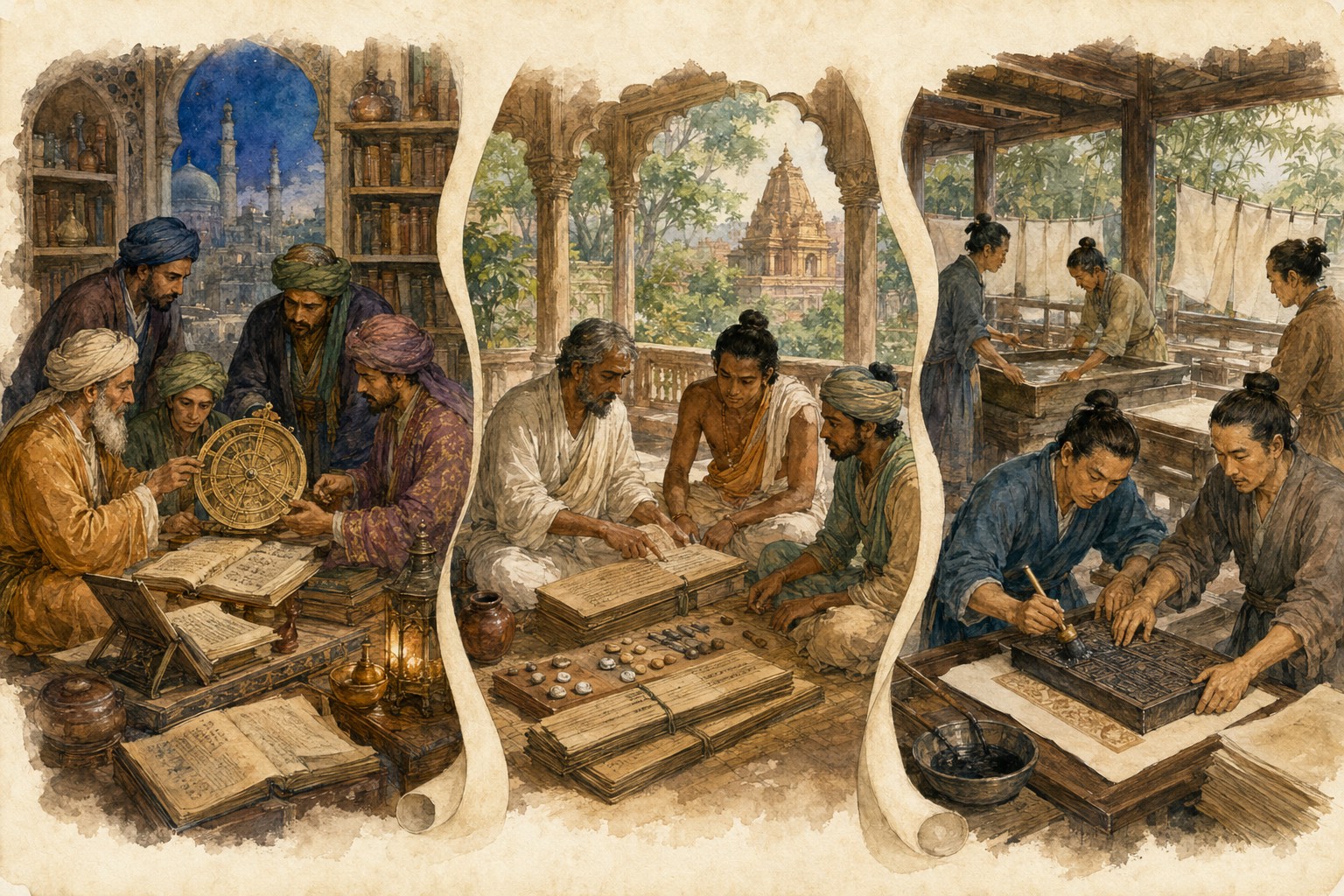
The history of knowledge has many simultaneous centers. While Greek thinkers debated nature and ethics, communities elsewhere were studying language, political order, medicine, numbers and the sky. Later generations inherited a world of connected traditions. A useful idea might be translated, criticized, combined with local experience and then sent onward in a changed form.
In China, traditions associated with Confucius, conventionally dated to 551–479 BCE, connected learning with character, ritual and responsible government. Education was part of becoming someone who could act well toward others. Questions about a worthy ruler or a trustworthy person were also questions about the kind of society people should build. The Analects and other sources preserve layered traditions shaped by followers and interpreters over time. Stanford Encyclopedia of Philosophy: Confucius
In South Asia, Pāṇini made language itself the subject of extraordinary analysis. His Aṣṭādhyāyī, composed in the middle of the first millennium BCE, organized Sanskrit through roughly 4,000 compact rules. These rules describe how forms can be built systematically. Everyday speakers do not need a grammar book to speak, but a grammar allows people to investigate the patterns behind their speech. Scholars disagree about Pāṇini's precise date; the importance of the work does not depend on fixing one exact year. University of Cambridge: research on Pāṇini's grammar
Indian mathematics developed powerful ways of representing and manipulating numbers. In 628 CE, Brahmagupta set out rules involving zero and negative quantities. A placeholder helps distinguish numbers such as 25 and 205; treating zero as a number also makes it part of calculation. This development drew on a longer history, and some of Brahmagupta's rules—especially concerning division by zero—differ from modern mathematics. His work nevertheless marks an important stage in making numerical procedures more general. University of St Andrews: Brahmagupta
China also developed traditions of paper-making and printing that changed the material life of knowledge. A surviving printed Chinese Diamond Sutra dated 868 CE shows how religious texts could be reproduced through woodblock printing centuries before Gutenberg. Books were physical objects requiring materials, skilled labor and distribution. Making more copies could enlarge a text's audience and improve its chances of survival. British Library: the printed Diamond Sutra, UNESCO: the movement of paper and printing along the Silk Roads
Across the medieval Islamic world, scholars working in Arabic drew on Greek, Syriac, Persian, Indian and other traditions. Translation involved difficult intellectual choices: words had to be understood, inconsistent accounts compared and unfamiliar ideas explained. Physicians produced substantial new syntheses and added clinical experience. Ibn Sina, known in Latin as Avicenna, wrote the influential Canon of Medicine, which later circulated in Latin translation. These communities included scholars of different religions and backgrounds. US National Library of Medicine: medieval Islamic medicine
Al-Khwarizmi, working in the early ninth century, organized methods for solving equations and wrote on calculation with Indian numerals. His name eventually contributed to the word algorithm, while al-jabr, from the title of his algebraic work, gave us algebra. An algorithm is a procedure—a sequence of steps for handling a kind of problem. People devised such procedures long before electronic computers. His achievement was a major contribution to a continuing mathematical conversation. University of St Andrews: al-Khwarizmi
Astronomers likewise made new observations and refined descriptions of the sky. Al-Sufi's star work and al-Biruni's astronomical studies are examples of inquiry that extended inherited knowledge. Greek-language scholarship also continued in the Byzantine world; Syriac, Arabic and Latin translation created overlapping paths of transmission. Knowledge traveled through several languages and institutions, with each generation selecting, interpreting and sometimes correcting what it received. Metropolitan Museum: astronomy in the medieval Islamic world, US National Library of Medicine: the Arabic contribution and its sources
In West Africa, Timbuktu's manuscript traditions record intellectual life connected to trade, religion and teaching, including mathematics and astronomy. These collections challenge any account that leaves Africa outside the history of written scholarship. Books depended on skilled people, reliable teaching and communities that valued their use. UNESCO: Timbuktu manuscripts, UC Davis: Mali's mathematical and astronomical manuscripts
13. Printing, universities, and the changing rules of evidence
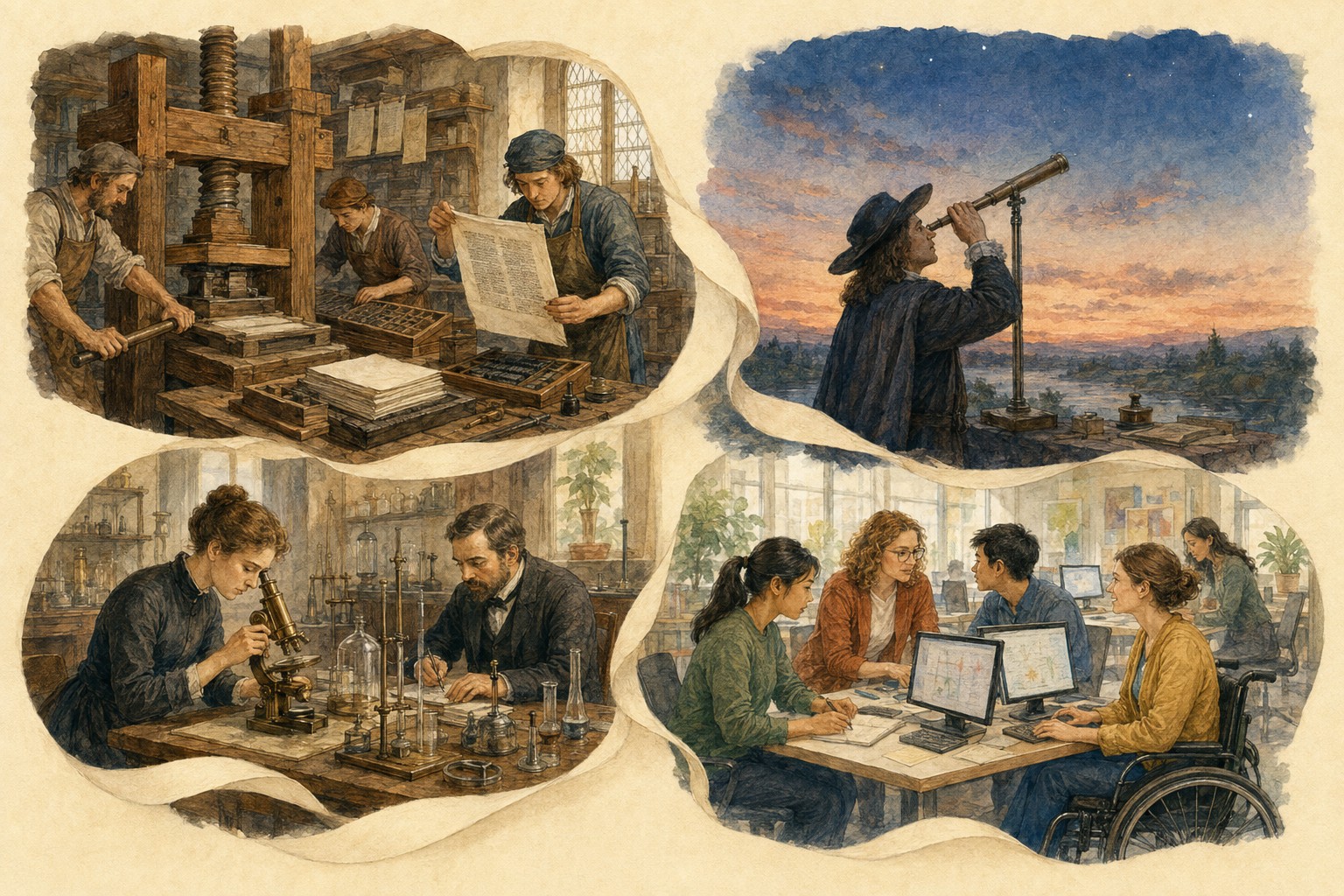
Knowledge grows more securely when people can teach it, inspect its sources and challenge its conclusions. Institutions and technologies changed how often those encounters could happen.
In medieval Europe, universities developed durable communities of teachers and students. Bologna, whose origins are traditionally dated around 1088, grew through legal study and student associations. Such institutions organized instruction, qualifications and argument. They belonged to a much longer global history of advanced learning in schools, religious establishments, courts and scholarly circles. A university gave learning a particular institutional shape; it did not create humanity's first teachers or investigators. University of Bologna: the birth of the Studium
European printing expanded the circulation of texts. Gutenberg and Fust's Bible, produced in Mainz in 1454–1455, became a landmark of printing with movable metal type in Europe. It followed much earlier Asian printing traditions. More copies allowed readers in different places to examine closely matching texts, compare arguments and discuss disagreements. Print supported religious debate, scholarship and education, while also spreading false claims. Reproduction made information easier to distribute; its reliability still had to be assessed. Library of Congress: the Gutenberg Bible
Instruments changed what could be observed. Galileo's telescopic observations in 1609–1610, including Jupiter's moons, brought unfamiliar evidence into discussions of the heavens. Objects orbiting Jupiter challenged the assumption that every celestial movement centered on Earth. Galileo improved and used an instrument that already existed; telescope-making itself depended on craft knowledge. Observation, interpretation and argument worked together as people assessed what the new images meant. Museo Galileo: Galileo's instruments and observations
Scientific societies and publications created further opportunities for scrutiny. The Royal Society first met in 1660; Philosophical Transactions began publication in 1665. Members exchanged correspondence, demonstrated experiments and discussed results. Newton's Principia appeared in 1687, bringing terrestrial and celestial motion into a powerful mathematical framework. Early scientific communities were socially restricted, and modern research practices did not arrive all at once. Nevertheless, organized exchange made it easier for claims to travel beyond their originators. Royal Society: institutional history
These changes encouraged an increasingly demanding question: what evidence would let someone else assess this claim? Different subjects required different answers. A mathematical proof, a historical document and an experiment do distinct jobs. Reliable inquiry depends on understanding those differences, showing how a conclusion was reached and remaining willing to revise it. As knowledge gained power, the institutions using it also acquired greater responsibility for its consequences.
14. Societies connected by roads, seas, belief, and power
To understand the setting of those intellectual changes, we now step back and follow the wider networks from antiquity through the early modern period. Families migrated, armies conquered, pilgrims travelled, traders learned new languages, and communities adopted or resisted new customs. Ideas did not move as isolated packages. They travelled with people who had purposes, loyalties, resources, and unequal freedom to move.
The Silk Roads were a changing network of land and sea routes, not one road along which everyone travelled from China to Rome. Maritime routes linked East and Southeast Asia with South Asia, Arabia, and Africa. Goods circulated alongside religious traditions, technical practices, languages, and stories. Buddhism, Christianity, Islam, and other traditions acquired new forms as communities interpreted them in different settings. UNESCO: About the Silk Roads
Large empires—among them Persian, Roman, Chinese, and later Islamic and Mongol states—could bring enormous areas under systems of rule. They did not make their populations culturally uniform. An administrative language might coexist with household languages; a religious text might be studied in a language people did not use at the market. Learning could be encouraged by royal patronage while criticism of rulers remained dangerous.
Across the Sahara, trade connected West African kingdoms with North Africa and Mediterranean economies. Ghana and Mali participated in major systems of wealth and exchange, and Mansa Musa's pilgrimage in 1324–1325 made Mali particularly visible in Mediterranean accounts. Here “Ghana” means the medieval Sahelian kingdom, not simply the territory of the modern country. Commercial routes also helped teachers, texts, and religious ideas circulate. Metropolitan Museum: Trans-Saharan Gold Trade
Pacific history provides another view of sophisticated knowledge. Navigators connected islands across vast stretches of ocean using trained observation of stars, swells, winds, birds, and other signs. Their skills were taught and practised within particular traditions; there was no single identical “Pacific method.” These achievements cannot be measured by whether their practitioners used alphabetic books or European instruments. National Museum of Australia: Voyages of the Pacific Ancestors
In the Americas, societies developed agriculture, urban centers, political systems, arts, and knowledge within their own connected histories. Andean khipu, arrangements of knotted cords, could record numerical information for administration. They demonstrate that durable record-keeping need not resemble a page of alphabetic text. Their full range of uses remains under investigation. NIST Museum: Inka Records Europeans arriving across the Atlantic encountered inhabited worlds, not a blank space awaiting history.
Oceanic exchange and the costs of conquest
From the late fifteenth century, Atlantic connections became far more intensive. Crops, animals, people, technologies, and diseases crossed oceans in new combinations. American foods eventually transformed diets elsewhere, while European colonization caused profound disruption in Indigenous societies.
That disruption included warfare, dispossession, forced labor, disease, and damage to existing food systems. Indigenous peoples also resisted, negotiated, formed alliances, adapted, and survived. A story in which disease simply swept away passive populations misses both human decisions and Indigenous agency. Library of Congress: The Atlantic Joined
The Atlantic slave trade forcibly carried millions of Africans into colonial economies. The scholarly SlaveVoyages reconstruction estimates that about 12.5 million people were embarked in Africa, of whom about 10.7 million disembarked. These are estimates for the transatlantic trade, not totals for all slavery throughout history. Behind the numbers were people with languages, expertise, beliefs, families, and ambitions whose labor and lives were violently appropriated. SlaveVoyages: Methodology and estimates
This period also changed languages. Conquest and settlement expanded the reach of several European languages, while contact produced borrowing, multilingual communities, and new linguistic varieties. African and Indigenous languages persisted and changed under extraordinary pressure. The language that becomes dominant is not necessarily more logical or expressive; political and economic power help determine which languages schools, governments, publishers, and employers reward.
Knowledge travelled through these unequal relationships too. Maps, collections, agricultural information, and descriptions of plants could depend on local expertise whose contributors were not properly credited. To ask who “discovered” something, we should also ask who already knew it, who explained it, who recorded it, and whose name entered the archive.
15. Industry, public education, and struggles over society
From the later eighteenth century, mechanization and new uses of fossil-fuel energy transformed production, first at large scale in Britain and later along different paths elsewhere. Steam engines powered work before railways became widespread. Industrialization depended on workshops, labor, waterpower, fuel, capital, transport, and trade; it was not the achievement of one inventor or one machine. Science Museum: Steaming Through the Centuries
Factories and industrial cities changed the organization of time. More people worked according to an employer's schedule and depended on wages and purchased food. Transport and communications connected distant markets. These changes increased productive capacity but also created harsh working conditions, overcrowding, and new concentrations of wealth.
Political thinkers and movements argued over the consequences. Who should own productive property? What could workers demand? Who should vote? Which responsibilities belonged to families, markets, communities, or governments? Liberal, socialist, conservative, nationalist, and other traditions offered competing answers, and none was internally uniform.
The European Enlightenment had already challenged many inherited claims to authority and encouraged arguments about reason, experience, liberty, and political institutions. Yet ideals of freedom often coexisted with slavery, empire, and exclusion. Studying those contradictions is part of understanding the period, not an optional correction afterward. Stanford Encyclopedia of Philosophy: Enlightenment
The spread of mass schooling and print created wider opportunities to learn, while also giving states powerful means to select official histories and standard languages. Access remained unequal by class, gender, location, and community. Education could widen a person's choices; it could also be used to suppress a family's language and traditions. The social history of knowledge includes both experiences.
The twentieth century brought world wars, genocide, nuclear weapons, anticolonial struggles, and movements for wider political and social rights. Many peoples won independence from colonial rule. Independence changed the political map without instantly removing economic inequalities, contested borders, or the effects of dispossession. United Nations: Decolonization
In 1948, representatives from varied backgrounds helped produce the Universal Declaration of Human Rights. It set out a common standard of dignity and rights, including education and participation in cultural life. A declaration does not by itself secure those rights. The continuing work of institutions and social movements reveals the distance that can remain between a stated principle and everyday experience. United Nations: Universal Declaration
16. Modern science changes our picture of life and the universe
Modern science did not grow through the accumulation of correct answers alone. It also advanced by showing that familiar explanations were incomplete. A useful theory must do more than sound convincing: it must fit evidence and remain open to serious testing.
Evolution transformed the study of life. Darwin and Wallace independently developed explanations involving natural selection. Their work was presented together at the Linnean Society in 1858; Darwin's On the Origin of Species followed in 1859. Populations contain inherited variation, and some differences affect reproduction in particular conditions. Across generations, this can change populations. Later genetics and other discoveries greatly expanded the explanation. Evolution is not a ladder ranking living peoples, and a description of nature is not a moral instruction for society. Natural History Museum: Natural Selection
Microbiology helped connect particular diseases with particular microorganisms. Pasteur, Koch, and many others developed experiments and techniques that changed explanations of infection. This did not mean germs caused every illness or that one discovery immediately solved public health. Clean water, sanitation, vaccination, nutrition, clinical care, antibiotics, and public infrastructure have distinct and interacting histories. Science Museum Group: Robert Koch
One extraordinary collective achievement was the eradication of smallpox, declared by the World Health Organization in 1980. It required much more than knowing a biological fact: vaccines, surveillance, local health workers, international coordination, and sustained practical action all mattered. It is an example of knowledge becoming effective through organized cooperation. WHO: History of Smallpox Vaccination
Relativity and quantum physics changed accounts of space, time, matter, and light in the early twentieth century. These theories did not make every older calculation worthless. Newtonian models remain extremely useful under the conditions where they are good approximations. The lesson is that an explanation can be powerful and limited at the same time. Quantum theory also does not mean that any imagined claim becomes scientifically possible. Nobel Prize: Physics in the Twentieth Century
Molecular biology opened another level of explanation. The double-helix model of DNA, proposed in 1953, drew on evidence from several researchers, including crucial X-ray work associated with Rosalind Franklin and Maurice Wilkins. Watson and Crick's model helped explain how hereditary information could be stored and copied. DNA itself was known before 1953; this was a breakthrough in understanding its structure. NHGRI: DNA Double Helix
The Human Genome Project, carried out from 1990 to 2003, produced a foundational human reference sequence through international collaboration. “Completed” described the project's goals; it did not mean every difficult DNA region, every person's variation, or every gene's function was fully understood. Later research continued filling gaps and widening representation. In a striking return to our opening chapters, genetic methods also made it possible to investigate relationships with extinct human groups. NHGRI: Human Genome Project Fact Sheet
These achievements depended on instruments, institutions, funding, skilled technical labor, and communities able to criticize results. The familiar portrait of a solitary genius captures only a fraction of how modern knowledge is made.
17. Computers, the Internet, and a new scale of shared information
Computers gave people new ways to represent information and carry out formal procedures. Electronic digital machines developed in the 1940s, followed by successive changes in memory, programming, electronics, size, and accessibility. There is no useful unqualified answer to “the first computer” without specifying whether we mean mechanical, electronic, programmable, digital, or general-purpose. Many machines and contributors mattered. Computer History Museum: Computing Timeline
A programming language is a designed system for expressing instructions or computations. A natural human language grows through the lives of its users and can serve the full range of social communication. Mathematics, writing scripts, computer code, and spoken or signed languages can interact, but they do different jobs. Confusing them can make technological change sound more mysterious than it is.
The Internet is a network infrastructure. The World Wide Web is one of the systems that uses it. Tim Berners-Lee proposed the Web at CERN in 1989, and CERN released the Web software into the public domain in 1993. Linked documents became a widely accessible way to share information across computers. The Web did not create the Internet, and neither appeared through the work of one person alone. CERN: The Birth of the Web
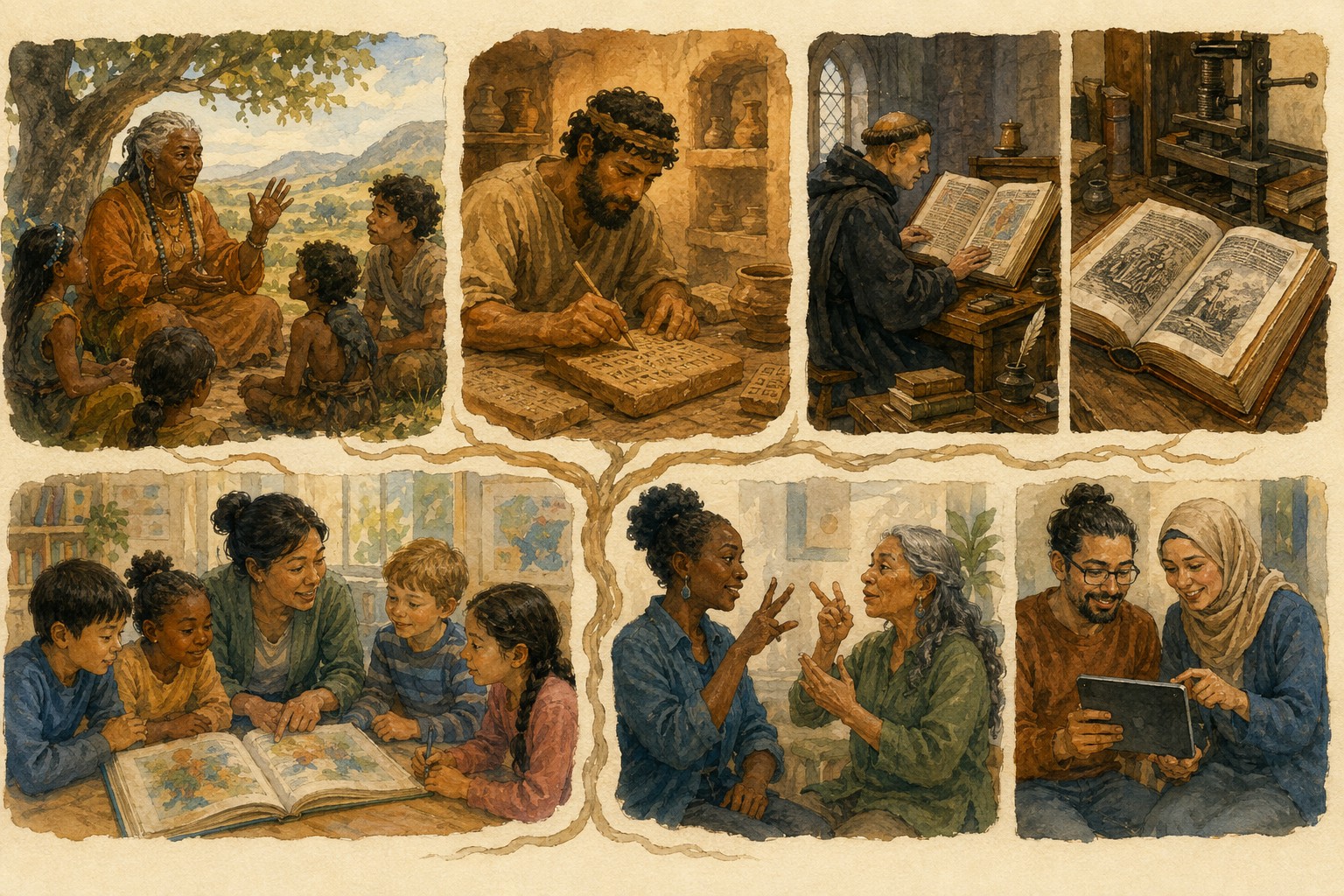
Digital communication shortened the journey between producing a statement and sharing it with distant readers. Search engines, online archives, video, collaborative projects, and mobile devices changed how people learn and participate. They also changed who can monitor communication, organize attention, and control access.
Access remains uneven. The ITU's 2025 estimates put about 6 billion people online and 2.2 billion offline. Those are dated estimates, not a live counter for 2026. Even among connected people, affordability, connection quality, accessibility, and skills affect what they can do. International Telecommunication Union: Facts and Figures 2025
Language remains central. UNESCO describes a world with more than 7,000 spoken or signed languages; exact totals vary with classification and the inclusion of different kinds of records. A technically connected world is not automatically one in which every language has equal visibility. Translation can open doors, but education and digital tools also need to support people in the languages through which they understand their lives. UNESCO: Language and Multilingualism
18. AI and the unfinished history of knowledge
Artificial intelligence has a history extending well before today's chatbots. A 1955 proposal for a 1956 Dartmouth research project explicitly used the term “artificial intelligence” and raised questions about language, learning, abstraction, and machines. Those were research ambitions, not proof that every aspect of a human mind could be reproduced. The Original Dartmouth Proposal
Contemporary AI systems draw on mathematical methods, computing hardware, data, and enormous amounts of human-created material and human work. Their achievements vary by system and task. The 2024 Nobel Prize in Chemistry, for example, recognized computational protein design and protein-structure prediction, including AI work. Such tools can help researchers investigate biological problems, while predictions still need appropriate validation. Nobel Prize: Chemistry 2024
Systems that generate language can also produce confident errors, including invented references. NIST's generative-AI guidance calls attention to this problem. Fluency alone is not evidence of truth, understanding, or consciousness. The practical response is to inspect sources, test important claims, and distinguish a plausible answer from a verified one. NIST: Generative AI Profile
That distinction links the present to the entire story. An ancient inscription can exaggerate a ruler's victory. A copied manuscript can preserve a mistake. A printed book can persuade through authority. A search result can repeat misinformation. An AI answer can combine accurate explanation with invented detail. Each medium changes what can be transmitted; none removes the need to ask how we know.
There are also choices about who can contribute and benefit. Open-science efforts seek to make publications, data, software, and other research resources more accessible, while widening participation and dialogue. The problem is social as well as technical: a file can be available without everyone having the language, equipment, time, or training needed to use it. UNESCO: Open Science
Our history does not end in a guaranteed technological destination. It ends, for now, with living people making decisions: what to teach, which languages to sustain, whose expertise to recognize, how to distribute power, and what evidence should change our minds.
19. The long view: what changed, and what connects us
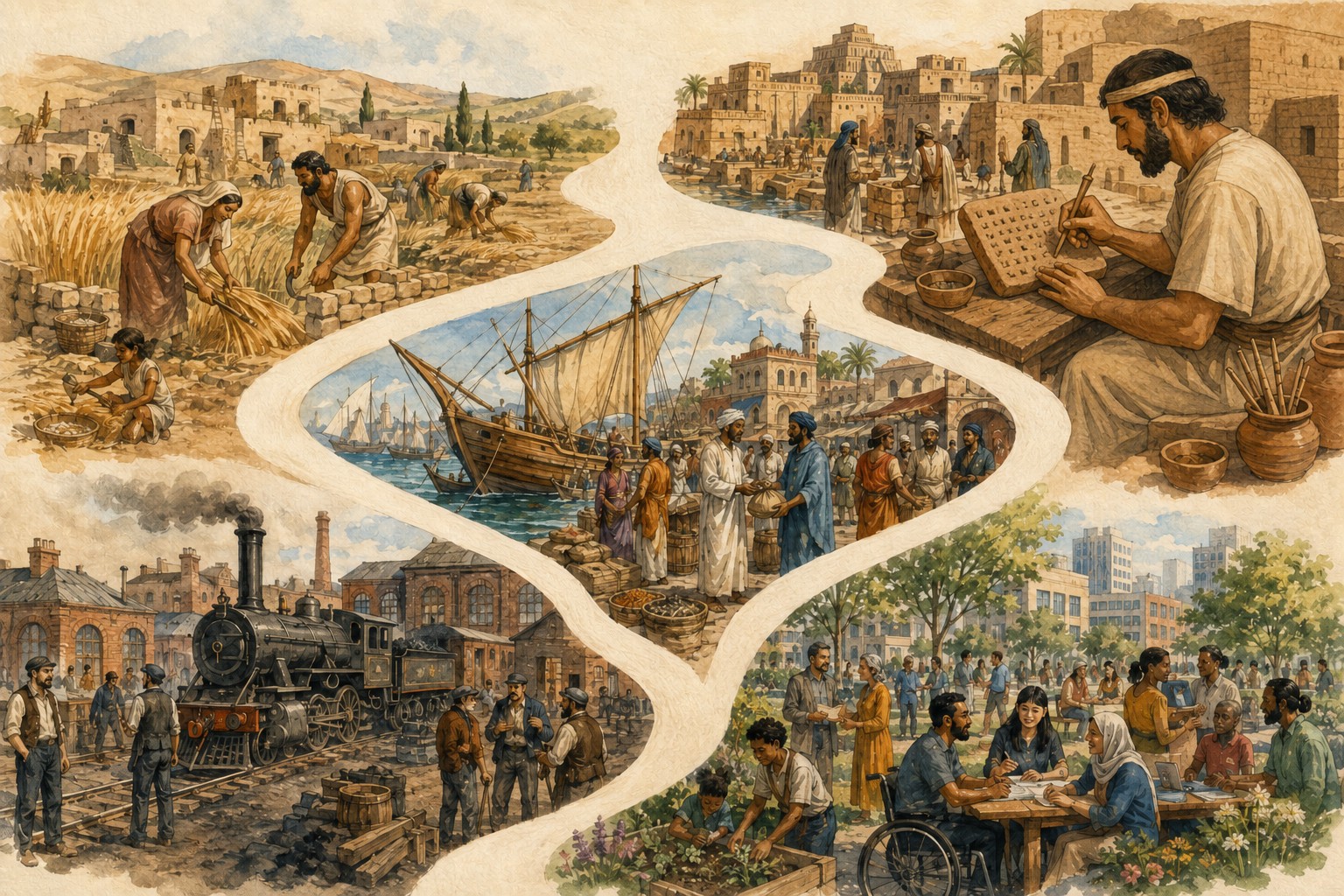
Across this history, several transformations overlap. Biological evolution produced the capacities and diversity from which our species emerged. Language helped people share experiences and possibilities beyond the immediate moment. Writing made some knowledge durable outside living memory. Institutions organized teaching and inquiry. Print multiplied texts; science developed powerful ways to test explanations; digital networks and AI changed the scale and speed of processing information.
None of those changes erased what came before. We still learn through imitation, conversation, practical experience, and trusted relationships. Scientists still depend on technicians and instruments. Books still depend on readers. Digital knowledge still depends on people deciding what is worth recording and whether a claim deserves belief.
Ancient Greeks made lasting contributions to argument and explanation. They were part of a far wider human achievement, built by named thinkers and countless unnamed farmers, caregivers, navigators, craftspeople, translators, teachers, and students. The history of knowledge is the history of those relationships as well as the history of ideas.
Every living person belongs to Homo sapiens. Different languages and societies do not represent different levels of biological humanity. Our surviving species carries a shared, branching past and an extraordinary variety of cultural lives. Understanding that past gives us better questions for the present—not a script that tells us what must happen next.
Research checked 6 September 2026. This is an introductory synthesis, not an exhaustive account of every society, language, discovery, or historical species name. Sources are linked throughout; dates and disputed classifications may change as evidence improves.