The Unlikely Record · Episode 24 · Twelve stories
Twelve histories of connections, warnings and uncertain receptions
A message can arrive without being understood. A warning can be clear on a screen and doubtful to its reader. These twelve histories follow the difficult space between sending, receiving and deciding what a signal means, from moving arms on French towers to a radio telescope’s puzzling paper record.
Story 01
The Secret Proposal Became Front-Page Evidence
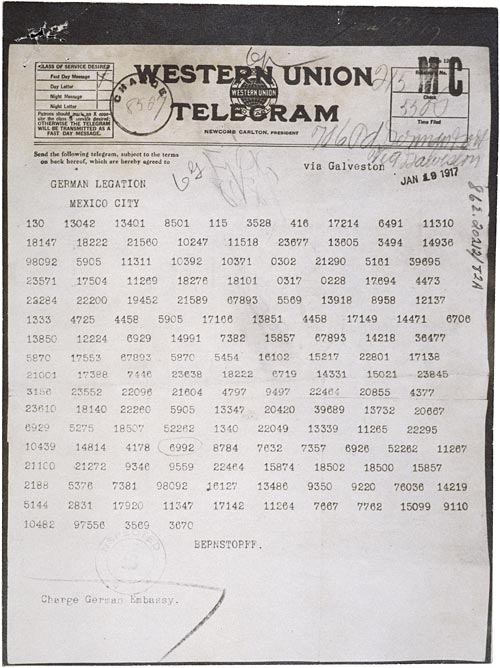
The proposal was intended to remain secret. In January 1917, German foreign secretary Arthur Zimmermann sent instructions concerning an alliance with Mexico if Germany failed to keep the United States out of the war. Financial support and the recovery of Texas, New Mexico and Arizona formed part of the suggested bargain.
The message also announced the coming return to unrestricted submarine warfare. Germany hoped to compel Britain to make peace while preserving American neutrality. Those aims sat uneasily together, and the proposed Mexican alliance was a contingency for the moment neutrality failed. Japan was to be invited into the arrangement as well.
British codebreakers obtained the message and deciphered it. Their government had to weigh the advantage of revealing the threat against the risk of exposing its intelligence work. Britain passed the telegram to President Woodrow Wilson on 24 February. On 1 March, its contents appeared widely in American newspapers.
A communication designed to shape a possible war in private now helped shape public opinion about entering it. Congress declared war on Germany on 6 April. The telegram did not cause that decision by itself: submarine warfare and the breakdown of diplomatic relations also mattered. Its striking reversal lay in the change of audience. A confidential diplomatic instruction became evidence available to the country it threatened.
Evidence and sources
The decoded message and its publication are documented. Its effect on United States entry into the war was part of a wider crisis.
- Zimmermann Telegram (1917) — United States National Archives
Complete historical introduction and decoded transcript
Story 02
The Celebration Outlasted the Connection
In August 1858, the Atlantic finally had an electrical connection between its shores. The British Agamemnon and American Niagara had met at sea, joined their sections of cable and steamed in opposite directions. Previous attempts had ended with broken cable, storms and exhausted crews.
Queen Victoria sent President James Buchanan a congratulatory message. It travelled far faster than a ship could carry a letter, but the new connection was hardly instantaneous in practice. The Science Museum records that the Queen’s message took sixteen hours to transmit. The distance had been crossed; dependable performance still had to be achieved.
Celebrations nevertheless treated the achievement as a decisive victory over the ocean. Cyrus Field received honours, while New York staged processions, salutes and fireworks. The fragile equipment beneath the water could not sustain the confidence expressed above it. Useful communication soon failed.
The Institution of Engineering and Technology identifies several contributing problems: faults in manufacture, damage from the laying machinery, and further harm from Wildman Whitehouse’s use of high-voltage instruments. Reducing the failure to one foolish act misses that accumulation. The cable had demonstrated the possibility of a transatlantic link while exposing how much engineering remained unfinished. Its short life became part of the knowledge required to build a lasting one.
Evidence and sources
The cable’s brief service and multiple technical problems are documented. Institutional accounts differ over the precise final-failure date.
- The First Transatlantic Telegraph Cable, 1858 — Institution of Engineering and Technology
- Sending Messages across the Atlantic — Chloe Vince; Science Museum
- The Laying of the Atlantic Cable — Josephine C. Dobkin; Metropolitan Museum Journal 41 (2006)
Printed pp. 155–159, especially recovery discussion pp. 158–159
Story 03
They Went Back for the Wire on the Seabed
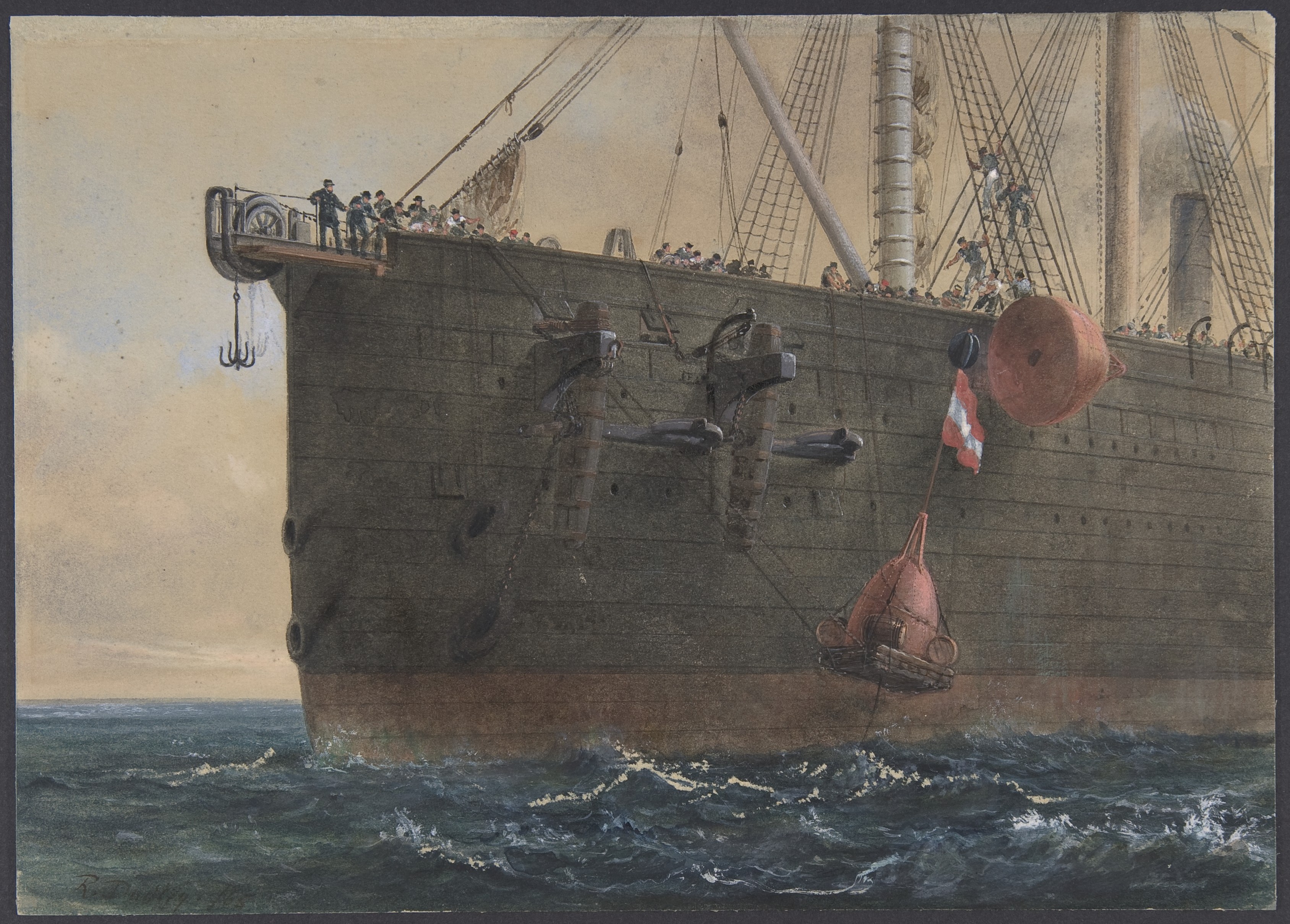
The Great Eastern reached Heart’s Content on 27 July 1866 with a new transatlantic cable. That success might have been enough to end the expedition. Instead, the ship and its companions returned to a much less visible task: retrieving the cable lost during the previous year’s attempt.
On 2 August 1865, that earlier cable had broken and disappeared into deep water. Attempts to recover it had failed. Robert Charles Dudley’s watercolour shows the immense bow of the ship with a grappling hook hanging ready, an image of engineering reduced to the difficult act of catching something far below sight.
In 1866, crews returned to the marked area and worked to catch and lift the lost line. Rough weather and repeated effort delayed them. In early September, they brought the cable to the surface after more than a year on the seabed. It was spliced to fresh cable and completed onward to Newfoundland.
The Atlantic now had two working connections, one newly laid and one rescued from an earlier failure. Dudley’s pictures preserved the equipment and the waiting crews, but their dates matter: an image of the unsuccessful 1865 grappling is not a photograph of the successful recovery. The achievement depended on returning to unfinished work and making a discarded length of cable useful again.
Evidence and sources
The recovery of the cable lost in 1865 is documented separately from the successful new cable laid in July 1866.
- In the Bows of the Great Eastern: The Cable Broken and Lost — The Metropolitan Museum of Art
- The Laying of the Atlantic Cable — Josephine C. Dobkin; Metropolitan Museum Journal 41 (2006)
Printed pp. 155–159, especially recovery discussion pp. 158–159 - Collection API Object 383827 — The Metropolitan Museum of Art
Story 04
The Wireless Was Silent, but the Rockets Were Visible
Californian had stopped for ice when her wireless operator contacted Titanic on the evening of 14 April 1912. Titanic was exchanging messages with Cape Race. Californian’s nearby transmission overwhelmed the more distant station, and Titanic’s operator told him to keep out. Californian’s sole operator later went off duty.
When Titanic began sending distress calls, no one aboard Californian was listening to the wireless. People on her bridge did see rockets and tried to communicate by Morse lamp. They did not wake the operator and establish what the rockets meant. The 1912 British inquiry concluded that Californian had failed to render assistance she could have offered.
The case did not settle there. Captain Stanley Lord disputed the findings, and a 1992 Marine Accident Investigation Branch reappraisal revisited the evidence. Its investigators agreed that proper action had not been taken over the rockets, but disagreed about the ships’ distance and whether Titanic herself had been visible.
The endorsed report placed Californian substantially farther away than the original inquiry had assumed. On that estimate, a realistic response would probably have brought her after Titanic sank. It still insisted that an attempt should have been made. Failure to investigate a warning and certainty about whom a different response would have saved are separate judgments; the surviving record supports the first more securely than the second.
Evidence and sources
Wireless exchanges and observed rockets are documented. The ships’ distance, visual contact and possible rescue outcome remain disputed.
- Circumstances in Connection with the S.S. Californian — British Wreck Commissioner’s Inquiry; transcription by Titanic Inquiry Project
Opening particulars, wireless exchanges and witness evidence about rockets - RMS Titanic: Reappraisal of Evidence Relating to SS Californian — Marine Accident Investigation Branch, United Kingdom, 1992
Cover letter; sections 1–2, 4–7, printed pp. 1–5 and 12–19
Story 05
The Warning System Was Certain; Its Officer Wasn’t
During the night of 26 September 1983, the Soviet satellite warning system reported American missile launches. Lieutenant Colonel Stanislav Petrov was on duty at Serpukhov-15, the centre that monitored the Oko early-warning satellites. The instruments were supposed to distinguish a real attack from misleading light.
The pattern made him doubtful. Soviet planning expected a large strike intended to overwhelm the country’s forces, while the system was reporting only a handful of launches. In a later interview with TIME, Petrov recalled feeling uncertain rather than knowing immediately that the machinery was wrong. He reported the warning as false.
Technical accounts connect the alarm to a rare alignment of the Sun, satellite and high clouds above American missile fields. Reflected sunlight resembled the signature the sensors were meant to detect. The satellite arrangement had been chosen partly to reduce such confusion, which made the episode a failure of an intended safeguard.
The story is often compressed into a man refusing to press a launch button. Petrov’s actual responsibility was assessing warning information for the command structure, not independently deciding to fire the Soviet arsenal. His judgment interrupted the escalation of a false report. What the leadership would otherwise have done cannot be known, but the incident exposed a real vulnerability: an apparently authoritative machine output still required a human decision about whether to believe it.
Evidence and sources
The false warning and Petrov’s judgment are documented through later interviews and technical research. A guaranteed nuclear-war counterfactual is unprovable.
- False Alarms on the Nuclear Front — Geoffrey Forden, MIT; WGBH/NOVA
The autumn equinox incident and warning-system discussion - Stanislav Petrov, the Russian Officer Who Averted a Nuclear War, Feared History Repeating Itself — Simon Shuster; TIME, 19 September 2017
Petrov’s 2015 interview, uncertainty, report and investigation
Story 06
A Signal to Surface Could Look Like an Attack
The Soviet submarine B-59 carried a nuclear-armed torpedo into the Cuban Missile Crisis. On 27 October 1962, pursued by American antisubmarine forces and needing to recharge its batteries, it surfaced into an alarming scene. Aircraft, lights and explosive signals surrounded the boat.
An American notice issued three days earlier described small explosive sound signals as a request for submarines to surface and identify themselves. That stated intention did not guarantee understanding aboard a Soviet vessel with unreliable communications. An action meant to convey a procedure could instead appear to announce hostilities.
Vasili Arkhipov, the brigade chief of staff aboard B-59, later recalled Captain Valentin Savitsky being blinded and shocked by lights and aircraft activity. In his 1997 account, he described how an emergency dive might have turned the encounter into war. He did not explicitly recount a nuclear launch order or his own intervention.
Other later recollections, examined by the National Security Archive, describe Savitsky ordering preparations for the nuclear torpedo and Arkhipov helping calm him before the command reached the torpedo officer. Those accounts warrant attention alongside their differences. The torpedo was not fired. The documented danger lies in exhausted people interpreting incomplete signals during a confrontation whose full political context they could not reliably receive.
Evidence and sources
American operational records and later Soviet recollections document a dangerous encounter. Accounts of the near-use of a nuclear torpedo differ and remain incomplete.
- The Underwater Cuban Missile Crisis at 60 — Svetlana Savranskaya; National Security Archive, George Washington University
Complete introduction and descriptions of documents 1–3 - Presentation at the Conference on the Cuban Missile Crisis, 14 October 1997 — Vasili Arkhipov; translation by Svetlana Savranskaya, National Security Archive
Complete six-page presentation, especially pp. 4–5 - Submarine Surfacing and Identification Procedures, 24 October 1962 — United States Navy; National Archives RG 330, hosted by National Security Archive
Both pages
Story 07
The Radar Saw the Planes Before Anyone Named Them
At 7:02 on the morning of 7 December 1941, Privates Joseph Lockard and George Elliott detected a large group of approaching aircraft on the radar at Opana. The equipment had found something real. The difficulty was deciding what the return represented and how the warning should move through the defence system.
At Fort Shafter, Lieutenant Kermit Tyler was working only his second shift in the air information centre. The National WWII Museum’s account describes a pilot placed there to become familiar with the new warning process, with little effective training for the task. Other members of the morning team had already left.
Tyler expected American bombers arriving from the mainland. Earlier, uninterrupted music on a local radio station had reinforced that expectation because he understood it could guide incoming aircraft. When the radar operators reported their contact, he interpreted it through the explanation already in his mind and told them not to worry.
The aircraft were the Japanese attack force. Radar had supplied advance information without producing a useful warning. Later inquiries, according to the museum’s account, did not find Tyler negligent in his assigned duties. His decision remained controversial, but the episode also reveals an unfinished organisation around a working instrument: detection, identification, staffing and response were different parts of the same system.
Evidence and sources
Radar detection, the report and Tyler’s mistaken identification are documented. Claims about how a different response would have changed the attack remain counterfactual.
- Opana Mobile Radar Site — National Park Service, Pearl Harbor National Memorial
- Kermit Tyler: A Call That Would Live in Infamy — Joey Balfour; National WWII Museum
Radar familiarisation, December 7 report, expected bombers and inquiry findings
Story 08
The Message Arrived, Then Needed a Horse
At eight in the evening on 30 August 1794, the president of France’s Convention read a letter from Claude Chappe. Written earlier that evening, it announced that a decree concerning the renamed town of Condé and the Army of the North had reached Lille. Chappe had received the signal confirming delivery.
The connection used moving arms rather than an electrical wire. Operators watched neighbouring stations through telescopes and reproduced coded positions on elevated masts. A message could pass along the chain much faster than a person could travel the whole route. The Paris–Lille line had become operational that year.
The people moving the arms did not necessarily know what the message said. The system separated relaying symbols from interpreting them through a code. It also depended on visibility: darkness, fog and heavy rain could interrupt a network whose parts were mechanically simple but geographically extensive.
Chappe’s letter preserved a practical boundary to the achievement. He had instructed his representative at Lille to send the decree onward to Nord-Libre, the new name for Condé, by an extraordinary courier. The rapid optical journey still required a human messenger for its final stage. The surviving notice captures both the novelty of near-immediate acknowledgement and the older delivery system that completed the connection.
Evidence and sources
Chappe’s letter records an acknowledgement from Lille and a courier onward to the renamed town. Museum sources explain the relay system.
- Lettre de Chappe annonçant la réception à Lille, 30 août 1794 — Archives Parlementaires, CNRS éditions; Persée
Tome XCVI (1990), p. 119, complete letter read in transcription - Modèle: Télégraphe optique système Chappe — Marie-Sophie Corcy; Musée des Arts et Métiers, Cnam
- Télécommunications: Postes, télégraphes et téléphones — Musée de La Poste
First two pages, Chappe system
Story 09
Three Dots, Two Witnesses, No Tape
Guglielmo Marconi arrived in Newfoundland in December 1901 to attempt an exceptionally long wireless connection. A powerful transmitter at Poldhu in Cornwall was to send repeated groups of three dots, the Morse letter S. At Signal Hill, his team raised an aerial using a kite after difficult weather disrupted its preparations.
Marconi reported hearing the signal on 12 December, with assistant George Kemp also listening through the telephone receiver. Oxford’s History of Science Museum preserves equipment associated with the experiment. Its account notes a crucial limitation: the weak sounds were heard rather than recorded on telegraphic tape.
Later technical analysis complicated the celebrated result. The IEEE’s historical account explains why the reported daytime crossing was difficult at the claimed wavelength. It discusses the possibility that energy at shorter wavelengths reached the untuned receiver. That possibility is an explanation to investigate, not a surviving measurement of what the listeners actually heard.
In 1902, tests aboard the liner Philadelphia produced signals recorded on paper tape over long distances, especially at night. Those results established the feasibility of the connection more securely while leaving questions about the earlier episode. Marconi’s ambition led to a working technology, but the famous three dots remain a useful reminder that a successful programme and every detail of its origin story need not have equal evidential strength.
Evidence and sources
The experiment and reported reception are documented. Whether the 1901 signal crossed at the claimed frequency remains technically disputed.
- Atlantic Crossing — History of Science Museum, University of Oxford
- Marconi Towers: A Photographic Description of Three Transatlantic Stations — IEEE Canadian Atlantic
Introduction and Marconi Bridges the Atlantic with Wireless section
Story 10
The Satellite Was a Reflector
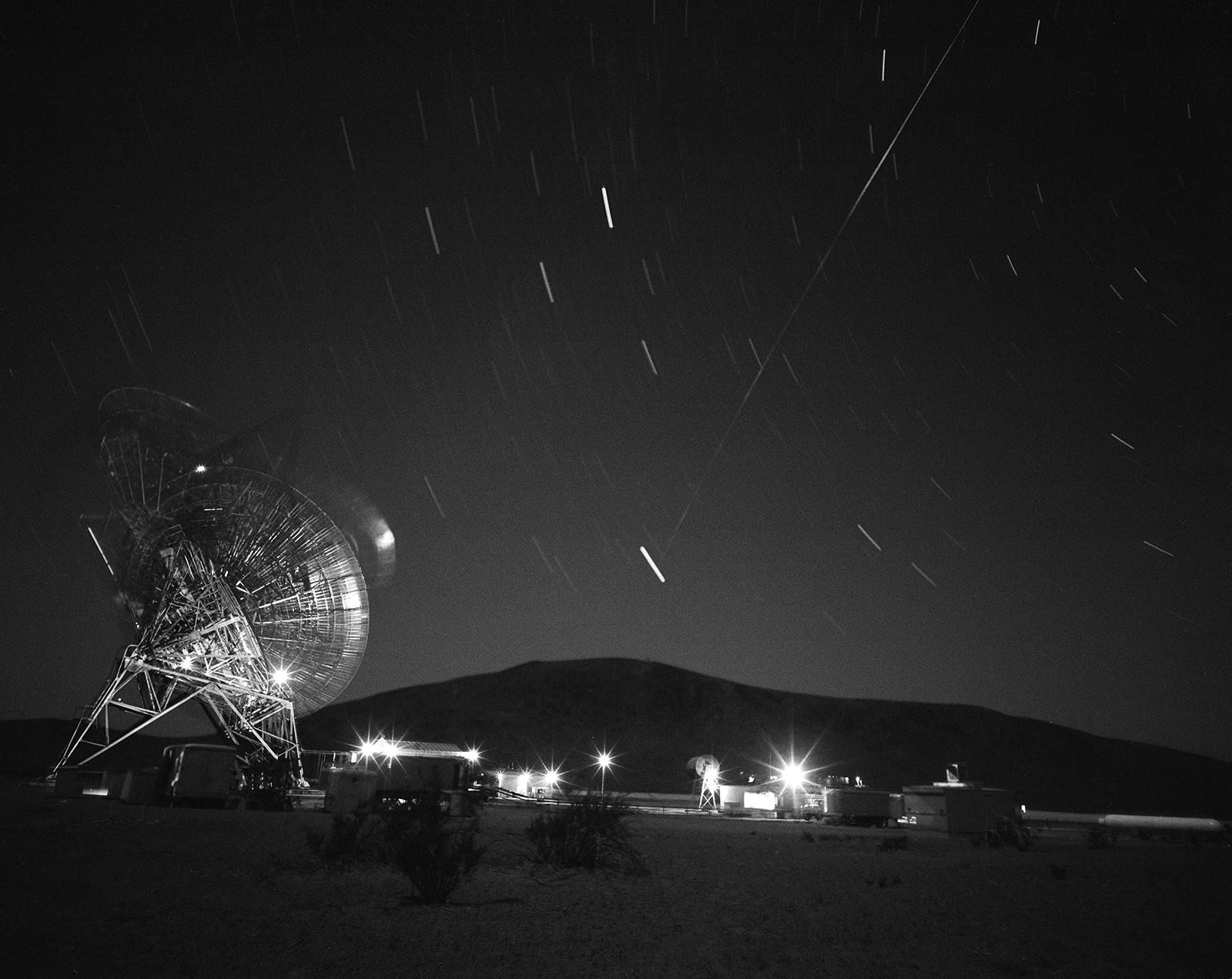
The voice crossing the United States on 12 August 1960 took a route through space. A recorded message by President Dwight Eisenhower left Goldstone, California, bounced from the Echo balloon in orbit and reached Bell Telephone Laboratories at Holmdel, New Jersey. The satellite was completing its first orbit.
Echo was an enormous, lightweight sphere of aluminised plastic. Its surface reflected radio signals sent from the ground. It carried no repeater that received, amplified and retransmitted the message. Powerful ground equipment and a sufficiently large reflecting surface made the passive experiment possible.
Getting that surface into orbit required its own trials. NASA’s historical data book records ruptured balloons during earlier suborbital tests and a failed launch attempt before the successful August flight. The large sphere had to travel folded inside a container and expand into its useful shape after release.
Eisenhower’s statement invited other nations to use the balloon for experiments and promised to share scientific information. A photograph of Echo’s first pass above Goldstone shows the satellite as a long streak among shorter star trails, with the tracking antenna below. The scene records a practical demonstration of space communications: the message depended as much on the stations facing the sky as on the bright object moving across it.
Evidence and sources
The launch, reflected transmission and presidential statement are documented. Echo was passive and did not amplify the radio signal.
- August 1960: Project Echo Launched — NASA
- Goldstone Tracking the Echo Satelloon — NASA/JPL-Caltech
PIA21114 description and credit - Message Recorded for Transmission via Communication Satellite Echo I — Dwight D. Eisenhower; American Presidency Project, UC Santa Barbara
12 August 1960, complete statement and transmission note - NASA Historical Data Book, Volume II: Programs and Projects 1958–1968 — Linda Neuman Ezell; NASA SP-4012 (1988)
Echo pp. 369–370; Telstar pp. 373–375, including table 3-213
Story 11
The Television Relay Entered a Damaged Sky
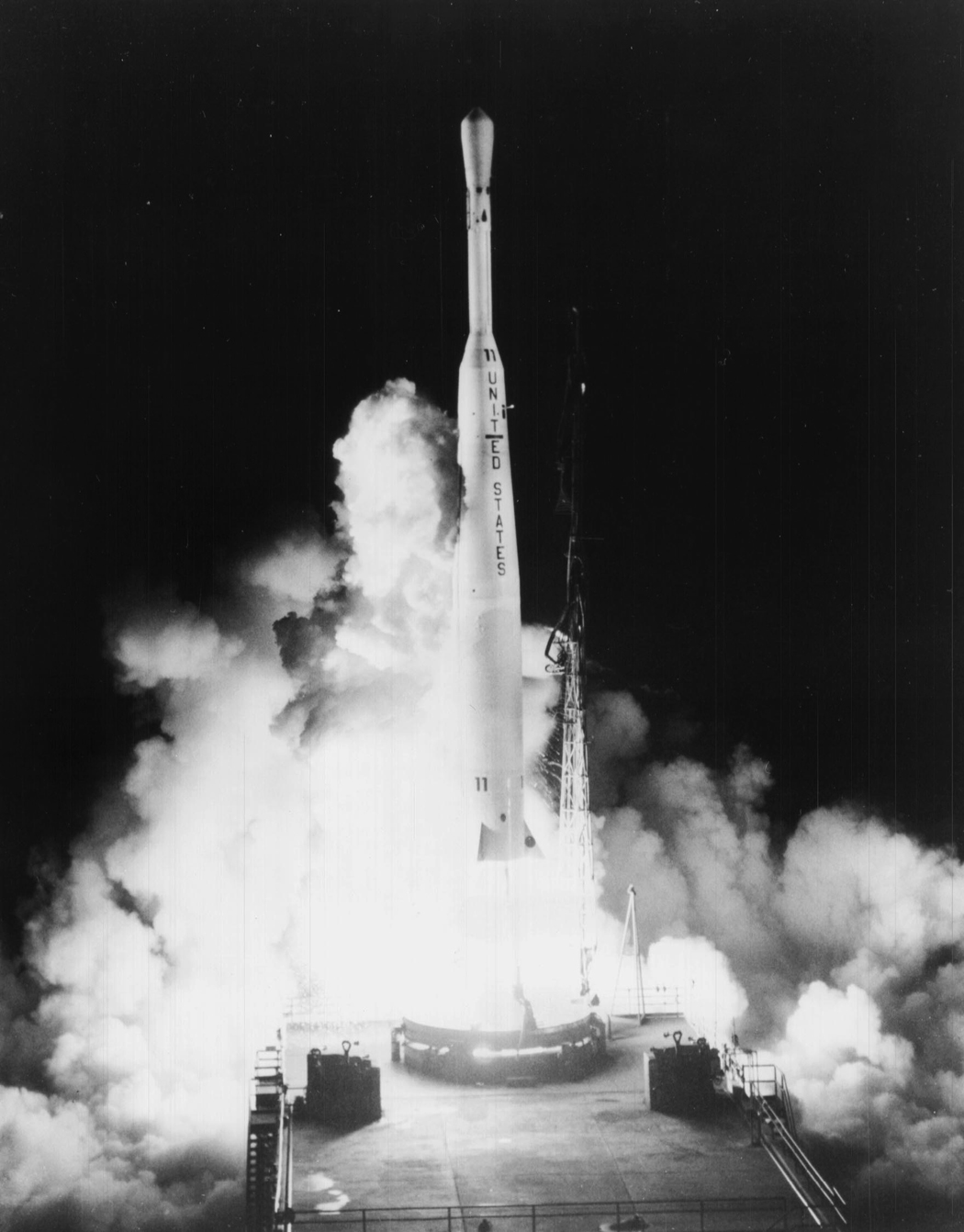
A Delta rocket launched Telstar 1 from Cape Canaveral on 10 July 1962. Bell Laboratories had built the small, solar-cell-covered spacecraft for AT&T, while NASA supplied launch and tracking support. Within hours, a test carried live television pictures from the United States to France.
The spacecraft could also relay telephone calls, data and facsimiles. Its size contrasted sharply with the installations required below. The receiving horn at Andover, Maine, stood seven storeys high. Telstar crossed the useful part of its orbit for only a limited interval, so the connection could not remain continuously available.
Its electronics also faced an unusually hostile environment. The American Starfish high-altitude nuclear test had taken place the day before launch. NASA’s historical data book attributes damage to part of Telstar’s communications system to radiation from that test. The satellite was simultaneously demonstrating a peaceful application of space and measuring the radiation that endangered it.
In November, the command channel stopped responding. Transmissions resumed for a time in early 1963, but the experimental satellite’s useful career was brief. Its public effect lasted longer. Images moving between continents showed what live satellite television could become, while the damaged hardware revealed how events elsewhere in space could compromise a device built to connect people on the ground.
Evidence and sources
Launch, successful television relay and radiation damage are documented. Telstar was an early active relay, not the first active communications satellite.
- Telstar Opened Era of Global Satellite Television — Bob Granath; NASA, 10 July 2012
- NASA Historical Data Book, Volume II: Programs and Projects 1958–1968 — Linda Neuman Ezell; NASA SP-4012 (1988)
Echo pp. 369–370; Telstar pp. 373–375, including table 3-213
Story 12
The Famous Letters Were Measurements
A few days after a run of observations beginning on 15 August 1977, Jerry Ehman examined the Big Ear radio telescope’s printout. One column contained an extraordinary sequence: 6EQUJ5. He circled it in red and wrote the word that became its lasting name, Wow!
Those characters were a compact numerical display devised for the computer’s paper output. Digits represented lower measured intensities; letters extended the scale. The U marked the strongest part of the detection. The sequence rose and fell in a way that fitted a small source passing through the telescope’s observing beam.
Six samples covered roughly seventy-two seconds, but that did not reveal the complete lifetime of whatever produced the signal. Big Ear’s two observing beams should have offered another chance to detect a steady source as the sky moved across them. Only one response appeared. Later searches did not recover the same event.
The uncertainty has prompted continuing analysis rather than a decoded alien sentence. A 2025 research preprint revisited archival observations, refined estimates of the signal’s properties and favoured an astrophysical explanation while still describing the event as unexplained. Ehman’s handwritten reaction survives as evidence of surprise. The printed letters preserve something narrower and more useful: measurements that any explanation must account for.
Evidence and sources
The printout and narrowband detection are authentic. The origin is unresolved; the code records intensity, not an intelligible message.
- Explanation of the Code 6EQUJ5 — Jerry Ehman; Ohio State University Radio Observatory / NAAPO
- The Big Ear Wow! Signal: What We Know and Don’t Know after 20 Years — Jerry R. Ehman; Ohio State University Radio Observatory / NAAPO
Introduction; computer printout; intermittency and duration; conclusion - Arecibo Wow! II: Revised Properties of the Wow! Signal from Archival Ohio SETI Data — Abel Méndez and colleagues; arXiv:2508.10657v1
Complete abstract and submission record, 14 August 2025
The surviving records contain remarkable successes and consequential mistakes. They also preserve uncertainty: a missing recording, contradictory testimony, an instrument whose output needed interpretation. Keeping those limits visible makes the achievements clearer and the failures more instructive.
About the evidence labels
Documented identifies a supported historical event. Disputed marks an account whose explanation or details remain contested. Folklore identifies a recorded tradition; its inclusion does not establish that a supernatural event occurred.