The Unlikely Record · Episode 25 · Twelve stories
Twelve stories of names, rights, court records, and the papers people needed to move.
A document can identify a person, disguise an injustice, record a decision, or help make escape possible. These twelve histories follow what happened when names and rights met official paperwork. The records do not speak without context; each story asks who created them, what they changed, and what they left out.
Story 01
The Manifest Used Another Name

Line 33 of the brig Orleans’s 1841 manifest names Plat Hamilton. The National Archives identifies that entry as Solomon Northup, a free Black man from New York who had been kidnapped and sold into slavery. The ship’s paperwork described a person while concealing the identity through which his freedom might have been recognized.
Another federal record tells a different part of the story. The 1840 census places Northup and his family in Saratoga Springs as free people of color. The two records do not describe a lawful change in his rights. Read together, they help expose what had happened between one official enumeration and another.
Paperwork also entered the effort to bring him home. In his 1853 memoir, Northup describes a memorial submitted by his wife, Anne, with supporting affidavits. New York’s governor appointed Henry B. Northup as an agent in November 1852 to seek his restoration. Identifying a free citizen and locating a man held under another name were connected but different problems.
Northup regained his freedom in 1853 and published his account that year. The surviving manifest now works against the purpose it once served. A document used to move him through the domestic slave trade has become evidence of the violence that separated him from his name and family.
Evidence and sources
The census, ship manifest and memoir document different parts of Northup’s experience. The manifest records an imposed name, not proof that his enslavement was lawful.
- Slave Manifest of Solomon Northup — National Archives
- The Documents Behind Twelve Years a Slave — National Archives
- Twelve Years a Slave (1853) — Solomon Northup; University of Hong Kong digital copy
Printed pages 291–292: Anne’s memorial, affidavits and November 23, 1852 appointment.
Story 02
The Court Was Asked Who Should Pay
The legal dispute that brought the Zong massacre into a London courtroom concerned an insurance payment. In 1781, the ship’s crew killed more than a hundred enslaved Africans by throwing them overboard. The owners then demanded compensation for the people they treated as lost cargo.
The crew claimed that a shortage of drinking water had endangered the ship. The insurers challenged that explanation and refused to pay. When the dispute reached the Guildhall in March 1783, the owners initially won. The verdict was challenged, but London Museum notes that the surviving history does not establish a completed second trial or a clear final settlement.
Olaudah Equiano brought the killings to the attention of Granville Sharp. Anti-slavery campaigners demanded that the deaths be treated as murder. Their efforts did not produce a criminal prosecution of the killers. The legal machinery had made room for a calculation of financial loss while failing to deliver that accountability.
Royal Museums Greenwich preserves a small bound volume of related papers. It includes Sharp’s July 1783 letter to the Admiralty, an account of the killings and a transcript of proceedings. The archive holds evidence of both the atrocity and the attempt to change the question being asked about it: from an owner’s compensation to the lives that had been taken.
Evidence and sources
The massacre and insurance litigation are documented. Institutional accounts differ on the exact death total; no precise count or undocumented retrial outcome is asserted.
- The Zong Massacre Trial — London Museum
- Documents relating a case in the Court of King’s Bench involving the ship ZONG — Royal Museums Greenwich
REC/19 catalogue description; the full 140-page manuscript was not read.
Story 03
Two Petitions Became One Famous Name
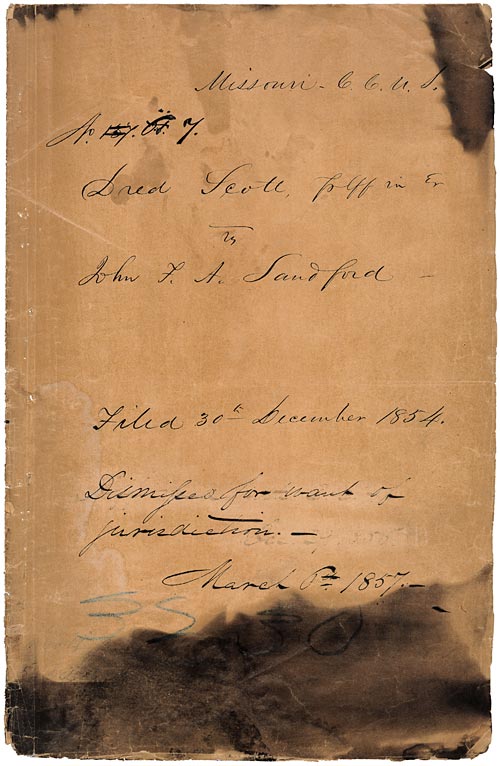
Harriet Robinson Scott’s legal struggle did not begin as a footnote to her husband’s. In 1846, she and Dred Scott filed separate petitions for freedom in the St. Louis Circuit Court. Both had lived while enslaved in territory where slavery was prohibited, and earlier freedom suits offered a reason to believe that residence could matter.
Their cases moved through years of hearings, reversals and appeals. In 1850, their lawyers combined the petitions, and Harriet’s name disappeared from the case’s leading title. The family remained at its center even as the name by which history would remember the dispute became narrower.
On March 6, 1857, the Supreme Court ruled against them. Its racist reasoning denied federal citizenship to people of African descent within the category it described and rejected Congress’s power to prohibit slavery in federal territory. An attempt to establish the Scotts’ freedom had become a national declaration protecting enslavement.
The family nevertheless became free a few months later, through a different action. Taylor Blow, who then legally held them, freed them on May 26. The court’s decision and their release must be kept separate. Looking back at the original petitions restores something else that the famous case title leaves out: Harriet had acted in her own name for freedom for herself and her family.
Evidence and sources
Harriet and Dred filed separate freedom petitions. Their later consolidation and the 1857 Supreme Court ruling are documented; the ruling did not grant their eventual freedom.
- Harriet Robinson Scott — National Park Service
- Dred Scott v. Sandford (1857) — National Archives
Story 04
A Property Action Challenged Ownership
The first document in Elizabeth Freeman’s freedom suit used a legal procedure for recovering property. A writ obtained in May 1781 directed John Ashley to release Bett and Brom because they were not his legitimate property. Ashley refused. The procedure exposed a contradiction at the heart of the case: two people were using the courts to challenge the claim that they could be owned.
The trial followed in August. Theodore Sedgwick argued that the new Massachusetts constitution’s promise of freedom and equality was incompatible with slavery. The jury found for Bett and Brom. They gained their freedom, and Ashley was ordered to pay damages and court costs.
The Massachusetts Historical Society emphasizes the decision’s limits. It settled this suit; it did not instantly free every enslaved person in Massachusetts on the same day. Together with other successful challenges, including the Quock Walker litigation, it helped make the institution legally unsustainable in the state.
Freeman’s later name carries a meaning that the case’s old title cannot. She chose Elizabeth Freeman after emancipation. Much of her biography comes through the Sedgwick family’s writings, so the exact words and immediate motives assigned to her require care. The legal outcome is firmer: the woman recorded as Bett had successfully demanded recognition as a free person.
Evidence and sources
The August 1781 case and verdict are documented. The precise event that prompted Freeman to seek counsel is uncertain; later reported speech is not reproduced as a verbatim contemporary record.
- Massachusetts Constitution and the Abolition of Slavery — Massachusetts Court System
- A Miniature Portrait of Elizabeth Freeman: podcast transcript — Massachusetts Historical Society
Transcript sections 12:51 and 18:56–24:54; trial, judgment limits and chosen name. - Brom and Bett v. Ashley Verdict — Massachusetts Archives
Story 05
The Ship Could Not Simply Take Him Away
James Somerset was being held aboard the Ann and Mary, waiting to be sent from England to Jamaica for sale. In December 1771, his godparents asked the Court of King’s Bench for a writ of habeas corpus. The immediate question was whether the captain could lawfully keep him imprisoned for that purpose.
Somerset had left Charles Steuart’s service and refused to return. He was recaptured and delivered to the ship. The writ brought him before a court, turning a planned removal into a legal challenge. Granville Sharp supported his case, while people with investments in Caribbean plantations supported the opposing side.
On June 22, 1772, Lord Mansfield ordered Somerset discharged. The ruling required legal authority for the power being claimed over him. In the form before the court, detention in England for forcible transportation and sale abroad could not be sustained.
The decision traveled farther in public understanding than its careful legal wording. Many celebrated it as the end of slavery in England, while Mansfield had deliberately framed a narrower judgment. That distinction matters without diminishing Somerset’s success. A person who had been placed on a ship as someone else’s property had forced the question of his detention into public law. His departure could no longer proceed simply because an enslaver demanded it.
Evidence and sources
The ruling protected Somerset against forcible removal for sale abroad. Its popular interpretation was broader than the narrowly framed decision; it did not abolish slavery throughout the British Empire.
- The Somerset v Stewart Case — English Heritage
- Decision of Lord Mansfield in the Somerset Case, 1772 — Gilder Lehrman Institute
Both pages of the institutional transcription.
Story 06
The Same Escape Had Different Endings
Three men escaped from Hugh Gwyn and were brought back from Maryland. The Virginia General Court’s record of July 9, 1640, begins by treating them together: each was to be whipped. Then the sentence divided their futures.
Victor, described as Dutch, and James Gregory, described as Scottish, were ordered to complete their existing terms of service. Each also owed an additional year to Gwyn and three years to the colony. Their punishment was severe, but the text still described a period that could end.
For John Punch, whom the record identified as Black, the court ordered service for the rest of his natural life. The difference sits within a single paragraph. The men had returned from the same escape, yet the court translated their circumstances into sharply unequal lengths of bondage.
The surviving text, available in an edited transcription of colonial court minutes, gives no personal account from Punch. It cannot tell us his thoughts at sentencing or provide the rest of his life. Nor should one entry be made to explain the whole development of racial slavery. Its force is specific. Where two men’s added labor could be counted in years, the third man’s sentence used his remaining lifetime as its measure. Administrative brevity did not make the consequence small.
Evidence and sources
The court minute explicitly gives different terms to the three men. It is evidence of racial differentiation in this ruling, not a claim that one decision invented slavery in the Americas.
- General Court Responds to Runaway Servants and Slaves (1640) — Virginia Humanities; General Court; 1924 edited minutes
July 9, 1640 entry, printed page 466; 1924 edition, spelling modernized.
Story 07
The Witnesses Had Signed Before He Left
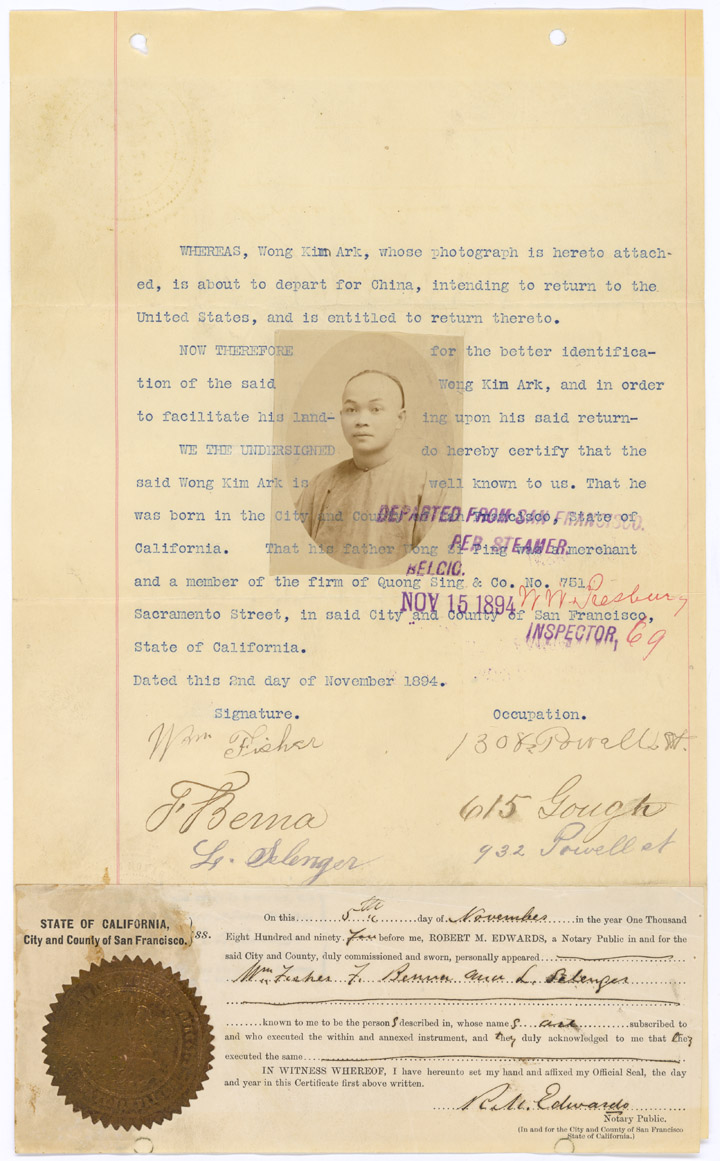
Before Wong Kim Ark traveled to China in 1894, three people signed a statement confirming his identity. A notary authenticated the document. It recorded his intention to visit and return to the United States, where he had been born in San Francisco.
The preparation did not prevent officials from refusing him entry in August 1895. The dispute was not simply whether the returning passenger was the man his witnesses described. The government challenged whether a man born in the United States to Chinese parents was a citizen at all.
His petition for habeas corpus brought that question into court. The case eventually reached the Supreme Court, which ruled on March 28, 1898. Its decision held that his birth in the United States to parents who lived and conducted business there, and were not serving as foreign diplomats, made him a citizen under the Fourteenth Amendment.
The National Archives preserves the departure statement alongside immigration and court records. Together they show why an identity document and a legal right are different kinds of protection. Wong had gathered witnesses before leaving, but officials contested the status attached to the identity they confirmed. The resulting judgment concerned the circumstances of his birth; getting that principle recognized had required a prolonged struggle after an ordinary visit to family.
Evidence and sources
The 1894 departure statement, 1895 refusal of entry and 1898 judgment are documented.
- Departure Statement of Wong Kim Ark, 1894 — National Archives
- United States v. Wong Kim Ark, 169 U.S. 649 (1898) — Supreme Court; Government Publishing Office
Printed pages 649–651 for case facts and holding; majority conclusion on page 705.
Story 08
The Certificate Did Not End the Argument

Bhagat Singh Thind received a citizenship certificate while serving in the United States Army in 1918. It was revoked. He obtained another in Oregon in 1920, only for the federal government to challenge that grant as well. A certificate could record acceptance and still become the object of an effort to take acceptance away.
The challenge reached the Supreme Court in 1923. The law then restricted naturalization through racial classifications. Thind’s case pressed the argument that contemporary classifications of people from northern India placed him within the category described as Caucasian.
The Court rejected that route. It treated the statute’s reference to white people as a matter of ordinary popular understanding, rather than accepting the claimed scientific classification. The opinion expressly said that Thind’s individual qualifications were not in question. The exclusion lay in the group to which the Court assigned him.
Thind continued seeking citizenship and finally obtained it in New York in 1935 under new legislation for veterans. The sequence is an unsettling record of moving definitions: military service, personal qualification and earlier approval had not secured his status. The documents show prejudice operating through the language of eligibility. They also preserve repeated applications by a man who refused to let a revoked certificate become the last word about his place in the country.
Evidence and sources
Thind’s grants and revocations of citizenship and the 1923 decision are documented. The racial categories in the judgment are discriminatory historical classifications, not biological facts.
- The Past is the Present in the Asian American/Pacific Islander Records Aggregation Project — National Archives
- United States v. Bhagat Singh Thind, 261 U.S. 204 (1923) — Supreme Court; Government Publishing Office
Printed pages 204, 206–210 and 214–215: certified question, racial test and conclusion.
Story 09
The Strike Leader Was Not the Case Name
Barbara Rose Johns helped organize the student strike at Robert Russa Moton High School on April 23, 1951. Yet the lawsuit that grew from the protest did not carry her name. Its leading plaintiff was Dorothy Davis, a younger student whose name appeared first on the legal filing.
The students were protesting the conditions of their segregated school in Farmville, Virginia. Overcrowding had pushed classes into makeshift buildings covered in tar paper. Johns and Carrie Stokes sought help from the NAACP, and attorneys Oliver Hill and Spottswood Robinson became involved in turning the students’ action into a court challenge.
Filed in May 1951, the Davis case went beyond a request for a better building. It challenged segregation. A district court ordered equal facilities but did not admit the students to white schools during that process. The attorneys appealed, and the Virginia case became part of the litigation decided in Brown v. Board of Education in 1954.
The change of names is a reminder of how a collective action can become compressed in a legal title. Johns’s organizing, Davis’s participation and the work of many students and parents were not competing claims to the same story. The record connects them. Behind the familiar name Brown was another case name, and behind that was a school community that had already begun to act.
Evidence and sources
The student strike, NAACP suit and Davis case’s place in Brown are documented. Dorothy Davis’s role as named plaintiff does not diminish Barbara Johns or the other students.
- Documents Related to Brown v. Board of Education: Barbara Johns — National Archives
Barbara Rose Johns biography and Davis case section. - Davis v. County School Board of Prince Edward County — Brown Foundation
Story 10
A Caribbean Destination Opened an Eastern Route
A document naming a Caribbean destination helped Jewish refugees escape eastward through Asia. In Lithuania in 1940, Dutch acting consul Jan Zwartendijk issued notations stating that entrance visas were not required for certain Dutch territories, including Curaçao. They omitted a crucial obstacle: colonial governors still controlled admission.
Those papers nevertheless helped refugees approach Japanese consul Chiune Sugihara for transit visas. His permissions made it possible to seek a route through the Soviet Union to Japan. The combination connected officials and territories thousands of miles apart in an urgent effort to get people out of danger.
Samuel Soltz’s surviving papers show what that journey through bureaucracy looked like. Among their many stamps is Sugihara’s visa dated August 21, 1940. The crowded page is evidence that one signature was part of a chain of permissions. Other documents, exit approval, transport and money were still needed.
Some recipients could not leave. Others reached Japan but had to seek new destination visas when the Curaçao papers could take them no farther. Jewish aid organizations and local communities helped with travel, housing and food. The escape route was therefore both ingenious and precarious. Its paper destination mattered before it became a real destination, opening a passage that depended on many people’s decisions along the way.
Evidence and sources
The permits and eastward escape route are documented. The Curaçao notation was not a guarantee of admission; visas did not ensure that every recipient could leave.
- Polish Jewish Refugees in Lithuania: Unexpected Rescue, 1940–41 — United States Holocaust Memorial Museum
- Samuel Soltz’s Visa — United States Holocaust Memorial Museum
- Polish Jews in Lithuania: Escape to Japan — United States Holocaust Memorial Museum
Story 11
The Scrapbook Was Also a Working Record
A scrapbook preserved photographs and names from a rescue operation. Decades after 1939, it helped bring Nicholas Winton’s work to wide public attention. But before it became an object of remembrance, the information it contained belonged to the practical task of getting children out of danger.
Winton worked from London with refugee workers in Prague. The British end of the operation required money, transport arrangements and families willing to care for children. The government also demanded a financial guarantee for each child’s eventual departure from Britain. Concern alone could not complete those requirements.
Between March and August 1939, the organizers brought children from Czechoslovakia to Britain through eight transports. The United States Holocaust Memorial Museum describes an initial flight followed by rail and sea journeys. Most of the children were Jewish. War then closed the opportunity for further departures through the operation.
The scrapbook also shows why a rescue total is a research question. It listed 664 children; later investigators identified five more, producing the familiar figure of approximately 669. The museum notes that other rescued children may remain unidentified. Behind the total were individual applications and households, and behind the celebrated name was a network of workers. The surviving list allows remembrance to become more precise without pretending that every part of the record is complete.
Evidence and sources
The rescue was collective. The museum identifies approximately 669 children and explains how its count developed; the scrapbook does not establish that one person acted alone.
- Nicholas Winton and the Rescue of Children from Czechoslovakia, 1938–1939 — United States Holocaust Memorial Museum
Story 12
The March Continued Through a Transcript
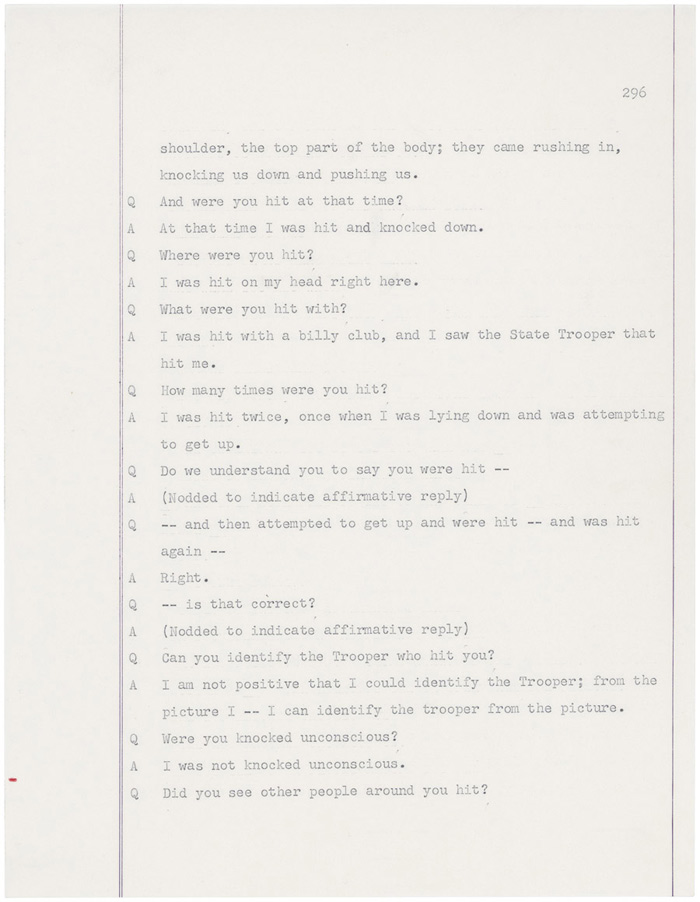
John Lewis’s account of Bloody Sunday survives as questions and answers. At a federal hearing after the March 7, 1965, attack in Selma, an attorney asked him to explain how the marchers had stopped and what the state troopers did next. A violent event on a bridge became testimony that a court could examine.
Lewis and Hosea Williams had been leading a voting-rights demonstration toward Montgomery. Officers blocked the marchers near the Edmund Pettus Bridge and ordered them to disperse. Troopers then advanced with weapons and tear gas. Lewis suffered a fractured skull.
In his testimony, he described being struck, falling and being hit again while trying to rise. The transcript preserves the exchange in sequence, with the attorney asking for clarification. Its form is restrained, but the experience it records is not. The hearing concerned the demonstrators’ request for protection so that a march could proceed.
On March 17, Judge Frank Johnson Jr. ruled that they had a constitutional right to march. Four days later, demonstrators left Selma under the protection of a federalized National Guard. The court record did not erase the attack or finish the struggle for voting rights. It became part of the work required to make another attempt possible. The next journey began after the first had been described under oath.
Evidence and sources
Lewis’s testimony is a firsthand account preserved in a federal hearing. The March 17 ruling and March 21 protected march are distinct events following the March 7 attack.
- Eyewitness: John Lewis, March from Selma to Montgomery, 1965 — National Archives
John Lewis section and hearing transcripts, pages 288 and 295–297.
The paper survives more easily than the circumstances in which it was made. Reading closely brings some of those circumstances back: the person behind an imposed name, the workers behind a list, and the distance between possessing a document and having its promise honored.
About the evidence labels
Documented identifies a supported historical event. Disputed marks an account whose explanation or details remain contested. Folklore identifies a recorded tradition; its inclusion does not establish that a supernatural event occurred.