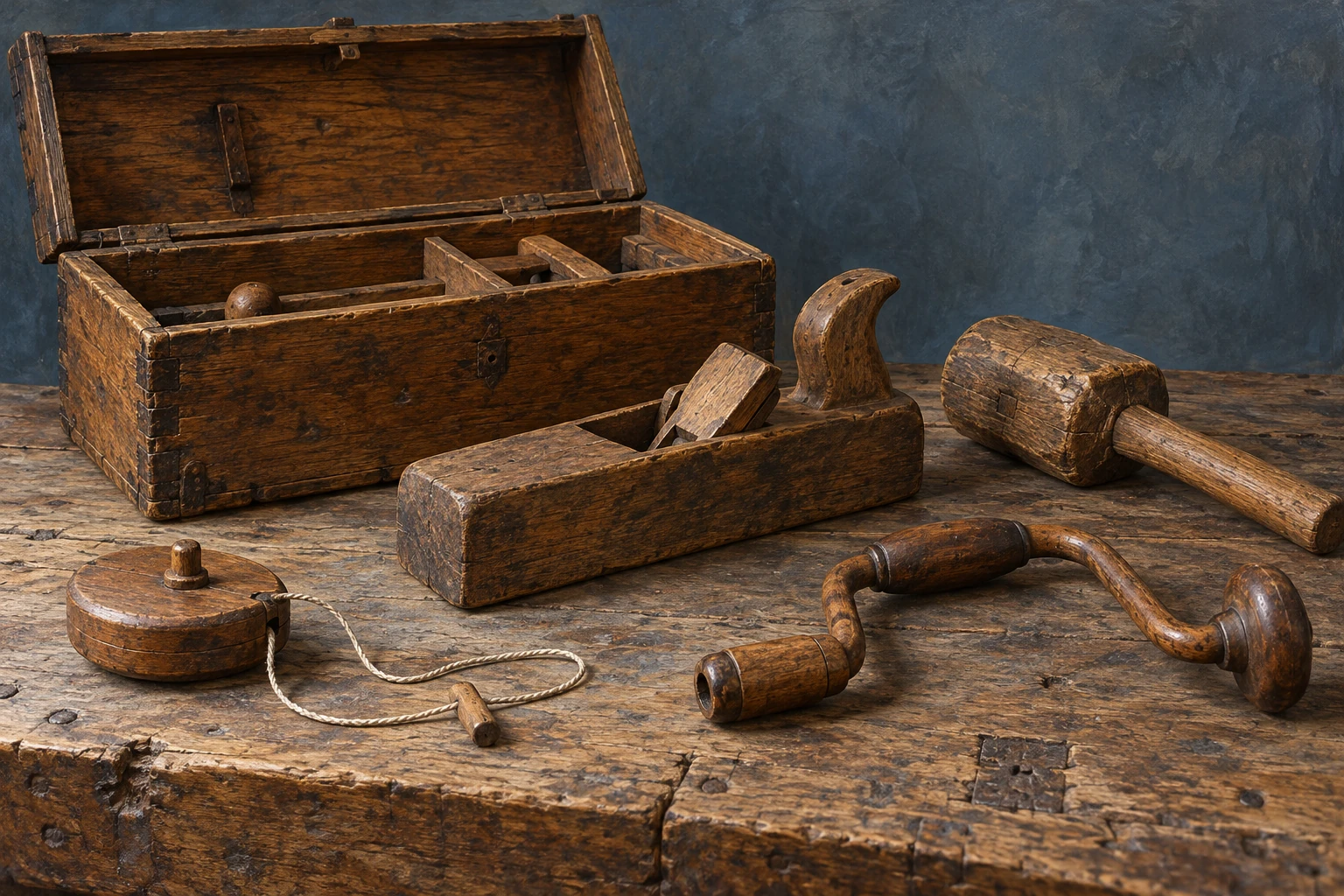
The missing metal is the first surprise. In the Mary Rose’s carpenter’s equipment, a wooden handle may survive while the blade that made it a tool has disappeared. A visitor has to learn to see two things at once: the object now in the case and the working assembly that researchers reconstruct from its shape and comparisons.
The tools bring a skilled occupation close, but they also resist the easy fantasy of a perfectly preserved workshop. Water, burial, corrosion, excavation, and conservation have all selected what we can see.
Begin with a room, not a famous shipwreck
The Mary Rose Museum’s carpenter account describes a cabin with benches and three chests. Their contents differed: one held working tools and materials; another probably clothing; a more elaborate walnut chest contained personal possessions as well as a few small tools. Combining those contents into one wonderful “toolbox” would erase the distinctions the excavation recovered.
The same account discusses a man found below the cabin among equipment and asks whether he was one of the ship’s six carpenters. Isotope evidence suggests childhood in a warmer part of mainland Europe; Spanish tools raise another question. The museum presents Spain as a possibility. An engaging reconstruction should preserve that uncertainty rather than confidently assign him a birthplace and biography.
The ship’s documented timeline places the sinking at the Battle of the Solent on 19 July 1545. It is a dated event that helps frame the assemblage. The personal histories of the people and tools on board extend before that event, and do not all become known because the end is known.
Turn a brace with your eyes
The museum’s oak brace, object 81A3094, was a hand-powered drill. Its description separates the missing iron bit, the wooden handle, and the rotating pad that protected the user’s hand. Eleven braces were recovered, six in the carpenter’s cabin and five elsewhere.
Try following the movement without touching an artifact. One hand supplies pressure at the pad; the other turns the offset handle; the bit rotates against the timber. The surviving wood is shaped around a body performing work. A catalog photograph becomes easier to understand when you ask where the hands would be and what each part must do.
A missing bit also provides a useful lesson in reconstruction. A museum may show a suggested outline based on other surviving tools. The outline is interpretation supported by comparison, not newly visible iron. When looking at a display, ask which parts are original, which have been stabilized, and which are drawn or added to explain use.
A line in chalk can preserve an earlier moment
A beech chalk reel, object 83A0386, was found deep in the hull between beams and among wood chippings. Its design differed from two reels found in the carpenter’s cabin. The museum suggests it may have been lost during construction, making it possible evidence for work at Portsmouth Dockyard rather than equipment being used immediately before the sinking.
That is a beautiful example of context changing time. All the objects share the wreck site, yet they need not record the same moment. The reel’s location and form permit a more specific hypothesis about how it entered the ship’s fabric.
The tool’s principle remains easy to picture: a taut cord carrying chalk is lifted and released against timber, leaving a straight guide. For a safe analogy, stretch an ordinary piece of string across a sheet of paper and mark its ends with a pencil. Compare the long line implied by the string with the small reel needed to store it. A tool can control a space much larger than itself.
Wood surviving does not mean wood stayed unchanged
The museum’s artifact conservation explanation describes weakened wooden cell structures filled with water. Uncontrolled drying could cause shrinkage, cracking, or warping. Wooden objects were treated using polyethylene glycol, a bulking agent, and then freeze-dried under controlled conditions.
This is why “they pulled it out and put it on display” is an incomplete account. The object in the case owes part of its present survival to decisions made long after the ship sank. Conservation is not simply cosmetic cleaning. It can be the difference between a recoverable shape and a collapsing one.
The 1982 raising of the hull was itself the result of years of searching, excavation, recording, and engineering. Not every part of the wreck was raised. The site and the collection are related but not identical archives.
A useful second inventory sorts the objects by task rather than appearance. Put tools for measuring together, then those for marking, boring, cutting, and finishing where the museum record supports those functions. Some objects may serve more than one task. The rearrangement turns a case of separate finds into a picture of coordinated work.
Pack an imaginary working chest
Here is a useful thought experiment for anyone who makes things. Choose a job you know: repairing a shelf, sewing a seam, sketching a room, tuning an instrument. List the equipment you would put in a small portable chest. Then divide the list into four functions:
- measuring or marking the intended result;
- removing or reshaping material;
- joining or fastening components;
- maintaining the tools themselves.
Now imagine only the wooden parts survive. Which functions would become difficult to recognize? Which apparently unimportant handle would carry the best clue? This exercise does not recreate Tudor ship carpentry. It helps explain how an incomplete assemblage can still disclose a coordinated set of tasks.
Return to the carpenter’s cabin with that question in mind. The chests divide working and personal space; the brace translates bodily motion into a rotating cut; the chalk reel lets a short tool establish a long line. The fascination lies in a collection of practical decisions, made by people whose skills were indispensable even when their full names and stories have not survived.
Sources and a closer look
Mary Rose Museum: the carpenter, cabin and chests; Mary Rose Museum: ship timeline; Mary Rose Museum: brace 81A3094; Mary Rose Museum: chalk reel 83A0386; Mary Rose Museum: conserving artifacts; Mary Rose Museum: raising the ship.
Find more art, ideas, and unexpected connections at Incoprea.