A young spotted hyena enters a world that already contains relationships. Its mother has particular associates, rivals and a position in the clan. The cub does not meet that world from a socially empty starting point.
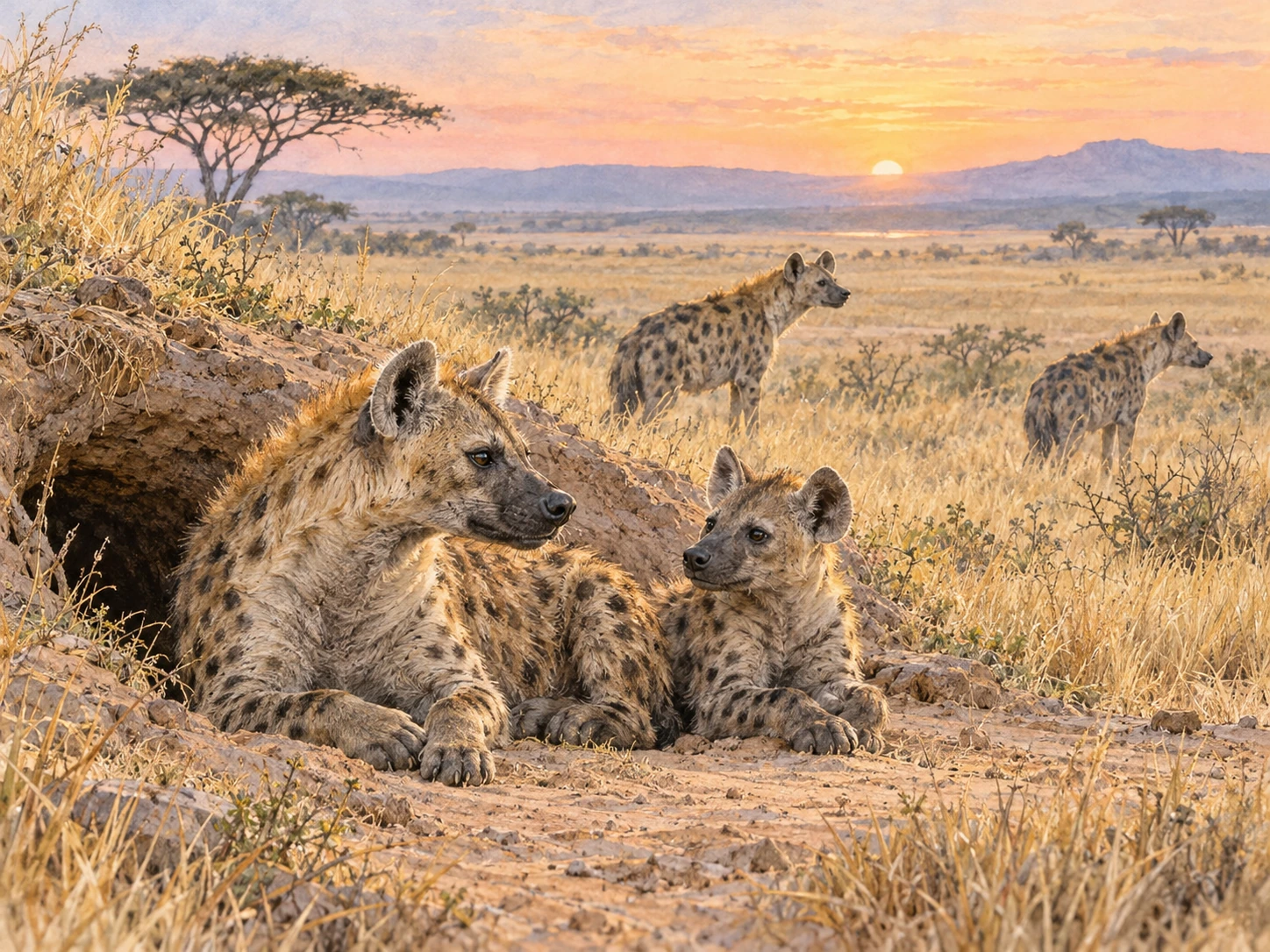
The familiar phrase “inheriting rank” captures only part of this beginning. Long-term observations suggest that an offspring can also inherit a pattern of social connections. Its network resembles its mother's network, and the resemblance is stronger in the offspring of higher-ranking mothers.
The interesting object is therefore larger than a pair. A mother and cub are connected to one another, but each is also connected to others. To understand social inheritance, compare those two sets of relationships.
What could a network inherit?
A network is a way of describing individuals and their ties. The individuals become nodes. A specified kind of observed association becomes a connection, sometimes with a weight representing its frequency or strength. The definition of the connection matters: proximity, affiliation and aggression are different observations.
A 2016 theoretical model explored how offspring bonding with maternal contacts, alongside forming other ties, could generate features of animal social networks. The appeal was its simplicity. Complex group patterns might arise partly from repeated local relationship rules rather than from each animal assessing the entire clan.
A model that resembles a network is not a complete history of how that network formed. Different processes can sometimes produce similar patterns. The next step is to follow real individuals over time and ask whether the predicted process is visible.
Twenty-seven years make a difference
The 2021 hyena study used long-term social observations to compare mothers' and offspring's association patterns. It found resemblance that could persist for years, with greater similarity associated with higher maternal rank. The strength of the mother-offspring relationship also mattered.
The university's account of the research explains why duration was valuable. Young cubs stay close to their mothers, so early network similarity is unsurprising. More revealing is similarity persisting after offspring spend less time beside them. The dataset covered 27 years, allowing the researchers to see relationships extend beyond one developmental snapshot.
This is social inheritance in the sense of a transmitted pattern of relationships. It does not mean that a social tie is encoded as a particular gene. Nor does an association with longevity, by itself, demonstrate that copying a mother's contacts causes a precise increase in lifespan. Shared circumstances and other social advantages remain relevant.
Try a miniature network
The downloadable worksheet uses entirely fictional animals and invented association scores. It is a tool for understanding the comparison, not a reduced version of the study's data. The mother M has scores for four associates: A, B, C and D. Two fictional offspring have their own scores for those same associates.
A fictional social-network workshop
Compare invented association rows and see how equal totals can hide different sets of social ties.
Offspring P closely matches which partners are prominent in M's network. Offspring Q has the same total association score but distributes it differently. That distinction is the point of the exercise. A total can conceal the arrangement of relationships.
First compare the largest entries. Then calculate the sum of absolute differences from the mother's row. The worksheet provides a check. This simple difference score is invented for the exercise; the researchers used their own network methods. It shows why “equally social” need not mean “social in the same way.”
Now make the observation harder
Suppose M and P were watched together far more often than M and Q. You might record more of P's encounters, even if the animals' true relationships were alike. Suppose A died before Q was old enough to form a bond. A missing connection would then have a different explanation from a rejected maternal contact.
These imagined cases explain why observation effort, timing and the availability of partners matter. A network is built from events recorded under conditions. It should not be treated as an all-seeing diagram of every social interaction an animal has ever had.
It also matters whether the comparison concerns young animals, adults, males or females. Individuals can differ in whether they remain within their natal social setting and in the opportunities available to them. A robust account should preserve the study's population and time frame rather than extend one average relationship to every hyena.
An inheritance with room for change
The language of inheritance can sound deterministic. A better reading is that the starting social environment creates persistent tendencies. Other relationships, individual experiences and changing group membership can still alter a network. Similarity is a matter of degree.
For a wildlife observer, this changes what is worth noticing. Instead of asking only which animal dominates an encounter, ask which individuals repeatedly spend time together, and whether those patterns cross generations. A single dramatic confrontation tells a different story from years of quieter associations.
The research also gives a practical lesson in reading animal behavior: choose the scale of the question before judging the evidence. A video clip can reveal a greeting. A sequence of observations can reveal a relationship. A long-term network can reveal how relationships connect across lives. Each is valuable, and each needs the others to be interpreted well.
Seen at that larger scale, the cub beside its mother is beginning more than an individual life. It is entering an existing web of opportunities, habits and partners, some of which may remain recognizable long after the pair stops moving together.
Sources and further reading: Rank-dependent social inheritance determines social network structure in spotted hyenas (2021); High-ranking hyena mothers pass their social networks to their cubs; Social inheritance can explain the structure of animal social networks (2016).
Explore all 80 new articles · Browse the complete illustrated collection
Explore more art, ideas, and independent projects at Incoprea.