A dead animal is food, but it is also a changing habitat. Microbes arrive, grow and transform the resource. For a burying beetle preparing a nursery, obtaining the carcass is therefore only the beginning. The food must remain usable while its larvae develop.
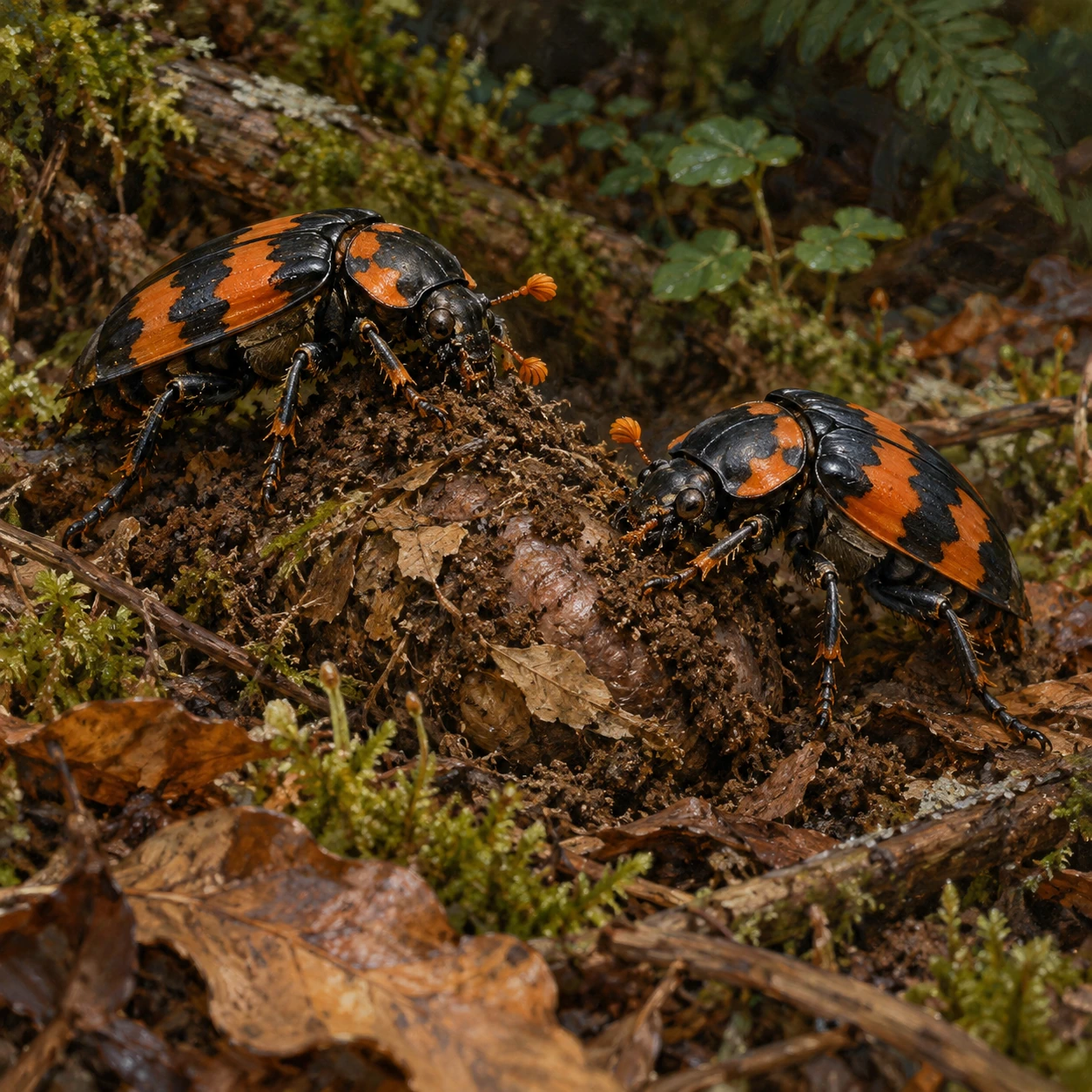
The beetle Nicrophorus vespilloides provides a useful case because the story does not reduce to killing every microbe. Parents prepare carrion with secretions, and the resulting nursery hosts a managed community. Some organisms are suppressed while others are introduced or encouraged.
That distinction makes the work especially interesting to read. A clean-looking resource is not necessarily sterile. A microbe's presence is not automatically decay. And a microbial community that differs between two treatments is only the beginning of a functional explanation.
Begin with three possible nurseries
Imagine comparing fresh carrion, carrion left to decompose and carrion tended by beetles. You would want to know both who lives there and what happens to the food. A species list alone cannot tell you whether the resource is preserved, digested more efficiently or made less suitable for a competing organism.
A study of beetle-prepared carcasses found microbial communities more similar to the beetles' oral and anal secretions than to the original carcass community or nearby soil. Core bacterial groups and Yarrowia yeasts were transmitted to larvae through the secretions and carcass surface. Meanwhile, untended decomposing carcasses carried higher total bacterial loads.
The combination supports regulation rather than a simple covering-up of carrion. It also makes the food surface a route of parent-to-offspring microbial transmission. The nursery is both a resource and an interface between generations.
What changed besides the species list?
In work on microbiome-assisted preservation, beetle-tended and untended carcasses differed in their communities and biochemical state. Tended resources had lower concentrations of putrefaction-associated polyamines and altered digestive-enzyme and nutrient profiles. A biofilm-like matrix developed where larvae fed.
Removing that matrix reduced larval growth. Importantly, this manipulation addressed function more directly than comparing microbial DNA alone. Something about the maintained interface contributed to how effectively larvae accumulated biomass from the resource. It did not prove that one named yeast performed every useful job.
The removal experiment also needs its proper scale. The matrix contained microbes, enzymes and processed nutrients. Removing it changes a package of things. The result supports the value of that package, while further experiments are needed to divide the work among its members and products.
Read a molecular result without giving it an extra job
An earlier digestive and defensive investigation examined the beetles and their associated yeast at the level of expressed genes. It found molecular machinery consistent with digestion and defense. The authors were careful about the difference between a potential function indicated by transcripts and a demonstrated effect on beetle nutrition or fitness.
That distinction is useful whenever a headline says that a microbe “helps” an animal. A gene sequence can suggest a capability. Expression shows the machinery is being used under particular conditions. A manipulated comparison can test whether the proposed activity changes a biological outcome. Those are connected steps, but they are not interchangeable.
A small evidence workshop
Try ranking these fictional findings before opening the discussion below. They are invented examples for thinking, not additional results from the beetle papers.
- A yeast occurs on every successful nursery sampled.
- The same yeast expresses a gene associated with lipid breakdown.
- Removing the entire surface matrix reduces larval growth.
- Removing only that yeast, then restoring it, changes growth while the rest of the nursery is controlled.
What each finding would add
The first establishes a repeated association. The second supports a plausible biochemical route. The third gives a functional result for the whole matrix. The fourth would more closely isolate the yeast's contribution, provided the manipulation and restoration had suitable controls. None automatically establishes that the identical relationship occurs in every beetle species or environment.
The fourth example also shows why a spectacular natural-history explanation can take years to develop. A realistic nursery contains interacting parts. Isolating one partner without disrupting the others is difficult. Failure to obtain a neat single-cause story can reflect biological complexity rather than a weak question.
Preservation can involve controlled transformation
We often imagine preserving food as stopping change. In this system, the more useful picture is directing change so that the resource remains suitable for the developing animal. Parents and their associated microbes influence which transformations proceed and which competitors gain ground.
That is an interpretation of the measured system, not a human food-storage recommendation. A beetle nursery's success is defined by larval development in its own ecological setting. The same process need not preserve food in a way useful to us.
The forest-floor scene becomes more complex when viewed this way. The beetles are tending a place whose chemistry, inhabitants and nutritional value all move through time. Their parental care includes the management of an environment that is too small and too transient to resemble a nest we would ordinarily notice.
Next time a study describes an animal's microbiome, ask for the missing verb. Does it carry, transmit, suppress, transform or experimentally depend on the organisms involved? Choosing the verb carefully reveals how much has been demonstrated and where the next interesting experiment begins.
Sources and further reading: Burying beetles regulate carcass microbiota (2018); Microbiome-assisted carrion preservation aids larval development (2018); The digestive and defensive basis of carcass utilization (2017).
Explore all 80 new articles · Browse the complete illustrated collection
Explore more art, ideas, and independent projects at Incoprea.