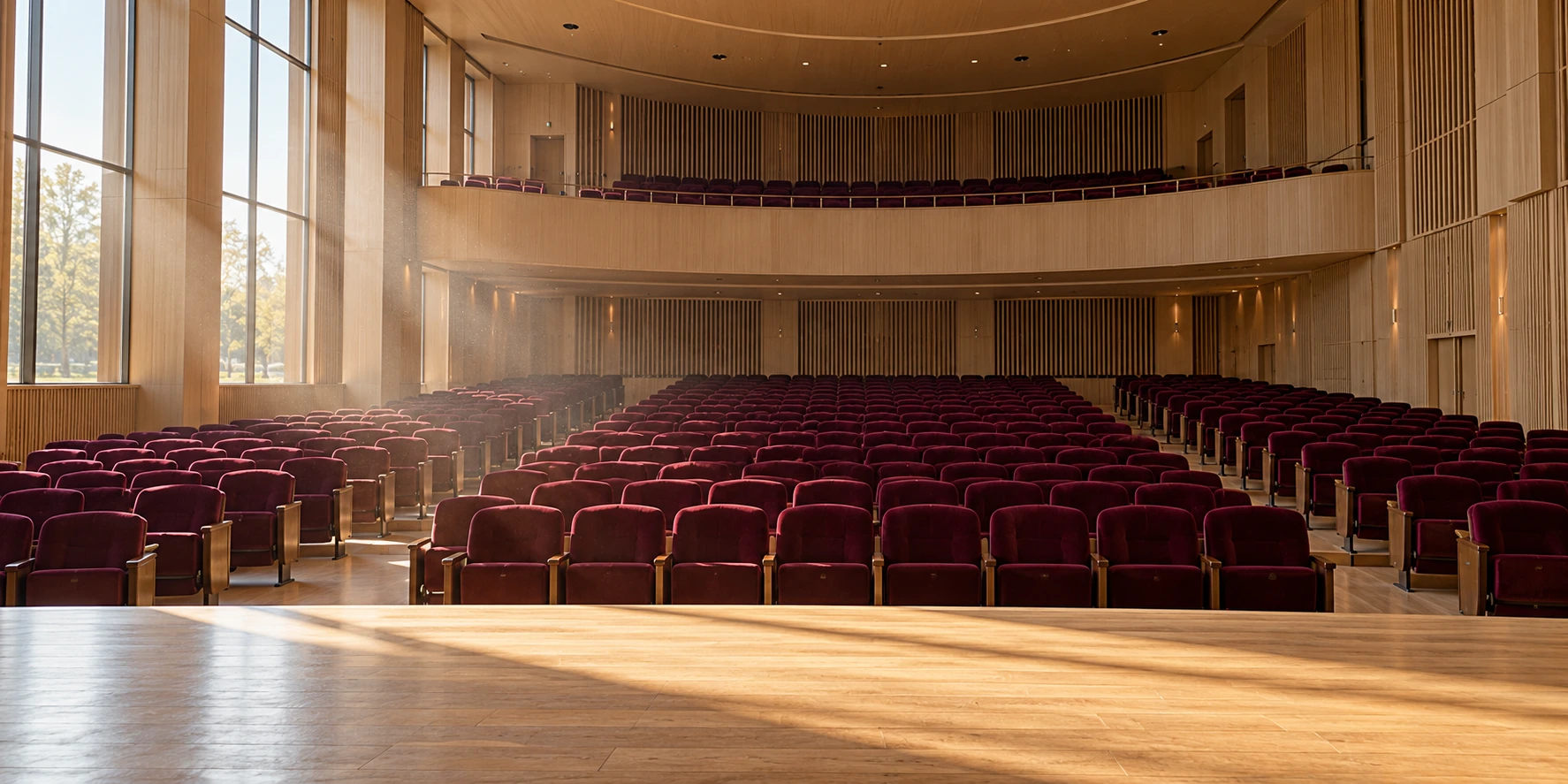
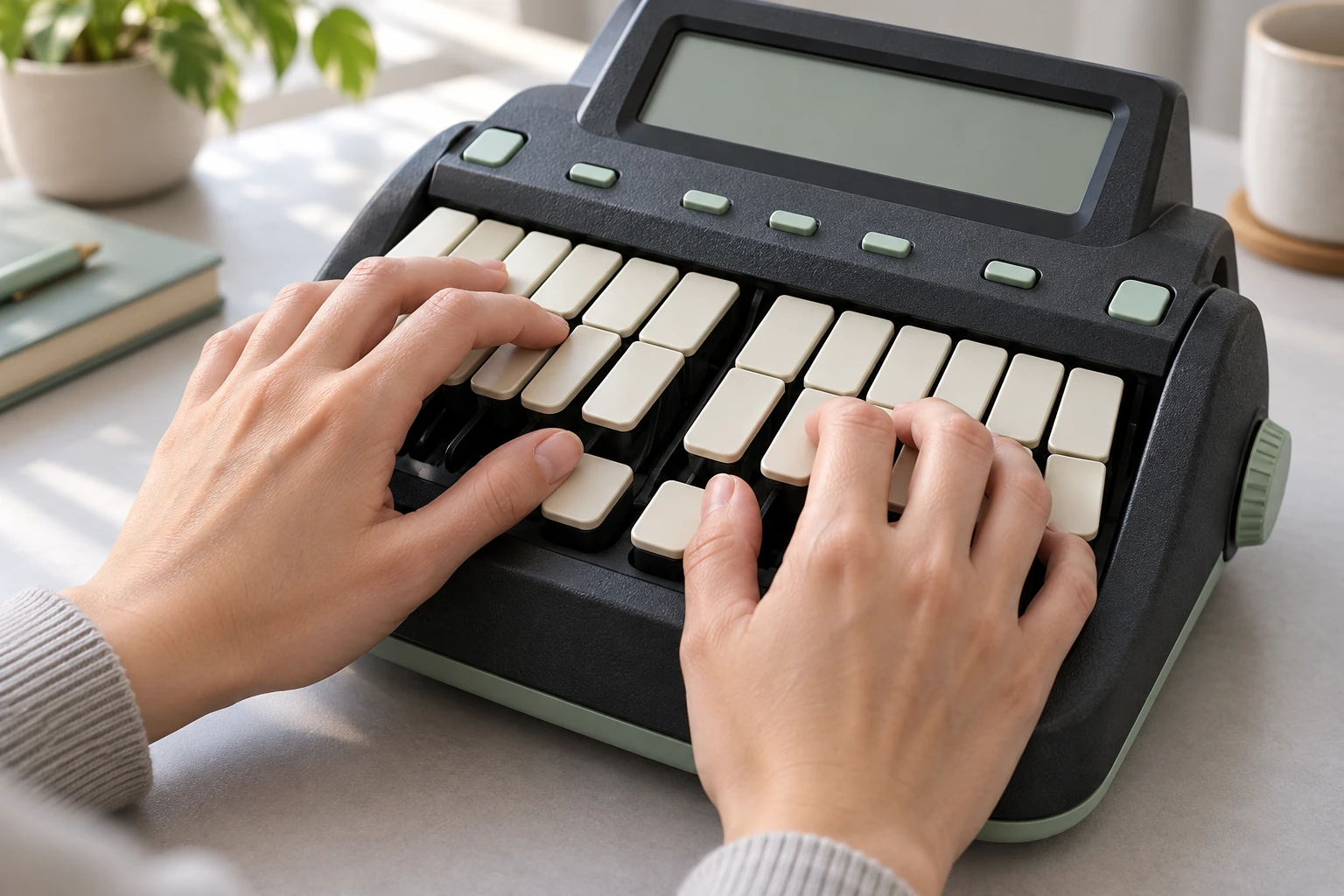
A court reporter’s keyboard can look as if someone removed most of the alphabet. There are few keys, some letters appear twice, and the hands do not move through ordinary words one character at a time. The apparent shortage is the point. A stenotype machine treats a group of simultaneous key presses as a meaningful unit.
Try a harmless analogy on your desk. Tap three fingers separately, then tap the same three together. The second gesture can be recognized as one pattern even though it contains several contacts. Machine shorthand builds a practiced language around such patterns. The skill lies in mapping heard speech into learned strokes, not simply moving each finger faster.
Read the chord across the word
On a conventional English-language steno layout, beginning consonants occupy the left, vowels sit near the thumbs, and ending consonants occupy the right. Combinations stand for sounds that do not have individual keys. A chord can represent a syllable, a word, or a familiar phrase, depending on the theory and dictionary.
The Stenograph Wave guide explains this sound-based organization and provides examples. It describes a two-stroke route through “courthouse” and also shows how a phrase can be compressed into a single learned outline. The guide is a primary explanation of one machine and its system, not a promise that every theory writes every word the same way.
Think about why duplicate letters can be useful. A consonant at the start of a syllable has a different position in the pattern from one at the end. The layout helps distinguish those roles spatially. It does not need a separate full alphabet for each role because combinations supply additional sounds.
The dictionary is part of the instrument
The machine captures strokes. Translation software interprets them using a dictionary that maps stroke sequences to text or actions. A single stroke may have one entry; a sequence may match a longer entry. Plover’s dictionary documentation makes that mapping explicit in a form you can inspect.
This is not ordinary autocorrect guessing a complete sentence from a few approximate letters. The stenographer learns a systematic representation, and the dictionary gives those outlines their translations. Personal briefs, specialized vocabulary, punctuation strokes, and conflict resolution all matter to useful output.
Imagine two shorthand users who hear the same sentence but have learned different briefs. Their finger movements need not be identical. Both may produce the same text through distinct trained mappings. The visible machine is only part of the writing system; the learned theory and the translator’s dictionary carry a great deal of its structure.
Three different kinds of speed
First there is physical stroke rate: how often the hands make a new chord. Then there is informational efficiency: how much speech each chord represents. Finally there is accurate, usable output after translation and review. Collapsing these into one impressive words-per-minute number hides what is actually being tested.
As checked for this article, NCRA’s Registered Professional Reporter page lists five-minute skills components at 180 words per minute for literary material, 200 for jury charge, and 225 for testimony/Q&A. Each requires 95 percent accuracy under its specified test process. These are certification requirements, not a claim that a novice becomes accurate at that speed by buying a machine.
They are also not the same as an unedited real-time stream. Time for transcription and the rules of a particular test affect what a result means. Whenever you see a shorthand speed record or a demonstration, ask whether the number refers to captured notes, live translation, or a final corrected transcript.
A five-minute visit to a different keyboard
The Open Steno Project offers an in-browser demonstration and learning material. You can explore the premise before installing software or purchasing equipment. Treat the first visit as an observation exercise rather than a typing competition.
- Look at the left, vowel, and right groups. Identify the direction in which an outline is read.
- Follow one supplied beginner example slowly. Notice which contacts belong to the same stroke.
- Release the chord and inspect the result. The release boundary helps distinguish one stroke from the next.
- Repeat the same example before choosing another. You are learning a gesture-to-unit relationship, not hunting for isolated letters.
- Compare the raw outline with its translated text. Ask which information belongs to the stroke and which comes from the dictionary.
A normal keyboard may not register every simultaneous combination because of its rollover behavior. A failed chord can therefore be a hardware limitation rather than an immediate failure of coordination. The project’s beginner resources explain compatible approaches. The important first discovery is conceptual: several keys can serve as one input event.
The human work continues after the chord
Speech arrives with names, interruptions, accents, ambiguity, and changing context. A writing system can compress familiar patterns, but it does not remove the need to listen and resolve meaning. The reporter’s practiced judgment includes knowing when a plausible translation is not the correct record.
That makes stenography a useful counterexample to the idea that fast work is always the same task performed at greater speed. Sometimes the task is reorganized into larger units. A pianist does not build every chord by consciously naming each key in sequence; a stenographer similarly develops coordinated patterns that can carry more than an isolated letter.
The tiny keyboard looks less strange once you see those units. It is not missing most of the language. It is asking the hands to reach language by a different route: sound, chord, learned outline, translation, and careful human checking.
Follow the evidence: Stenograph: Wave user guide, chapter two; NCRA: Registered Professional Reporter; Open Steno Project; Plover: dictionary formats.
Explore all 80 new articles · Browse the complete illustrated collection
Explore more art, ideas, experiments, and independent projects at Incoprea.